
Updated June 2026 · Reviewed by Billy Forte
The Texas Graduated Driver License (GDL) system moves teens through three stages: a learner license at 15 (supervised driving only), a provisional license at 16 (independent driving with restrictions), and a full, unrestricted license at 18. Each stage has its own requirements — the learner stage needs the DE-964E and a licensed adult 21+ in the front seat, while the provisional stage adds a nighttime limit, a passenger limit, and a no-handheld-devices rule. The system is designed to build experience gradually before a teen earns full driving privileges.
Applies to Texas teen driver education and licensing (ages 14–17). Requirements are set by TDLR (driver education) and the Texas DPS (licensing) and can change.
Key Facts
- Stage 1 — Learner license (15+): Supervised driving only, with a licensed adult 21+ in the front seat; needs the DE-964E.
- Stage 2 — Provisional license (16+): Independent driving with restrictions, after the 6-month permit hold and DE-964.
- Stage 3 — Full license (18): Unrestricted driving once the teen turns 18.
- Provisional restrictions: No midnight–5am driving (except work/school/medical emergency), max 1 non-family passenger under 21, no handheld devices.
- ITTD required: The free two-hour ITTD video is completed within 90 days before the driving test.
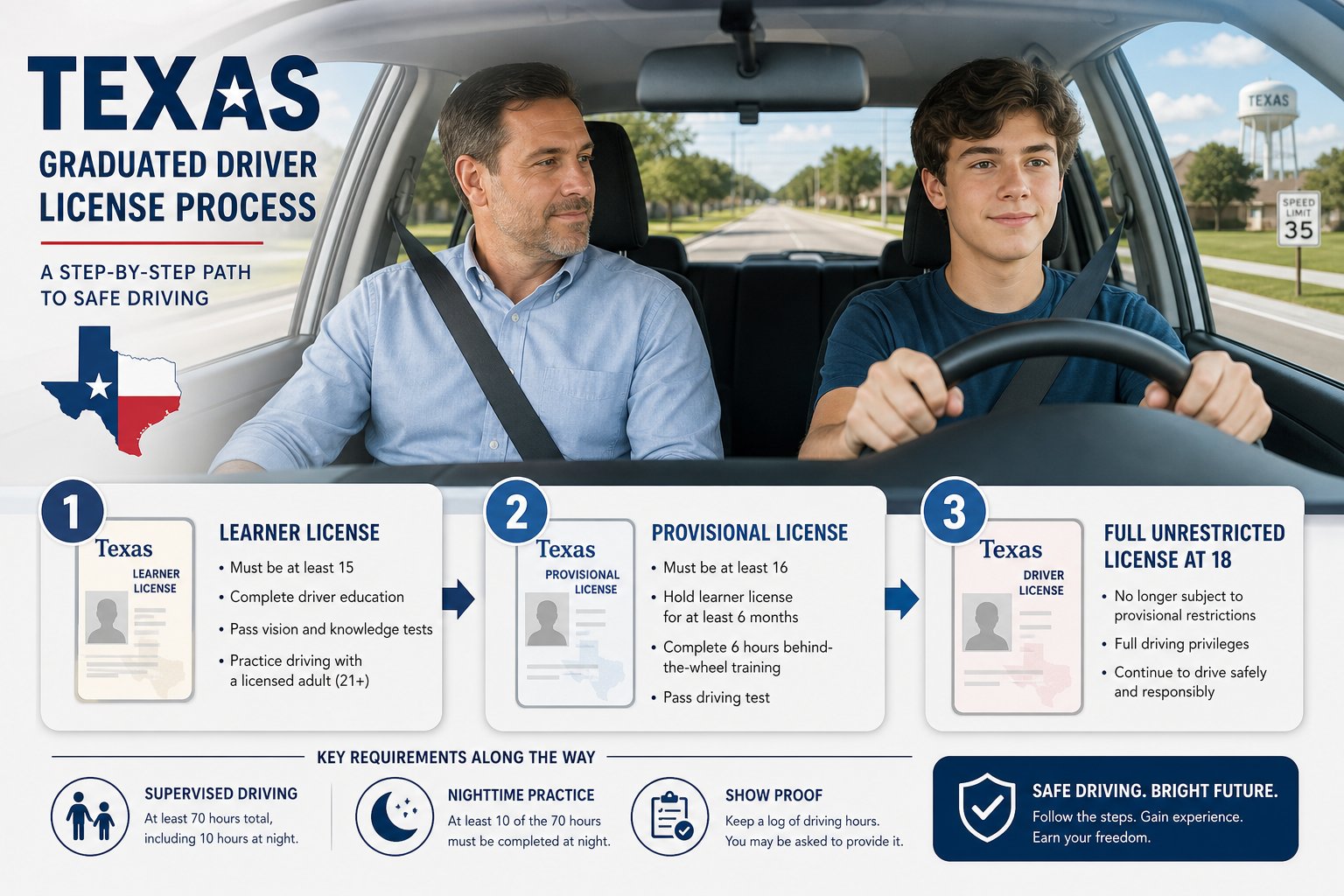
What The Texas Graduated Driver License Program Is And Why It Matters
Texas uses a graduated driver license system to give teens more practice before full driving freedom. The idea is simple: new drivers face the highest crash risk early on, so the state adds driving steps instead of handing out a full license right away.
In the texas gdl program, teens usually pass through two limited stages first:
- Learner license
- Provisional license
- Full unrestricted license at 18
Each step adds more freedom and more responsibility. That gradual approach is the point.
Texas DPS, also called TxDPS, manages licensing. The Texas Department of Licensing and Regulation, or TDLR, approves teen driver education providers and course formats.
For most teens, the system matters because it sets the exact path you must follow. If you miss a training step, fail to bring the right paper, or misunderstand a rule, your next license stage can be delayed.
It also matters for safety. Texas requires supervised driving before solo driving. That includes 30 hours of practice, with 10 hours at night, done with a licensed adult who is at least 21. Those rules are meant to build skill in lower-risk settings before a teen drives alone in heavier traffic, bad weather, or after dark.
So if you want the short version: Texas teen licensing is staged on purpose. Learn first, drive with limits next, then get full privileges later.
Phase 1: Learner License Requirements For Teens Ages 15 To 17
The first stage starts when a teen is at least 15. A teen can begin coursework at 14, but cannot get the learner license until 15.
To qualify, you need a state-approved teen driver education path. That may be PTDE (Parent Taught Drivers Ed) or a standard TDE course. These are for drivers under 18. They are not the same as ADE, which is a separate course for adults 18 and older.
For PTDE, the parent must first get the PTDE Program Guide from TDLR. That packet costs $20 and, as of January 2026, is sent by email only.
A learner license lets a teen drive only with a licensed adult age 21 or older in the front passenger seat. No solo driving yet.
You will also need documents. Exact paperwork can vary, but teens should expect to bring items such as:
- Proof of identity
- Social Security documentation if required by TxDPS
- Texas residency documents
- School enrollment, attendance, or graduation proof when required
- Driver education proof
For the permit step, the key course proof is the DE-964E, which shows partial completion of teen driver education, usually after Module 1. That is not the same as the full DE-964 used later.
Once the learner license is issued, the clock starts. A teen must hold it for at least six months before applying for the provisional license, even if all other training is finished sooner.
Phase 2: Provisional License Rules, Restrictions, And Eligibility
The second stage is the provisional license. Most teens can apply at 16 or older if they have held the learner license for at least six months.
Before that upgrade, the teen must finish the required parts of driver education and practice. That includes behind-the-wheel training and the state practice log requirement of 30 supervised hours, including 10 hours at night.
The full course completion proof for this step is the DE-964. Teens also must complete the free Impact Texas Teen Drivers course, often called ITTD. ITTD is a separate two-hour TxDPS course. It is not the same thing as PTDE or TDE, and it must be completed within 90 days before the driving test.
A provisional license allows independent driving, but with strict teen driving restrictions. If you are under 18, you may not:
- Drive between midnight and 5:00 a.m., except for work, school, or emergencies
- Carry more than one passenger under 21 who is not a family member
- Use a wireless communication device while driving
These limits target higher-risk situations for new drivers. Late-night roads, extra teen passengers, and phones can all raise crash risk.
The provisional stage is more freedom, but it is not full freedom. If a teen breaks these rules, that can lead to tickets, delays, or bigger problems with licensing.
When Drivers Get A Full Unrestricted Texas License
In most cases, a driver gets a full unrestricted Texas license at age 18. That is the point when the teen restrictions tied to the graduated system end.
Before then, the driver usually has already moved through both earlier stages:
- Learner license
- Provisional license
- Full license at 18
At the unrestricted stage, the special limits on midnight driving, teen passengers, and wireless device use under the teen license rules no longer apply in the same way. Of course, general Texas traffic laws still apply to every driver.
That matters because some families assume a teen gets a fully open license at 16 after the road test. In Texas, that is not how the GDL system works. A 16- or 17-year-old driver normally receives a provisional license, not the final unrestricted one.
This step is less about new training and more about aging out of the teen restrictions after completing the earlier path. Still, it helps to keep records from the earlier stages until everything is fully updated.
If you are checking status, always use official TxDPS information rather than guessing based on what a friend got years ago. Rules, forms, and online steps can change.
So the clean answer is this: the Texas graduated driver license path ends with an unrestricted license at 18, after the teen has already completed the learner and provisional stages.
Driver Education Options, Testing, And Training Requirements
Texas requires approved driver education for teens under 18. You generally have two common paths: PTDE or a licensed school-based TDE option.
PTDE means Parent Taught Drivers Ed. A parent, guardian, or eligible instructor teaches the course. Before starting PTDE, the family must get approval materials through the TDLR PTDE Program Guide process.
TDE means a teen driver education course from an approved provider or school. Both PTDE and TDE are teen options. Again, ADE is different and only for adults 18+.
Training usually includes:
- Classroom or online instruction
- Behind-the-wheel instruction
- Observation time if required by the course format
- 30 hours of supervised practice, with 10 at night
Testing and completion documents matter a lot. For the learner license, teens often need the DE-964E partial completion certificate. For the provisional license, they need the full DE-964 certificate.
Before the driving test, teens must also complete the free ITTD course through Impact Texas Teen Drivers. Because the ITTD completion certificate has a limited validity window, many families wait too long and have to repeat that step.
If you want a flexible online option, Driving Logic offers Texas teen courses designed for busy families who want to work on any device and move at their own pace. That can help when your schedule is packed and in-person classes are hard to fit in.
Special Cases: Hardship Licenses And Other Exceptions For Minors
Texas does allow some exceptions for minors, but they are limited. The most known one is the hardship license.
A hardship license may help a minor who has a serious need to drive before meeting the normal timeline. For example, the need may relate to school, work, or a family situation. But it is not automatic, and it is not a shortcut for convenience.
For some applicants age 15 or older, Texas may allow hardship licensing if they meet regular licensing requirements except the six-month learner hold period, and if they provide documents that show the hardship.
That usually means a family should expect extra review and extra paperwork. The state will want proof, not just a request.
Because these cases are fact-specific, the safest move is to check the current rules directly with TxDPS. Families should also review TDLR course rules if they are using PTDE or another approved teen course path.
Other exceptions can exist in narrow cases, but they do not replace the standard GDL path for most teens. Most young drivers still need to complete teen driver education, supervised practice, and the usual licensing steps.
And one more point: hardship licensing rules can affect eligibility and documents, but they do not erase the need to follow Texas driving laws. If your family thinks an exception may apply, use official sources and get clear answers before booking tests or assuming approval.
How Parents And Teens Can Stay Compliant And Avoid Delays
Most delays in the Texas GDL program come from missing documents, timing mistakes, or skipped training steps. A little planning can save weeks.
Start with a simple checklist. Track what is done and what still needs proof.
Important items to watch:
- Start teen driver education early
- Keep the learner license for at least six months
- Log all 30 practice hours, including 10 at night
- Save the right completion papers: DE-964E and DE-964
- Finish ITTD within 90 days before the road test
- Bring the required identity, residency, and school documents
Parents should also make sure the supervising adult meets the rule for the learner stage: licensed, age 21 or older, and seated in the front passenger seat.
For the provisional stage, teens need to know the restrictions by memory. The big ones are the midnight to 5 a.m. limit, the one non-family passenger under 21 limit, and the no wireless device use rule.
If you want an easier path, choose a course that fits real life. Driving Logic’s Texas PTDE/TDE options are built for busy schedules, mobile access, and fast progress through state-required steps.
The Texas graduated driver license system is very manageable when you stay organized. Most problems are not hard problems. They are paper problems, timing problems, or “we thought we already did that” problems.
FAQ
What are the three stages of the Texas GDL system?
Learner license at 15 (supervised only), provisional license at 16 (independent with restrictions), and a full unrestricted license at 18.
When can a teen drive without supervision?
At the provisional license stage (16+), after holding the learner’s permit six months and completing the requirements. Restrictions still apply until 18.
What’s required to move from learner to provisional?
Hold the learner’s permit at least six months, complete the full driver ed course (DE-964) and the ITTD video, log supervised driving, and pass the driving test.
When do all restrictions end?
At 18, when the provisional restrictions lift and the driver receives a full, unrestricted Texas license.
Conclusion
The GDL system is best understood as three steps with rising privileges: supervised practice, then restricted independence, then a full license at 18. Each stage exists to add experience before the next, which is why the certificates, holding period, and restrictions line up the way they do. Knowing the stages makes the whole teen-licensing timeline predictable.
The GDL path starts with driver education — your teen can complete the 32-hour TDLR-approved Texas parent-taught driver education course online.
Related Articles
- How to Get a Texas Driver’s License at 16: The Complete Teen Guide
- Texas Provisional License Restrictions: Complete Rules for 16-Year-Old Drivers
- When Do Texas Teen Driving Restrictions End?
- Texas Teen Midnight Driving Rule: What It Is and the Exceptions
Sources
Billy Forte is the owner of Driving Logic, a TDLR-approved Texas driver education provider. Driving Logic offers the online Texas parent-taught and teen driver education course that helps Texas teens complete the 32-hour classroom requirement and work toward a learner’s permit and provisional license.
This article is general information about Texas teen driver education and licensing, not legal advice. Requirements, fees, and procedures are set by TDLR and the Texas DPS and can change, so confirm current details with official Texas sources before you enroll or visit a DPS office.