
Updated June 2026 · Reviewed by Billy Forte
Texas requires a teen to hold a learner’s permit for at least six months before applying for a provisional license, which is available at 16. The rule exists so new drivers log supervised practice across a meaningful stretch of time rather than rushing to a license. Even if a teen finishes the classroom course quickly, the six-month clock — plus the supervised driving hours logged during it — sets the real minimum timeline.
Applies to Texas teen driver education and licensing (ages 14–17). Requirements are set by TDLR (driver education) and the Texas DPS (licensing) and can change.
Key Facts
- 6-month minimum: The learner’s permit must be held at least six months before a provisional license.
- Provisional at 16: The earliest a teen can move up, assuming the hold and requirements are met.
- Practice during the hold: Supervised driving hours are logged across the permit period.
- Course speed doesn’t shorten it: Finishing the classroom fast can’t shorten the 6-month clock.
- Plan the start: Getting the permit at 15 lets the clock finish by 16.
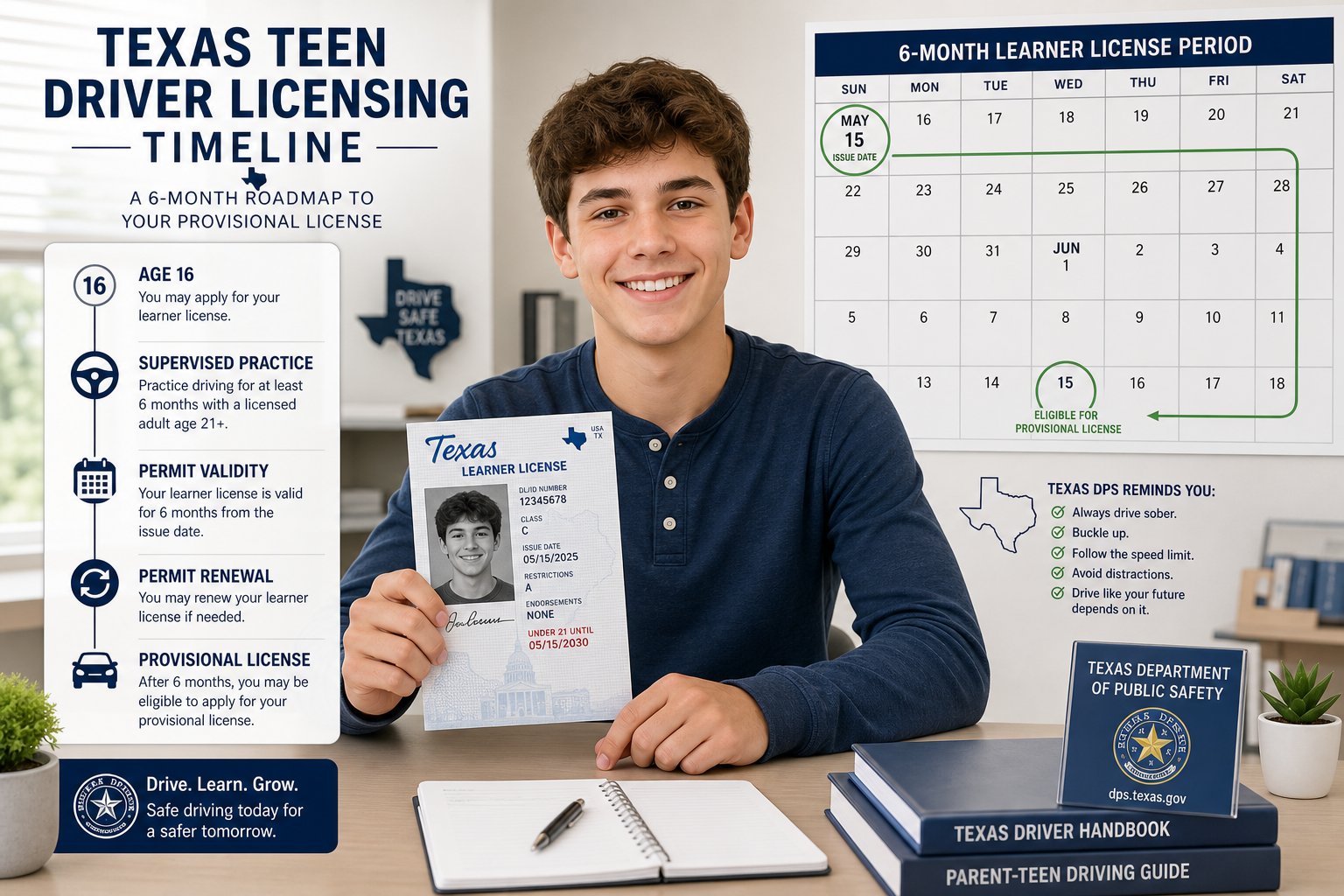
What The Texas 6-Month Learner’s Permit Rule Actually Means
The 6-month holding period is simple in theory. Texas requires most teens to keep a learner’s permit, also called an instruction permit, for at least six months before they can get a provisional license.
That clock starts on the date the permit is issued by TxDPS, not when you start a course and not when you buy a PTDE packet. If your permit says it was issued on June 10, the earliest date to move forward is six months later, assuming you also meet every other teen requirement.
A few details matter here:
- You must generally be at least 16 to apply for the provisional license.
- You must have held the permit for the full 6 months.
- If the permit expires before the six months are up, you may need to renew it with Texas DPS.
- If the permit is suspended, the holding period can be extended by the suspension time.
This rule fits into the larger teen licensing process. For teens under 18, that means TDE or PTDE first, then the learner’s permit stage, then supervised practice, then the provisional license step.
And one important line to keep clear: PTDE and TDE are teen programs only. They are not the same as ADE, which is for adults age 18 and older.
If you’re trying to figure out how long to hold learners permit texas rules require, the shortest honest answer is this: 6 months from issue date, plus completion of the rest of the teen requirements.
Who Can Get A Texas Learner’s Permit
In Texas, a teen must be at least 15 years old to get a learner’s permit. A younger teen can begin driver education at 14, but cannot receive the permit until age 15.
Because this is a teen license step, a parent, legal guardian, or another authorized adult usually has to be involved. For many applicants under 18, that adult signs forms and helps with the DPS appointment.
You may qualify for a Texas learner’s permit if you:
- Are 15 to 17 years old
- Meet identity and lawful presence rules
- Are enrolled in or have started the required teen driver education path
- Have the needed school attendance documents, if required
- Have a parent or guardian complete the required consent steps
Texas uses TxDPS for licensing and the Texas Department of Licensing and Regulation (TDLR) for approving driver education providers and the PTDE process. That matters because families often mix up the two agencies.
If you are doing Parent Taught Drivers Ed (PTDE), the parent must first get the PTDE Program Guide from TDLR. As of January 2026, that packet costs $20 and is delivered by email only, not by mail.
If you are using a driving school course instead of PTDE, the school handles its own approved teen education process. Either way, the teen must still meet the permit age and document rules before Texas DPS can issue the permit.
How Driver Education Requirements Differ By Age
Texas splits driver education by age, and this is where many families get confused.
For teens under 18, the path is teen driver education. That can be through a licensed school or PTDE. The teen first completes the early part of the course and gets the DE-964E, which is the partial completion certificate used for the learner’s permit step.
Later, after the full teen course is finished, the student gets the DE-964, which is the full completion certificate used when moving toward the provisional license.
That difference matters a lot:
- DE-964E = for getting the learner’s permit
- DE-964 = for getting the provisional license
Adults are different. ADE, or Adult Driver Education, is only for adults 18+. It is a separate course and does not replace teen education requirements for a minor.
Teens also have extra driving steps. They must complete the required behind-the-wheel training and supervised practice before moving on. And they must complete ITTD, the Impact Texas Teen Drivers course, before the road test.
ITTD is separate from your main driver education course. It is a free, 2-hour course provided by TxDPS through Impact Texas Teen Drivers. It is not the same thing as PTDE or a driving school course.
So if you are under 18, think in stages: start teen education, get the permit with DE-964E, hold it for six months, finish the full course and practice, complete ITTD, then apply for the next step.
What Documents You Need Before You Apply
Before your DPS appointment, gather every document first. That saves time and lowers the chance of being turned away.
Texas DPS may ask for documents that prove who you are, that you can legally be in the United States, and that you qualify as a teen applicant. Common items include:
- A completed driver license application
- Proof of U.S. citizenship or lawful presence
- Proof of identity
- Your Social Security number
- Your teen driver education certificate
- A VOE form, diploma, or GED record if required
- Parent or guardian signature
If a parent is not at the office, Texas may require the signature to be notarized. That small detail causes a lot of delays.
For teen education paperwork, make sure you bring the right certificate for the right step. For the permit, that is usually the DE-964E, not the full DE-964.
Also, if you are doing PTDE, keep your program records organized. Families often need the TDLR program materials, course records, and completion documents in one folder.
You can check current licensing document rules through Texas DPS and PTDE details through the Texas Department of Licensing and Regulation. Requirements can change, and your exact situation may affect what you need to bring.
A little prep helps here. Most permit problems are not about driving skill. They start with missing papers.
How To Apply For A Texas Learner’s Permit
The basic process is straightforward, even if the paperwork feels annoying.
First, complete the early part of your teen driver education program. If you are in PTDE, that means the approved course plus the TDLR program steps. Once eligible, you use the DE-964E to move forward with the learner’s permit application.
Next, schedule a Texas DPS appointment at a driver license office. Then complete the application online if available, or finish it at the office.
At the appointment, you usually will:
- Submit your documents
- Take a vision exam
- Have your photo taken
- Provide fingerprints or other biometrics
- Pay the required state fee
- Take the knowledge exam if it was not already completed through driver education
After Texas DPS approves the application, the learner’s permit is issued. That issue date is the date that starts the 6-month holding period.
This is why timing matters in PTDE. You can start coursework before the permit stage, but the six months do not begin until the permit is actually issued by TxDPS.
If you want a simple online option for the teen course itself, Driving Logic offers a state-approved Texas teen driver education option designed for flexible scheduling on your phone, tablet, or computer. That can help if your family is trying to fit lessons around school, work, and sports without adding classroom trips.
Rules, Restrictions, And Practice Requirements During The Permit Period
A learner’s permit is not a full license. Texas places clear limits on what you can do.
The biggest rule is supervision. A licensed adult age 21 or older must sit in the front passenger seat whenever you drive. If that adult is not there, you cannot legally drive on the permit.
Texas also bans cell phone use for teens during this stage, including hands-free use, except in an emergency. That rule is easy to overlook, but it matters.
During the permit period, your job is to build safe habits and complete the required practice. That often includes supervised driving in different conditions, including night driving, along with the rest of the behind-the-wheel work in your teen program.
Try to practice in a mix of settings:
- Neighborhood streets
- Multi-lane roads
- Parking lots
- Night conditions
- Light rain, if safe and allowed
The goal is not just to “get hours done.” It is to be ready for the road test and for real driving decisions.
Also, keep an eye on your permit expiration date. If the permit expires before you complete the texas learners permit 6 months requirement, you may need to renew it before moving on. A lapse can slow down your timeline.
And if the permit is suspended, that can push back when you become eligible for the provisional license. So the safest move is simple: follow the rules closely and keep clean records while you practice.
What Happens After 6 Months And How To Move Toward A License
After the full six months pass, you are not automatically done. You still need to meet the rest of Texas’s teen licensing steps.
If you are 16 or 17, you may apply for a provisional license once you have:
- Held the learner’s permit for at least 6 months
- Finished the required teen driver education program
- Completed the needed supervised practice and behind-the-wheel work
- Completed ITTD at TxDPS Impact Texas Teen Drivers
- Met the Texas DPS testing and appointment requirements
At this stage, the key course paper is the DE-964, not the DE-964E. The DE-964 shows full course completion.
The provisional license still comes with teen restrictions, and it remains in effect until age 18 unless another rule changes your status sooner.
For families using PTDE, the six-month rule fits into the middle of the process, not the end. You buy the TDLR packet, complete the early coursework, get the permit with the DE-964E, practice for at least six months, finish the remaining course work, complete ITTD, and then schedule the next DPS appointment.
If you want to start that path with a flexible online course, you can look at Driving Logic’s Texas PTDE/TDE options at MyDrivingLogic.com. It is a practical choice for busy families who want to work on state-required training on their own schedule.
For the latest rules, always confirm details with Texas DPS and TDLR, since forms and agency steps can change.
FAQ
How long do you have to hold a learner’s permit in Texas?
At least six months before applying for a provisional license, which is available at 16. The holding period is part of graduated licensing.
Can I shorten the 6-month period?
No. The six-month minimum is set by Texas law and cannot be shortened by finishing the classroom course faster. Use the time to log supervised practice.
When can my teen get the provisional license?
At 16, after holding the permit for six months and completing the required driver education and supervised driving.
What should we do during the 6 months?
Log supervised behind-the-wheel practice with a licensed adult 21+, building the hours and experience needed for the provisional license.
Conclusion
The six-month rule is the timeline’s anchor: it can’t be sped up, so the smart move is to get the permit at 15 and treat the hold as structured practice time. The teens who use those months to log varied, supervised driving arrive at 16 genuinely ready for a provisional license. Plan around the clock, and it works for you rather than against you.
Start the clock sooner by completing Module 1 of a TDLR-approved Texas parent-taught driver education course online to earn the DE-964E.
Related Articles
- Texas Learner’s Permit: How to Get It, What You Need, and What It Allows
- Texas Learner’s Permit Restrictions: What Your Teen Can and Can’t Do
- Texas Learner’s Permit vs Driver’s License: What’s the Difference?
- How to Get a Texas Learner’s Permit at 15: Step-by-Step Guide
Sources
Billy Forte is the owner of Driving Logic, a TDLR-approved Texas driver education provider. Driving Logic offers the online Texas parent-taught and teen driver education course that helps Texas teens complete the 32-hour classroom requirement and work toward a learner’s permit and provisional license.
This article is general information about Texas teen driver education and licensing, not legal advice. Requirements, fees, and procedures are set by TDLR and the Texas DPS and can change, so confirm current details with official Texas sources before you enroll or visit a DPS office.