
Updated October 2026 · Reviewed by Billy Forte
Texas learners permit vs driver’s license comes down to supervision: a learner license holder drives only with a licensed adult 21 or older in the front passenger seat, while a provisional license lets a teen of 16 or 17 drive alone. The provisional license adds under-18 limits on late-night driving and passengers, and the phone ban covers both. Both licenses expire on the 18th birthday.
Key Facts
- Supervision: required on every learner drive; not required with a provisional license. See the comparison.
- Ages: learner license from 15; provisional license at 16 or 17. See the two phases.
- Waiting period: at least six months with the learner license first. See moving up.
- Extra limits: midnight to 5 a.m. and passenger rules apply when driving alone. See provisional limits.
- At 18: both expire on the 18th birthday. See what happens at 18.
Two Licenses, Two Phases
Texas licenses teens in two phases under the Graduated Driver License (GDL) program. The Texas Driver Handbook calls them Phase One and Phase Two.
Phase One is the learner license. Phase Two is the provisional license. A teen moves from one to the other, never skipping the first.
People say “driver’s license” for both, and for the adult license too. For teens, the real comparison is learner license vs provisional license. The provisional license is the first one that allows solo driving.
The Learner License in Brief
The DPS learner license page says the learner license “allows driving practice with a licensed adult.” A teen can get it at 15 after the first part of a driver education course.
Its core rule is supervision. A licensed adult 21 or older sits in the front passenger seat on every drive. Our restrictions guide covers each learner rule.
The Provisional License in Brief
The DPS provisional license page is for teens 16 or 17. It allows driving alone, with three limits:
- Passengers: “You may not drive with more than one passenger in the vehicle under 21 who is not a family member.”
- Late night: driving is restricted between midnight and 5:00 a.m. unless for work, school activities or emergencies.
- Phones: all cell phone use is prohibited, including hands-free devices, unless it is an emergency.
These limits come from Transportation Code Section 545.424. The statute words the late-night exceptions as employment, a school-related activity or a medical emergency. It also counts work on a family farm as employment.
Texas Learners Permit vs Driver’s License, Side by Side
This table puts the two teen licenses next to each other:
| Feature | Learner license | Provisional license |
|---|---|---|
| Age | 15 or older | 16 or 17 |
| Driving alone | Not allowed | Allowed |
| Adult in the front seat | Licensed, 21 or older, every drive | Not required |
| Phone use, including hands-free | Banned except in an emergency | Banned except in an emergency |
| Midnight to 5 a.m. | Not limited while supervised | Limited except work, school activities, emergencies |
| Passengers under 21, not family | Not limited while supervised | No more than one |
| Driver education needed | DE-964 learner license portion | Full course and DE-964 driver license portion |
| DPS fee | $16 | $16 |
| Expires | 18th birthday | 18th birthday |
The fees come from the DPS fee page. It lists $16 for a learner license under 18 and $16 for an under-18 driver license.
The two “not limited while supervised” rows come from Section 545.424(c). It says the late-night and passenger limits do not apply while the teen drives with the supervision a learner license requires.
Moving From Learner to Provisional
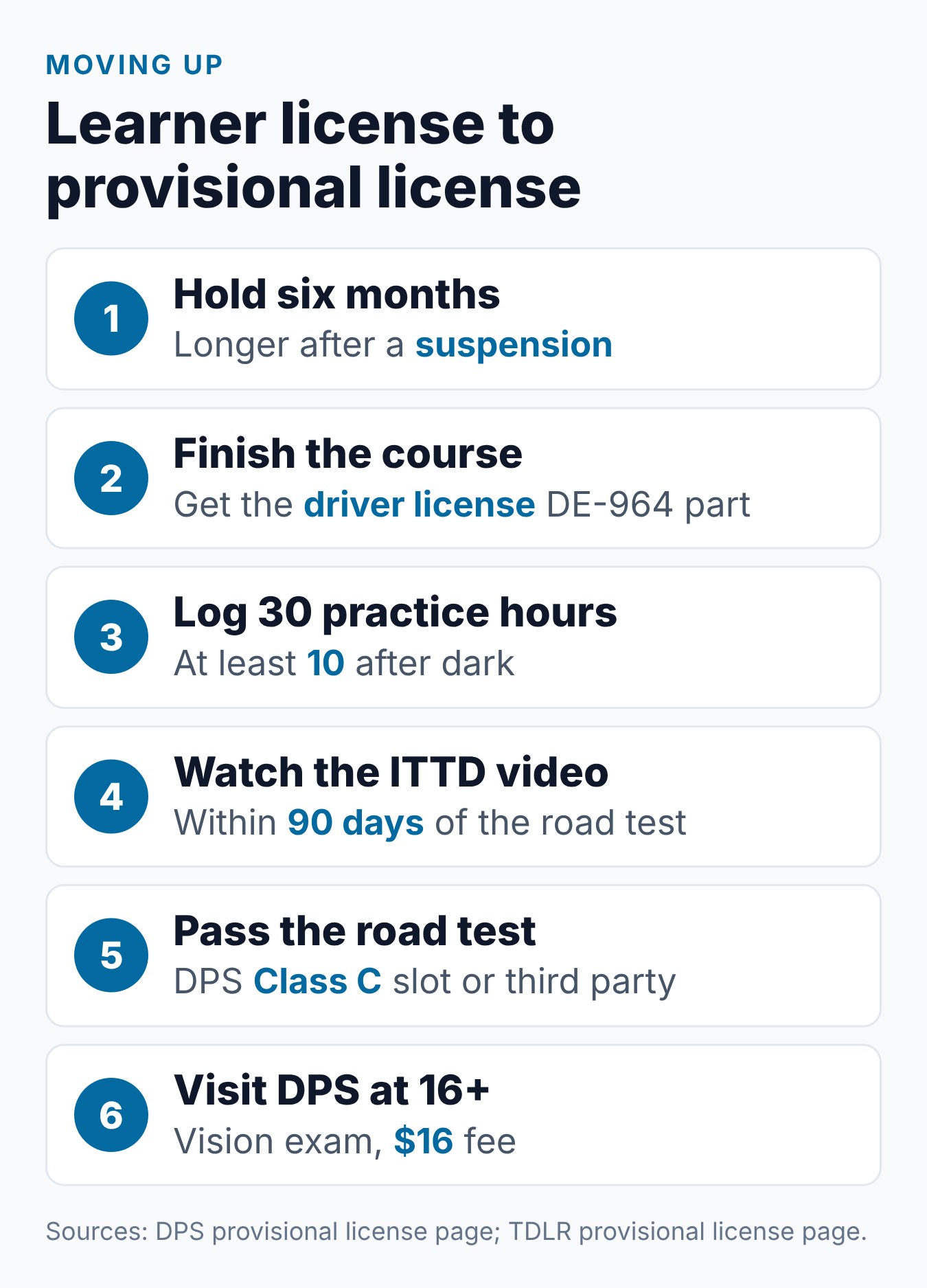
The step up takes more than time. DPS lists these requirements for a provisional license:
- Age: 16 or 17.
- Holding period: the learner license held at least six months.
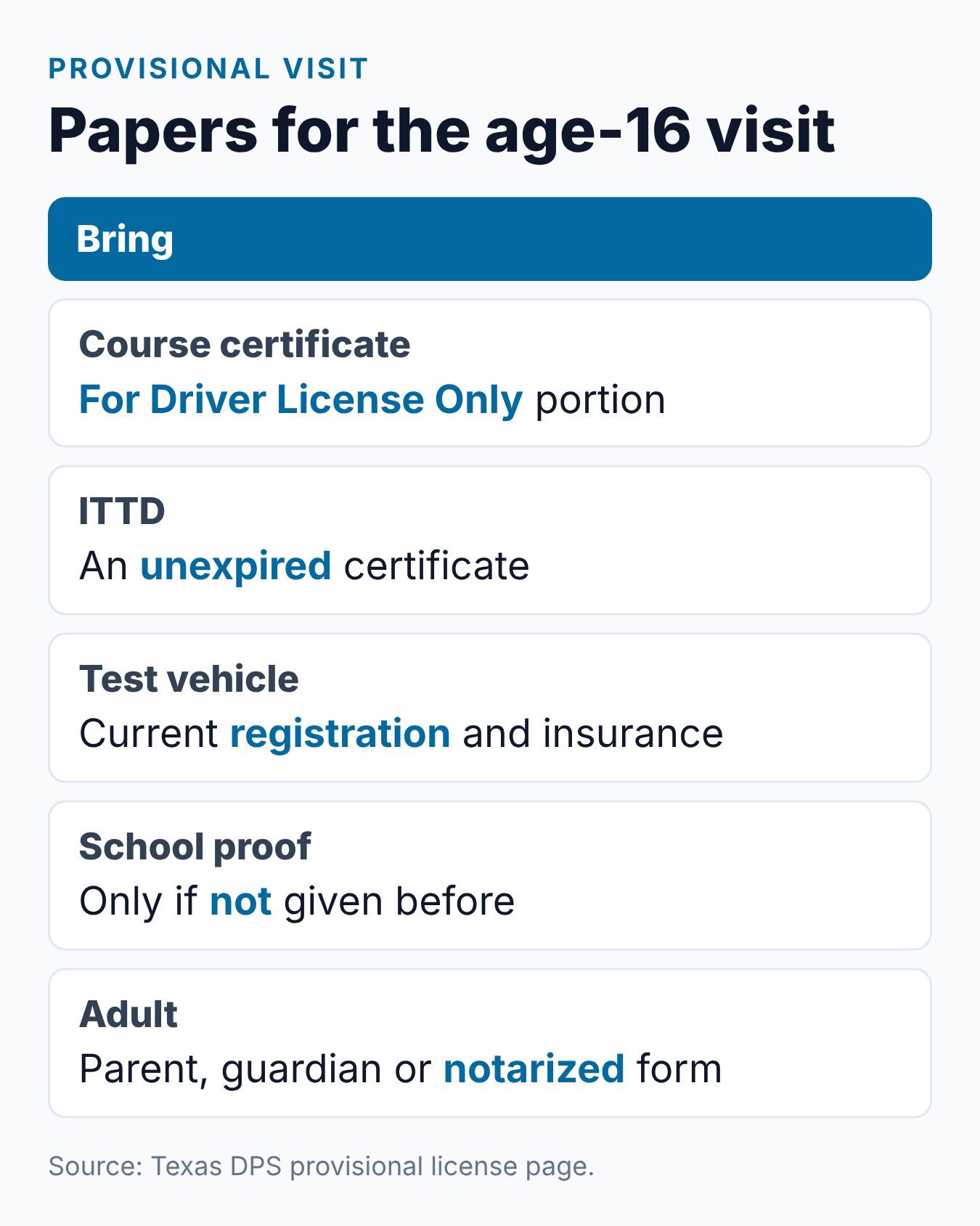
- Course: driver education complete, with the “For Driver License Only” portion of the DE-964.
- In-car hours: 7 hours of observation, 7 hours of behind-the-wheel instruction and 30 hours of practice, at least 10 at night.
- Impact Texas Teen Drivers (ITTD): completed within 90 days of the driving test.
- School proof: a VOE, diploma or GED, if not already given with the learner license.
- Exams: a vision exam and a driving test.
DPS also lists the DL-14B, identity papers and an unexpired ITTD certificate. A parent or guardian attends, signs a notarized application, or the teen brings a waiver such as emancipation.
The Driving Test
The teen can test at a DPS office or with a third-party provider. For a DPS test, schedule online and choose “Class C” under the Road Skills Test. Bring proof of current registration and insurance for the test vehicle.
If a driver education school gives the test, the results go to DPS in a sealed envelope. The school may also send the packet through the TPST Submission Portal.
What Parent-Taught Families Add
The TDLR provisional license page says the parent instructor on record must go to the driver license office. It also says the knowledge test is waived if the student completed it during the course.
The ITTD program is a free two-hour video on distracted driving. It is done after the behind-the-wheel training, and DPS says the certificate is valid 90 days. The DPS Impact Texas Drivers page has the details.
How the Six Months Fits In
The learner license must be held at least six months, unless the teen turns 18. A suspension adds its days to that period.
Age still controls the earliest date. A teen who gets the learner license at 15 years and 1 month reaches six months at 15 years and 7 months. That teen still waits until 16 to apply.
Our 6-month rule guide shows more date examples.
Which License Covers Which Trip
The rules make some everyday trips easy to sort. These examples apply the DPS rules and Section 545.424:
- A 15-year-old driving to school alone. Not allowed. A learner driver always needs the adult up front.
- A 15-year-old driving to school with a licensed parent in the front seat. Allowed on a learner license.
- A 16-year-old with a provisional license driving to school alone. Allowed.
- That same driver taking two classmates under 21 home. Not allowed when driving alone, unless they are family.
- A provisional driver heading home from a job at 12:30 a.m. Allowed, since work is an exception.
- Either driver answering a call on a car speaker. Not allowed, except in an emergency.
Costs Across Both Stages
The state fees are small and the same at each stage. DPS charges $16 for the learner license and $16 for the under-18 driver license.
ITTD is free, per TDLR. Parent-taught families also pay TDLR $20 once per child for the instructor designation.
Course prices are set by each provider. Our cost guide lists the official fees.
What Happens at 18
Both teen licenses end on the 18th birthday. The DPS fee page lists that expiration for the learner license and the under-18 license.
The TDLR step-by-step guide says, “After turning 18, the student must renew the license to receive a regular driver license without restrictions.” TDLR also says the license can be renewed online. Renewing in person before 18 needs a parent or legal guardian.
Our guide on when teen restrictions end covers that change.
What About How the Cards Look?
Families also search for what a learner license looks like. We do not describe card designs, because DPS can change them and we cannot show an official card here.
What DPS does say is how you receive each one. After approval, the teen gets a temporary permit to drive right away. DPS says the card should arrive by mail in about 2 to 3 weeks, and you can track its mailing status online.
Check the temporary permit for errors before leaving the office. DPS asks for that on both the learner and provisional pages.
What Stays the Same
Some rules carry across both licenses. Knowing them avoids surprises at 16:
- The phone ban. It applies to every driver under 18, learner or provisional.
- Zero tolerance for alcohol. DPS says any detectable alcohol is DUIA by a Minor for drivers under 21.
- The tobacco program rule. A minor convicted of a tobacco offense must finish an awareness program within 90 days or risk suspension.
- The fee. $16 for each license under 18.
Our Review of the Two DPS Pages
On the DPS learner and provisional license pages we checked on October 26, 2026, both pages named the phone ban, including hands-free devices. Only the provisional page listed the passenger limit and the midnight to 5:00 a.m. rule.
The provisional page also listed the 44 in-car hours and the ITTD 90-day rule. The learner page listed the six-month minimum and the suspension extension.
Common Mistakes When Moving Up
Each item comes from a DPS or TDLR rule:
- Applying before six months. The learner license must be held at least six months.
- Doing ITTD too early. It must be within 90 days of the driving test.
- Bringing the wrong DE-964 portion. The provisional visit needs the driver license portion.
- Forgetting test-vehicle papers. A DPS road test needs current registration and insurance.
- Assuming passengers are fine. Alone, a provisional driver may carry only one non-family passenger under 21.
For the full learner picture, see our learner’s permit guide. Adults should read our guide to the rules at 18 and older.
How Requirements Can Vary
Texas driver education rules come from TDLR, and driver license rules come from Texas DPS. They apply statewide, but what you need depends on the student’s age, the course method, and whether the classroom part comes from a parent-taught course, a driving school, or a public school.
Fees, forms, and office procedures can change. Check the TDLR parent-taught pages and the DPS driver license pages before each step, and follow the instructions from your course provider.
Frequently Asked Questions
What is the difference between a learner’s permit and a driver’s license in Texas?
A learner license requires a licensed adult 21 or older in the front passenger seat on every drive. A provisional license lets a teen of 16 or 17 drive alone, with under-18 limits.
When can a Texas teen switch to a provisional license?
At 16 or 17, after holding the learner license at least six months. The teen also needs the full course, 30 practice hours, ITTD and a driving test.
Does the phone ban change with a provisional license?
No. Drivers under 18 may not use a wireless device, including hands-free, except in an emergency, on either license.
Can a provisional driver drive after midnight?
Only for work, school activities or emergencies, per DPS. The statute words them as employment, a school-related activity or a medical emergency.
How much does each teen license cost?
DPS lists $16 for the learner license under 18 and $16 for the under-18 driver license. Both expire on the 18th birthday.
Do I need to take the knowledge test again?
TDLR says the knowledge test is waived for the provisional license if it was completed during the course.
Is the provisional license a Class C license?
DPS lists the under-18 driver license under its Class A, B or C fees, at $16. For a DPS road test, the teen books under “Class C” in the Road Skills Test.
What happens to the provisional license at 18?
It expires on the 18th birthday. TDLR says the driver then renews to get a regular license without the under-18 restrictions.
Conclusion
The learner license is supervised practice, and the provisional license is solo driving with under-18 limits on passengers and late nights. Both carry the phone ban, cost $16 and expire on the 18th birthday. Driving Logic’s Texas Parent Taught Drivers Ed course is coming soon, and TDLR lists licensed providers now.
Related Articles
- Texas Learner’s Permit: How to Get It, What You Need, and What It Allows
- Texas Learner’s Permit Restrictions: What Your Teen Can and Can’t Do
- How Long Do You Need to Hold a Texas Learner’s Permit Before Getting Your License?
- Texas Learner’s Permit for Adults: Do 18-Year-Olds and Adults Over 25 Need One?
Sources
- Texas DPS — Texas Learner License as a Teen
- Texas DPS — Texas Provisional License as a Teen
- TDLR — Parent-Taught Provisional License
- TDLR — Parent-Taught Step-by-Step Guide (PDF)
- Texas DPS — Driver License Fees
- Texas Transportation Code § 545.424 — Operation of vehicle by person under 18
- Texas DPS — Texas Driver Handbook (DL-7, PDF)
- Texas DPS — Impact Texas Drivers (ITD) Program
Billy Forte is the owner of Driving Logic, a state-approved driver improvement course provider serving Texas and other U.S. states.
This article is general information, not legal advice. Texas driver education and licensing rules are set by TDLR, Texas DPS, and Texas law, and can change. Check the official TDLR and DPS websites for current requirements.