
Updated June 2026 · Reviewed by Billy Forte
On a Texas provisional license, a teen may not carry more than one passenger under 21 who is not a family member, a rule aimed at reducing the distraction and crash risk that extra young passengers add. Family members generally do not count toward the limit, and the restriction applies until the driver turns 18. Understanding who counts helps teens and parents avoid an easy-to-miss violation.
Applies to Texas teen driver education and licensing (ages 14–17). Requirements are set by TDLR (driver education) and the Texas DPS (licensing) and can change.
Key Facts
- The limit: No more than one passenger under 21 who is not a family member.
- Family exception: Family members generally don’t count toward the one-passenger limit.
- Why it exists: Multiple young passengers raise distraction and crash risk for new drivers.
- Applies until 18: Part of the provisional restrictions that end at 18.
- Violations carry penalties: Breaking the limit can result in a citation.
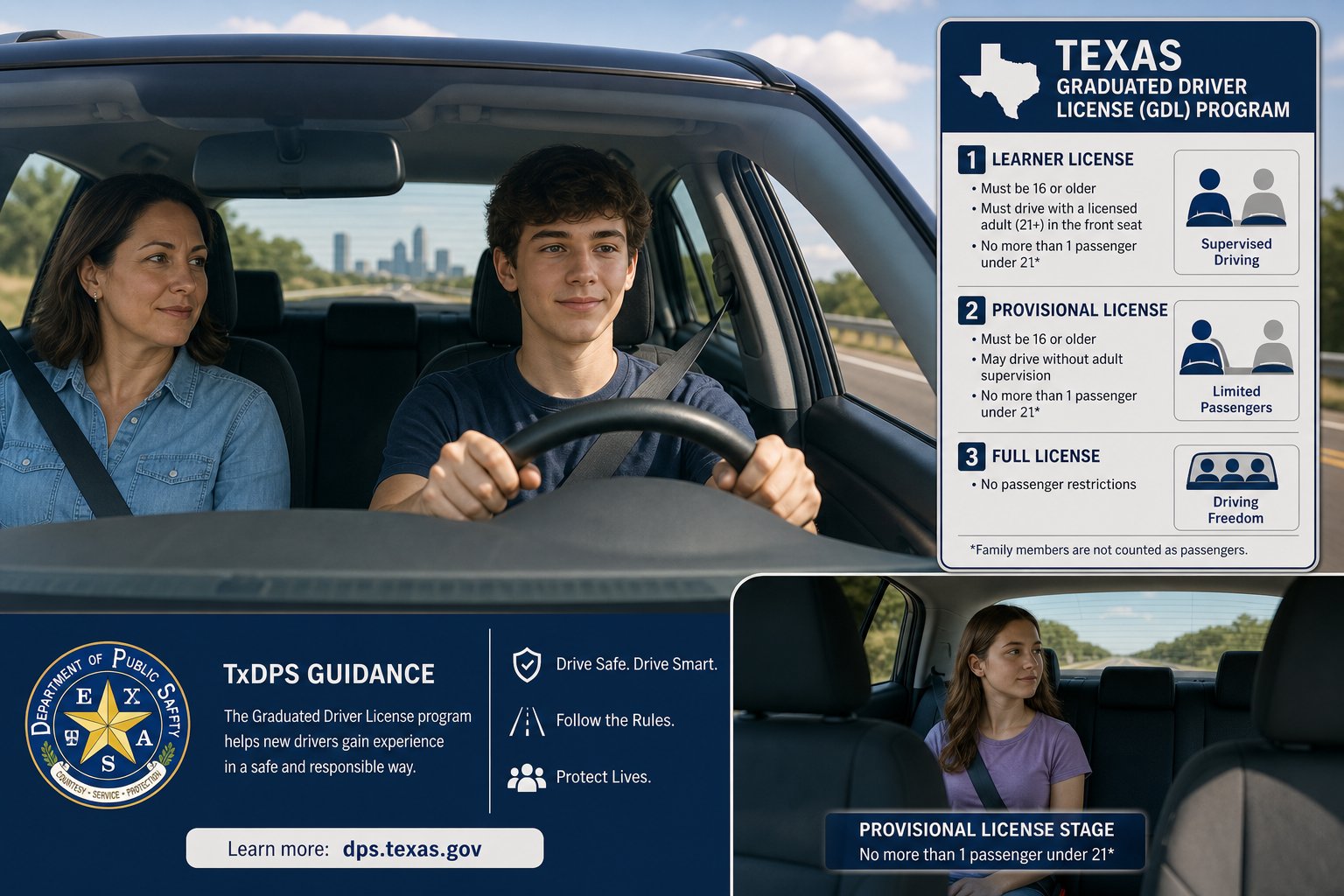
How The Texas Graduated Driver License Program Affects Passenger Rules
Texas uses a Graduated Driver License (GDL) system for drivers under 18. The system adds driving rights in steps. That helps teens build skill before they drive without limits.
The first step is the learner license. In this phase, a teen cannot drive alone. A licensed adult who is 21 or older must sit in the front seat. Because the teen is not driving on their own yet, the main issue is supervision, not a separate teen passenger cap.
The second step is the provisional license. This usually starts at age 16 after the teen has held a learner license for at least six months and passed the required testing with TxDPS. This is the phase where the texas teen driving passenger limit matters most.
Texas made these rules to reduce risk during the first months of solo driving. A new driver may know the basics, but real traffic is harder. Friends in the car can add noise, pressure, and split attention.
If your teen is still working through training, keep the agencies straight. The Texas Department of Licensing and Regulation approves driver education providers through TDLR. TxDPS issues the permit and license. And if you are using PTDE, remember that Parent Taught Drivers Ed is for teens under 18, while ADE is a different course for adults 18 and older.
For official rules, check TxDPS and TDLR.
What The Texas Teen Passenger Limit Actually Is
The Texas provisional license passenger rule is simple once you break it down. A driver under 18 with a provisional license may carry only one passenger under age 21 who is not a family member.
That means the limit is not one total passenger. It is one non-family passenger under 21. So if a teen driver has one 17-year-old friend in the car, that is allowed. If they add a second 17-year-old friend, that breaks the rule.
The restriction lasts through the full provisional period. It ends when the driver turns 18. Until then, the rule applies whenever the teen is driving, unless a specific law says otherwise.
This is where many families get confused:
- One teen friend may be allowed
- Two or more teen friends are not allowed
- Family members under 21 do not count the same way as non-family teen passengers
- Adults 21 and older are not the focus of this passenger rule
The rule is part of Texas teen driving restrictions meant to lower distraction. It is not just a suggestion from parents or a school policy. It is tied to the state’s GDL rules for provisional drivers.
If your teen is moving from permit to provisional status, make sure they have finished the right steps. For teens, that may include PTDE or another approved teen course, the correct completion certificate, and ITTD. Impact Texas Teen Drivers is a free, 2-hour course from TxDPS, and it is separate from the PTDE or TDE course itself.
Who Counts As A Passenger And When Family Exceptions Apply
A passenger is anyone in the vehicle other than the driver. That part is easy. The harder part is the family exception.
In plain terms, the Texas rule limits non-family passengers under 21. So a sibling, step-sibling, or other family member under 21 is treated differently from a friend, classmate, teammate, or neighbor. If the young person is not family, they count toward the limit.
A few simple examples help:
- One brother and two sisters in the car: generally allowed under the family exception
- Two school friends under 21: not allowed
- One cousin and one friend under 21: the friend is the one that counts toward the non-family limit
When teens hear “one passenger,” they often think it means one person total. That is not the rule. The real limit is about non-family riders under 21.
Other Texas Provisional License Restrictions Teens Must Follow
The passenger limit is only one part of the provisional license rules. Texas also limits when and how a teen under 18 can drive.
The biggest rule is midnight driving. A teen with a provisional license may not drive between midnight and 5 a.m. unless the trip is for:
- Work
- A school activity
- A medical emergency
Texas also bans cell phone and wireless device use for provisional drivers. That means no calling, texting, or hands-free use while driving, except in an emergency. This is stricter than what many adults expect.
There are also rules tied to alcohol and other conduct. Texas uses a strong approach for underage drivers. Any detectable alcohol can create serious trouble. Other violations, including tobacco-related issues in some cases, may also affect driving privileges.
Training details matter too. Teens under 18 may complete TDE with a licensed school or PTDE with a parent instructor. If you choose Parent Taught Drivers Ed, the PTDE Program Guide packet must come from TDLR. It costs $20, and as of January 2026 it is delivered by email only, not by mail.
Also keep the certificates straight:
- DE-964E: partial completion for Module 1, used for the learner license
- DE-964: full completion for the provisional license
And again, ITTD is separate. Teens need the free Impact Texas Teen Drivers course before the driving test, but it is not the same as the main teen driver education course.
Why Passenger Limits Matter For Teen Driver Safety
The rule exists for a clear reason: teen passengers can raise crash risk. A new driver already has a lot to manage. Speed, space, mirrors, signs, and other cars all need attention.
Add friends, and the risk often goes up. Friends may talk loudly, play music, joke around, or push the driver to take chances. Even quiet passengers can distract a teen who is still building driving habits.
Research often cited in safety discussions shows how serious this can be. AAA findings have been cited to show crash risk rising about 44% with one passenger and 200% to 300% with three or more teen passengers. That is a big reason Texas and other states use passenger limits in their GDL systems.
The danger is not only wild behavior. Small distractions matter too:
- Looking away for a second
- Turning to answer a question
- Feeling pressure to speed up
- Missing a stop sign or lane change
Parents sometimes think their teen is careful, so the law does not matter as much. But the law is built for average real-life moments. Most crashes do not start with drama. They start with one bad choice, one late brake, or one glance away.
So the texas provisional license passenger rule is about reducing load on a new driver. Fewer teen passengers usually means less noise, less pressure, and more focus. For a 16- or 17-year-old driver, that can make a real difference.
What Happens If A Teen Violates Texas Passenger Restrictions
If a teen breaks the passenger rule, the result may be more than a warning. Penalties can include fines, a license suspension, or problems that delay full driving privileges. Exact outcomes can depend on the situation and any related violation.
There is also the safety risk. A teen who ignores the rule may be more likely to drive in other risky ways too. If a crash happens, the fact that the teen was breaking a passenger restriction could become part of what parents, insurers, or courts review.
Possible effects may include:
- A traffic citation
- Higher costs tied to the violation
- Trouble keeping or advancing license status
- Added concern if a crash causes injury or property damage
Families should also think beyond the ticket. If a teen was carrying too many young non-family passengers and a crash happened, that could make a hard day even harder. It may affect insurance issues and possible civil claims.
That is why it helps to treat the rule as firm. Not flexible. Not “close enough.” If your teen has a provisional license, they need to know the count before the car moves.
A simple habit works well: before driving, your teen should ask, “How many non-family passengers under 21 are in this car?” If the number is more than one, the ride plan should change.
How Parents Can Help Teens Follow Texas Driving Laws
Parents matter a lot here. Most teens do better when the rules at home are clear and repeated often. Do not assume your teen understands the passenger limit just because they passed a test.
Start with a short family rule sheet. Keep it simple:
- No more than one non-family passenger under 21
- No driving from midnight to 5 a.m. unless an exception applies
- No phone use while driving
- No last-minute ride changes without parent approval
Ride with your teen often. Watch how they handle turns, traffic, and pressure from other people in the car. Calm feedback works better than long lectures.
It also helps to model the same habits yourself. If you drive with your phone in hand, your teen sees that. If you stay focused and keep distractions low, they see that too.
If your teen still needs to finish training, choose a state-approved course that fits your schedule. Driving Logic offers Texas teen driver education options online, including support for families using PTDE and other approved paths. You can review the Texas teen course options at Driving Logic and then confirm current state requirements with TDLR and TxDPS.
One more point that trips people up: ADE is not for teens under 18. Adults 18 and older use Adult Driver Education. Teens need the correct teen path, plus the required documents such as DE-964E or DE-964, and the separate ITTD course when required.
FAQ
How many passengers can a Texas teen driver have?
On a provisional license, no more than one passenger under 21 who is not a family member. Family members generally don’t count toward the limit.
Do siblings or family count toward the limit?
Family members generally do not count toward the one-passenger limit. The restriction targets non-family passengers under 21.
How long does the passenger limit last?
Until the driver turns 18, when the provisional restrictions lift and a full license is available.
What if a teen exceeds the passenger limit?
It can result in a citation and penalties. The limit is part of the graduated licensing restrictions designed to reduce crash risk.
Conclusion
The passenger limit addresses one of the clearest risk factors for new drivers: a car full of young peers. With the family exception, it’s usually easy to follow once teens and parents know who counts. Like the other provisional limits, it’s a temporary safeguard that ends at 18.
Provisional privileges start with driver education — your teen can complete the TDLR-approved Texas parent-taught driver education course online.
Related Articles
- How to Get a Texas Driver’s License at 16: The Complete Teen Guide
- Texas Provisional License Restrictions: Complete Rules for 16-Year-Old Drivers
- Texas Teen Midnight Driving Rule: What It Is and the Exceptions
- Texas Teen Drivers and Cell Phones: What the Law Says
Sources
Billy Forte is the owner of Driving Logic, a TDLR-approved Texas driver education provider. Driving Logic offers the online Texas parent-taught and teen driver education course that helps Texas teens complete the 32-hour classroom requirement and work toward a learner’s permit and provisional license.
This article is general information about Texas teen driver education and licensing, not legal advice. Requirements, fees, and procedures are set by TDLR and the Texas DPS and can change, so confirm current details with official Texas sources before you enroll or visit a DPS office.