
Updated November 2026 · Reviewed by Billy Forte
For most tickets, the answer to “do you have to sign a traffic ticket in Florida” is no: the officer certifies that the citation was delivered to you, and signing is not what admits the infraction. You must sign and accept the citation only when it requires a mandatory court hearing or charges a criminal traffic violation, and that citation indicates a promise to appear. For a regular ticket, Florida law treats you as admitting the infraction when you pay the civil penalty or enter a payment plan within 30 days instead of choosing to appear.
Key Facts
- Regular tickets: your signature is not required for a noncriminal infraction. See the rule for most tickets.
- When you must sign: citations that need a mandatory hearing, and criminal traffic citations. See when a signature is required.
- What signing means: the citation indicates a promise to appear. See what a signature means.
- What counts as an admission: paying the civil penalty or entering a payment plan. See what admits the infraction.
- Refusing when required: a willful refusal to accept and sign is a second-degree misdemeanor. See refusing to sign.
- Your deadline: 30 days from the date the citation was issued. See your 30 days.
Most Tickets Need No Signature
Most Florida traffic tickets are noncriminal infractions. Regular speeding and careless driving are two examples. For these tickets, Florida law does not make you sign.
Section 318.14(2) puts the duty on the officer instead. The officer must certify that the citation was delivered to the person cited. The officer can do that by electronic signature, electronic facsimile signature or written signature.
That certification matters. The statute calls it prima facie evidence that the person was served. In plain words, the officer’s certification is the proof that you got the ticket.
So a regular ticket does not depend on your signature. The same deadline and the same choices apply either way.
Why the Officer’s Signature Counts
Many drivers think a ticket only counts once they sign it. Florida law does not work that way for a regular ticket. The statute asks for the officer’s certification, not the driver’s name.
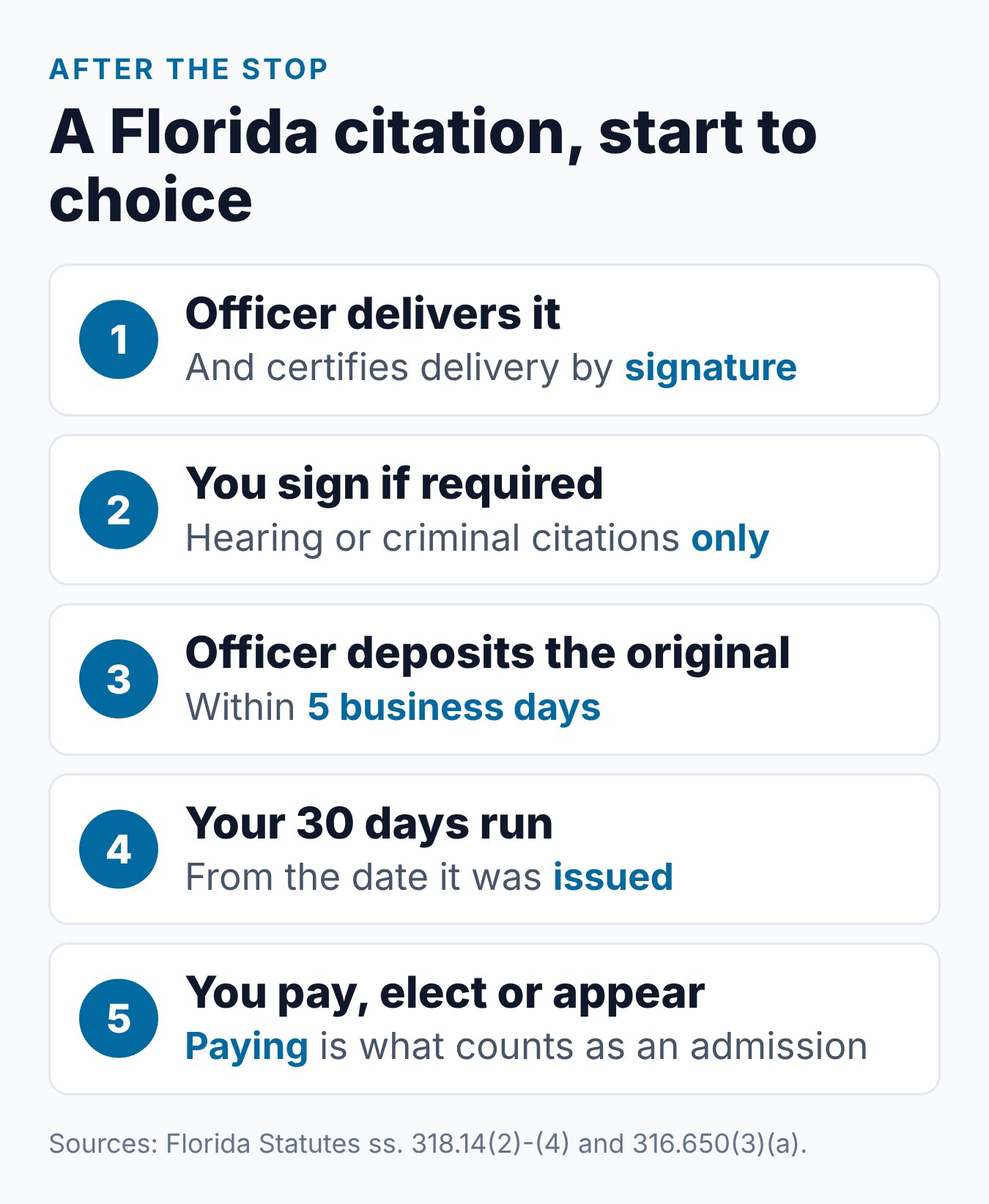
The officer also has a filing duty. Under s. 316.650(3)(a), the officer deposits the original citation within 5 business days after it is issued. Both steps belong to the officer, not to you.
Your part comes later. It is the choice you make within 30 days, explained in the sections below.
When You Must Sign
The rule changes for two kinds of citations. Under s. 318.14(2), you must sign and accept the citation when:
- the violation requires a mandatory hearing under s. 318.19, or
- the charge is any other criminal traffic violation listed in chapter 316.
In both cases, the citation indicates a promise to appear. The case will be heard in court, and your signature goes on that promise.
Tickets That Need a Mandatory Hearing
Section 318.19 lists noncriminal tickets that still need a court hearing. They include:
- a crash that causes death or serious bodily injury
- passing a stopped school bus on the side where children enter and exit
- certain load violations
- speeding 30 mph or more over the limit
- speeding 50 mph or more over the limit
These tickets cannot be closed by paying the clerk. A hearing is required, so the citation comes with a promise to appear.
Criminal Traffic Citations
Some driving acts are crimes, not infractions. Reckless driving is one (s. 316.192).
Leaving the scene of a crash with property damage is another (s. 316.061). DUI is a criminal charge too.
Since July 1, 2025, Florida also has a charge called dangerous excessive speeding (s. 316.1922). It covers driving 50 mph or more over the limit. It also covers driving 100 mph or more in a way that threatens people or property.
A criminal citation is handled by the court. Our guide on criminal and civil tickets explains where that line falls.
Signature Rules by Type of Ticket
Here is how the rule in s. 318.14(2) sorts some common citations:
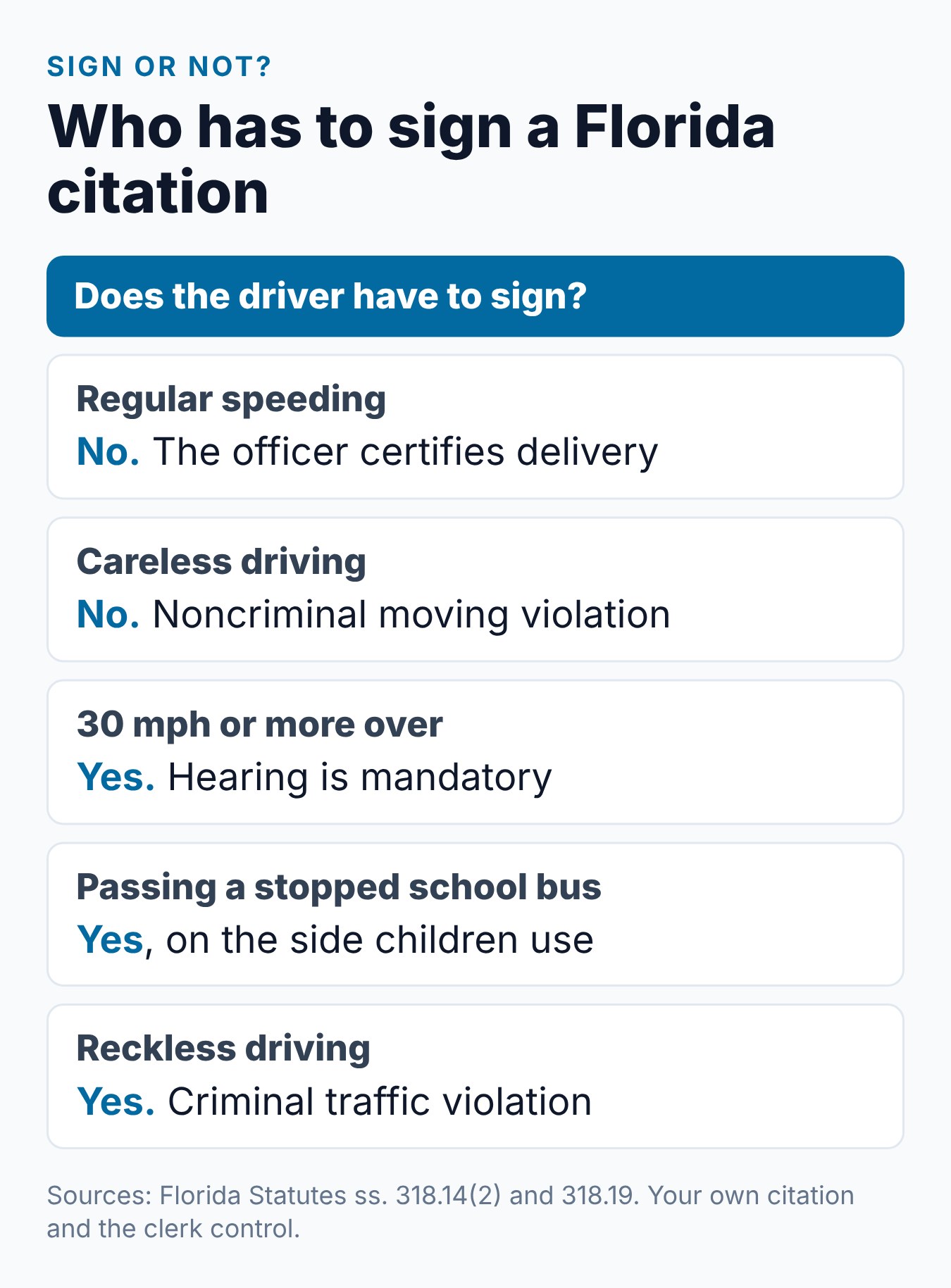
- Regular speeding, under 30 mph over the limit: no signature required. It is a noncriminal infraction, and the officer certifies delivery.
- Careless driving: no signature required. It is a noncriminal moving violation.
- Speeding 30 mph or more over the limit: you must sign and accept. A hearing is mandatory under s. 318.19.
- Passing a stopped school bus on the side children use: you must sign and accept. A hearing is mandatory.
- Reckless driving: you must sign and accept. It is a criminal traffic violation.
One ticket can fall under more than one rule. For example, an infraction that causes a crash with a death or a serious bodily injury needs a hearing. That is true even when the same infraction would normally be a regular ticket.
Read your own citation closely. If it lists a court date or a required appearance, ask the Clerk of Court in the county where it was issued what applies to your case.
What a Signature Means
A signature on a Florida citation is not a plea. The statute describes the signed citation as one “indicating a promise to appear.” That is a promise to come to court on the charge.
Signing is not what admits the infraction. The statute ties an admission to a different act, which the next section covers.
The law also limits how the paper itself is used later. Under s. 316.650(9), a traffic citation is not admissible evidence in any trial. The only exception is when it is used as evidence of falsification, forgery, uttering, fraud or perjury.
So the citation works as a notice and a record of the charge. It tells you what you are charged with and what you have to do next.
What Admits the Infraction
For a noncriminal ticket, the act that counts is paying. Section 318.14(4) covers a driver who does not elect to appear. Within 30 days after the date the citation was issued, that driver must do one of two things:
- pay the civil penalty, by mail or in person, or
- enter into a payment plan with the clerk under s. 28.246.
A driver who does either one is deemed to have admitted the infraction and to have waived a hearing. So the admission comes from paying or starting a payment plan. It does not come from a signature at the roadside.
The same subsection adds a limit. The admission “shall not be used as evidence in any other proceedings.”
Paying has other effects too. Paying the civil penalty without electing a course counts as a conviction, and points are added (s. 322.01(11)). Our ticket options guide compares each choice side by side.
If You Refuse to Sign
What happens depends on the kind of citation.
Regular noncriminal ticket. The law does not require your signature, so there is nothing to refuse. The officer certifies delivery, and that certification is the proof of service.
Your 30 days still run from the date the citation was issued.
Mandatory hearing or criminal citation. Here the law requires you to sign and accept. Under s. 318.14(3), a person who willfully refuses to accept and sign the summons commits a misdemeanor of the second degree.
That refusal is itself a crime under the statute.
So a refusal does not make a ticket go away. On a regular ticket, it changes nothing about the case. On a hearing-required or criminal citation, it can lead to a criminal charge.
If you are not sure which kind of citation you have, ask the Clerk of Court in the county where it was issued. The clerk and the court handle the case from there.
What Happens to the Citation After the Stop
The officer’s work does not end at the roadside. As noted above, the officer deposits the original citation within 5 business days after it is issued.
A new ticket may take several days to appear in a clerk’s online search. Our ticket lookup guide explains how to find a ticket and what to do when it does not show up.
Your deadline does not wait for that filing. The 30 days in s. 318.14(4) run from the date the citation was issued. They do not run from the day the ticket appears online.
Your 30 Days After the Ticket
For a regular noncriminal ticket, there are three paths within 30 days of the citation date:
- Pay the civil penalty or enter a payment plan. This is the act the law treats as an admission.
- Elect a Basic Driver Improvement (BDI) course, if you qualify.
- Appear at a hearing. At a hearing, the official may impose a civil penalty of up to $500 (s. 318.14(5)).
Which paths are open depends on your citation, county, court and case type. The Clerk of Court in the county on your ticket can tell you what applies to your case.
How the BDI Election Fits
Under s. 318.14(9), an eligible driver may elect a BDI course approved by FLHSMV in lieu of a court appearance. The driver must not hold a commercial driver license or a commercial learner’s permit.
With a valid election, three things happen:
- adjudication is withheld
- the civil penalty is reduced 18 percent
- points are not assessed for that ticket
A withheld adjudication “is not a conviction” under s. 318.14(11). It is also not a dismissal. The record shows adjudication withheld.
The election has limits. You cannot elect if you made an election in the preceding 12 months. You also cannot make more than eight elections in a lifetime.
Tickets that need a mandatory hearing cannot be elected, and criminal charges have no election at all. Those are the same citations the law requires you to sign.
To elect, you tell the clerk within the 30 days, before you take the course, and pay the clerk’s election fee. Our election guide covers each step and every limit.
If You Do Nothing
Doing nothing has its own result. Under s. 318.15(1)(a), the clerk notifies FLHSMV when a driver does not pay, does not appear at a scheduled hearing or does not attend a required driver improvement school. FLHSMV then suspends the license.
This is why the deadline matters more than the signature. A signed ticket and an unsigned ticket both come with a date. Missing that date is what puts a license at risk.
Points and Your Record
A signature does not add points. Points come from a conviction for a moving violation. Paying a regular ticket without electing counts as a conviction.
Florida sets point values by violation under s. 322.27(3)(d). Speeding 15 mph or less over the limit is 3 points. Speeding more than 15 mph over is 4 points, and careless driving is 3 points.
Points stay on the record for at least 5 years from the disposition date, according to FLHSMV. A BDI course does not take away points that are already on a record. A valid election only keeps points from being assessed for that one ticket.
Our Florida traffic ticket guide covers costs, points and suspensions in full.
What We Found in the Statutes
On November 22, 2026, we reviewed s. 318.14 and s. 316.650 for every rule about signing, serving and using a citation. Then we sorted each rule by who has to act.
| Rule | Who acts | What the statute says |
|---|---|---|
| s. 318.14(2), regular ticket | Officer | Certifies delivery by electronic, electronic facsimile or written signature |
| s. 318.14(2), hearing or criminal | Driver | Must sign and accept a citation indicating a promise to appear |
| s. 318.14(3) | Driver | Willful refusal to accept and sign is a second-degree misdemeanor |
| s. 318.14(4) | Driver | Paying or entering a payment plan is deemed an admission |
| s. 316.650(3)(a) | Officer | Deposits the original citation within 5 business days |
| s. 316.650(9) | Court | Citation is not admissible at trial, with narrow exceptions |
Three things stand out. First, on a regular ticket the only required signature is the officer’s. The driver’s signature is required in just two kinds of cases.
Second, the word “admitted” appears with paying, not with signing. A driver who signs has promised to appear, not admitted anything. A driver can also skip the signature on a regular ticket and still admit the infraction later by paying.
Third, the signed paper has a narrow use in court. It is not admissible at trial except in the few cases the statute lists.
Common Mistakes
These mistakes come from mixing up the signature with the choice that follows:
- Thinking a signature is a guilty plea. The signed citation indicates a promise to appear. An admission comes from paying.
- Thinking an unsigned ticket does not count. The officer’s certification is proof that you were served.
- Refusing to sign a citation that requires it. A willful refusal on a hearing-required or criminal citation is a second-degree misdemeanor.
- Counting 30 days from the wrong date. The 30 days run from the date the citation was issued.
- Paying before you decide. Paying is deemed an admission and waives a hearing. It also counts as a conviction, and points are added.
- Taking a course before telling the clerk. An election is made with the clerk first, within the 30 days.
- Calling a withheld adjudication a dismissal. It is not a conviction, but the record still shows adjudication withheld.
- Ignoring the ticket. The clerk notifies FLHSMV, and FLHSMV suspends the license.
How Requirements Can Vary
Florida’s election rules, point values and suspension levels come from Florida Statutes and FLHSMV, and they apply statewide. The election fee, the date to finish the course and how proof is filed are set by the Clerk of Court in the county on your ticket, or by the court. A court order sets its own deadline and proof steps.
Laws, fees and clerk practice can change. Check your citation, your clerk’s instructions, any court order and the FLHSMV website before you enroll or file anything.
Frequently Asked Questions
Do you have to sign a traffic ticket in Florida?
Not for most tickets. For a noncriminal infraction, the officer certifies that the citation was delivered to you. You must sign and accept a citation that needs a mandatory hearing or charges a criminal traffic violation.
Does signing a Florida ticket mean I admit guilt?
No. Under s. 318.14(2), the signed citation indicates a promise to appear. For a noncriminal ticket, the law treats paying the civil penalty or entering a payment plan as the admission.
What happens if I refuse to sign?
It depends on the citation. A regular ticket does not need your signature, and the officer’s certification is proof of service. On a mandatory-hearing or criminal citation, a willful refusal to accept and sign is a second-degree misdemeanor under s. 318.14(3).
Does an unsigned Florida ticket still count?
Yes. For a regular ticket, the statute says the officer’s certification is prima facie evidence that you were served. Your 30 days still run from the date the citation was issued.
What does “promise to appear” mean on a citation?
It means the citation calls for a court appearance. Florida uses it for tickets that need a mandatory hearing and for criminal traffic violations. For your court date and what to bring, ask the clerk or the court handling the case.
Does paying a Florida ticket mean I admit it?
Yes, for a noncriminal infraction. Under s. 318.14(4), a driver who pays or enters a payment plan is deemed to have admitted the infraction and waived a hearing. That admission cannot be used as evidence in any other proceedings.
Can the ticket itself be used as evidence at trial?
Under s. 316.650(9), a traffic citation is not admissible evidence in any trial. The exception is when it is used as evidence of falsification, forgery, uttering, fraud or perjury.
Can I elect the BDI course on a ticket I had to sign?
The citations you must sign are mandatory-hearing tickets and criminal charges, and those cannot be elected. For a regular ticket, an eligible driver may elect within 30 days by telling the clerk first. Ask the clerk whether your ticket qualifies.
Conclusion
You do not have to sign most Florida traffic tickets, and a required signature goes on a promise to appear, not an admission. What counts is the choice you make within 30 days of the citation date. If you are eligible and elect with the clerk first, you can then take the Florida BDI course online. With a court order, follow the order and ask the court or clerk if you are unsure.
Related Articles
- Florida Traffic Ticket: Costs, Points, and Traffic School Options
- Florida Traffic Ticket Options: Pay, Elect Traffic School, or Contest
- Is a Speeding Ticket a Misdemeanor in Florida?
- Florida Traffic Ticket Lookup: How to Find Your Ticket by License Number
Sources
- Florida Statutes s. 318.14 — Noncriminal traffic infractions
- Florida Statutes s. 316.650 — Traffic citations
- FLHSMV — Basic Driver Improvement (BDI) Approved Course Providers
- FLHSMV — Driver Improvement Schools
Billy Forte is the owner of Driving Logic, a driver improvement course provider serving Florida and other U.S. states.
This article is general information, not legal advice. Election rules, deadlines, fines and penalties depend on your citation, county, court and case facts, and they can change. Use official FLHSMV, Florida Statutes and Clerk of Court sources, and consult a qualified Florida attorney for advice about your own case.