
Updated November 2026 · Reviewed by Billy Forte
The Arizona Traffic Ticket and Complaint (ATTC) is the standard ticket form that Arizona police agencies and courts use, and you read it by finding each charge, its ARS section, the box that marks it civil or criminal, and the court, date and time where you must appear. The form has up to five violation rows, lettered A to E, and the current version was revised effective 10/21/25. Signing it is not an admission, but you must appear at or before the date and time printed in the “You must appear at” block.
Key Facts
- What it is: the standard, multi-agency ticket form used in Arizona. See what the form is.
- The charges: up to five rows, A to E, each with its ARS section. See the violation rows.
- Civil or criminal: a checked box on each row tells you. See the charge-type boxes.
- Your deadline: appear at or before the date and time in the “You must appear at” block. See the court block.
- Your signature: it is not an admission of responsibility or guilt. See what signing means.
- Before you pay: a driver who already paid the fine cannot use Defensive Driving School for that ticket. See payment.
What the Arizona Traffic Ticket and Complaint Is
The Arizona Traffic Ticket and Complaint is one form used across the state. The Arizona Supreme Court’s ATTC page calls it a multi-agency form. That means different police agencies use the same form.
The current version was revised effective 10/21/25. You can see the blank form in the ATTC 2025 PDF on the court’s website.
An agency cannot redesign the form on its own. If an agency wants a substantial variation, it must get approval from the Arizona Supreme Court. That approval comes under Rule 4 of the Rules of Court Procedure for Civil Traffic, Boating, Marijuana, and Parking and Standing Violations.
This helps you as a driver. Tickets from different agencies follow the same standard layout, unless the Supreme Court approved a variation.
How to Read the Front of the Ticket
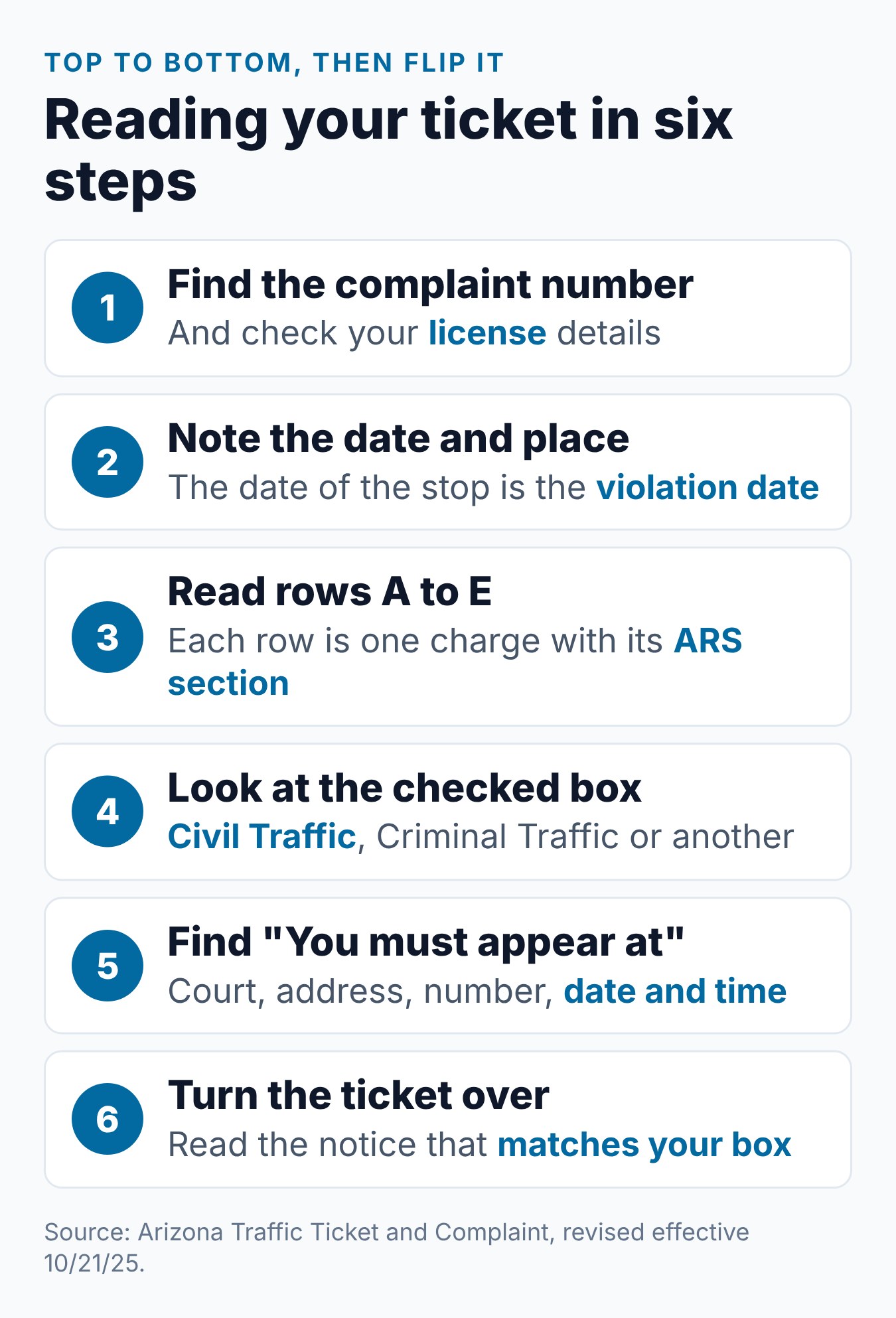
The front of the form holds the facts of the stop and the charges. Read it from top to bottom, one block at a time.
The Complaint Number and Your Details
The form has a complaint number. Keep it handy when you contact the court, along with your name and the date of the stop.
The form also lists your driver’s license number, state and class. Check that each one is right. The class matters if you hold a commercial driver license, because Defensive Driving School is not available for commercial violations.
The Vehicle, Date, Time and Location
The next block has the vehicle details. It also shows the date, time and location of the stop.
The date matters for Defensive Driving School. The class can be used once every 12 months, and that period is measured from the violation date. So the date on this ticket is the one that counts for the 12-month rule.
The Speed Boxes
The form has a place for approximate speed and posted speed. On a speeding ticket, these two numbers show how far over the limit the officer says you were.
That gap can change the kind of charge. Under ARS 28-701.02, criminal speeding means going more than 20 mph over the posted limit. It also covers going over 35 mph approaching a school crossing, or over 45 mph in a business or residential district with no posted limit.
Do not decide the charge type from the speeds alone. The checked box on the violation row is what tells you.
The Violation Rows A to E
The charges sit in rows lettered A through E. One ticket can hold up to five violations. Each row shows the ARS section or other code section for that charge.
Read every row that has writing in it. A driver stopped for speeding may also be cited for something else on the same form. Each row is its own charge.
The ARS section is the exact law you are charged under. Write it down. You will need it when you check whether the violation is eligible for Defensive Driving School.
The Charge-Type Boxes
Each violation row has a set of boxes. The officer checks the one that fits the charge. The form lists seven:
- Civil Traffic
- Criminal Traffic
- Criminal
- Petty Offense
- Municipal Code
- Civil Non-Traffic
- Domestic Violence
This box is the most important mark on the ticket. It tells you which notice on the back applies to you. It also tells you whether Defensive Driving School could be an option at all.
Civil or Criminal: Why the Box Matters
A Civil Traffic box and a Criminal Traffic box lead to very different next steps.
For a civil traffic charge, a driver can pay, ask for a hearing or take Defensive Driving School if the ticket qualifies. Our guide to Arizona traffic ticket options compares those three paths.
A criminal charge is more serious. Criminal speeding under ARS 28-701.02 is a class 3 misdemeanor, not a civil violation.
It is not automatically eligible for Defensive Driving School. Under ARS 28-3392, the court decides.
If a criminal box is checked, talk with an attorney about your case. Our guide on criminal and civil speeding explains how the two differ.
One ticket can mix both kinds. Row A may be civil while row B is criminal. Check the box on each row before you decide anything.
The “You Must Appear At” Block
Find the block that starts with the words “You must appear at.” It names:
- the court
- the court’s address
- the court number
- the date
- the time
The form says you must appear at or before that date and time. So the date is a final deadline, not the first day you can act.
Use the court printed in this block. That is where you must appear, even if another court is closer to your home. Send your questions about the case to that court.
This date also sets your Defensive Driving School deadline. The course must be finished at least 7 days before the court date. Count back from the date in this block, and see our guide to the 7-day deadline for the details.
What Your Signature Means
Many drivers worry that signing the ticket means they agree with it. The form says otherwise.
- Civil charge: by signing, you acknowledge receipt of the complaint. You do not admit responsibility.
- Criminal charge: by signing, you promise to appear as directed. You do not admit guilt.
So the signature is about getting the ticket and showing up. It is not a plea.
The Back of the Ticket: Notice to Defendant
Turn the ticket over. The back has a section called Important Notice to Defendant. It tells you to look at the boxes checked on the front to see which notice applies to you.
The three notices are not the same. Here is what each one says about failing to appear:
| Box checked on the front | What the notice says if you fail to appear |
|---|---|
| Civil Traffic | A default judgment and a civil sanction. Registration renewal may be refused, and the case may go to collections. |
| Criminal Traffic | A warrant could be issued, and your license could be suspended (A.R.S. 28-1557(B)(1)). |
| Criminal or Petty Offense | A warrant will be issued (A.R.S. 13-3903(F)). |
Read the notice that matches your box. A ticket with both civil and criminal rows means more than one notice applies.
The back of the form also speaks to drivers who are short on money. It says a driver who cannot pay should tell court staff or the judge. Payment over time or other options may be available.
The message is clear either way. Do not ignore the citation.
Arizona Traffic Ticket and Complaint Payment: Read This First
Paying is one way to close a civil traffic ticket. But payment has a cost that is easy to miss.
A driver who has already paid the fine can no longer use Defensive Driving School for that ticket. So decide about the class before you pay, not after.
Before any Arizona Traffic Ticket and Complaint payment, check these items on the form:
- The box on each row. Is the charge civil or criminal?
- The court. Which court is named in the “You must appear at” block?
- The date. How many days are left before the court date?
- The rows. Is there more than one charge?
If you cannot pay the full amount, the form tells you what to do. Tell court staff or the judge. Payment over time or other options may be available.
Payment questions go to the court named on your ticket. Each court handles its own cases, so that court has the right amount and the right way to pay.
What the Ticket Tells You About Defensive Driving School
Arizona’s Defensive Driving School is approved by the Arizona Supreme Court. It is not approved by MVD or ADOT. The court’s Defensive Driving Program page lists the certified schools.
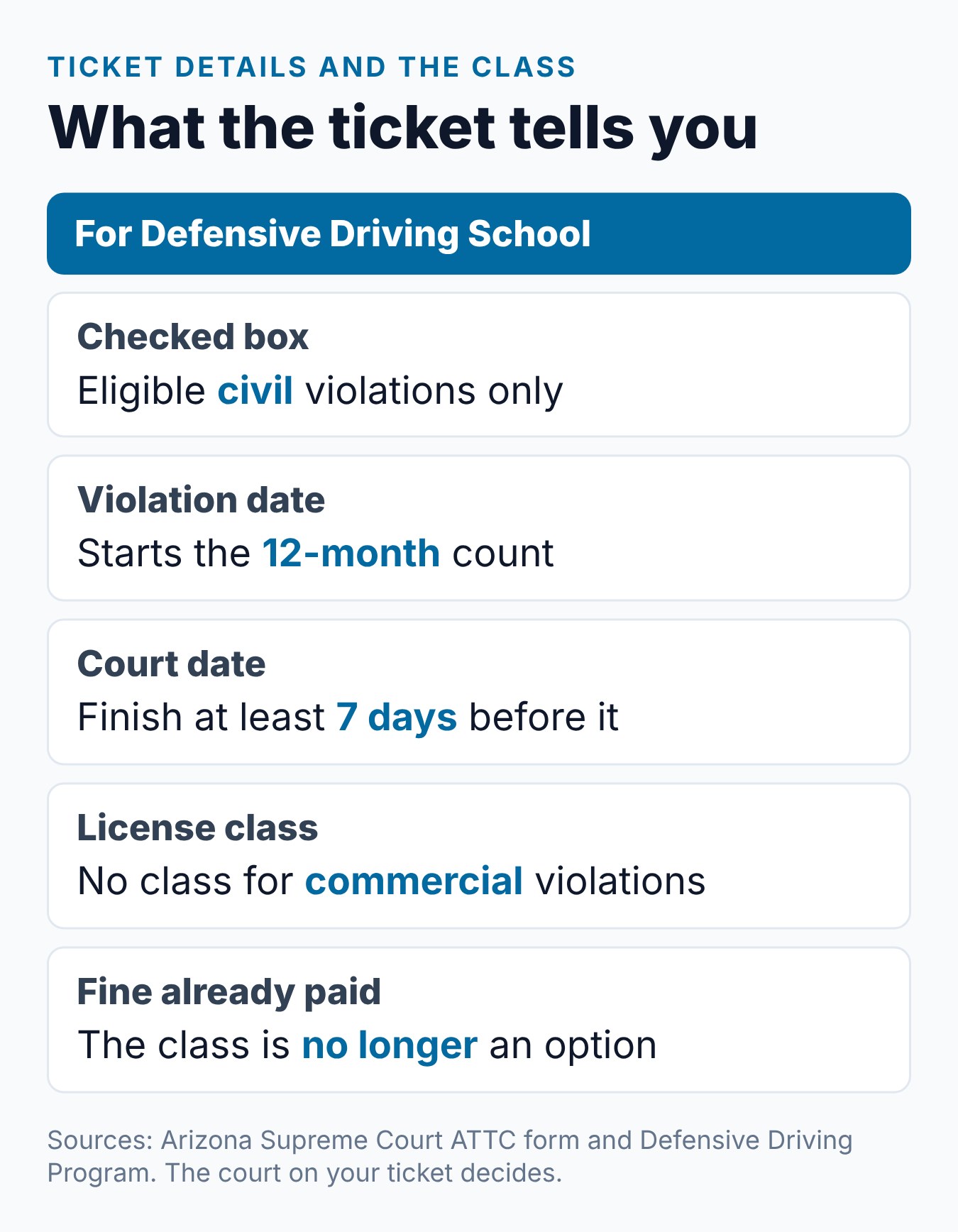
Your ticket answers most of the questions about whether the class is possible:
- Is the charge civil? The class is only for eligible civil violations. Check the box on each row.
- What is the violation date? The class can be used once every 12 months, measured from the violation date.
- What is the court date? The class must be finished at least 7 days before it.
- What is your license class? There is no class option for commercial violations.
- Have you paid? A driver who already paid the fine cannot use the class for that ticket.
Not every civil violation qualifies. Our guide to eligible violations covers which tickets do.
The cost of the class varies by court. There is no single statewide price.
Do not mix up Defensive Driving School with Traffic Survival School. Traffic Survival School is a different program that ADOT MVD orders.
Taking the class is never a promise of dismissal. The rules, your ticket and your court decide whether the class applies.
How to Look Up Your Case
You may want to check your case after the stop. The Arizona Supreme Court’s ATTC page links to a public case lookup. That tool is for finding court and case information.
Start with what is printed on your ticket:
- the complaint number
- your name as written on the form
- the court named in the “You must appear at” block
If you cannot find your case, contact the court on the ticket. Do not wait for the case to show up online while your court date gets closer. The date on the form still applies.
What We Found on the Form
On November 22, 2026, we reviewed the current ATTC and the Arizona Supreme Court’s ATTC page. We counted what a driver has to read. Here is what stood out:
- Five violation rows. One ticket can carry charges A through E, and each row has its own ARS section.
- Seven charge-type boxes on each row. Only one of them, Civil Traffic, is the kind of charge Defensive Driving School is meant for. For criminal speeding, the court decides.
- Five facts in one block. The “You must appear at” block gives the court, its address, the court number, the date and the time.
- Three different notices on the back. Which one applies depends on the box checked on the front.
- Two different warrant warnings. For criminal traffic, the notice says a warrant “could be issued.” For criminal or petty offenses, it says a warrant “will be issued.”
The last point is easy to miss. The form uses stronger words for criminal and petty offenses than for criminal traffic charges. Either way, the form treats a missed court date as serious.
One more thing stood out. The form never asks you to agree with the officer. For both civil and criminal charges, the signature line is written so that signing is not an admission.
Common Mistakes
These mistakes come from reading the ticket too fast:
- Reading only row A. A ticket can have up to five charges. Read every row with writing in it.
- Guessing civil or criminal from the speed. The checked box tells you. The speeds do not.
- Treating the court date as a start date. You must appear at or before it.
- Refusing to sign out of fear. The form says signing is not an admission of responsibility or guilt.
- Paying first. A driver who already paid cannot use Defensive Driving School for that ticket.
- Counting 7 days the wrong way. The class must be finished at least 7 days before the court date.
- Skipping the back. The notice on the back explains what happens if you fail to appear.
- Staying silent when money is tight. The form says to tell court staff or the judge.
How Requirements Can Vary
Arizona’s defensive driving rules are set by state law and the Arizona Supreme Court, but each court handles its own cases. The total cost includes a court diversion fee that each court sets, so the price depends on the court on your ticket.
Extension allowances also differ by court, from 14 to 60 days on the Supreme Court’s list. If a judge orders in-person attendance, you must take a classroom course.
Court fees can change in April and October each year. Check the Arizona Supreme Court Defensive Driving Program and the court on your citation for current rules before you register.
Frequently Asked Questions
What is the Arizona Traffic Ticket and Complaint?
It is the standard ticket form that Arizona police agencies and courts use. It lists each charge with its ARS section, a box for civil or criminal, and the court, date and time where you must appear.
Does signing an Arizona ticket mean I am guilty?
No. For a civil charge, signing acknowledges receipt without admitting responsibility. For a criminal charge, signing is a promise to appear without admitting guilt.
How do I know if my Arizona ticket is civil or criminal?
Look at the boxes on each violation row. The officer checks Civil Traffic, Criminal Traffic or another box for each charge. Check every row, because one ticket can hold both kinds.
Where is my court date on the ticket?
It is in the “You must appear at” block. That block names the court, its address, the court number, the date and the time. You must appear at or before that date and time.
What happens if I miss my court date?
It depends on the box checked. For civil traffic, the notice says a default judgment and a civil sanction follow. For criminal traffic, a warrant could be issued and your license suspended.
Can I still take defensive driving after I pay?
No. A driver who already paid the fine can no longer use Defensive Driving School for that ticket. Decide about the class before you pay.
What if I cannot afford to pay my ticket?
Tell court staff or the judge. The form says payment over time or other options may be available. Do not ignore the citation.
Conclusion
The Arizona Traffic Ticket and Complaint tells you three things you need: the charge on each row, whether it is civil or criminal, and where and when you must appear. Read the front, then the notice on the back, before you pay or sign up for anything. For more details, see Driving Logic’s Arizona Defensive Driving Course. Find a school certified by the Arizona Supreme Court at azcourts.gov/drive.
Related Articles
- Arizona Online Traffic School: Ticket Dismissal Guide
- Arizona Traffic Ticket Options: Pay, Contest, or Defensive Driving
- Arizona Defensive Driving Eligible Violations: What Tickets Qualify?
- Arizona Defensive Driving 7-Day Deadline: What You Need to Know
Sources
- Arizona Supreme Court — Arizona Traffic Ticket and Complaint (ATTC)
- Arizona Supreme Court — ATTC form, revised effective 10/21/25 (PDF)
- Arizona Supreme Court — Defensive Driving Program
- Arizona Supreme Court — Defensive Driving Schools (eligibility)
- Arizona Supreme Court — Cost to Attend School
- Arizona Supreme Court — Court Approved Continuances
- Arizona Revised Statutes — ARS 28-3392 (eligibility)
- Arizona Revised Statutes — ARS 28-701.02 (criminal speeding)
- ADOT MVD — Points Assessment
- ADOT MVD — Traffic Survival School
Billy Forte is the owner of Driving Logic, a state-approved driver improvement course provider serving Florida and other U.S. states.
This article is general information, not legal advice. Arizona defensive driving eligibility, deadlines, and fees are set by Arizona law, the Arizona Supreme Court, and each court, and can change. Check the Arizona Supreme Court Defensive Driving Program and the court on your citation for current requirements before you register for a course.