
Updated November 2026 · Reviewed by Billy Forte
There is no course called the NJ DMV defensive driving course, because New Jersey’s agency is the Motor Vehicle Commission (NJMVC, or MVC). What people search for under that name is a voluntary defensive driving course given by a State-approved provider that the MVC lists, and the MVC does not teach the course itself. Your 2-point credit reaches your driving record when the provider notifies the MVC that you finished.
Key Facts
- The agency is the MVC: a 2003 law created the Motor Vehicle Commission and abolished the old Division of Motor Vehicles. See where the old name comes from.
- The MVC lists, it does not teach: State-approved providers give the course. See what the MVC does.
- The provider reports: proof of completion goes to the MVC within 7-10 business days. See part 2.
- The credit has limits: 2 points, once every 5 years, only if you have points. See part 3.
- You can check it: request your driver history to see your points. See confirming the credit.
Is There an NJ DMV Defensive Driving Course?
Not by that name, because the course comes through the MVC. The New Jersey agency that runs driver licenses and points is the Motor Vehicle Commission, often shortened to MVC.
The course people mean is the defensive driving course. It is a voluntary course, and the MVC’s Driver Programs page lists the State-approved providers who give it.
So two things are true at once:
- The course is real. You can take it in a classroom or online from an approved provider.
- The MVC is not the teacher. It approves and lists providers, receives their reports and applies the credit.
This article follows that second part: what the agency does, step by step, from the day you finish to the day the credit shows on your record.
Where the Old Name Comes From
The old name stuck for a reason. New Jersey did have a Division of Motor Vehicles, inside the Department of Transportation.
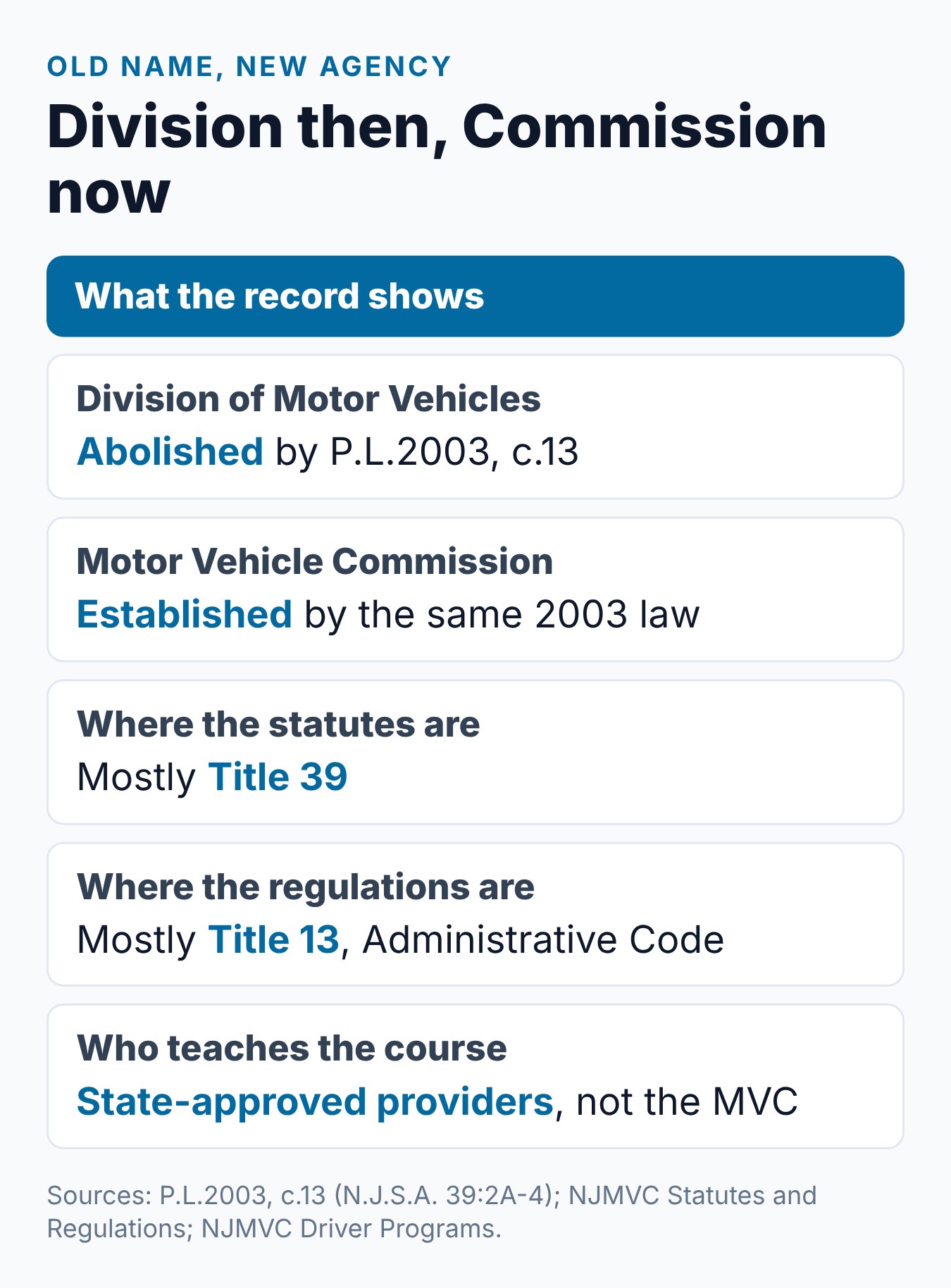
A 2003 law changed that. The Motor Vehicle Security and Customer Service Act, P.L.2003, c.13, established the New Jersey Motor Vehicle Commission. The same law abolished the Division of Motor Vehicles and transferred its functions, powers and duties to the commission (section 4, N.J.S.A. 39:2A-4).
The law’s own findings say a review commission had found the old division in crisis. That group recommended a Motor Vehicle Commission formed in, but not of, the Department of Transportation.
The findings list four purposes for the new commission:
- Identify and regulate drivers and vehicles to deter unlawful and unsafe acts.
- Find and correct vehicle defects and limit vehicle air pollution.
- Focus on customer service and security.
- Bring more attention and resources to the needs of the organization.
The same section of the law has a rule for old paperwork. When any law, rule, order or document refers to the Division of Motor Vehicles, the reference now means the commission. So an old form or sign that still says the division now points to the MVC.
The agency’s rules live in a few places. The MVC’s Statutes and Regulations page says:
- Most statutes about motor vehicle laws and the Motor Vehicle Commission are in Title 39.
- Most regulations about the commission, driving and the surcharge system are in Title 13 of the Administrative Code.
- Title 17 holds laws on the motor vehicle violations surcharge system and some insurance laws.
So whatever name you type into a search box, the answer still comes from the MVC and its rules.
What the MVC Does for the Course
The MVC’s part in the defensive driving course has four steps. Each one comes from an MVC page.
1. It Approves and Lists Providers
The Driver Programs page lists State-approved classroom and online defensive driving courses. It also lists mature driver course providers.
Approval is what makes the credit possible: the MVC gives point credits only for a New Jersey curriculum that the State has approved. Its advice to drivers is to check with the provider before signing up.
The page also describes what the course is for. It says most road accidents are caused by driver error, and that the course will provide standard accident-preventing techniques.
The MVC does not sell the course and does not recommend one provider over another. It keeps the list, and you choose from it.
2. It Receives the Completion
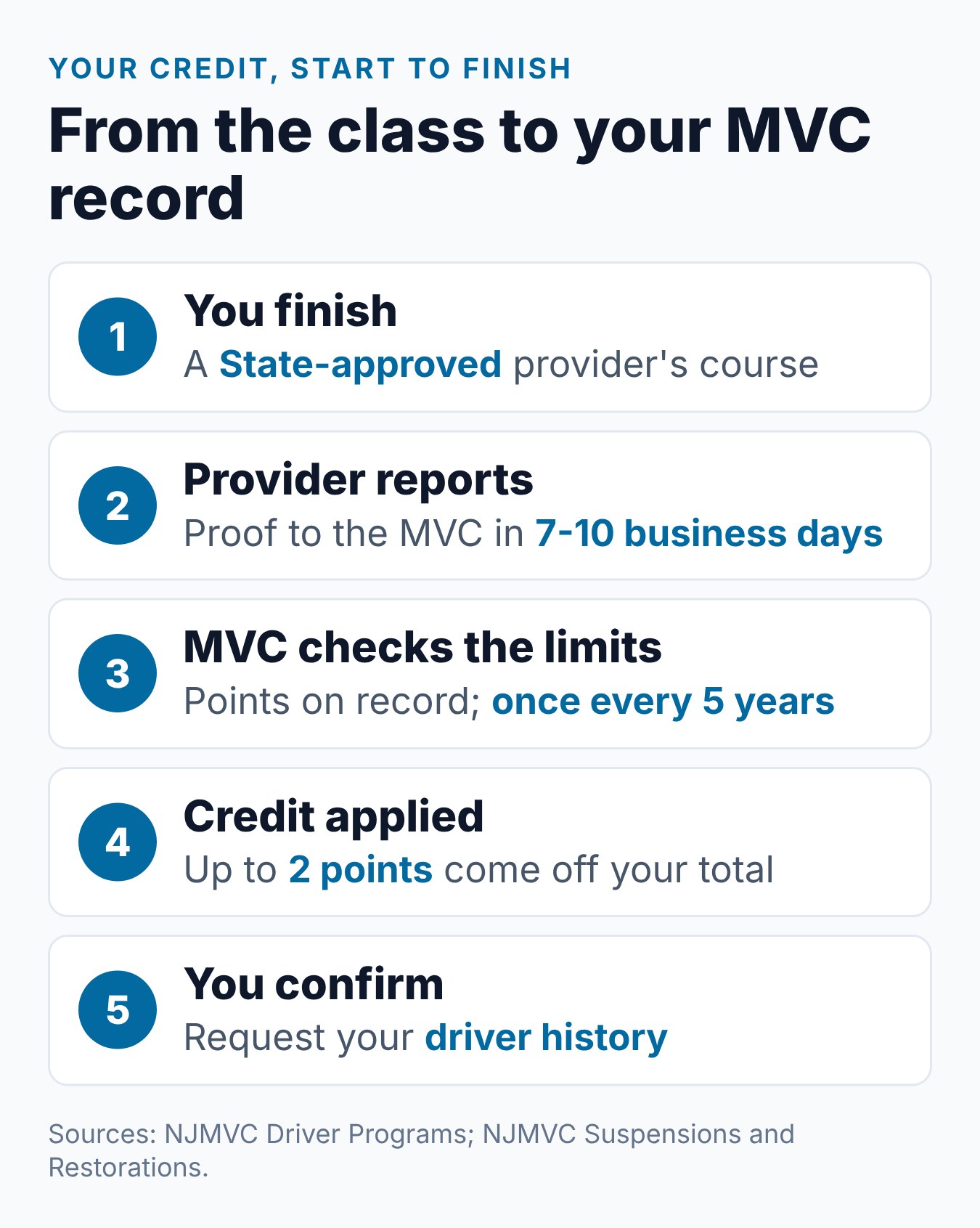
The second step happens without you. The Driver Programs page says that upon completion of the course, the provider will notify the MVC with the proof of completion within 7-10 business days.
The page adds one more line: certificates are not acceptable from the driver license holder.
That means there is nothing for you to mail, upload or carry to an MVC office. The approved provider sends the proof, and the MVC takes it from there.
3. It Applies the Credit
Once the proof arrives, the MVC applies the point credit if you qualify. On the Driver Programs page, the credit is two points off the points already on your license, and it comes with two conditions: you must have points when you finish, and you can receive it once in 5 years.
The MVC’s Suspensions and Restorations page shows the same rule in its table of point deductions. The Defensive Driving Program is worth 2 points and may be used to subtract points once every five years.
4. It Keeps the Record
The last step is the record itself. The MVC keeps a permanent record of all the points a driver has earned.
Point deductions, like the course credit, are earned on top of that record. They lower your point total; they do not wipe out the history behind it.
How to Confirm the Credit Posted
You do not have to take the credit on faith. The MVC says you can check how many points are on your license by requesting your Driver History.
A simple plan:
- Finish the course with a State-approved provider.
- Wait at least 7-10 business days for the provider’s report to reach the MVC.
- Request your driver history from the MVC.
- Compare the points with your total before the course.
The pages read for this article do not give a fee for the driver history. They also do not give a date by which the credit will show after the provider’s report.
If the credit seems missing, ask the provider to confirm when it reported your completion. The My MVC account guide covers checking your record online, and the 2-point reduction guide covers the credit rules in depth.
What Is Not the Voluntary Course
The MVC runs two other programs that people sometimes call a “DMV course.” They are the MVC’s two remedial programs: the Driver Improvement Program (DIP) and the Probationary Driver Program (PDP).
These are not the same as the defensive driving course. Here is how they differ on the MVC’s Driver Programs page:
| Defensive driving course | Driver Improvement Program | Probationary Driver Program | |
|---|---|---|---|
| Who starts it | The driver, by choice | A notice in the mail from the MVC | A Fee Due notice from the MVC |
| Points removed | 2, if you qualify | Up to 3 | Up to 3 |
| What the MVC charges | No MVC fee listed | $75 administrative fee | $75 administrative fee |
The page also says a defensive driving course is not a substitute for either program. If the MVC sent you a DIP or PDP notice, follow that notice.
Two more MVC rules show how different these programs are:
- The PDP is for new drivers. Drivers who get a permit for the first time serve a two-year probationary period. A probationary driver convicted of two or more moving violations with a total of four or more points gets a Fee Due notice for the PDP.
- Both end with a warning. After the DIP or PDP class, any motor vehicle violation within one year results in suspension, and failing to attend as scheduled is also cause for suspension.
The voluntary course has no such warning period on the MVC page.
Which fee goes to whom, and why the voluntary course shows none, is covered in Free Defensive Driving Course Online New Jersey: The Facts.
Why the Credit Matters
Points are what make the credit useful. On the MVC’s Suspensions and Restorations page, a surcharge starts at six points within three years, and a suspension at twelve points on your current record.
The course can also matter for insurance. The state’s insurance department, on its page Controlling the Cost of Auto Insurance, says insurers must offer a discount after an MVC-approved course.
No official page gives the amount, so ask your insurer before you sign up. The complete NJ defensive driving course guide covers the insurance side in full.
Finding an Approved Provider
The MVC’s list is where to start. How to find a provider on it and check the listing before you pay is explained in NJ MVC Defensive Driving Course: How to Find and Verify an Approved Provider.
Driving Logic’s New Jersey defensive driving course is live, and Driving Logic appears on the MVC’s list of approved online course providers, as read on the Driver Programs page on November 27, 2026.
Common Mistakes
These mistakes come from mixing up the old name and the real rules:
- Looking for a course taught by the agency. The MVC lists providers; it does not teach the course.
- Mailing your certificate to the MVC. Certificates are not acceptable from the driver license holder.
- Taking the course with no points. The reduction applies only to points on your record when you finish.
- Expecting a second credit too soon. The reduction is allowed once every 5 years.
- Treating a DIP or PDP notice like the voluntary course. The course is not a substitute for either one.
- Expecting the ticket to disappear. The credit lowers your points; the course does not dismiss a ticket.
How Requirements Can Vary
New Jersey’s point system and defensive driving rules are set by state law and NJMVC rules, and they apply statewide. Fines and court costs come from the municipal court that handles your ticket, so the amount you owe depends on the court and the violation.
Insurance discounts also differ. State law requires insurers to reduce your premium after an approved course, but each insurer sets the amount.
Check the NJMVC Driver Programs page, your driver history abstract, and your insurer for current rules before you sign up for a course.
Frequently Asked Questions
Does New Jersey still have a Division of Motor Vehicles?
No. A 2003 law, P.L.2003, c.13, abolished the Division of Motor Vehicles and created the New Jersey Motor Vehicle Commission.
Does the MVC teach the defensive driving course?
No. The MVC lists State-approved classroom and online providers, and those providers give the course.
How does the MVC learn that I finished?
The provider notifies the MVC with proof of completion within 7-10 business days. The MVC does not accept a certificate from the driver.
How many points does the course remove?
Two points may be removed from the points currently on your license, once every 5 years, if you have points when you finish.
How can I check that the credit was applied?
Request your driver history from the MVC. It shows how many points are on your license.
Is the DIP the same as the defensive driving course?
No. The DIP is a remedial program offered after an MVC notice, with a $75 administrative fee. A defensive driving course is not a substitute for it.
Conclusion
New Jersey’s agency does not teach the course: the Motor Vehicle Commission approves providers, receives their completion reports and applies the 2-point credit to your record. Check your points before you sign up, and request your driver history afterward to confirm the credit. Driving Logic’s nj defensive driving course online is on the MVC’s approved online list.
Related Articles
- NJ Defensive Driving Course: The Complete Guide to Point Reduction and Insurance Discounts
- NJ MVC Defensive Driving Course: How to Find and Verify an Approved Provider
- Free Defensive Driving Course Online New Jersey: The Facts
- NJ Driver Improvement Program vs Defensive Driving: What’s the Difference?
- How Long Is the NJ Defensive Driving Course and How Is It Structured?
Sources
- NJMVC — Driver Programs (defensive driving, DIP, PDP)
- NJMVC — Suspensions and Restorations
- NJMVC — Statutes and Regulations
- New Jersey Legislature — P.L.2003, c.13 (Motor Vehicle Security and Customer Service Act)
- NJ Department of Banking and Insurance — Controlling the Cost of Auto Insurance
Billy Forte is the owner of Driving Logic, a state-approved driver improvement course provider serving Florida and other U.S. states.
This article is general information, not legal advice. New Jersey point rules, surcharges, and insurance discounts are set by New Jersey law, the Motor Vehicle Commission, and your insurer, and can change. Check the NJMVC website, the court on your ticket, and your insurer for current requirements.