
Updated November 2026 · Reviewed by Billy Forte
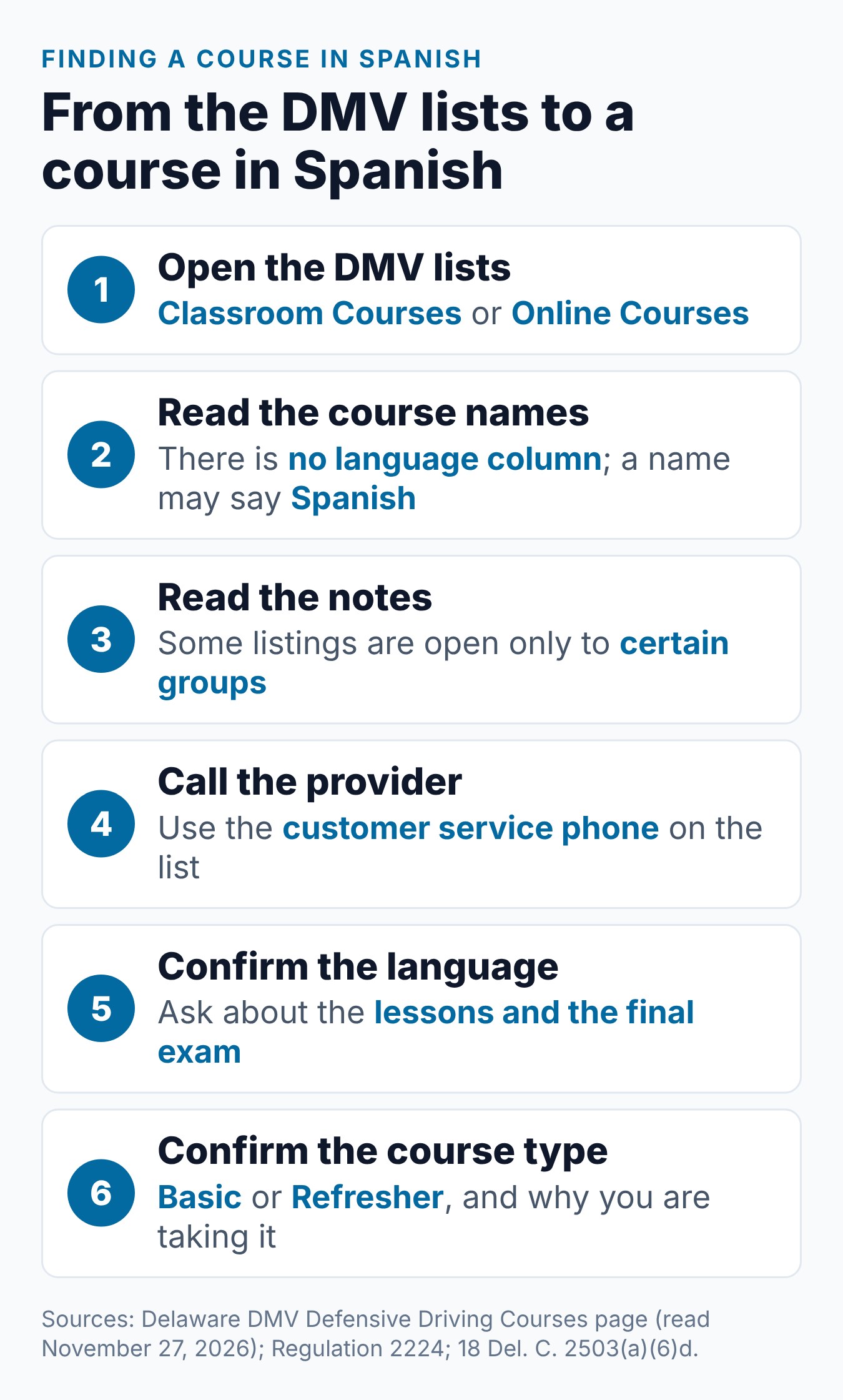
To take a Delaware defensive driving course in Spanish, choose a course from the Delaware DMV’s approved lists that the provider teaches in Spanish, and confirm the language with the provider before you pay, because the language depends on the provider. On November 27, 2026, the DMV lists had no language column, but two of the 29 listings had the word “Spanish” in the course name. The rules for course hours, the 3-point credit and the insurance reduction are the same in Spanish and in English.
Key Facts
- Where to look: the DMV’s “Classroom Courses” and “Online Courses” lists. See what the lists show.
- Translation rule: a course in another language needs a certified third-party translation. See the translation rule.
- Your options: an approved online or classroom course in Spanish, or a question to the DMV. See your options.
- Same rules: hours, the point credit and the discount do not change with the language. See the same rules.
- Before you pay: confirm the list, the language, the course type and why you are taking it. See the checklist.
What the DMV Lists Show About Language
The DMV does not teach defensive driving. Approved providers do, and the DMV keeps the lists. Its defensive driving page has two tables: “Classroom Courses” and “Online Courses.”
Each table has four columns: course name, company address, company contact and customer service phone. There is no column for language. So the page cannot tell you, for most listings, which language a course uses.
A course name can still give a clue. On November 27, 2026, the lists had 6 classroom and 23 online listings. One classroom listing and one online listing had the word “Spanish” in the course name.
Treat that as a starting point, not a final answer. The DMV page says, “Please contact a course provider for a list of classes being offered (i.e., dates, times and locations).” The lists also change, so check them close to the day you plan to start.
Some listings carry a note about who may attend.
On November 27, 2026, one classroom listing was open only to employees of the Delaware Department of Transportation (DelDOT). Another program, listed in both tables, was open only to students ages 16 to 22 in Delaware high schools or registered homeschools. Read the note under a course name before you call.
What Regulation 2224 Says About Other Languages
Regulation 2224 is the DMV rule for defensive driving courses, providers and instructors. It has one rule about language, in section 4.2.3.
The rule says, “If the course is offered in any language other than English, the provider must have a translation of the course from a certified third-party translator in that particular language.” The provider must also supply “a static copy of the course as it is presented to the student, the English translation of the course, and the accreditation of the company providing the service.”
That rule sits in the part of Regulation 2224 about applying to become a provider. In plain words, a course in Spanish is reviewed like any other course, along with its translation.
The rule does not list which parts of a course must be in the other language. It does not say whether the final exam, the sign-up pages or other material are translated. That is why you should ask the provider about each part before you pay.
Your Options as a Spanish Speaker
The official pages support three options. Each one still ends with a call or email to confirm the details.
- An approved online course taught in Spanish. Look in the “Online Courses” table. On November 27, 2026, one online listing had “Spanish” in its name. Other online providers may also teach in Spanish, but the list does not say, so ask them.
- An approved classroom course taught in Spanish. Look in the “Classroom Courses” table. On November 27, 2026, one classroom listing had “Spanish” in its name. Under Regulation 2224, a classroom course “may be offered in a virtual setting or environment.”
- Ask the DMV. The DMV page says, “If you need more information, email us at [email protected].” The Department of Insurance page lists (302) 744-2566 for the DMV defensive driving program.
Driving Logic’s courses are offered in Spanish as well as English. Whichever provider you look at, choose a course that is on the DMV’s approved lists.
For the online format in depth, see how the Delaware online course works.
The Rules Are the Same in Any Language
A Spanish course follows the same Delaware rules as an English one. The language does not change the course type, the hours or the benefits.
Basic and Refresher Courses
Regulation 2224, section 4.2.1.2, sets at least six hours of instruction for the Basic course and at least three hours for the Refresher. Each instructional hour must average at least 50 minutes, and registration does not count as instruction.
Not sure which one you need? Our guide to the Refresher course vs. the Basic course explains the difference.
The 3-Point Credit
Under Regulation 2208, section 4.2.2, the DMV enters a 3-point credit on your record after you finish an approved course. The credit is effective on the date of course completion, and it “will not be applied retroactively once an action item is in effect.”
The DMV says the credit “is only applied to future violations, in certain circumstances.” It adds that the credit “does not decrease your overall point values,” and that the course “remains valid for three years from the completion date.”
The Insurance Reduction
Under 18 Del. C. 2503(a)(6), insurers must give a rate reduction for 3 years to a person who “voluntarily attends and successfully completes” a course approved by the DMV. Regulation 607 sets the amounts:
- 10% on the bodily injury liability, property damage liability and personal injury protection premiums.
- A fraction of 10% when only some of the operators named on the policy finish a course.
- 15% after a Refresher finished within the 180 days before the 3 years end.
Our insurance discount guide covers the timing and the late-Refresher rule.
Online and Classroom Rules Do Not Change Either
The format rules in Regulation 2224 apply to every approved course, whatever its language. Here are the ones a Spanish speaker should know before signing up.
- Final exam online. An online course ends with a final exam of at least 25 questions, and you need 80% or better to get credit.
- Your license number. The provider collects it when you register, before you can open the course.
- An online affidavit. You confirm that you are the person who took the course and is receiving the certificate.
- A support line. Online providers must have a toll-free line staffed by people who can answer questions about the course content.
- Virtual classes. A virtual classroom course is recorded, attendance is confirmed on screen, and the provider keeps recordings for 3 years.
Because the exam decides whether you get credit, ask whether it is in Spanish. A course with Spanish lessons and an English-only exam may not fit your needs.
Checklist Before You Pay
Use this checklist for any course you are thinking about. It is built for a driver who wants the whole course in Spanish.
- On the list that day. The course name is in the DMV’s “Classroom Courses” or “Online Courses” table when you sign up.
- Spanish from start to finish. The provider confirms that the lessons and the final exam are in Spanish.
- The right course type. You know whether you need the Basic course or the Refresher.
- The right format. You know whether you want an online, in-person or virtual classroom course.
- Open to you. The listing has no note that limits who may attend.
- Why you are taking it. A course ordered by a court or required by the DMV does not earn the insurance reduction.
To check approval step by step, read how to check that a course is DMV-approved.
Voluntary Courses and Required Courses
The reason you take a course matters for insurance, in any language. Under 18 Del. C. 2503(a)(6)d, “voluntary attendance does not include any attendance ordered as permitted by a court or required by the Division of Motor Vehicles pursuant to any violations of Title 21.”
So a course a court orders, or one the DMV requires, does not bring the insurance reduction. The DMV can also require a different course, the Behavior Modification course, when a driver reaches 12 points under Regulation 2208.
If a court or the DMV told you to take a course, follow the paper you received. Ask the court or the DMV which course counts for that order.
After You Finish the Course
The provider, not you, tells the DMV that you finished. Regulation 2224, section 4.2.4, says the provider must notify the DMV “within fourteen days of the course completion.”
You also get a certificate. Under section 4.4.5, it is free for students who show a valid Delaware driver license or ID card. It shows your full name, the completion date, the provider, the course name and the provider’s authorized signature.
For your insurer, Regulation 607 says the certificate “shall constitute conclusive evidence” for the discount. Our certificate guide explains how to use it.
If You Have a Problem
Two state offices handle different problems. Knowing which one to contact saves time.
- A problem with a course provider. The DMV page links to a Defensive Driving Complaint page.
- A problem getting the discount. The Department of Insurance takes emails at [email protected], or calls at (800) 282-8611 in Delaware or (302) 674-7310.
- A question about approved courses. Email [email protected].
The Department of Insurance explains the split. Since March 11, 2015, the DMV regulates the courses, and the Department of Insurance kept authority over the insurance discount.
What We Found on the Official Pages
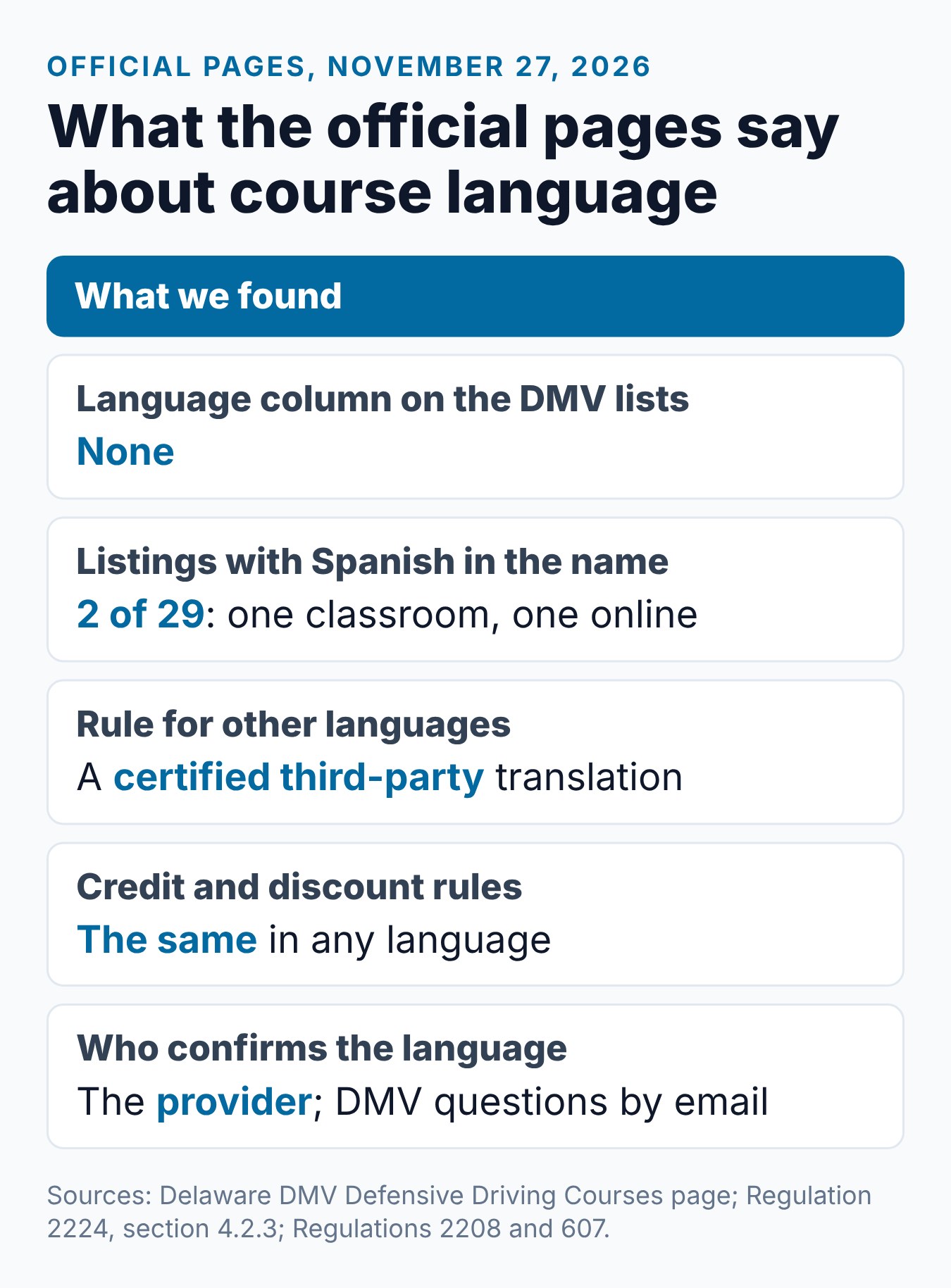
We read the DMV defensive driving page, Regulation 2224, Regulation 2208, Regulation 607, 18 Del. C. 2503 and the Department of Insurance page on November 27, 2026. Here is what they showed about language:
- The lists: 6 classroom and 23 online listings, with no language column.
- Course names: 2 of the 29 listings had “Spanish” in the name, one in each table.
- The rules: Regulation 2224, section 4.2.3, was the only rule we found about course language.
- The benefits: none of the pages set different credit or discount rules for a course in another language.
Common Mistakes
These mistakes come from misreading the official pages:
- Assuming the list shows languages. It shows names, addresses, contacts and phone numbers only.
- Reading a course name as a promise. A name with “Spanish” in it is a clue; the provider confirms the details.
- Checking only the lessons. Ask about the final exam too, because the exam decides your credit.
- Picking a course that is not listed. Only an approved course brings the credit and the discount.
- Expecting a required course to cut your premium. Court-ordered and DMV-required courses do not qualify.
How Requirements Can Vary
Delaware’s point system, defensive driving course rules and insurance discount come from state law and state regulations (Regulations 2208, 2224 and 607, and section 2503 of Title 18 of the Delaware Code) and apply statewide. How your ticket is handled is up to the court on your ticket. The fines in the Delaware Code do not include court costs and assessments, so the amount due is on your ticket.
Laws, regulations and DMV fees can change. Check your ticket, any DMV letter, the Delaware DMV website and the Delaware Code before you take a course or pay a ticket.
Frequently Asked Questions
Can I take a Delaware defensive driving course in Spanish?
You can look for one on the DMV’s approved lists. On November 27, 2026, two listings had “Spanish” in the course name. Confirm the language with the provider before you pay.
Does the DMV list show which courses are in Spanish?
No. The tables show the course name, address, contact and phone number, with no language column. A course name may mention Spanish, but the provider confirms it.
Is a Spanish course approved the same way as an English course?
Yes. Regulation 2224 adds one step: a course in another language needs a translation from a certified third-party translator. The provider also supplies the English translation and the translator’s accreditation.
Does a Spanish course earn the same 3-point credit?
Yes, if it is an approved course. The credit is effective on the completion date. It applies only to future violations, in certain circumstances.
Does a Spanish course count for the insurance reduction?
Yes, if you take an approved course by choice. The reduction is 10% on the bodily injury, property damage and personal injury protection premiums for 3 years. A course ordered by a court or required by the DMV does not count.
Who can I ask which approved courses are in Spanish?
Start with the provider, using the customer service phone on the DMV list. You can also email the DMV at [email protected].
Conclusion
A Delaware defensive driving course in Spanish starts with the DMV’s approved lists, followed by a call to the provider to confirm the lessons and the final exam. The course rules, the 3-point credit and the insurance reduction stay the same in any language. Choose a course from the DMV’s approved lists, and for more details, see the delaware defensive driving course page at Driving Logic.
Related Articles
- Delaware Defensive Driving Course: Basic and Refresher Guide
- Delaware Defensive Driving Course Online: How It Works
- Delaware DMV Defensive Driving Course: How to Check Approval
- Delaware Defensive Driving Classes: Classroom and Virtual
Sources
- Delaware DMV — Defensive Driving Courses
- 2 DE Admin Code 2208 — Problem Driver Program
- Delaware JP Court — Traffic FAQs
- 2 DE Admin Code 2224 — Defensive Driving Course, Providers and Instructors
- 18 DE Admin Code 607 — Motor Vehicle Accident Prevention Course Discount
- 18 Del. C. Chapter 25 — Rates and Rating Organizations (section 2503)
- Delaware Department of Insurance — Defensive Driving Discount
- Delaware DMV — Point and Speed System
Billy Forte is the owner of Driving Logic, an online driver education course provider serving drivers in several U.S. states.
This article is general information, not legal advice. Delaware course rules, point values, fines and penalties depend on your ticket, court, DMV notice and case facts, and they can change. Use official Delaware DMV, Delaware Code and court sources, and consult a qualified Delaware attorney for advice about your own case.