
Updated June 2026 · Reviewed by Billy Forte
The 8-hour driver improvement course va online works by letting you sign up with a Virginia DMV-approved Driver Improvement Clinic, complete the required 8 hours in short online lessons at your own pace, pass the provider’s final exam, and then have your completion sent to the Virginia DMV electronically. The course is the official Virginia Driver Improvement Clinic (DIC), and the online version usually lets you stop and start as needed while a timer tracks your seat time because Virginia requires the full eight hours. Your exact requirement can depend on your Virginia DMV notice, court order, ticket, driver record, license status, court, judge, locality, and case facts, so you should follow the instructions on your paperwork and confirm any court-specific rules before you enroll.
This article covers Virginia requirements only.
Key Facts
- Online format: Virginia allows DMV-licensed online Driver Improvement Clinics.
- Course length: The clinic is 8 hours, even when completed online.
- Final test: Online students complete the final test through the approved online provider.
- Proof: Keep your certificate and follow court or DMV reporting instructions.
- Deadline: Court and DMV notices control your required completion date.
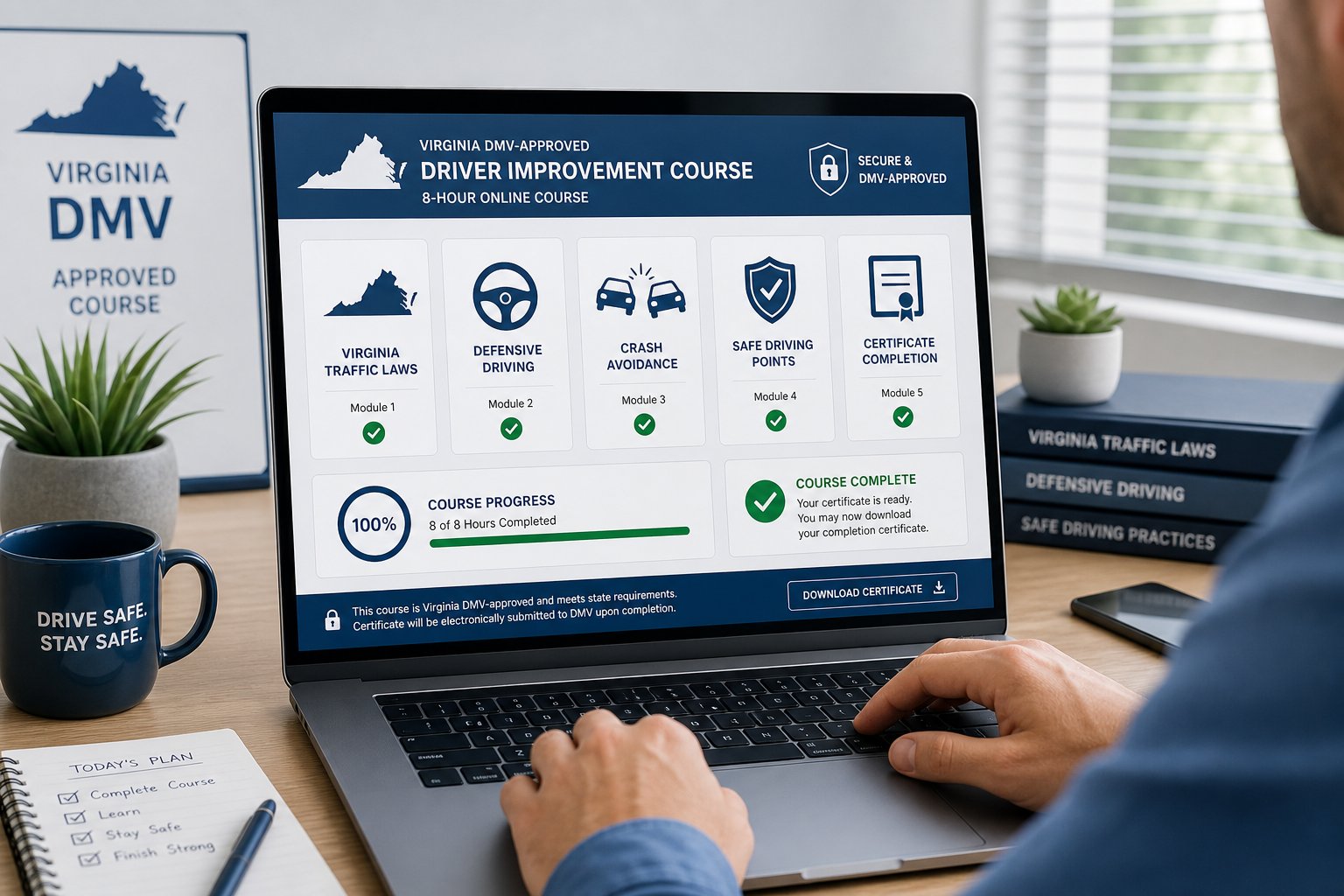
What The 8-Hour Virginia Driver Improvement Course Is
The 8-hour Virginia Driver Improvement Course is Virginia’s official Driver Improvement Clinic, often called a DIC. It is a state-regulated traffic safety course for drivers who are ordered by a court, required by the Virginia Department of Motor Vehicles, or taking it on their own for safe driving point credit.
In plain terms, this is not a random defensive driving class. It must come from a DMV-approved provider. Virginia sets the rules for the course length, certificate form, and reporting process.
The course covers topics like:
- Virginia traffic laws
- Defensive driving habits
- Crash avoidance
- Risky driving behavior
- Choices that affect your record and license
Virginia treats the online and classroom versions as the same basic program when they are properly approved. The online format simply changes how you take it. Instead of sitting in one room for eight hours, you complete the same required instruction through web-based lessons.
For some drivers, the reason for taking the course affects what happens next. A voluntary student may be looking for up to 5 safe driving points if eligible under DMV rules. A court-ordered student may need to file proof with a court by a deadline. A DMV-required student may need the course to satisfy a notice tied to demerit points or another DMV action.
That’s why the key point is simple: the official Virginia course is the DMV-approved 8-hour Driver Improvement Clinic, and the online version counts only when the provider and completion process meet Virginia rules.
Who Usually Needs To Take It
Most people taking a virginia driver improvement course online fall into one of three groups: court-ordered, DMV-required, or voluntary. The course may look the same on screen, but the reason you are taking it matters.
If a court ordered the course, your judge or clerk may want proof by a set date. If the Virginia DMV required it, the course may be tied to your driver record, demerit points, or license status. If you are taking it voluntarily, you are usually trying to improve your record or earn safe driving point credit if you qualify.
You should not assume that one rule fits every case. Your paperwork controls. A ticket, a conviction, a DMV letter, or a court order may each have different instructions.
Court-Ordered, DMV-Required, And Voluntary Reasons Compared
A court-ordered course usually follows a traffic case. In some cases, a judge may require a driver improvement clinic as part of the court outcome. The court may also decide whether it accepts an online provider, so checking with your specific court matters.
A DMV-required course usually comes from a DMV notice. This often happens after too many demerit points or another driver control action. If DMV assigned the course, you should complete the exact requirement listed in the notice and watch all deadlines closely.
A voluntary course is different. You choose it on your own, often to earn safe driving points or possibly support an insurance discount if your insurer offers one. But insurers make their own decisions, so a discount is never automatic.
In short, the same 8-hour course can serve different purposes. The reason on your paperwork tells you how to use it and where your proof may need to go.
How The Online Course Works From Registration To Completion
The online process is simple, but Virginia still requires the full course. You register with a DMV-approved provider, log in on a phone, tablet, or computer, work through the lessons, finish the exam, and receive proof of completion while the provider reports your result to the DMV.
Most online providers use a start-and-stop format. That means you can study for a while, log out, and come back later. Your progress is saved. This works well for busy drivers who cannot sit through eight straight hours in one block.
Virginia’s 8-hour rule still applies online. So providers usually use timer enforcement in the lessons. You cannot simply click through the pages at top speed and finish early. The system tracks the required seat time, and the course is built to make sure you complete the legal minimum.
Device access is usually flexible. Many approved providers support:
- Desktop computers
- Laptops
- Tablets
- Smartphones
You still need a steady internet connection and enough screen access to read and answer questions. If your court or notice has a deadline, do not wait until the last minute in case you hit a tech problem.
Once you finish, the provider usually issues a completion certificate and sends your completion to the Virginia DMV electronically. That reporting step matters because DMV records and some courts rely on official reporting, not just a screenshot or receipt.
Course Length, Exam, And Certificate Delivery
The required length is at least 8 hours. That is a Virginia rule for the official Driver Improvement Clinic. No approved provider can legally turn it into a two-hour shortcut.
The final exam is usually taken online through the same provider. Some providers allow retakes, but exam rules can vary, so you should read the provider terms before you begin.
After you pass, two things usually happen:
- You get a certificate of completion
- The provider sends your completion to DMV electronically
For Virginia, the accepted certificate format matters. The provider should use the DMV-standard completion process and certificate required for a valid online driver improvement course. If you need proof for court, save your certificate and follow the filing instructions from the court or clerk. If you want a course from a provider built for speed and flexible access, you can review the online 8-hour driver improvement course va online before you enroll.
How To Make Sure Your Course Is Accepted In Virginia
The safest way to make sure your course counts is to verify the provider first. In Virginia, the course should come from a DMV-licensed online driver improvement clinic. If the provider is not properly approved, your time may not satisfy your requirement.
Start with the Virginia Department of Motor Vehicles. DMV explains the driver improvement program and provider rules on its official site at dmv.virginia.gov. A real Virginia course should match DMV terms like Driver Improvement Clinic, DIC, and approved online delivery.
If your course is tied to a court case, take one more step. Ask your specific court if it accepts that online provider. Some courts may have their own limits or preferences for online clinics, and local practice can matter.
You should also check these points before you pay:
- The provider states it is Virginia DMV-approved
- The course is the 8-hour Driver Improvement Clinic
- The provider issues the proper certificate of completion
- The provider reports completion to DMV electronically
- The course works on the device you plan to use
This part is easy to overlook, but it matters a lot: court acceptance and DMV approval are not always the same question. A provider may be valid for DMV purposes, while a court may still want you to confirm use in that case.
If your requirement came from a court order, ticket, or DMV notice, read it closely. Match the provider to that document. Then keep copies of your registration receipt and completion certificate in case you need proof later.
Why Busy Drivers Choose The Online Option
Most drivers choose the online option for one reason: control over time. The course still takes the full eight hours, but online study lets you decide when to do those hours.
That matters if you work long shifts, care for family, travel often, or just cannot sit in a classroom all day. With an online course, you can complete one lesson in the morning, another at lunch, and more later at night. The start-and-stop format fits real schedules better than fixed class times.
The online option also removes travel time. You do not need to drive to a classroom, wait for check-in, or lose extra hours in transit. For many people, that convenience is the difference between meeting a deadline and missing one.
Other common reasons drivers pick online learning include:
- 24/7 access with many providers
- Phone, tablet, or computer compatibility
- Saved progress between sessions
- The same basic Virginia requirement as classroom instruction
And for drivers who want a faster path through the process, a well-designed course can feel easier to finish because it is broken into manageable parts. You are still doing the legal minimum time, but the day feels less blocked off.
If you need flexibility, device access, and quick proof after completion, an online clinic often makes the most sense. You can compare options and start with 8-hour driver improvement course va online if you want a Virginia-focused online provider.
FAQ
Does this article apply to the Virginia Driver Improvement Clinic?
Yes. It covers the Virginia DMV-approved Driver Improvement Clinic, which many drivers search for as 8-hour driver improvement course va online.
Can the course be completed online?
Yes, Virginia allows online clinics through DMV-licensed online driver improvement providers. Court-ordered drivers should confirm that the court accepts online completion.
Does completion erase a ticket or conviction?
No. Completion does not erase a ticket, conviction, or demerit-point history. Eligible drivers may receive safe driving points or satisfy a requirement depending on the situation.
What should I check before enrolling?
Check your court order, DMV notice, deadline, license type, and the provider’s Virginia DMV approval before registering.
Conclusion
How the 8-Hour Virginia Driver Improvement Course Works Online is easier to handle when you separate the DMV rule, the court rule, and your own reason for taking the course. The course can be useful, but it does not erase tickets or guarantee court or insurance outcomes. Check your paperwork first, then choose a DMV-approved provider.
Take the Virginia Driver Improvement Course when you are ready to begin.
Related Articles
- Virginia Driver Improvement Course: The Complete Guide
- Virginia Defensive Driving Course vs. Driver Improvement Clinic: Same Thing?
- Virginia DMV-Approved Driver Improvement Course: What It Means and How to Verify
- How to Take the Virginia Driver Improvement Course Online
Sources
- Virginia DMV — Driver Improvement
- Virginia DMV — Driver Improvement Clinics
- Virginia DMV — Points System
- Virginia Judicial System
- Code of Virginia
Billy Forte is the owner of Driving Logic, a state-approved driver improvement course provider serving Virginia and other U.S. states. Driving Logic offers online driver improvement and defensive driving courses for drivers handling DMV notices, court orders, traffic tickets, and state requirements.
This article is general information, not legal advice. Virginia DMV rules, court orders, deadlines, safe driving points, insurance decisions, and case facts can differ. Use official Virginia DMV and court sources for current requirements, and consult a qualified Virginia attorney for legal guidance specific to your situation.