
Updated June 2026 · Reviewed by Billy Forte
A Florida traffic ticket can raise your car insurance rate, especially if it is a moving violation like speeding, running a red light, or careless driving. Many insurers in Florida look at tickets for 3 to 5 years, and a single speeding ticket often raises full-coverage rates by about 18% to 21%, though the exact increase depends on the company and your record. Under Florida law, some drivers can elect a state-approved Basic Driver Improvement course for eligible tickets within 30 days, which may prevent points from being added, but insurance results still depend on the insurer and the facts of the case.
This article covers Florida requirements only.
Key Facts
- Not automatic: A traffic ticket does not automatically raise your insurance — an adjudicated conviction may
- Insurer discretion: Each company sets its own rules for how traffic violations affect rates
- Adjudication withheld: Traffic school election withholds adjudication — may limit insurance impact depending on your insurer
- Confirm with your carrier: Ask your insurer directly how a withheld adjudication vs. a conviction affects your rate
- Criminal violations: DUI and criminal traffic convictions have more significant and lasting insurance effects
- Lookback period: Insurers typically review 3 to 5 years of driving history when setting rates
Key Facts
- Not automatic: A traffic ticket does not automatically raise your insurance — an adjudicated conviction may
- Insurer discretion: Each company sets its own rules for how traffic violations affect rates
- Adjudication withheld: Traffic school election withholds adjudication — may limit insurance impact depending on your insurer
- Confirm with your carrier: Ask your insurer directly how a withheld adjudication vs. a conviction affects your rate
- Criminal violations: DUI and criminal traffic convictions have more significant and lasting insurance effects
- Lookback period: Insurers typically review 3 to 5 years of driving history when setting rates
How A Florida Traffic Ticket Affects Your Insurance Rate
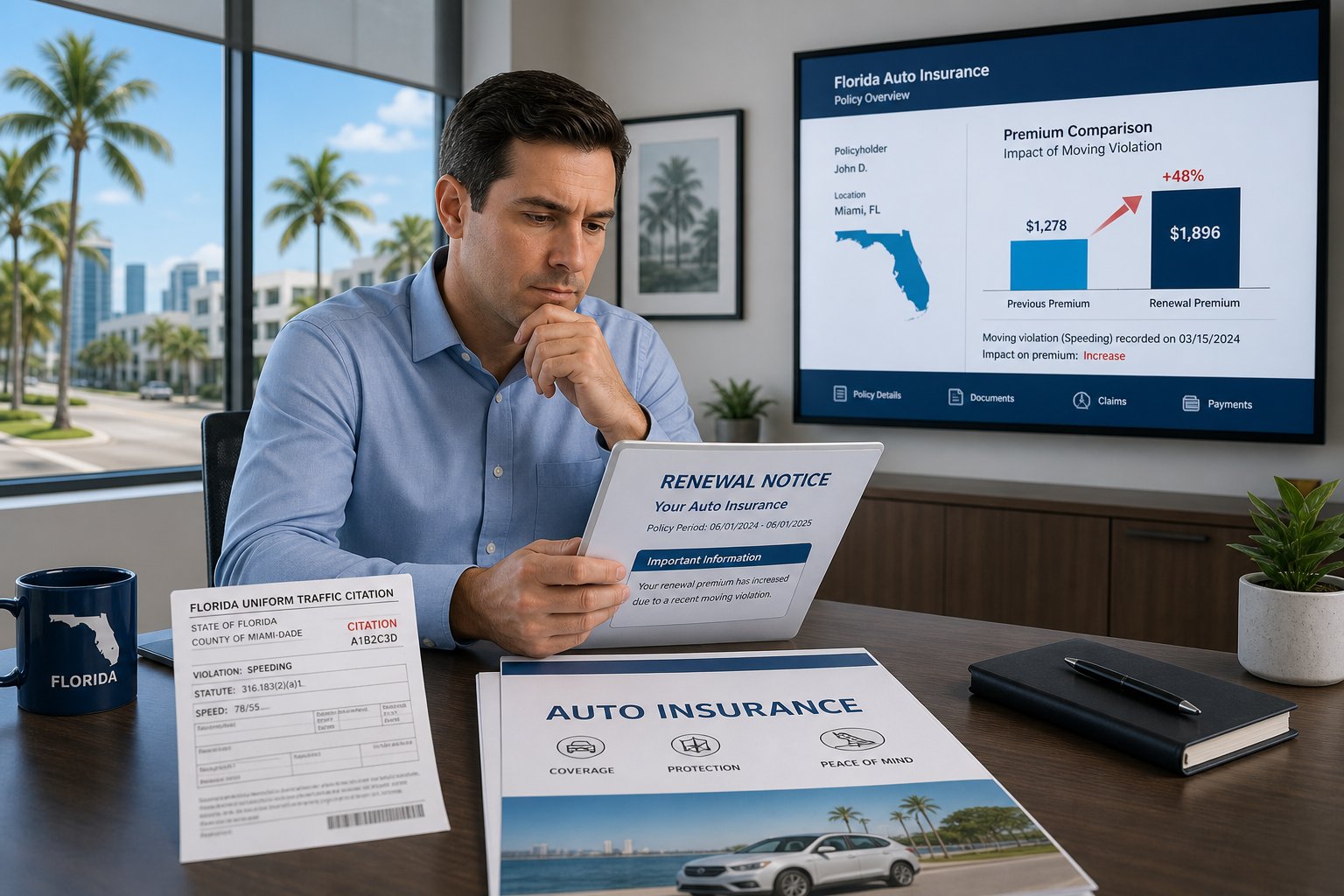
A Florida traffic ticket insurance increase usually starts with one basic fact: insurers price risk, and a moving violation can signal more risk. If you pay a ticket or are found to have committed the violation, your insurer may see that on your motor vehicle record and use it when your policy renews. That does not mean every ticket causes the same increase, or that every company reacts the same way. But for many Florida drivers, a moving violation leads to a higher premium.
Speeding is a common example. Industry data often shows a single speeding ticket raising full-coverage premiums by around 18% to 21% on average, while some insurers apply much steeper surcharges. Other moving violations, like failing to stop, failing to yield, or careless driving, can also increase your rate. And if the ticket came with a crash or injury claim, the insurance effect can be much larger.
Florida drivers should separate license points from insurance pricing. They are related, but not identical. The state’s point system is handled through the Florida Highway Safety and Motor Vehicles, while your insurance premium is set by your carrier using its own rating rules. In other words, avoiding points can help, but it does not guarantee that your insurer will ignore the ticket.
A parking ticket usually does not affect car insurance because it is generally a non-moving violation. But most standard moving violations can matter. If you want the most reliable next step, read the citation closely and check the instructions from the clerk or court listed on your ticket.
What Determines How Much Your Premium Goes Up
The size of the increase depends on several moving parts.
First, the type of violation matters. A minor speeding ticket may lead to a smaller increase than reckless driving, DUI, or leaving the scene. If your ticket involved high speed, that can matter too. Going a few miles over the limit is not the same as going 30 mph over.
Second, insurers look at your driving history. If this is your first recent ticket, the increase may be less severe than it would be for someone with multiple violations, prior accidents, or a lapse in coverage. Carriers often view a pattern of violations very differently from a single mistake.
Third, the insurer’s own rating rules play a big role. One company may treat a Florida speeding ticket insurance event as a modest surcharge. Another may price the same driver much more aggressively. That is why two people with similar tickets can see very different renewal offers.
Fourth, the claim history behind the ticket matters. A ticket tied to a crash, property damage, or bodily injury can trigger both a violation-based surcharge and accident-related pricing changes.
And finally, your policy details matter. Your age, ZIP code, coverage level, vehicle type, annual mileage, and discount mix can all affect the final number. So while general ranges are useful, no honest source can promise your exact increase in advance.
How Long A Ticket Can Affect Your Insurance In Florida
For many Florida drivers, a ticket can affect insurance for 3 to 5 years. A common pattern is that standard moving violations are rated for about 3 years, while some insurers keep them in pricing models for up to 5 years. Serious offenses, such as DUI or reckless driving, may affect you longer.
That time frame is important because the cost is often spread out over several renewals. A ticket may not hit your premium the next day. Instead, the change often appears when your policy renews and the insurer pulls updated driving data. Then the effect can continue for multiple policy terms.
Florida’s state record rules and an insurer’s underwriting rules are not always identical. The official record is one thing: how long a company uses that information for pricing is another. That is why drivers sometimes hear different answers from the clerk, the state, and their insurer. They are talking about different systems.
If you had more than one violation close together, the timeline can feel even longer because each incident may have its own rating window. The practical takeaway is simple: a ticket is rarely a one-month problem. It can shape your insurance costs for years, even if the dollar impact is smaller than expected at first.
What To Do Right After Getting A Florida Ticket
Start with the date on the citation. In many Florida cases, you have 30 days to respond by paying, electing an option that applies to your case, or contesting the citation. But do not assume every case works the same way. Eligibility, deadlines, fees, court procedures, and clerk instructions can depend on the citation, county, court, judge, and case type. Read the ticket itself and check the county clerk or court listed on it.
A quick stop at the official Florida Courts traffic page or your county clerk’s website can help you confirm the current process. If the citation involves a required court appearance, injury, a commercial driver license issue, or a more serious charge, your options may be narrower.
You should also think about the insurance side right away. Even if the fine seems manageable, the longer-term premium increase may cost more than the ticket itself. That is one reason some drivers look into traffic school eligibility or speak with a traffic attorney about whether contesting the citation makes sense.
Do not ignore notices from the court, clerk, or FLHSMV. Missing a deadline can create bigger problems than the original ticket, including license or registration issues in some situations.
When Traffic School Can Help Protect Your Record
Florida allows many eligible drivers to elect a Basic Driver Improvement (BDI) course for certain moving violations. Under Florida Statute 318.14, a qualifying driver who properly elects and completes the course can generally avoid having points assessed for that citation. That can help protect your driving record, which may also help limit insurance impact.
But this is where careful wording matters. No-point treatment does not guarantee no insurance increase. Some insurers focus heavily on points. Others may still consider the underlying violation or other record details, depending on their rules and what appears in the record they use.
There are also limits. Florida generally allows this election once every 12 months and no more than five times in a lifetime, and it is not available for every violation. Court-required appearances, CDL-related issues, and serious offenses can change the analysis. If you are eligible and want an online option built for busy schedules, DrivingLogic offers a Florida Basic Driver Improvement course that is state approved and designed for fast, flexible completion.
Ways To Reduce The Insurance Impact After A Ticket
You may not be able to erase the effect of a ticket, but you may be able to reduce it.
One option is to elect traffic school when Florida law and your case allow it. For an eligible moving violation, completing BDI can prevent points from being added to your license record. That may help keep the insurance impact lower than it would be otherwise, though each insurer decides how it prices risk.
Another option is to contest the ticket. If a citation is dismissed, or if it is resolved in a way that avoids a moving violation or points, that can reduce or avoid some insurance consequences. But outcomes depend on the facts, the court, and the resolution reached. Nothing is automatic.
You can also shop around at renewal. This is often overlooked. Some insurers penalize a single ticket less than others, so comparing quotes after a violation can make a real difference. Ask about telematics or safe-driver programs, along with discounts for bundling, paperless billing, paying in full, or insuring multiple vehicles.
If the premium still rises, review your policy structure. Raising a deductible or adjusting optional coverages can lower your bill, but only if you understand the added out-of-pocket risk.
A good practical move is to gather your renewal notice, your declaration page, and your driving record details before you compare options.
Other Florida Violations That Can Raise Your Insurance Costs
Speeding gets most of the attention, but it is far from the only violation that can raise your insurance in Florida.
Common examples include careless driving, reckless driving, failure to obey a traffic control device, running a stop sign or red light, failure to yield, and improper backing. Insurers may also rate more heavily for driving without insurance, driving with a suspended license, or leaving the scene of a crash. A DUI is in a different league and can lead to very large premium increases, filing requirements, and long-term insurance trouble.
Serious speeding also deserves its own mention. A basic speeding citation may already hurt, but very high-speed violations can be treated much more harshly by both the court system and insurers. That is one reason the phrase florida speeding ticket insurance often brings up such different rate estimates online: not all speeding cases are alike.
By contrast, standard parking tickets usually do not affect insurance because they are non-moving violations. Still, unpaid parking tickets can create other problems, so they should not be brushed aside.
If you are dealing with an eligible Florida moving violation and want a flexible online course option, you can review DrivingLogic’s Florida Basic Driver Improvement course. This article is general information only and is not legal advice.
How County Rules and Fines Can Vary
Florida traffic ticket fine amounts, court costs, and surcharges vary significantly by county. The base fine for a speeding violation is set by state law under Florida Statute 318.18, but county and local surcharges, court costs, and administrative fees can substantially increase the total amount due. Check with the Clerk of Court in the county where the ticket was issued for the exact total amount and any local requirements before paying or electing traffic school.
FAQ
Will a Florida traffic ticket raise my car insurance?
Not automatically. Receiving a ticket does not immediately trigger a rate increase. What matters to most insurers is whether the violation results in an adjudicated conviction on your driving record. If you elect traffic school and adjudication is withheld, some insurers may treat that differently from a conviction.
Does electing traffic school protect my car insurance rates in Florida?
It may, depending on your insurer. Traffic school election withholds adjudication. Some insurers treat withheld adjudication more favorably than a conviction when reviewing driving records. Confirm with your specific carrier before assuming any protection.
How long does a traffic ticket affect my insurance in Florida?
Insurance companies set their own lookback periods — commonly 3 to 5 years for standard violations. For serious violations like DUI, the lookback period may be longer.
What is the difference in insurance impact between a civil infraction and a criminal traffic conviction?
Civil traffic infractions may cause moderate insurance rate increases depending on the insurer. Criminal traffic convictions — such as DUI or reckless driving — typically have more significant and longer-lasting effects and may result in policy cancellation or non-renewal.
Should I tell my insurance company about my Florida traffic ticket?
Your insurance company typically learns about adjudicated convictions when they pull your driving record at renewal. If adjudication is withheld through traffic school, your record may not show a conviction.
What if my insurance already went up after a Florida traffic ticket?
Contact your insurer to understand the basis for the increase. If adjudication was withheld, you may be able to ask your insurer to reconsider. Shopping for a new policy may also be an option if your rates increased substantially.
Conclusion
A Florida traffic ticket’s insurance impact depends on your insurer, the violation type, and whether adjudication is withheld. Traffic school election is the most direct tool for keeping a conviction off your record — but whether it helps with insurance specifically depends on your carrier. Ask before you assume.
Take the Florida BDI course online at Driving Logic
Related Articles
- Florida Traffic Ticket: Costs, Points, and Traffic School Options
- Florida Speeding Ticket Cost: What Affects the Total?
- Florida Red Light Camera Tickets: Do They Add Points to Your License?
- Florida Traffic Ticket Options: Pay, Elect Traffic School, or Contest
Sources
- FLHSMV — Driver Improvement Schools
- FLHSMV — Basic Driver Improvement Course Providers
- Florida Statute 318.14 — Noncriminal Traffic Infractions
- Florida Statute 322.27 — Authority of Department to Suspend or Revoke License
- Florida Clerks of Court
Billy Forte is the owner of Driving Logic, a state-approved driver improvement course provider serving Florida and other U.S. states. Driving Logic offers FLHSMV-approved online BDI courses for drivers handling traffic tickets, court orders, and state requirements.
This article is general information, not legal advice. Eligibility, deadlines, court acceptance, and filing steps depend on the citation type, county, court, judge, and the facts of your case. Use official Florida court and state sources for current requirements, and consult a qualified Florida attorney for legal guidance specific to your situation.