
Updated November 2026 · Reviewed by Billy Forte
A florida traffic ticket lookup is done with the Clerk of Court in the county where the ticket was issued, so you first find that county on your citation and then use that clerk’s own case search or phone line. FLHSMV says you make your choice with the clerk of court listed on the citation, and its locations page leads to the clerk office for each of Florida’s 67 counties. Your 30 days to respond count from the date the citation was issued, not from the day you find the case.
Key Facts
- Who holds the case: the Clerk of Court in the county where the ticket was issued. See how the lookup works.
- First clue: the clerk of court listed on your citation. See find the county.
- Clerk contacts: FLHSMV’s locations page, county by county. See reach the clerk.
- Not found yet: one clerk says most tickets are filed within 5 days of issue. See if it does not show up.
- Deadline: 30 days from the citation date to pay, elect a course or ask for a hearing. See after you find it.
How a Florida Traffic Ticket Lookup Works
Florida traffic tickets are handled county by county. The FLHSMV traffic citations page tells drivers to deal with the Clerk of Court in the county where the violation occurred to pay or to contest a ticket. To elect a driver improvement course, it says to contact the clerk in the county where the citation was issued.
FLHSMV is the state agency for driver licenses. It does not keep your ticket case. The county clerk does.
That is why every lookup starts with one question: which county wrote this ticket?
FLHSMV’s traffic page also names an online site where you can pay a traffic fine for any of the sixty-seven counties. FLHSMV describes that site as a way to pay, so this article does not describe it as a search tool. The official pages read for this article do not describe a single statewide case search.
This article is about finding the case by county. If you lost the ticket and want to know whether a clerk search takes a license number, see how to find a ticket by license number.
A traffic ticket lookup Florida drivers can trust uses official pages only: the county clerk, the court and FLHSMV. Private ticket sites are not the clerk, and they are not where your choice is recorded.
Step 1: Find the County on Your Citation
Start with the paper ticket, if you still have it. FLHSMV says drivers have 30 days to make their election “with the clerk of court listed on the citation.” So the citation itself names the clerk you need.
The citation holds other clues too. FLHSMV says the civil penalty is listed on the front of the citation.
Its Basic Driver Improvement (BDI) page says the options for handling the ticket are listed on the back. Read both sides before you search.
Some clerks show where these details sit. The St. Johns County Clerk’s traffic FAQ points readers to a sample citation image with boxes around the important items.
Citation layouts are not described on the state pages read for this article, so this article does not list box numbers or field names.
If You Do Not Know the County
Sometimes the ticket is gone, or the county is hard to read. FLHSMV’s rule still helps: the case is with the clerk in the county where the violation occurred.
Think about where the stop took place. Use the road, the city and the direction you were driving. A city name is not always the county name, so check which county that city is in.
A clerk’s search covers its own county only.
The St. Johns clerk tells drivers who cannot find a ticket to verify that the citation was issued in St. Johns County.
If you are not sure between two counties, call the clerk in each one and ask.
Your home county does not matter here. A driver who lives in one county and is stopped in another has a case in the county of the stop.
Step 2: Reach That County’s Clerk of Court
Once you know the county, go to the FLHSMV locations page. FLHSMV’s traffic page says to “click on the county where the violation occurred to locate the Clerk of Court’s contact information.”
The locations page lists every Florida county in alphabetical order, from Alachua to Washington. Each county page covers several kinds of offices. The locations page names driver license and motor vehicle service centers, Bureau for Administrative Reviews offices, Florida Highway Patrol stations, Clerk of the Court offices and motorist services regional offices.
Here is what one county page showed when it was read for this article. The St. Johns County entry on the FLHSMV locations page has a “Clerk of the Court Office” section.
It links to the clerk’s website “for Paying a Traffic Citation or Court Information.” It also lists the office in St. Augustine with an address, a phone number and weekday hours.
Use the county page to reach the clerk’s own website. Then look on the clerk’s site for its traffic section. That is where the clerk explains its own search, payment and court request steps.
What One County’s Lookup Shows: St. Johns County Example
This section uses one county’s page as an example: the St. Johns County Clerk traffic FAQ.
It shows the kind of details a clerk posts. Other clerks use other tools and rules, so check the clerk for the county on your own ticket.
What You Can Search By
The St. Johns clerk says you can pay online by entering your citation number or case number.
It also says there is an option to find your citation or case number by running a name search. So in this county, a name can lead you to the number if the paper ticket is gone.
The FAQ names a third-party service that takes these online and phone payments. It also says the school election is only available online if you pay within the first 30 days.
Tickets That Cannot Be Handled Online
The St. Johns FAQ lists tickets that are not eligible for online payment:
- Tickets that need proof, such as for failure to display insurance, registration or a driver license
- Tickets that require a mandatory court appearance
- Cases where you pleaded not guilty and have not been to court yet
- Cases sent to collections
For those, the clerk says to call the Clerk’s Office at (904) 819-3600 or come in person.
In-person payments go to the Richard O. Watson Judicial Center at 4010 Lewis Speedway in St. Augustine.
Asking for Court or More Time
The same FAQ says you have 30 calendar days from the date the citation was issued to ask for a court hearing. It says to send its Court Request form by email to [email protected] or by mail. After that, the case is set for a hearing and a notice of the court date is sent.
The FAQ also mentions a payment plan with the clerk’s office for more time to pay, and a request to perform community service to pay the fine. Florida law also allows a payment plan with the clerk within the 30 days, under s. 318.14(4).
All of this is how St. Johns County describes its own process. Another county may use a different search screen, a different phone line and different forms.
Lookup Steps at a Glance
| Step | Where to look | Official source |
|---|---|---|
| Name the county | The clerk of court listed on your citation | FLHSMV traffic citations page |
| Check both sides of the ticket | Civil penalty on the front, options on the back | FLHSMV traffic and BDI pages |
| Find the clerk’s contact | Click your county on the locations page | FLHSMV locations page |
| Open the clerk’s own site | The Clerk of the Court Office section of the county page | FLHSMV county location page |
| Search the case | The clerk’s traffic search, by the details it accepts | Your county clerk’s website |
| Mark the deadline | 30 days from the date the citation was issued | Florida Statutes s. 318.14(4) |
If Your Ticket Does Not Show Up
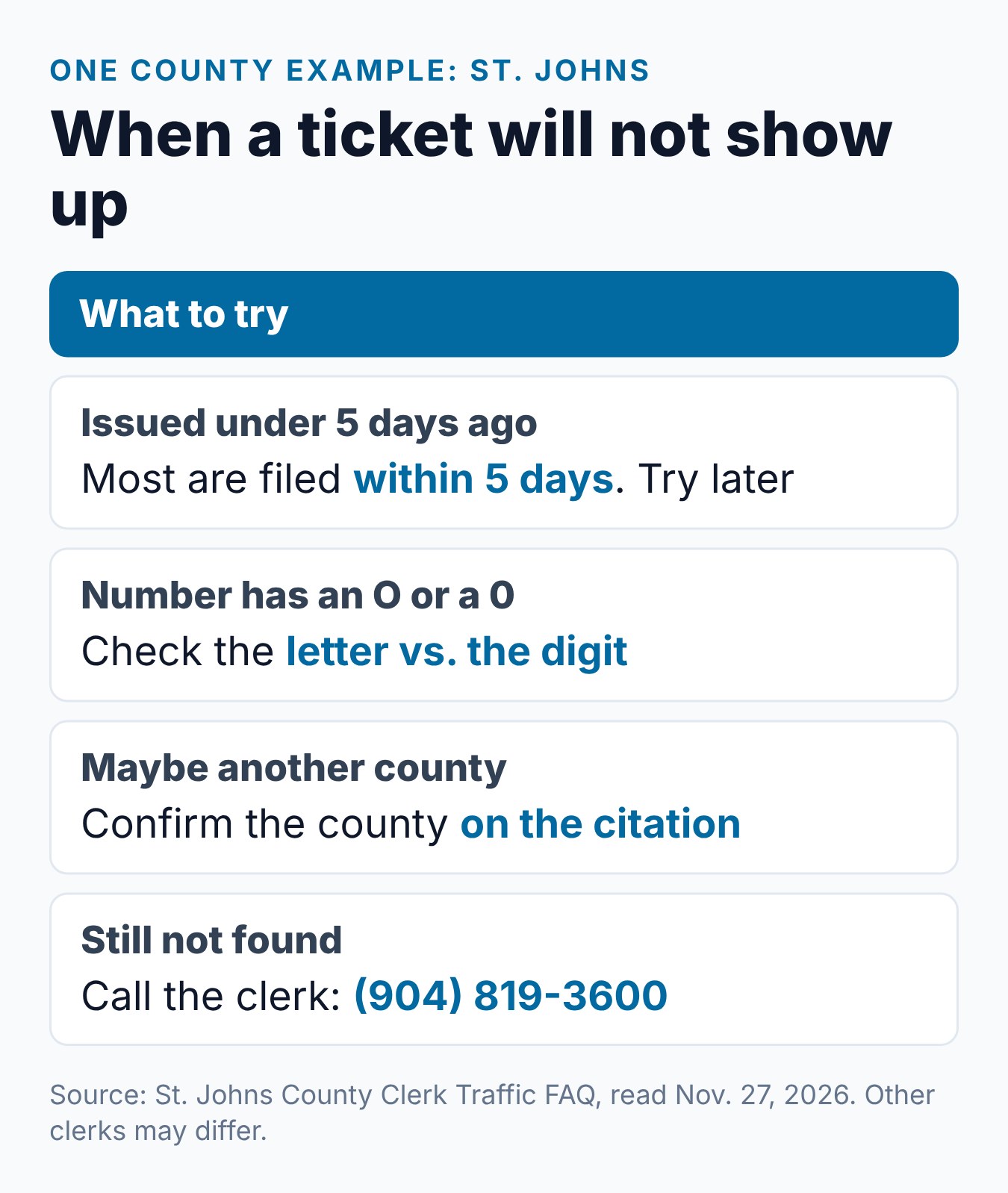
An empty search result is common right after a stop. The St. Johns clerk gives three reasons in its FAQ:
- It is too soon. If the citation was issued less than 5 days ago, try again later. The clerk says most citations are filed by the officer within 5 days from the date of issue.
- A letter and a digit got mixed up. If the ticket number has a letter O or a number 0, check that you typed the right one.
- It is the wrong county. Check that the ticket was issued in that county.
These are one clerk’s reasons. Other clerks may give other reasons or none at all.
If the ticket still does not appear, call the clerk for the county of the stop. Have your full name, your date of birth and the date of the stop ready. Ask what the clerk needs to find the case.
Do not let the search hold up your deadline. The 30 days run from the date the citation was issued. If the deadline is close and the search is still empty, call the clerk instead of waiting.
What to Do After You Find Your Case
Write down the case number and the citation date first. Use the case number every time you pay, elect or call.
FLHSMV lists three options for a Uniform Traffic Citation: pay the citation, contest it, or take a driver improvement course. You have 30 days to make this election with the clerk of court listed on the citation.
Your choice depends on your ticket, your county and your court. For a full look at costs and points, see the guide to Florida traffic ticket costs, points and options.
Pay the Fine
You pay the civil penalty to the Clerk of Court in the county where the violation occurred. FLHSMV says payment of the civil penalty is considered a conviction, and points are added to the record if they apply. Some tickets also need proof, such as a valid license or registration.
Ask for a Hearing
To contest a ticket, FLHSMV says to contact the Clerk of Court in the county where the violation occurred. If the judge, magistrate or hearing officer finds that you committed the offense, they may impose a penalty and may also require a driver improvement course.
Elect the Basic Driver Improvement Course
Under s. 318.14(9), an eligible driver may elect a Basic Driver Improvement course approved by FLHSMV instead of a court appearance.
When that happens, adjudication is withheld, the civil penalty is reduced by 18 percent, and points are not assessed for that ticket. Under s. 318.14(11), a withheld adjudication “is not a conviction.”
FLHSMV’s BDI page sets out the steps. You elect within 30 days of the citation date, you tell the clerk in the county where the citation was issued before you attend the course, and you pay the clerk’s election fee. You cannot elect after the first 30 days.
Not every driver can elect:
- You cannot elect if you elected in the preceding 12 months.
- You cannot make more than eight elections in your lifetime.
- Commercial driver license and commercial learner’s permit holders cannot elect.
- Speeding 30 mph or more over the posted limit is not eligible.
If you elect, you must finish the course in the time the court requires. FLHSMV says the license is suspended if that time is not met. The FLHSMV traffic page says to take the certificate of completion to the clerk where you made the election, so check how your clerk wants proof.
If Nothing Is Done
Under s. 318.15, if you do not pay within the time allowed, do not follow a payment plan, do not attend driver improvement school or do not appear at a scheduled hearing, the clerk must notify FLHSMV within 10 days. FLHSMV then issues an order suspending the license, effective 20 days after the order is provided.
The St. Johns clerk adds its own note. If you are past your compliance date, a late fee has most likely been added, and notice has been sent to suspend your driving privilege.
It asks drivers in that spot to call (904) 819-3600 to check the case.
Limits of Each Official Source
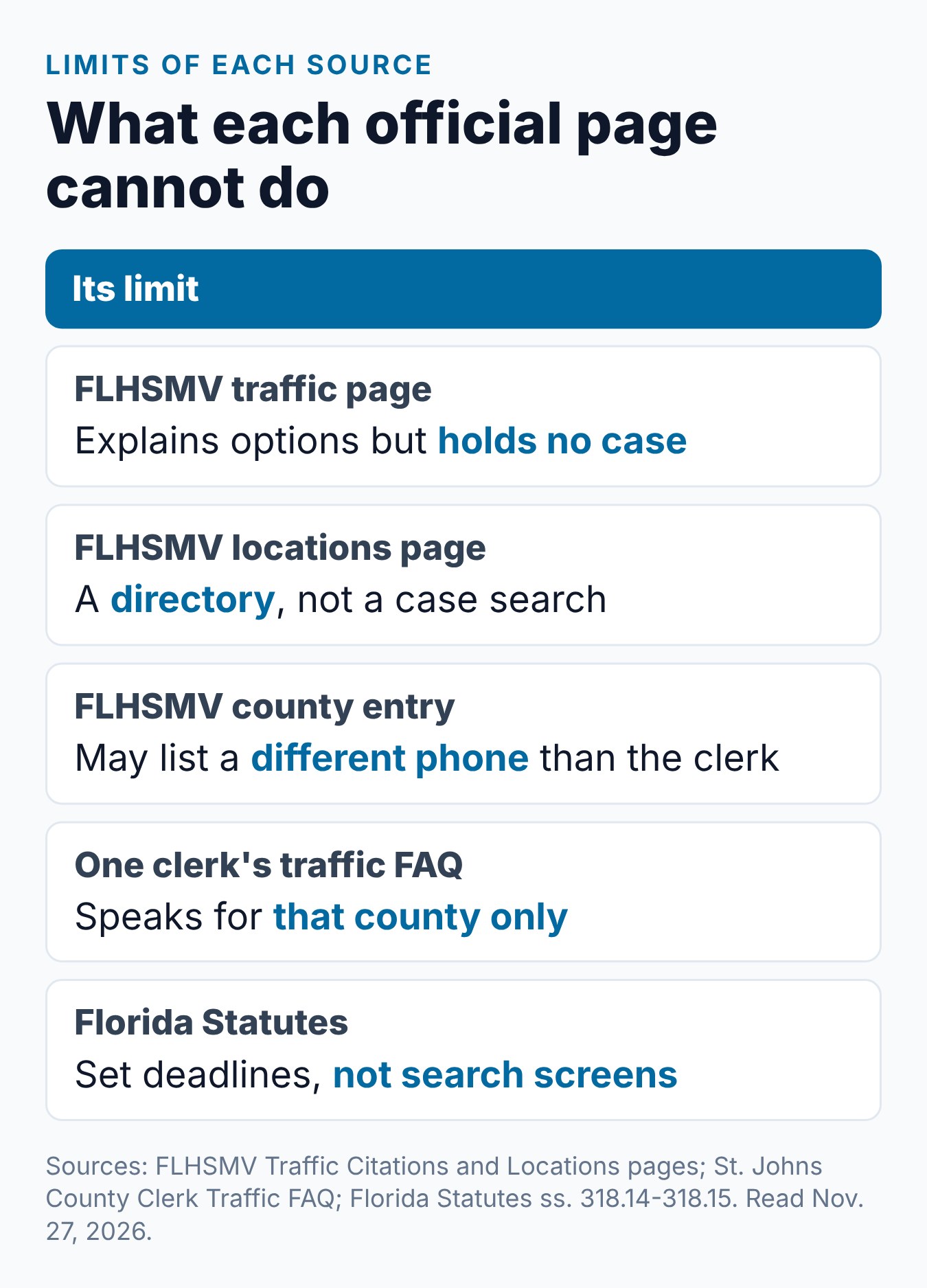
None of the official pages read for this article handles the whole lookup alone. Each one does one job, and each has limits. Here is what we found when we read these pages on November 27, 2026:
- FLHSMV traffic citations page. It explains the three options and the 30 days, and it sends you to the clerk. It does not hold or show any case.
- FLHSMV locations page. It lists the counties and leads to each clerk’s contact details. It is a directory, not a case search.
- FLHSMV county entries. The St. Johns entry links to the clerk’s website and lists a phone number of 904-819-3628. The clerk’s own FAQ lists (904) 819-3600 for traffic questions. When two official pages differ, use the clerk’s own site for the clerk’s current contact details.
- The St. Johns County Clerk FAQ. It explains that clerk’s search, filing time and payment rules. It speaks for St. Johns County only.
- Florida Statutes. Sections 318.14 and 318.15 set the deadlines, the election rules and what happens if you do nothing. They do not describe any clerk’s search screen.
Clerk search tools differ by county. No official page read for this article lists every county’s tool, so this article does not list them. Websites also change, so tool names and phone numbers can change too.
Common Mistakes
Each of these mistakes comes from skipping a rule on the official pages:
- Searching where you live. The case sits with the clerk for the county of the stop.
- Skipping the back of the ticket. FLHSMV says your options are listed there.
- Treating an empty result as good news. One clerk says most tickets are filed within 5 days of issue.
- Typing O for 0. One letter can hide a ticket from the search.
- Waiting for the case to appear before you act. The 30 days start on the citation date.
- Paying before you decide. Payment counts as a conviction, and points are added if they apply.
- Taking the course before telling the clerk. FLHSMV says to elect with the clerk before you attend.
- Relying on a private ticket site. Use the clerk, the court or FLHSMV.
How Requirements Can Vary
Florida’s election rules, point values and suspension levels come from Florida Statutes and FLHSMV, and they apply statewide. The election fee, the date to finish the course and how proof is filed are set by the Clerk of Court in the county on your ticket, or by the court. A court order sets its own deadline and proof steps.
Laws, fees and clerk practice can change. Check your citation, your clerk’s instructions, any court order and the FLHSMV website before you enroll or file anything.
Frequently Asked Questions
How do I do a Florida traffic ticket lookup by county?
Find the clerk of court listed on your citation, or the county where you were stopped. Open that county on the FLHSMV locations page and follow the link to the clerk’s website. Then use that clerk’s traffic search or call its office.
Is there one statewide Florida ticket search?
The official pages read for this article do not describe one. FLHSMV sends drivers to the clerk in the county of the violation. Its traffic page names an online site for paying a fine in any of the 67 counties, and it describes that site only as a way to pay.
What can I search by?
It depends on the clerk. In St. Johns County, the clerk says you can enter a citation or case number and can run a name search to find the number.
Check your own county’s search page.
Why can’t I find my ticket online?
It may not be filed yet, the number may be typed wrong, or it may be in another county.
The St. Johns clerk says most citations are filed within 5 days of issue. If it still does not appear, call the clerk.
Does finding my ticket late give me more time?
No. Under s. 318.14(4), the 30 days run from the date the citation was issued.
If the deadline is close, call the clerk right away.
Can I elect traffic school after I find my case?
Yes, if you are eligible and you are still within 30 days of the citation date. Tell the clerk in the county where the ticket was issued before you take the course, and pay the clerk’s election fee.
Conclusion
A Florida ticket lookup comes down to the county: find the clerk listed on your citation, reach that clerk through the FLHSMV locations page, and search or call. Keep the citation date in view, since your 30 days do not wait for the search.
If you choose the course, tell the clerk first and then take florida traffic school. If you have a court order, follow the order and ask the court or clerk if anything is unclear.
Related Articles
- Florida Traffic Ticket: Costs, Points, and Traffic School Options
- Florida Traffic Ticket Lookup: How to Find Your Ticket by License Number
- Florida Traffic Ticket Options: Pay, Elect Traffic School, or Contest
- Do You Have to Sign a Traffic Ticket in Florida?
Sources
- Florida Statutes s. 318.14 — Noncriminal traffic infractions
- Florida Statutes s. 318.15 — Failure to comply with civil penalty or to appear
- FLHSMV — Traffic Citations
- FLHSMV — Locations
- St. Johns County Clerk — Traffic Frequently Asked Questions
- FLHSMV — Basic Driver Improvement (BDI) Approved Course Providers
- FLHSMV — Driver Improvement Schools
Billy Forte is the owner of Driving Logic, a driver improvement course provider serving Florida and other U.S. states.
This article is general information, not legal advice. Election rules, deadlines, fines and penalties depend on your citation, county, court and case facts, and they can change. Use official FLHSMV, Florida Statutes and Clerk of Court sources, and consult a qualified Florida attorney for advice about your own case.