
Updated June 2026 · Reviewed by Billy Forte
In Florida, most traffic tickets add 3, 4, or 6 demerit points to your driving record, depending on the offense. The Florida Department of Highway Safety and Motor Vehicles uses those points to track moving violations, and too many points in 12, 18, or 36 months can lead to a license suspension. In many eligible cases, you can elect a Basic Driver Improvement (BDI) course, also called traffic school or a defensive driving course, to keep points from being added if you meet the rules and act before the deadline.
This article covers Florida requirements only.
Key Facts
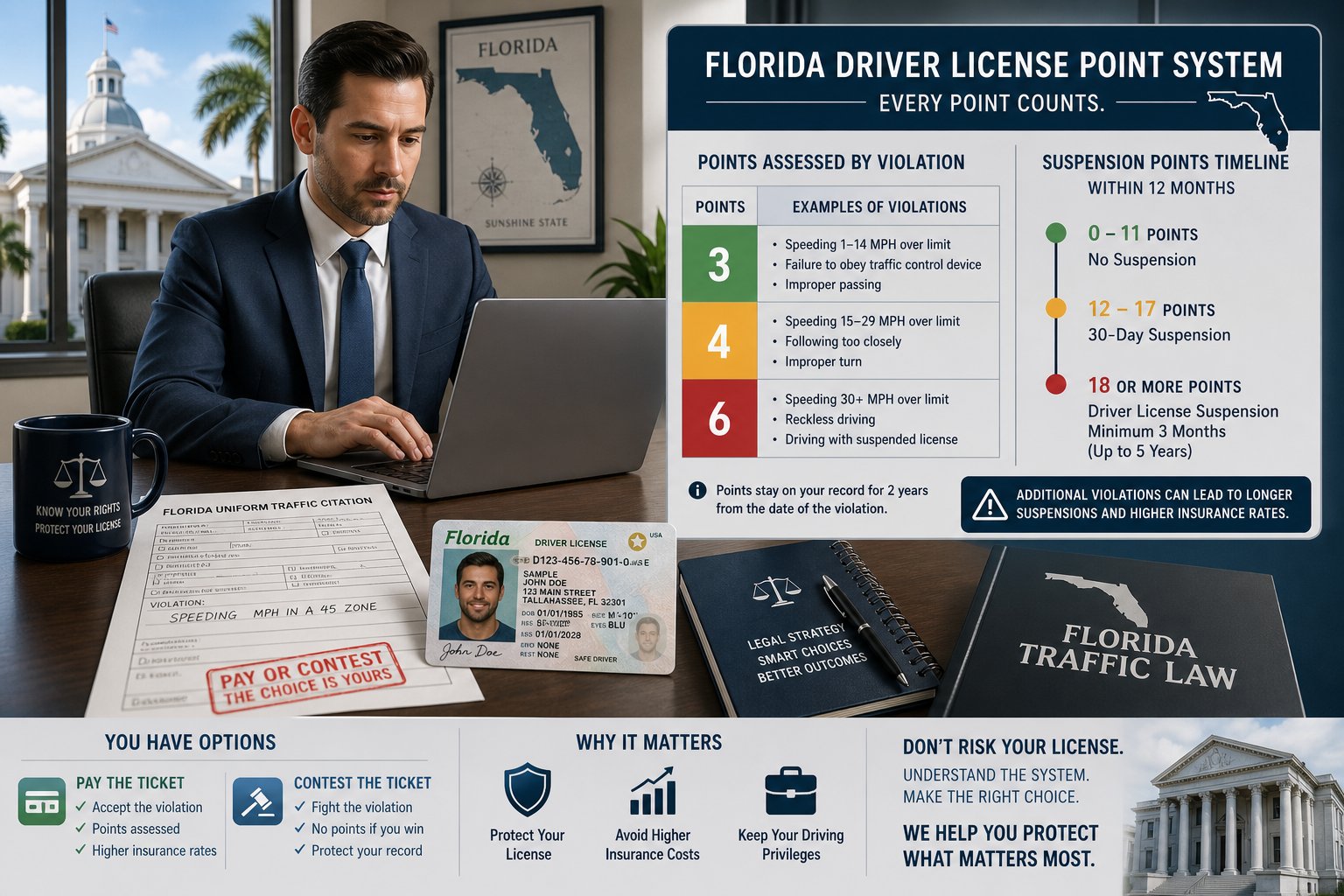
- Point suspension: Florida may suspend a license at 12 points in 12 months, 18 points in 18 months, or 24 points in 36 months.
- Common values: Many moving violations are 3 points, traffic-signal violations are 4 points, and certain crash-related violations can be higher.
- Offense dates: Florida computes point-suspension periods using the offense dates of convictions.
- BDI limit: An eligible BDI election can help prevent points on a current citation, but it does not erase old points.
- Clerk rules: Election deadlines, certificate filing, and court instructions can vary by county and citation.
If your goal is to prevent new points on an eligible current citation, review the Florida Basic Driver Improvement course before your clerk or court deadline.
Florida uses a driver license point system for moving violations. When you are convicted, or when you pay certain tickets, the violation can post to your driving record and add traffic violation points.
For most drivers, the key rule is simple: points stay active for 36 months for suspension purposes. Florida counts them from the date of the violation or case resolution, depending on how the record is posted. And yes, multiple tickets from one stop can stack if each one carries points.
Not every citation adds points. Parking tickets usually do not. But common moving violations often do. The FLHSMV point system page and Florida law, including Florida Statute 318.14, control how many points apply and when you may elect a course.
A few practical things matter:
- Paying a ticket can count as admitting the violation
- Points are cumulative
- Insurance effects are separate from FLHSMV points
- Court orders and county rules still apply
If you want to check deadlines or payment options, use the Florida Clerk of Court directory. Eligibility, deadlines, and course options can depend on the citation type, county, court, judge, and your case facts.
Florida Traffic Violation Points Chart For Common Tickets
Here is the short answer many drivers want: Florida assigns 3 points for many common moving violations, 4 points for more serious or higher-speed offenses, and 6 points for certain crash-related or leave-the-scene offenses. The exact charge on your ticket matters.
3-Point And 4-Point Violations Drivers Get Most Often
Most everyday tickets fall into the 3-point group. These often include:
- Speeding less than 15 mph over
- Following too closely
- Improper lane change
- Failure to yield
- Seat belt violations in many point-chart summaries
Common 4-point violations include more serious driving conduct. These often include:
- Speeding 15 mph or more over the limit
- Careless driving
- Illegal passing
- Running a red light
- Passing a stopped school bus
- Speeding in a school zone or work zone when charged under a point-bearing offense
Some 4-point violations also apply when a moving violation causes a crash. That is why two drivers with what looks like the same ticket can end up with different point totals.
6-Point Violations And Crash-Related Offenses
The 6-point category is for more serious conduct. Examples often include:
- Leaving the scene of a crash with property damage
- Speeding that causes a crash
- Leaving the scene of a minor accident
Some drivers expect reckless driving to carry the highest point count, but Florida point schedules can vary by charge wording and case facts. Always read the exact citation. If the officer marked a crash, injury, or leave-the-scene offense, your point exposure may be higher than you think.
Because ticket labels can differ, the safest move is to confirm the charge with the court and compare it to official Florida sources before you decide how to respond.
How Many Points Trigger A Suspension In Florida
Florida has three main suspension thresholds under the demerit point system. If you hit one, FLHSMV can suspend your license even if each ticket looked minor on its own.
The thresholds are:
- 12-point threshold in 12 months = 30-day suspension
- 18-point threshold in 18 months = 3-month suspension
- 24-point threshold in 36 months = 1-year suspension
This is where the florida driving points chart becomes more than a list. It shows how fast points can build. For example, four separate 3-point tickets in one year can reach the 12-point threshold. A mix of 4-point and 6-point offenses can get you there even faster.
Florida also has special rules for young drivers. If you are 15 to 17 years old, getting 6 points within 12 months can trigger a Business Purposes Only restriction for 12 months, or until age 18. Each added point can extend that restriction.
You do not want to guess about your status. You can review your record through FLHSMV and check court case details through your county Clerk of Court. If you are close to a threshold, respond to new tickets fast and follow every deadline.
How To Avoid Or Reduce Points After A Florida Ticket
In many cases, you may be able to avoid points or reduce the damage, but the path depends on the ticket. Florida drivers often have three main options: contest the ticket, seek a reduction, or elect a Basic Driver Improvement course when allowed.
The BDI course is the same thing as traffic school or a defensive driving course in this context. It is a FLHSMV-approved 4-hour course. If you are eligible and you elect it on time, points usually are not added for that citation. Florida generally lets a driver make that election once every 12 months, up to five times in a lifetime, but case-specific limits and court rules still matter.
Your options may include:
- Paying the ticket, which may add points
- Electing BDI, if the citation qualifies
- Requesting a hearing
- Trying to resolve the charge as a non-moving violation
Eligibility, deadlines, and requirements can depend on the citation type, county, court, judge, and the facts of your case. Do not miss a required court date or clerk deadline.
If you need an approved online course, you can take the Florida BDI course at Driving Logic. It is built for busy drivers who want to finish on their schedule and get a fast certificate.
Do Out-Of-State Tickets And Teen Driver Violations Count
Yes, some out-of-state tickets can count in Florida. Florida shares traffic information through reciprocity rules and interstate reporting systems, so a qualifying moving violation from another state may post to your Florida record as if it happened here.
That does not mean every out-of-state ticket works the same way. The effect depends on:
- The state where the ticket happened
- The type of violation
- How that offense matches a Florida offense
- What information gets reported to FLHSMV
That is why a simple answer is risky. If you got a ticket while traveling, check both the issuing court and your Florida driving record.
Teen drivers face stricter limits. In Florida, drivers ages 15 to 17 can face a Business Purposes Only restriction after 6 points in a 12-month period. The restriction can last 12 months or until age 18. Each extra point can add 90 more days.
For families, this matters because a few smaller tickets can change a teen’s license status fast. Review the citation, meet all court rules, and confirm whether a course election is allowed in that county.
Not legal advice.
FAQ
What is the Florida traffic violation points chart?
Florida assigns a fixed point value to each moving violation type. The values are set by the Florida driver license point system: most violations are 3 points, more serious violations are 4 points, and the most severe are 6 points.
Which Florida violations are worth 3 points?
Common 3-point violations include speeding under 15 mph over the limit, improper lane change, failure to yield, running a red light or stop sign, and most standard moving infractions.
Which Florida violations are worth 4 points?
Speeding 15 mph or more over the speed limit, reckless driving, and racing or street racing are typically 4-point violations.
Which Florida violations are worth 6 points?
The most common 6-point violations are careless driving resulting in an accident and leaving the scene of an accident with property damage.
How quickly can points add up to a suspension?
If you receive three standard 3-point violations in a 12-month period, you have 9 points. Four violations bring you to 12 points — the threshold for a 30-day suspension. Higher-point violations can push you to the threshold faster.
Can traffic school help with point accumulation?
Traffic school (BDI) election withholds adjudication for eligible citations — no points are added for that citation. It does not remove points already on your record from prior violations. Using traffic school strategically for higher-point tickets can help prevent suspension.
Conclusion
Florida’s point values are fixed by statute and apply uniformly. Knowing the point value of your specific violation helps you assess suspension risk and decide whether electing traffic school for the current citation is worth using one of your available elections.
Take the Florida BDI course online at Driving Logic
FAQ
What is the Florida traffic violation points chart?
Florida assigns a fixed point value to each moving violation type. The values are set by the Florida driver license point system: most violations are 3 points, more serious violations are 4 points, and the most severe are 6 points.
Which Florida violations are worth 3 points?
Common 3-point violations include speeding under 15 mph over the limit, improper lane change, failure to yield, running a red light or stop sign, and most standard moving infractions.
Which Florida violations are worth 4 points?
Speeding 15 mph or more over the speed limit, reckless driving, and racing or street racing are typically 4-point violations.
Which Florida violations are worth 6 points?
The most common 6-point violations are careless driving resulting in an accident and leaving the scene of an accident with property damage.
How quickly can points add up to a suspension?
If you receive three standard 3-point violations in a 12-month period, you have 9 points. Four violations bring you to 12 points — the threshold for a 30-day suspension. Higher-point violations can push you to the threshold faster.
Can traffic school help with point accumulation?
Traffic school (BDI) election withholds adjudication for eligible citations — no points are added for that citation. It does not remove points already on your record from prior violations. Using traffic school strategically for higher-point tickets can help prevent suspension.
Conclusion
Florida’s point values are fixed by statute and apply uniformly. Knowing the point value of your specific violation helps you assess suspension risk and decide whether electing traffic school for the current citation is worth using one of your available elections.
Take the Florida BDI course online at Driving Logic
Related Articles
- Florida Driver License Points System: Suspensions, Point Values, and BDI Options
- Careless Driving in Florida: How Many Points and What Happens?
- How Many Points Is a Speeding Ticket in Florida?
- Does Florida Traffic School Remove Points Already on Your Record?
Sources
- Florida Statute 322.27 — Driver License Suspension and Point System
- Florida Statute 318.14 — Traffic Infractions and BDI Election
- FLHSMV — Driver Improvement Schools
- FLHSMV — Driver License Check
- Florida Clerks of Court
Billy Forte is the owner of Driving Logic, a state-approved driver improvement course provider serving Florida and other U.S. states. Driving Logic offers FLHSMV-approved online BDI courses for drivers handling traffic tickets, court orders, and state requirements.
This article is general information, not legal advice. Eligibility, deadlines, court acceptance, license consequences, insurance decisions, and filing steps depend on the citation type, county, court, judge, and facts of your case. Use official Florida court and state sources for current requirements, and consult a qualified Florida attorney for legal guidance specific to your situation.