
Updated June 2026 · Reviewed by Billy Forte
An Indiana speeding ticket can cost more in a work zone and in a school zone, but the extra amount depends on which law applies. In a police-issued active work zone case, Indiana law sets added fines that can reach $300 for a first offense, $500 for a second within three years, and $1,000 for a third within three years when the zone is properly posted and workers are present. In a school zone, courts can impose higher total amounts when the school zone speed limit and signs apply, but the full ticket total still varies by the charge, local court costs, speed, and case facts.
This article covers Indiana requirements only.
Key Facts
- Zones can cost more: Work zone and school zone speeding can carry higher fines or added consequences.
- Facts matter: The amount depends on the zone, signage, enforcement type, and citation details.
- BMV points still apply: A zone ticket can still affect your Indiana driver record.
- DSP credit: An approved DSP may provide a 4-point credit when eligible.
- Check the citation: Follow the court or payment instructions on the ticket.
If you need a BMV-approved online option, review the Indiana Driver Safety Program course and compare it with your ticket, court notice, or BMV requirement.
How Indiana Work Zone Speeding Tickets Work
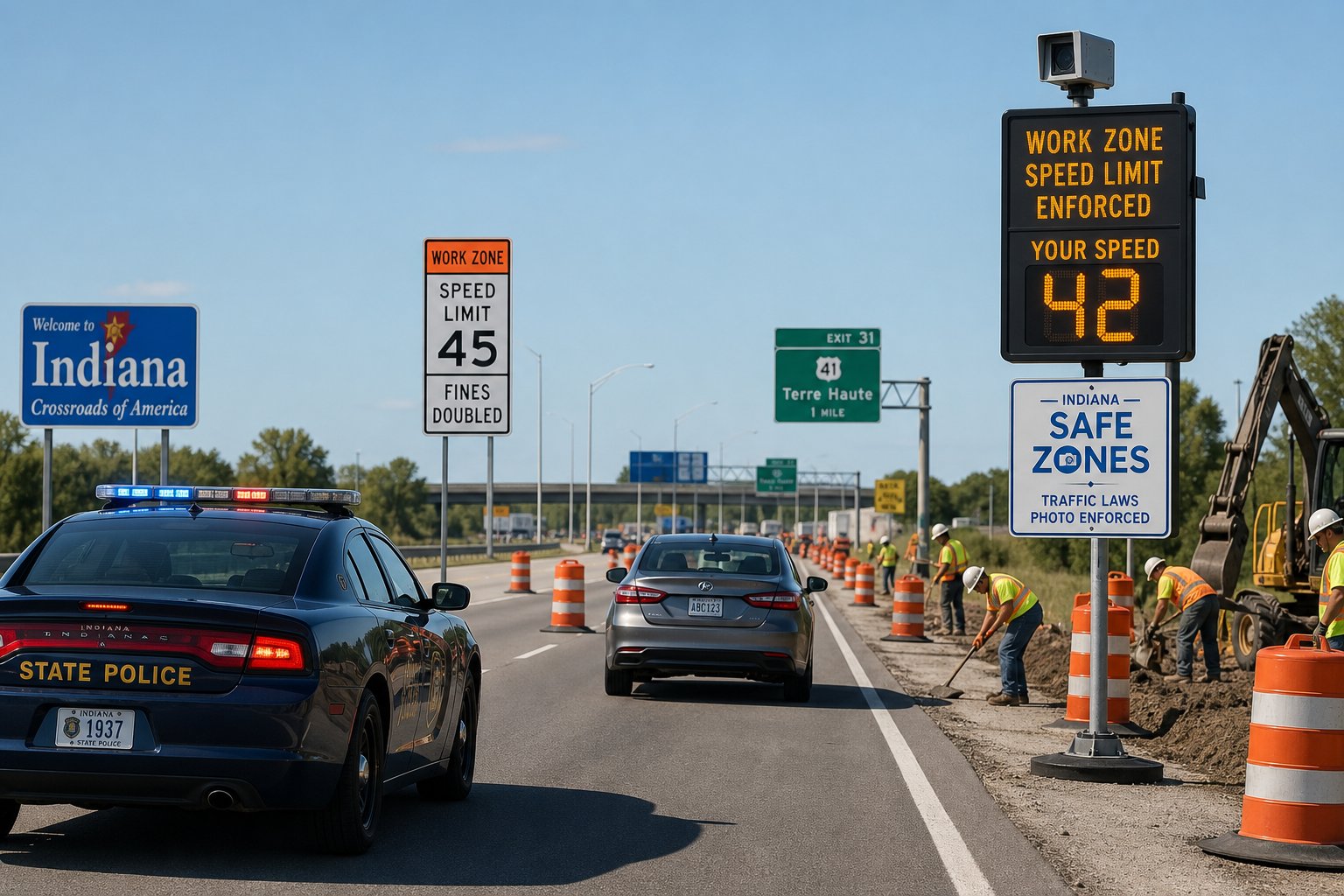
Indiana handles a work zone speeding ticket Indiana drivers get in two main ways. One is a regular police stop. The other is a mailed notice from the state’s Safe Zones camera program.
If an officer stops you in a work zone, the case is a normal traffic case under Indiana law. That means it can be treated as a moving violation. It can also lead to Indiana BMV demerit points, court costs, and fines.
A work zone must be properly marked. Indiana uses signs and reduced speed postings to show where the work zone rules apply. The details matter because enhanced work zone fines depend on the zone being active under the law.
For police-issued cases, Indiana’s Work Zone Safety Law increases fines when you speed in a qualifying work zone. The violation itself is still tied to the speeding charge, but the work zone status raises the money at stake. If the facts are worse, such as reckless driving or injury to a worker, the penalties can rise sharply.
When Reduced Speed Limits And Enforcement Apply
The key fact is simple: you must obey the posted reduced speed limit in the work zone when the signs are in place. For traditional enforcement, Indiana law ties enhanced penalties to work zones with reduced speeds and workers present. That is what makes the zone active for the added fine structure described by the state.
For the Safe Zones camera program, the rules are even more specific. The area must have signs warning that speeds are monitored by an automated system. And the event is valid only when workers are present at the site at the time of the violation.
So, if you are asking when the lower speed really counts, the safest answer is: when posted, treat it as in force. If you receive a ticket or notice, read it closely and compare the time, place, and work zone signs with the facts listed on the citation or notice.
Useful sources include the Indiana Code work zone penalty law and the state Safe Zones materials through INDOT.
What The Safe Zones Camera Program Means For Drivers
Indiana’s Safe Zones program is not the same as a police stop. It is a civil automated enforcement program in selected highway work zones. The program runs as a pilot through 2028, and it allows speed cameras in up to four work zones at one time based on state materials.
The trigger is important. A mailed Safe Zones violation applies when a vehicle is recorded at 11 mph or more over the posted work zone speed limit. The notice goes to the vehicle owner, not automatically to the person who was driving.
The penalty ladder is fixed by state sources:
- First violation: warning, $0
- Second violation: $75
- Third and later violations: $150 each
These are civil penalties. They are not treated like a standard moving violation conviction. That matters because Safe Zones notices do not add driver’s license points.
That is very different from a police-issued speeding ticket. A camera notice may still cost money, but it does not work like a normal Indiana BMV point case. It also does not mean every work zone speeding event is handled by camera. Many are still enforced by officers.
If you get a mailed notice, check whether it is a Safe Zones violation or a regular citation. The response steps are different, and the point impact is different too. You can review the state program details through INDOT Safe Zones and the related rules in the Indiana Administrative Code.
Penalties, Fines, And License Consequences To Expect
For a police-issued work zone ticket, Indiana increases the fine when the work zone qualifies under state law. The source-backed added amounts are:
- First work zone speeding offense: $300
- Second within 3 years: $500
- Third within 3 years: $1,000
Those numbers do not always equal the full amount you pay. Your total can also include the base speeding fine, court costs, and any local fees. So the real cost can be higher than the added work zone amount shown above.
If the conduct becomes more serious, the risk grows fast. Indiana states that reckless or aggressive driving in a work zone can bring a fine of up to $5,000. If a worker is injured or killed, penalties can go as high as $10,000 and even include prison exposure.
For your license, police-issued work zone tickets can carry the same Indiana BMV points as other speeding violations in the same speed range. The work zone enhancement changes the fine, not the standard point tiers. That means the zone can hurt your wallet more even when the demerit points are the same.
Safe Zones camera tickets are different. They are civil only and come with no BMV points.
School zones work differently from the Safe Zones pilot. Indiana can impose higher speeding consequences when the school zone limit and signs are active, but the total amount depends on the court, the exact charge, speed, and case facts. As with work zones, your total may include both fines and court costs.
For official point information, check the Indiana BMV point schedule.
How To Pay Or Respond To A Work Zone Speeding Ticket In Indiana
The first step is to identify what kind of notice you got. A Safe Zones camera notice is handled one way. A police-issued citation is handled another way.
For a Safe Zones camera notice, state materials say you can pay in three main ways:
– Online through the program payment portal listed on the notice – By phone at (833) 840-0222 with your ticket number and card – By mail by certified check or money order to: Indiana Department of Transportation, Worksite Speed Control Program, PO Box 986, 125 W. South St., Indianapolis, IN 46206
Include the violation number and plate number if you pay by mail. Use the instructions on the notice because program details can change.
For a police ticket, follow the citation. It will usually tell you whether you can pay online, by mail, or in court through the local county system. Some courts allow payment without a hearing for certain infractions. Others may require a court appearance, especially if the charge is more serious.
Do not miss the deadline. And do not ignore any Indiana BMV notice, court order, citation, or required court date. Requirements can depend on the ticket, your driver record, license status, the court, the judge, and the exact facts in your case.
If you need the official state agency pages, start with Indiana BMV and INDOT.
What To Do If You Were Not Driving Or Want To Challenge The Notice
If the notice is from Safe Zones, Indiana gives you specific grounds to contest it. This matters because the notice is mailed to the vehicle owner, and the owner may not have been the driver.
State materials say you may challenge a Safe Zones violation by showing one of these facts:
- You did not own the vehicle at the time
- You were not driving
- The vehicle was stolen and not yet recovered
- The system was not properly tested, certified, or calibrated
- Workers were not present at the time of the incident
The notice should explain how to file the contest. A court or hearing officer reviews the dispute under the program rules.
For a police-issued work zone citation, the process is more like any other traffic case. You can choose to contest the ticket in court. Common issues may include driver identity, signage, the speed reading, or whether the work zone conditions matched the law for enhanced fines.
That does not mean every challenge wins. It means the facts matter. Read the charge line, the date, the speed alleged, and the court instructions. Keep copies of the ticket, notice, photos, and any records tied to the vehicle or location. If the notice gives you a response date, act before that date.
Can Traffic School Or A Driving Course Help After An Indiana Ticket?
Sometimes, yes. But it depends on the kind of ticket and who ordered the course.
For Safe Zones camera tickets, traffic school is usually not the issue because those notices do not add BMV points. Paying or contesting the notice is the main step.
For a police-issued Indiana speeding ticket, a course may still help in some cases. Indiana’s official course is the BMV-approved Driver Safety Program (DSP). It is a 4-hour course. Courts and the Indiana Bureau of Motor Vehicles may use it for different reasons depending on your notice, ticket, driving record, and license status.
The big point to understand is this: the DSP does not remove a conviction and does not erase the underlying violation. Instead, it can provide a 4-point credit that helps offset the same demerit points you earned. That matters because work zone and school zone cases can carry the same point tiers as ordinary speeding, even when the fine is higher.
You must follow the exact terms in your Indiana BMV notice, court order, or citation. Eligibility can depend on the court, judge, case facts, and your record. If a course is allowed or required, use a provider that offers the Indiana-approved program.
If you need a flexible option, you can take the Indiana Driver Safety Program online at Driving Logic. Check your notice first so you choose the right course and meet the right deadline.
Not legal advice.
FAQ
Can a Driver Safety Program remove my speeding ticket?
No. The Indiana DSP does not erase the speeding ticket or conviction. It may provide a 4-point credit when you complete a BMV-approved course and meet the rules.
Can I take the Indiana DSP online?
Yes. Indiana BMV-approved Driver Safety Program providers may offer online courses. Confirm that the course matches your court or BMV requirement before enrolling.
Do I still need to follow my court deadline?
Yes. A course does not replace court instructions or deadlines. Follow the citation, court order, clerk instructions, or BMV notice tied to your case.
Will my insurance change after a speeding ticket?
Maybe. Each insurance company uses its own rating rules. Ask your insurer how a conviction, point credit, or course completion may affect your policy.
Conclusion
Indiana Work Zone and School Zone Speeding Tickets: Higher Fines is easier to handle when you know the Indiana BMV point rules, court deadline, and the limits of the Driver Safety Program. The DSP may provide a 4-point credit when eligible, but it does not erase the ticket, conviction, or violation. Review your citation or court notice before you act.
Take the Indiana Driver Safety Program course online when you are ready to begin.
Related Articles
- Indiana Speeding Ticket: Costs, Points, and What to Know
- Indiana Speeding Ticket Fines: What Affects the Cost?
- 20 Over Speeding Ticket in Indiana: What to Know About Cost and Points
- Indiana Speeding Ticket: What to Know Before You Pay or Contest It
Sources
- Indiana BMV — Citation Points and Driver Safety Program
- Indiana BMV — Driver Record Points
- myBMV — Indiana BMV Online Services
- Indiana Code and Administrative Rules
Billy Forte is the owner of Driving Logic, a state-approved driver improvement course provider serving Indiana and other U.S. states. Driving Logic offers online driver safety and driver improvement courses for drivers handling BMV notices, court orders, and state requirements.
This article is general information, not legal advice. Indiana BMV rules, court orders, deadlines, provider reporting, insurance decisions, and case facts can differ. Use official Indiana BMV and court sources for current requirements, and consult a qualified Indiana attorney for legal guidance specific to your situation.