
Updated June 2026 · Reviewed by Billy Forte
Indiana teen and young drivers can face stricter BMV action because age, violations, and license status can change how points affect them. This article is for Indiana drivers who need a clear answer before choosing a course, responding to a notice, or checking their record. You will learn what the rule means, how the Driver Safety Program fits in, and what to check before your next step.
This article covers Indiana requirements only.
Key Facts
- Young drivers: Drivers under 21 can face stricter consequences.
- Points matter: Traffic convictions can add BMV points.
- DSP role: DSP may be required or may provide credit when eligible.
- Deadlines: Notices and court orders control deadlines.
- Parent review: Families should check the official record and paperwork.
How Indiana’s Teen Licensing System Works
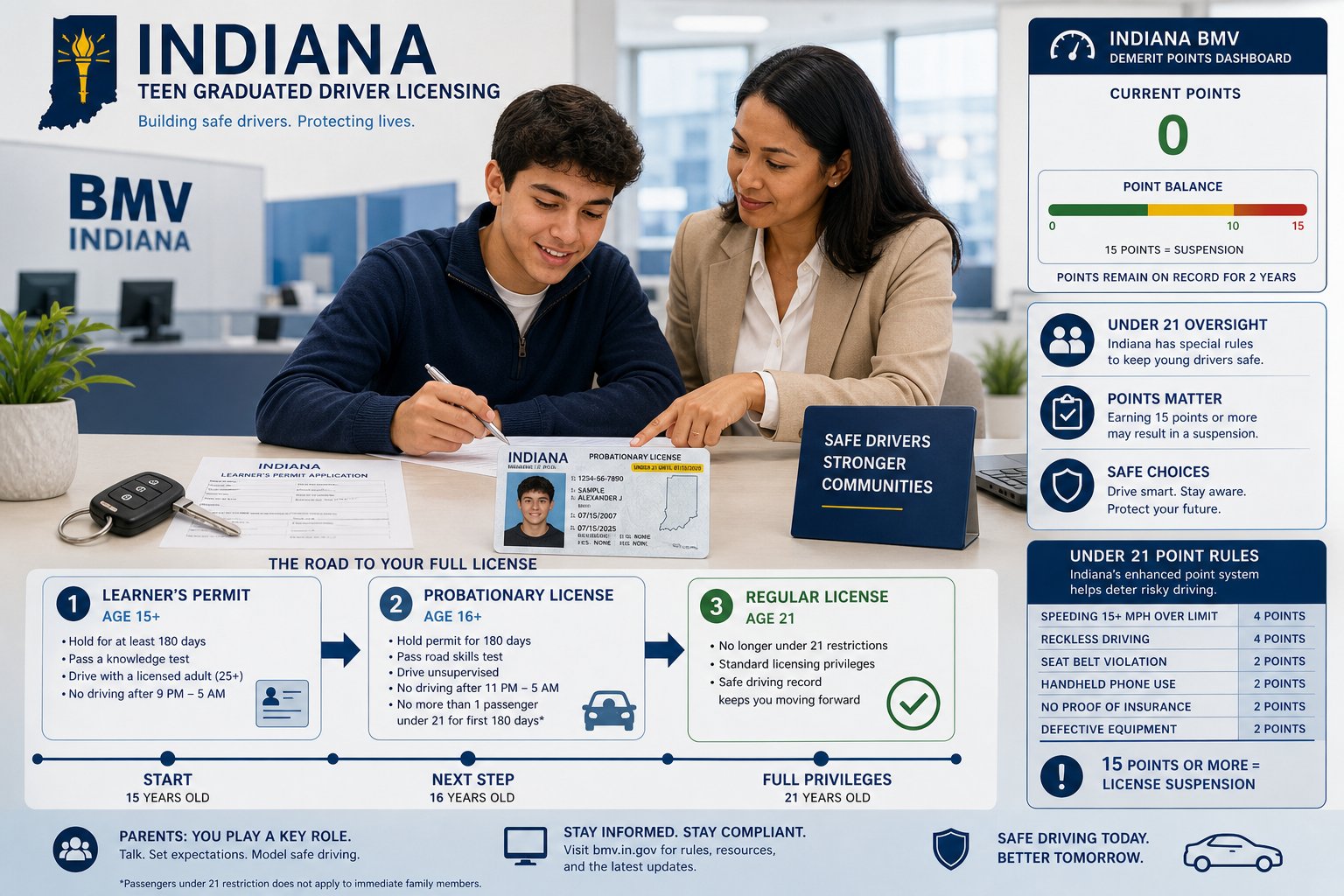
Indiana uses a graduated driver licensing system. You do not move from permit to full license in one step.
For most teen drivers, the path looks like this:
- Learner’s permit first
- Probationary license next
- Regular license at 21
A learner’s permit must usually be held for 180 days before you can apply for a probationary license. According to the Indiana BMV, a probationary license is the license issued to drivers under age 21, and it expires 30 days after your 21st birthday. After that, you can renew into a regular non-probationary license.
This matters for points because teens are not treated exactly like older adult drivers in every situation. The same Indiana BMV demerit points system applies to moving violations, but young drivers face extra oversight through probationary license rules and DSP requirements.
If you are a parent, think of the teen license system as two layers:
- Normal point tracking for violations
- Special under-21 rules tied to age and license type
That second layer is where many families get surprised. A teen may not be near the 20-point threshold for a suspension, but the BMV can still require action because of the driver’s age and convictions.
The official details on permit and probationary license stages are in the Indiana BMV driver education and licensing information and the Indiana Driver’s Manual.
When Points Apply To A Teen Driver’s License
Points apply to a teen driver’s license when the Indiana BMV receives a traffic conviction for a moving violation. Indiana assigns 0 to 10 demerit points depending on the offense, and those points stay active for two years from the conviction date.
That point system applies to teen drivers too. So if you hold a learner’s permit or probationary license and you are convicted of a moving offense, the violation can affect your driving record and point total.
Here is the key difference for Indiana BMV under 21 points issues: for many young drivers, the BMV may require a Driver Safety Program after two or more traffic convictions. The rule for under-21 drivers is stricter than the adult point discussion most people know.
A few important facts help clear up confusion:
- Points are tied to convictions, not just getting a ticket
- Active points last two years from conviction
- A 4-point credit lowers the point total, but it does not remove the conviction
- The BMV may act based on your driver record, license status, and the exact notice you receive
That means a teen can have a problem even if the total point count does not sound huge. Two convictions can matter a lot for a young driver.
For official rules, see the Indiana BMV point system page and Indiana administrative rules at the Indiana Administrative Code.
What Happens After A Ticket Or Point Violation
After a ticket, nothing changes on your BMV record unless there is a conviction or another reportable outcome. Once the court reports the case, the Indiana BMV updates your driving record and adds any related demerit points.
Then the BMV looks at your total active points. The general Indiana point system includes these ranges:
- 14 to 18 points: warning notice
- 20 or more points within 24 months: administrative hearing and possible license suspension
The length of suspension can vary based on the point total. Indiana BMV materials state that suspension periods can range from 1 month to 1 year. So, even for adults, points can get serious fast.
For teens, there can be another problem before you ever hit 20 points. If you are under 21 and have the required number of convictions for a DSP notice, the BMV can order a BMV-approved Driver Safety Program. That is separate from whether a court also orders a class.
And that part matters: BMV action and court action are not always the same thing. Your case may depend on:
- The ticket or citation
- A court order
- A BMV notice
- Your license status
- Your full driver record
- The facts of the case
If you get a notice, read it closely and follow every deadline. You can check official point and suspension information at the Indiana BMV and review the suspension statute in the Indiana Code.
Probationary License Restrictions Teens Need To Follow
A probationary license gives you driving privileges, but it also comes with extra limits. These rules are separate from points, yet they can lead to tickets that later affect your record.
One major rule is the first 180 days restriction. During that period, you generally cannot drive between 10 p.m. and 5 a.m., with limited exceptions allowed by Indiana law.
Indiana also has added nighttime and passenger limits for younger drivers. The exact rule can depend on your age and how long you have held the probationary license. The Indiana Driver’s Manual explains those details.
Why does this matter for points? Because many teen tickets come from simple probationary license mistakes, such as:
- Driving during a restricted time
- Carrying passengers you should not have
- Failing to follow permit or supervision rules
A probationary license also affects what happens when you apply for the next stage. If points are already on your record, Indiana may require you to take the knowledge test again when applying for the probationary license.
For parents, the practical step is simple. Make sure your teen knows the curfew rules, passenger limits, and permit conditions before a stop happens. Many point problems start with a rule the teen did not fully understand.
How Driver Education, Traffic School, And Court Programs Can Help
Driver education and traffic programs can help teen drivers, but they do different jobs. It helps to separate them.
Driver education can help you get licensed sooner
In Indiana, a teen who completes approved driver education may qualify for a probationary license at 16 years and 90 days. Without it, the age is 16 years and 270 days.
So driver education mainly helps with licensing progress.
The Driver Safety Program can reduce your point total
Indiana’s official point-reduction course is the BMV-approved Driver Safety Program (DSP). It is a 4-hour course, and when completed and properly reported, it gives a 4-point credit.
That credit can help lower your point total. But it does not remove the conviction, and it does not erase the violation from your driving record.
Indiana BMV materials also state that the 4-point credit is available once every 3 years.
Under-21 drivers may be required to take it sooner
This is the part many families miss. Indiana has stricter under-21 rules, and two or more traffic convictions can trigger a mandatory DSP requirement for a juvenile or young driver. That is why indiana teen driver license points often become a problem even before a teen reaches a high point total.
If you need a BMV-approved online option, you can take the Indiana Driver Safety Program online at Driving Logic. Before enrolling, match the course to your BMV notice, court order, or citation terms.
How To Move From A Learner’s Permit To A Probationary And Regular License
Moving through Indiana’s teen license stages is mostly about timing, testing, and record status.
To go from a learner’s permit to a probationary license, you generally must:
- Hold the permit for 180 days
- Meet the age rule
- Show supervised driving practice
- Pass required tests
- Have a parent or guardian sign financial liability if you are under 18
The age rule is:
- 16 years, 90 days with approved driver education
- 16 years, 270 days without driver education
Indiana also says that if you have points on your driving record, you must pass the knowledge test again before getting the probationary license. That catches some teens off guard.
You may also need to show proof of driver education if you are using that path to qualify earlier. A vision test and driving skills test are part of the process as well.
Then, when you turn 21, you can move from a probationary license to a regular license through renewal with the Indiana BMV. The probationary license expires 30 days after your 21st birthday, so do not wait too long to update it.
The official license path is explained by the Indiana Bureau of Motor Vehicles. If your record includes convictions or points, check your status before scheduling the next licensing step.
When To Contact The Indiana BMV Or The Court About Your Case
Contact the Indiana BMV when the issue is your record, points, testing, or license status. Contact the court when the issue is the ticket case itself, a hearing, or a court-ordered program.
That sounds simple, but many drivers mix the two up.
Contact the Indiana BMV if you need help with your record
Reach out to the BMV if you:
- Receive a warning notice or suspension notice
- Need your official driving record or current point status
- Have questions about reinstatement
- Need to confirm a DSP credit
- Need to know whether testing is required for your next license step
Contact the court if the ticket or order came from the court
Reach out to the court if you:
- Want to contest the ticket
- Need information on a court-ordered class or program
- Need a hearing date, deadline, or payment terms
- Need to ask about a deferral or other court process allowed in your case
Do not ignore notices, court dates, or deadlines. The right answer can depend on the BMV notice, court order, citation, judge, court, and the exact facts in your case.
If you need a state-approved online course to satisfy an Indiana requirement, review the Driving Logic Indiana course options. This article is not legal advice.
This article also relates to searches for provisional license points indiana, but the safe answer depends on the Indiana BMV record, conviction date, and any court or BMV notice.
FAQ
Can the Indiana DSP help with points?
Yes, an approved Indiana Driver Safety Program may provide a 4-point credit when you qualify. It does not erase the conviction or violation.
Does the DSP remove a ticket from my record?
No. The DSP does not remove a ticket, conviction, or violation from your Indiana driving record.
Where should I check my Indiana points?
Use your Indiana BMV driving record to check your current point status, conviction dates, and license status.
What if I have a court order or BMV notice?
Follow the exact deadline and instructions in the court order or BMV notice. Do not rely only on general article guidance.
Conclusion
Indiana Teen and Young Driver Point Rules: Lower Thresholds is easier to manage when you check your Indiana BMV record, understand what the points mean, and know what the Driver Safety Program can and cannot do. The Indiana DSP may provide a 4-point credit when eligible, but it does not erase a ticket, conviction, or violation. Before you act, compare your record, BMV notice, or court papers with official instructions.
Take the Indiana Driver Safety Program course online when you are ready to begin.
Related Articles
- Indiana BMV Points System Explained
- Indiana Driver Safety Program and Points: What It Can and Cannot Do
- Indiana DSP 4-Point Credit: How It Works
- How Long Do Points Stay on Your Indiana Driving Record?
Sources
- Indiana BMV — Citation Points and Driver Safety Program
- Indiana BMV — Driver Record Points
- Indiana BMV — Driver Records
- Indiana Code and Administrative Rules
Billy Forte is the owner of Driving Logic, a state-approved driver improvement course provider serving Indiana and other U.S. states. Driving Logic offers online driver safety and driver improvement courses for drivers handling BMV notices, court orders, and state requirements.
This article is general information, not legal advice. Indiana BMV rules, court orders, deadlines, provider reporting, insurance decisions, and case facts can differ. Use official Indiana BMV and court sources for current requirements, and consult a qualified Indiana attorney for legal guidance specific to your situation.