
Updated June 2026 · Reviewed by Billy Forte
An Indiana traffic violation can appear on a driving record or background check depending on the check type and the record requested. This article is for Indiana drivers who need a clear answer before choosing a course, responding to a notice, or checking their record. You will learn what the rule means, how the Driver Safety Program fits in, and what to check before your next step.
This article covers Indiana requirements only.
Key Facts
- Record type matters: Different background checks show different driving details.
- Convictions matter: Traffic convictions can appear on driver records.
- DSP limit: DSP does not erase the conviction from the record.
- Employers vary: Employer review depends on the job and check type.
- Official record: Use BMV records for your own review.
What An Indiana Driving Record Background Check Includes
If you need the approved online option, review the indiana driving record background check before your deadline.
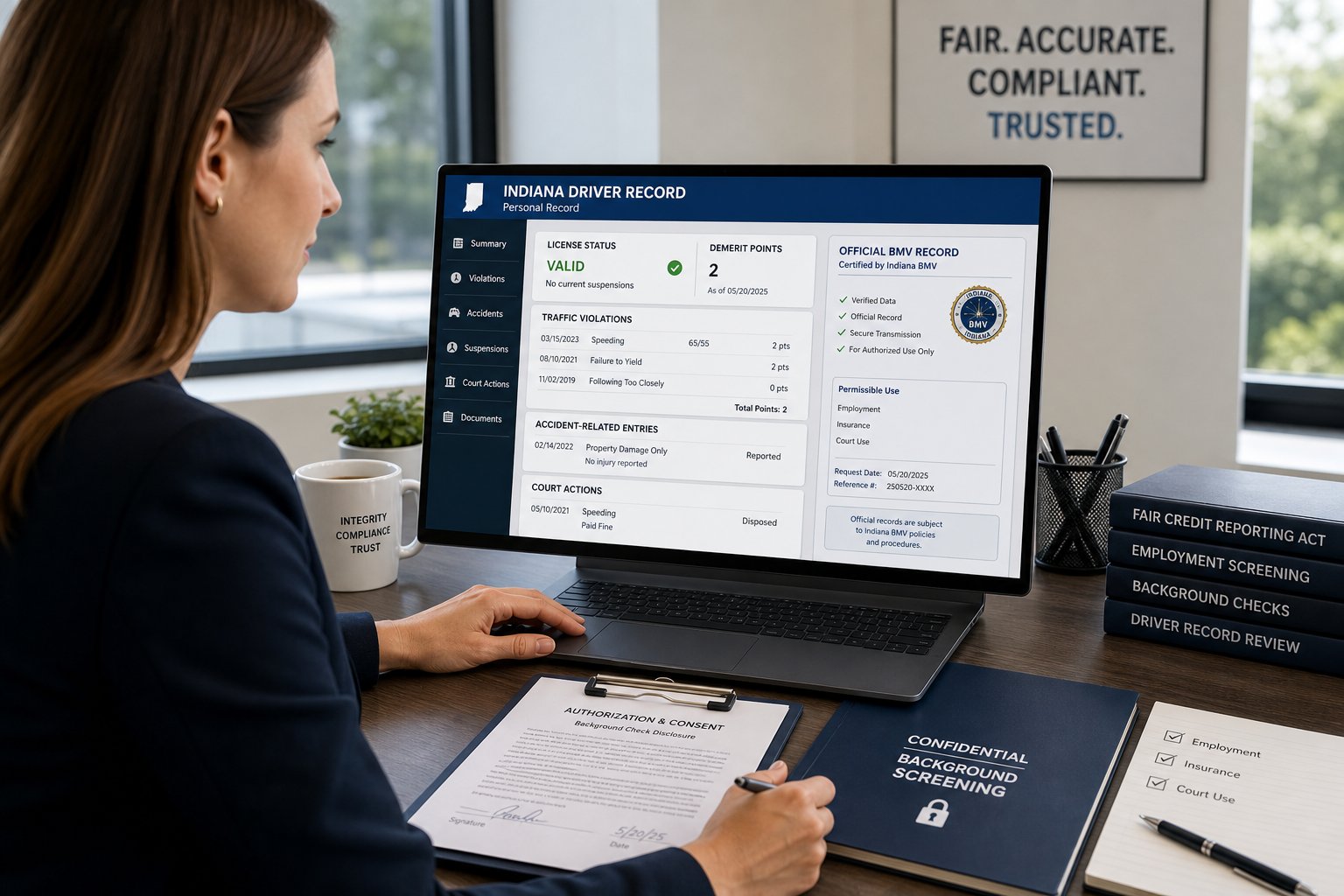
An Indiana driving record background check usually means a check of your Indiana BMV driver record, also called a motor vehicle record or MVR. That record is different from a standard criminal background check. If an employer wants to know how you drive, they often look at your BMV record, not just a criminal database.
Your Indiana BMV record can include:
- License status such as valid, suspended, or revoked
- Traffic violations and citations reported to the BMV
- Demerit points tied to those violations
- Current and past suspensions
- Court-ordered actions that affect your license
- Some accident-related entries when reported through official channels
This is why the answer to the main question is often yes. If your employer requests an MVR, your traffic history may be visible even when the violation was not a crime.
There is also an important split between a personal record and a certified or official record. Through the Indiana BMV, you can view a personal driver record for your own review. An employer or court may request an official driver record for formal use. The official version is the one more often used in hiring, court, or insurance decisions because it is issued by the BMV as a formal record.
Third-party screening companies may also run an Indiana traffic violation background check by pulling driving data with your consent. In many job settings, the employer asks you to sign a form before they do this.
For Indiana-specific rules and record access, the best starting point is the Indiana BMV driver records page.
How To Request Your Indiana Driving Record
You can get your own Indiana driving record directly from the Indiana Bureau of Motor Vehicles. That is often the smartest first step if you are applying for a job, dealing with a ticket, or trying to understand whether a violation may affect your license.
The fastest option is usually myBMV. Indiana lets drivers log in and view a Viewable Driver Record (VDR) online. This is useful if you want to check your license status, see violations, and review suspension history before an employer does.
You may also request an Official Driver Record (ODR) from the BMV. That is the certified version often used for formal purposes. Indiana also allows record requests by mail using the proper state form listed by the BMV.
In simple terms:
- VDR: personal viewing copy for your own review
- ODR: official certified copy for formal use
- Mail request: available through the BMV records process
If you need the official source, use myBMV or review the BMV record request instructions on the state site. The BMV also publishes forms and guidance for records requests.
This matters because a personal check of your record lets you catch problems early. If a ticket was reported wrong, if a suspension still shows as open, or if your point total looks too high, you can spot it before a job application turns into a surprise.
And if your case involves a court order, your own citation, or a BMV notice, use those documents to compare dates and case details against your record.
What Shows Up On Your Record And How Far Back It Can Go
Indiana BMV records can show a long history of driving events, not just recent tickets. That is why one traffic case can matter longer than many drivers expect.
A key point: points and violations are not the same thing. In Indiana, demerit points tied to a violation generally count for 24 months from the offense date. But the violation entry itself may remain on your driving record beyond that point. So even when the points no longer count toward your total, the event may still be visible on a BMV record.
That difference matters in hiring.
For example:
- A speeding conviction may add points for 24 months
- After 24 months, those points may stop counting
- But the underlying violation may still appear in the record history
Some employers or screening companies only review a shorter window, such as the last three years, depending on the product they buy and the job they are filling. But the Indiana BMV itself maintains record history, including resolved suspensions and past entries.
The type of offense also matters. A routine speeding case is usually an infraction. A reckless driving conviction can be more serious because it may be charged as a misdemeanor under Indiana law. If that happens, it may appear in two ways:
- On your driving record as a traffic-related conviction
- On a criminal background check if the screening includes misdemeanor records
That is one of the biggest differences between a normal speeding conviction and reckless driving. Speeding usually stays in the traffic lane, so to speak. Reckless driving may cross into criminal screening too. For Indiana law, see the Indiana Code website.
Why Employers, Courts, And Insurance Companies Check Your Record
Employers check your record because they want to measure risk. If the job involves driving a company car, making deliveries, visiting clients, transporting people, or operating under a commercial license, an Indiana MVR is often part of the hiring process.
The employers most likely to pull an MVR include:
- Delivery and courier companies
- Trucking and CDL employers
- Fleet and service vehicle employers
- Rideshare, shuttle, and transport roles
- Sales or field jobs with regular driving
- School or care-related transport positions
They often look for:
- Valid license status
- Suspensions or revocations
- Repeat moving violations
- Serious offenses like OWI or reckless driving
- A point history that suggests unsafe driving
Courts also review your record. If you are dealing with a traffic case, probation issue, or a request tied to driving privileges, your Indiana driving record helps the court confirm your status and history. Depending on the case, requirements can depend on the Indiana BMV notice, court order, ticket, citation, driver record, license status, court, judge, and case facts.
Insurance companies use the same type of information for pricing and underwriting. A clean record may help. A record with violations, suspensions, or accidents may raise concerns.
So, will an Indiana traffic violation show up on a background check for a job? If the employer checks your Indiana BMV record, yes, it often can. If the employer only runs a criminal background check, a simple infraction may not show there, but a misdemeanor traffic offense might.
Points, Suspensions, And Other Red Flags To Watch For
The biggest red flags on an Indiana driving record are usually high point totals, active suspensions, and serious convictions. Indiana uses a point system, and those points can affect both your job options and your license status.
Under Indiana BMV rules, points from a violation generally stay active for 24 months from the offense date. If your point total gets too high, the BMV may take action. Indiana drivers should pay close attention to the 20-point threshold, because that level can put you in danger of a license suspension or other BMV action depending on the record.
Common red flags include:
- Active suspension listed on the record
- Repeated speeding convictions
- Driving while suspended
- OWI-related entries
- Reckless driving convictions
- A high demerit point total
The Indiana BMV also approves a Driver Safety Program (DSP) that can help reduce your point total. This is Indiana’s official BMV-approved Driver Safety Program, and it is a 4-hour course. When completed and properly reported, it gives a 4-point credit on your record. But that credit does not remove the conviction, the ticket, or the violation itself. It only reduces the point total used by the BMV.
That is a very important distinction. If an employer sees your MVR, they may still see the underlying violation even if you later earned the 4-point credit through DSP.
Indiana publishes point rules in state materials and administrative rules, including guidance through the Indiana Administrative Code and BMV pages.
How To Correct Errors On An Indiana Driving Record
If your Indiana driving record is wrong, act fast. Errors can affect jobs, insurance, court compliance, and your license.
Start by comparing your BMV record to your documents. Look at the ticket, court papers, proof of payment, completion records, and any BMV notices. Check names, dates, case numbers, point entries, and suspension status.
Common problems include:
- A suspension that should show as cleared
- A violation listed with the wrong date
- A court result not updated by the BMV
- DSP completion not reflected properly
- Points that do not match the actual entry
If you spot a problem, contact the Indiana BMV and ask about its error review or correction process. In some cases, you may need to provide supporting records from the court, such as a disposition or order. If the issue came from a court case, the court record often needs to be corrected or transmitted properly before the BMV can update the driver record.
Do not ignore BMV notices, court orders, citations, deadlines, or hearing dates. Record errors can get worse if you miss a required step.
If your issue involves DSP, keep proof that you completed the 4-hour BMV-approved Driver Safety Program and confirm whether the completion was sent and posted. If you need a convenient online option, you can review the Indiana course at Driving Logic.
What To Do If Your Record Affects Traffic School Or License Requirements
If your record affects your license or course requirement, the right next step depends on why the issue appears. In Indiana, not every driver has the same requirement. Your next move can depend on the BMV notice, court order, ticket, citation, driver record, license status, court, judge, and case facts.
For some drivers, the Indiana BMV or a court may require a course. For others, taking the Driver Safety Program may be a way to earn a 4-point credit and lower a risky point total. Again, the DSP does not erase the conviction. It changes the point total.
If your record shows a problem, review these items first:
- Is your license valid, suspended, or revoked?
- Is there a court order requiring a class?
- Did the BMV send a notice with a deadline?
- Do you have enough points to risk suspension?
- Is a previous suspension still unresolved?
If you need to complete Indiana’s official course, use a BMV-approved Driver Safety Program. Driving Logic offers an online Indiana DSP built for busy drivers who want a simple, flexible format on almost any device. You can review the course details and start when ready at MyDrivingLogic.com.
If your record shows an active suspension or court issue, confirm the exact requirement with the Indiana BMV and the court before you act. This article is for general information only and is not legal advice.
FAQ
Can the Indiana DSP help with points?
Yes, an approved Indiana Driver Safety Program may provide a 4-point credit when you qualify. It does not erase the conviction or violation.
Does the DSP remove a ticket from my record?
No. The DSP does not remove a ticket, conviction, or violation from your Indiana driving record.
Where should I check my Indiana points?
Use your Indiana BMV driving record to check your current point status, conviction dates, and license status.
What if I have a court order or BMV notice?
Follow the exact deadline and instructions in the court order or BMV notice. Do not rely only on general article guidance.
Conclusion
Will an Indiana Traffic Violation Show Up on a Background Check? is easier to manage when you check your Indiana BMV record, understand what the points mean, and know what the Driver Safety Program can and cannot do. The Indiana DSP may provide a 4-point credit when eligible, but it does not erase a ticket, conviction, or violation. Before you act, compare your record, BMV notice, or court papers with official instructions.
Take the Indiana Driver Safety Program course online when you are ready to begin.
Related Articles
- Indiana BMV Points System Explained
- Indiana Driver Safety Program and Points: What It Can and Cannot Do
- Indiana DSP 4-Point Credit: How It Works
- How Long Do Points Stay on Your Indiana Driving Record?
Sources
- Indiana BMV — Citation Points and Driver Safety Program
- Indiana BMV — Driver Record Points
- Indiana BMV — Driver Records
- Indiana Code and Administrative Rules
Billy Forte is the owner of Driving Logic, a state-approved driver improvement course provider serving Indiana and other U.S. states. Driving Logic offers online driver safety and driver improvement courses for drivers handling BMV notices, court orders, and state requirements.
This article is general information, not legal advice. Indiana BMV rules, court orders, deadlines, provider reporting, insurance decisions, and case facts can differ. Use official Indiana BMV and court sources for current requirements, and consult a qualified Indiana attorney for legal guidance specific to your situation.