
Updated October 2026 · Reviewed by Billy Forte
The Impact Texas Teen Drivers program and Parent Taught Driver Education (PTDE) are two separate requirements that a Texas teen meets at different stages. PTDE is the full driver education course, with 24 classroom hours and 44 in-car hours, and it ends with the DE-964 certificate. ITTD is a free, 2-hour DPS video that comes after behind-the-wheel training and within 90 days before the driving test, so a teen needs both.
Key Facts
- Different owners: TDLR oversees PTDE, and DPS runs ITTD. See who runs what.
- Different size: 68 course hours vs a 2-hour video. See the side-by-side table.
- Order: PTDE classroom and in-car work come first, ITTD comes last. See the timeline.
- No credit swap: ITTD hours do not count toward PTDE. See the hours question.
- Both needed: the road test needs the DE-964 and the ITTD certificate. See test day.
Two Requirements, Two Agencies
PTDE is a driver education course. The Texas Department of Licensing and Regulation (TDLR) sets its rules, and its parent-taught pages explain how a parent becomes the instructor.
ITTD is a safety video. The Texas Department of Public Safety (DPS) runs it through the Impact Texas Drivers program, and it is free.
Because two agencies are involved, each one hands out its own proof. PTDE ends with the DE-964 from the course provider. ITTD ends with a certificate printed from the DPS site.
What the Impact Texas Teen Drivers Program Is
DPS says ITTD is a “2-hour video” required for drivers aged 15 to 17 taking an approved parent-taught or minor driver education course. Its topic is distracted driving.
The ITTD FAQ says the video has eight modules. For a full overview, read our Impact Texas Teen Drivers guide.
What PTDE Is
In PTDE, an eligible parent teaches the teen using a curriculum bought from a TDLR-licensed provider with the parent-taught endorsement. The parent first applies to TDLR for the instructor designation, and TDLR says the fee to apply is $20.
The course has two phases. Classroom work is at least 24 hours under 16 TAC 84.500, a minimum that took effect December 1, 2024. The in-car phase is 44 hours under 16 TAC 84.50.
Our Texas parent-taught drivers ed guide covers PTDE from start to finish.
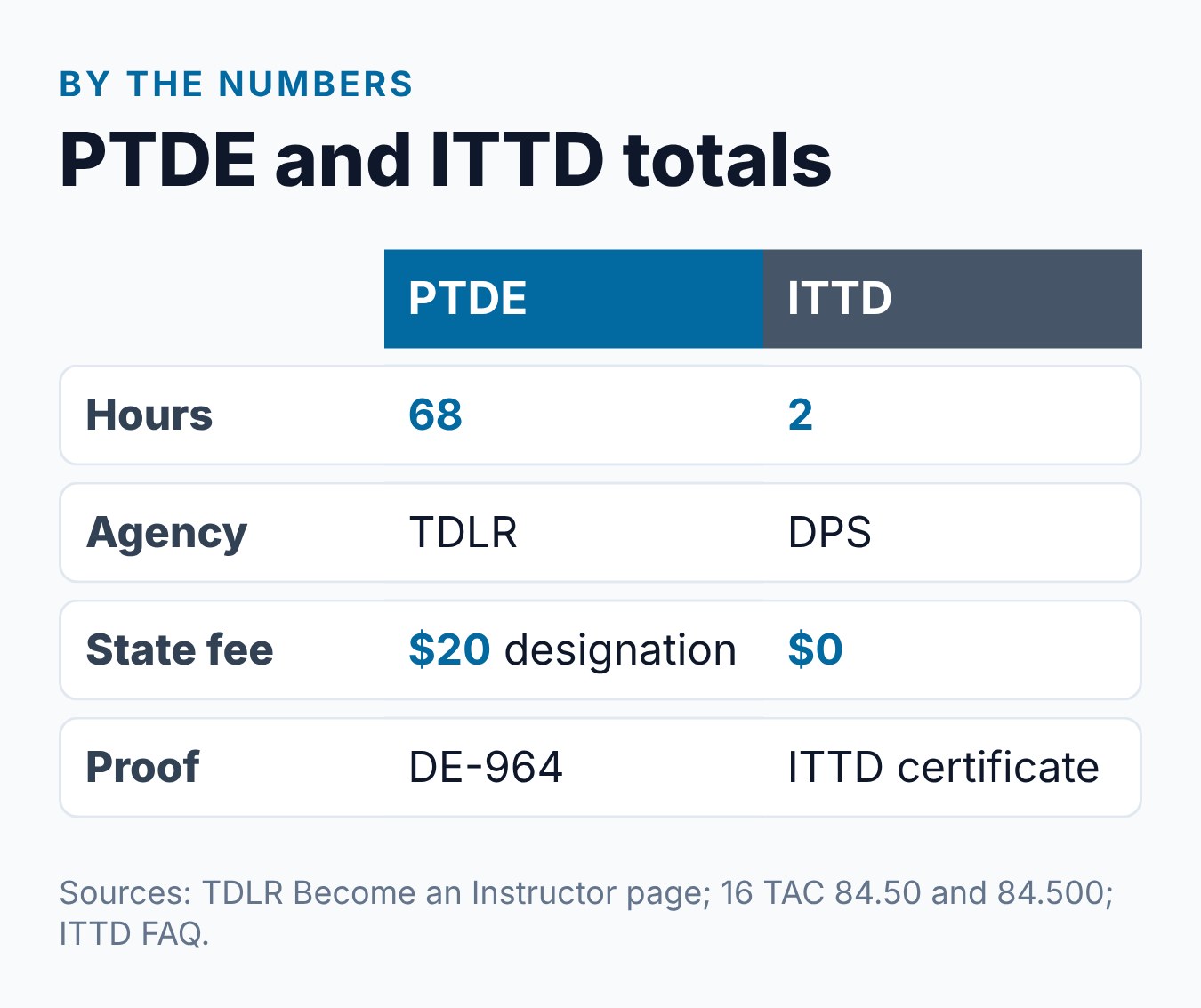
PTDE and ITTD Side by Side
| Point | PTDE | ITTD |
|---|---|---|
| Rules set by | TDLR and 16 TAC Chapter 84 | Texas DPS |
| Time required | 24 classroom hours plus 44 in-car hours | 2 hours of video |
| Fees named by the state | $20 TDLR designation fee, plus the curriculum price | None |
| Who teaches | The parent instructor, using a licensed curriculum | Recorded video on the DPS site |
| Paper you receive | DE-964 learner license and driver license portions | ITTD certificate, valid 90 days |
| Stage | From the first classroom lesson to the end of in-car work | After in-car work, before the road test |
Adding them up, 24 plus 44 is 68 hours of driver education. ITTD adds 2 more hours on top.
The Timeline: Where ITTD Fits
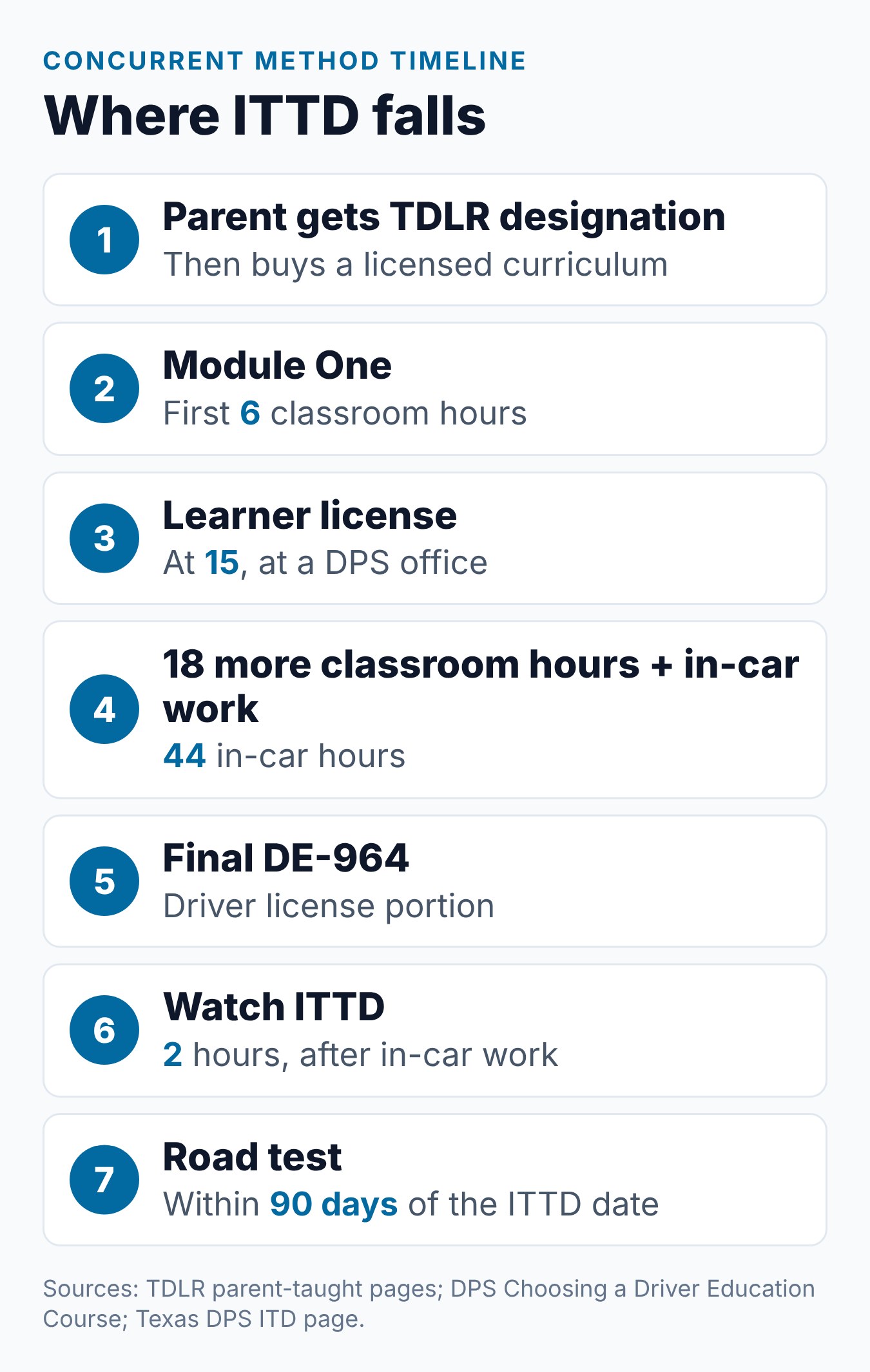
Here is the parent-taught path in order, using the concurrent method. Each stage names who handles it.
Stage 1: Set Up the Course
The parent applies online to TDLR for the Parent-Taught Driver Education Instructor Designation. Then the parent buys a curriculum from a TDLR-licensed provider.
DPS says on its course choice page that classroom work can start at 14.
Stage 2: First 6 Classroom Hours
DPS says the concurrent method starts with “the first 6 hours of classroom instruction.” After that part, the provider issues the DE-964 “For Learner License Only” portion.
Stage 3: Learner License at DPS
At 15 or older, the teen applies for a learner license at a DPS office. The under-18 fee is $16, and the parent instructor on record must attend, according to TDLR.
Stage 4: Classroom and Driving Together
DPS says the teen will “Finish the remaining 18 hours of classroom instruction while practicing.” Behind-the-wheel work can begin only after the learner license is issued.
The 44 in-car hours break down as 7 hours of observation, 7 hours of behind-the-wheel instruction and 30 hours of practice, with at least 10 at night. TDLR says the in-car part cannot be finished in fewer than 15 calendar days.
Daily limits apply too. TDLR caps instruction at six hours a day, with no more than two hours of behind-the-wheel instruction a day. Its requirements page says parent-taught driver education takes “at least 7 weeks of daily instruction.”
The 30 practice hours are done with a licensed adult who is 21 or older and has been licensed at least one year. For a minor, a parent or legal guardian certifies those hours on the 30-hour log from the TDLR behind-the-wheel page.
Stage 5: The Final DE-964
When the whole course is done, the provider issues the DE-964 “For Driver License Only” portion. PTDE is now complete.
If the provider does not send the DE-964, TDLR says to contact its customer service. Have the student’s full name and the course name ready.
Stage 6: Impact Texas Teen Drivers
Now ITTD fits in. DPS says it “must be completed after the behind the wheel driver education requirements and prior to taking the driving skills test.”
The teen watches the eight modules and prints the certificate. Timing matters, because the certificate is valid for 90 days.
Stage 7: The Road Test
The teen must have held the learner license at least six months, unless 18. At the test, DPS will not proceed without the ITTD certificate.
The DPS provisional license page lists the other items, including the DE-964 and a school form. The provisional license fee is $16.
What Each Paper Unlocks
Three papers move a parent-taught teen forward. Each one opens a different door:
- DE-964, learner license portion: lets the teen apply for a learner license at DPS after Module One.
- DE-964, driver license portion: shows DPS the whole PTDE course is finished.
- ITTD certificate: lets the driving skills test begin, as long as it is dated within 90 days.
The first two come from the PTDE provider. Only the third comes from DPS, and it is the last one a teen earns.
A Sample Calendar
Dates make the order easier to see. Here is the math for one sample teen:
- May 1: the teen, now 15, gets a learner license.
- November 1: six months have passed, but the teen is still 15.
- February 10 the next year: the teen turns 16, and in-car work is done.
- February 20: the road test date.
Counting back 90 days from February 20 lands on November 22. So an ITTD certificate dated November 22 or later works for that test, while one from October would be too old.
Why ITTD Comes Last
The FAQ is clear on order. It says ITTD “should be completed after the 24 classroom hours and all behind the wheel instruction has been given and is the last step before taking the driving skills examination.”
Three rules push it to the end:
- DPS timing: the program comes after behind-the-wheel requirements.
- The 90-day limit: an early certificate can expire before the test.
- Sign-up needs: the ITTD form asks for the learner license number, so it cannot come before Stage 3.
Does ITTD Count Toward PTDE Hours?
No. The FAQ says ITTD “is a separate requirement” and is not part of the 24 classroom hours.
It also does not replace any PTDE lesson. DPS says the ITD programs “do not replace the distracted driving module in the 24-hour teen driver education course.”
So a parent-taught student covers distracted driving twice: once in the PTDE classroom module and once in ITTD.
Concurrent or Block, ITTD Lands in the Same Spot
PTDE has two methods. In the block method, DPS says the teen will “Complete all 24 hours of classroom instruction” before driving.
Either way, ITTD stays after the in-car work and before the road test. Our concurrent vs block guide compares the two methods.
The Parent’s Role vs the Video’s Role
In PTDE, the parent is the teacher. TDLR sets eligibility rules for that role, from age and driving history to the relationship with the student. Our instructor requirements guide lists them.
The parent instructor on record also shows up at DPS. TDLR says that person must attend for the learner license and go to the driver license office for the provisional license.
ITTD gives the parent no teaching job. The sign-up page says the form must use the student’s information, and the student watches the modules.
How the ITTD Site Links to PTDE
The ITTD sign-up page asks for a driver education type. “Parent Taught (PTDE)” is the first choice, and picking it opens a menu to choose the course.
That is the only overlap. The video does not ask the parent to teach anything, and the course does not issue the ITTD certificate.
Our Review of the ITTD FAQ
On the ITTD FAQ page we checked on October 26, 2026, the teen course was described as “24 hours classroom/44 hours behind the wheel.” That matches the current TDLR classroom minimum of 24 hours.
The same page said any applicant with a DE-964 and a drive test on or after September 1, 2015 must view ITTD. So the rule is not tied to one course method.
Common Mistakes When Mixing Up ITTD and PTDE
Each item comes from the DPS, TDLR or ITD pages:
- Thinking ITTD is the course. PTDE is the course; ITTD is a separate DPS video.
- Watching ITTD right after the learner license. It belongs after behind-the-wheel work.
- Counting ITTD as classroom time. It is not part of the 24 hours.
- Bringing only one certificate. The road test needs the DE-964 and the ITTD certificate.
- Skipping the PTDE distracted driving lesson. ITTD does not replace it.
How Requirements Can Vary
Texas driver education rules come from TDLR, and driver license rules come from Texas DPS. They apply statewide, but what you need depends on the student’s age, the course method, and whether the classroom part comes from a parent-taught course, a driving school, or a public school.
Fees, forms, and office procedures can change. Check the TDLR parent-taught pages and the DPS driver license pages before each step, and follow the instructions from your course provider.
Frequently Asked Questions
What is the difference between ITTD and PTDE?
PTDE is a full driver education course taught by a parent under TDLR rules. ITTD is a free 2-hour DPS video on distracted driving watched near the end.
Do I need both ITTD and PTDE?
Yes. A parent-taught teen finishes PTDE for the DE-964 and finishes ITTD for its certificate. The road test needs both.
Which comes first, PTDE or ITTD?
PTDE classroom and behind-the-wheel work come first. ITTD comes after behind-the-wheel training and before the road test.
Does ITTD count toward the 24 classroom hours?
No. The FAQ says ITTD is a separate requirement. It also does not replace the distracted driving module in the course.
Can the parent instructor teach ITTD?
No. ITTD is a recorded DPS video that the student watches online. The parent teaches the PTDE course, not ITTD.
How long before the road test should we do ITTD?
Within 90 days. The certificate is valid for 90 days, so finish it after in-car work and close to the test date.
Does ITTD replace the PTDE driving log?
No. TDLR requires a special log for the 30 hours of behind-the-wheel practice. ITTD is a video and has nothing to log.
Conclusion
PTDE builds the driving skills over 68 hours, and the Impact Texas Teen Drivers program adds a 2-hour safety video at the end. Finish PTDE, watch ITTD within 90 days of the test, and bring both certificates. Driving Logic’s Texas Parent Taught Drivers Ed course is coming soon, and TDLR’s provider search lists licensed parent-taught courses today.
Related Articles
- What Is Impact Texas Teen Drivers (ITTD)? The Complete Guide
- Impact Texas Teen Drivers Video: How to Complete ITTD
- Impact Texas Teen Drivers Certificate: How to Get It and Use It at DPS
- How Long Is Impact Texas Teen Drivers (ITTD)?
Sources
- Texas DPS — Impact Texas Drivers (ITD) Program
- Impact Texas Drivers (official DPS course site)
- TDLR — Parent-Taught Driver Education (Getting Started)
- TDLR — Parent-Taught Behind-the-Wheel Instruction
- TDLR — Parent-Taught Provisional License
- 16 Tex. Admin. Code § 84.500 — Courses of instruction (24 classroom hours)
- 16 Tex. Admin. Code § 84.50 — Parent-taught program requirements
- Texas DPS — Choosing a Driver Education Course
- Texas DPS — Texas Provisional License as a Teen
Billy Forte is the owner of Driving Logic, a state-approved driver improvement course provider serving Texas and other U.S. states.
This article is general information, not legal advice. Texas driver education and licensing rules are set by TDLR, Texas DPS, and Texas law, and can change. Check the official TDLR and DPS websites for current requirements.