
Updated October 2026 · Reviewed by Billy Forte
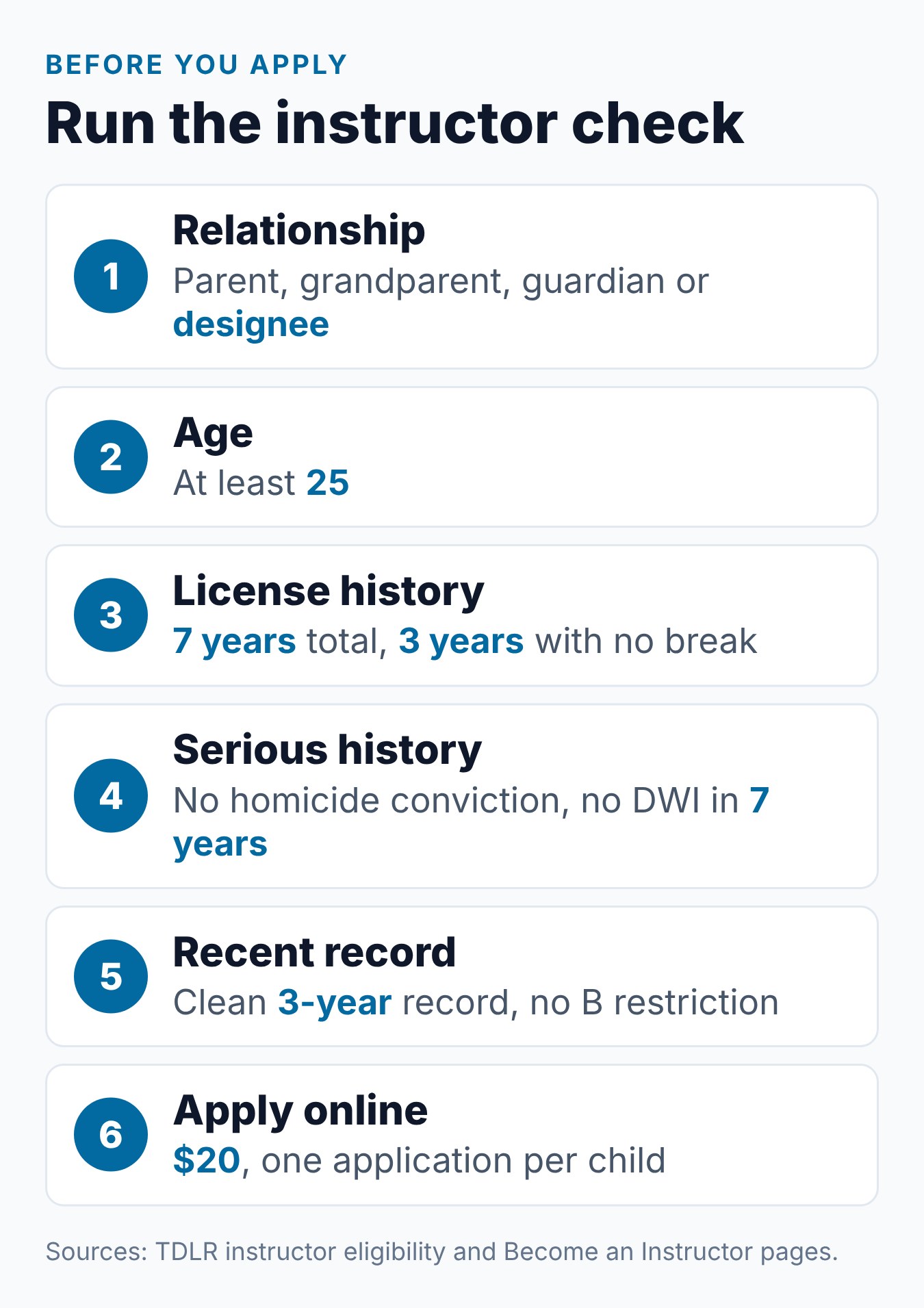
Parent taught drivers ed Texas requirements say the instructor must be a parent, stepparent, grandparent, step-grandparent, foster parent, legal guardian, or a designee named by a parent, legal guardian or judge. That person must be at least 25, must have held a driver license for at least seven years, and must pass TDLR’s driving record checks. A license with the B restriction rules a person out, and instructors may not charge a fee.
Key Facts
- Relationship: parent, stepparent, grandparent, step-grandparent, foster parent, legal guardian or approved designee. See who can teach.
- Age and license: at least 25, licensed at least seven years, and continuously licensed for the past three. See the full list.
- Record: no recent DWI, suspensions, at-fault crash pattern or moving violation pattern. See the look-back windows.
- Ongoing checks: DPS reviews the instructor’s record at both license visits. See checks after approval.
- Practice drives: a separate role that any eligible adult 21 or older can fill. See practice supervisors.
Who Can Be the Instructor
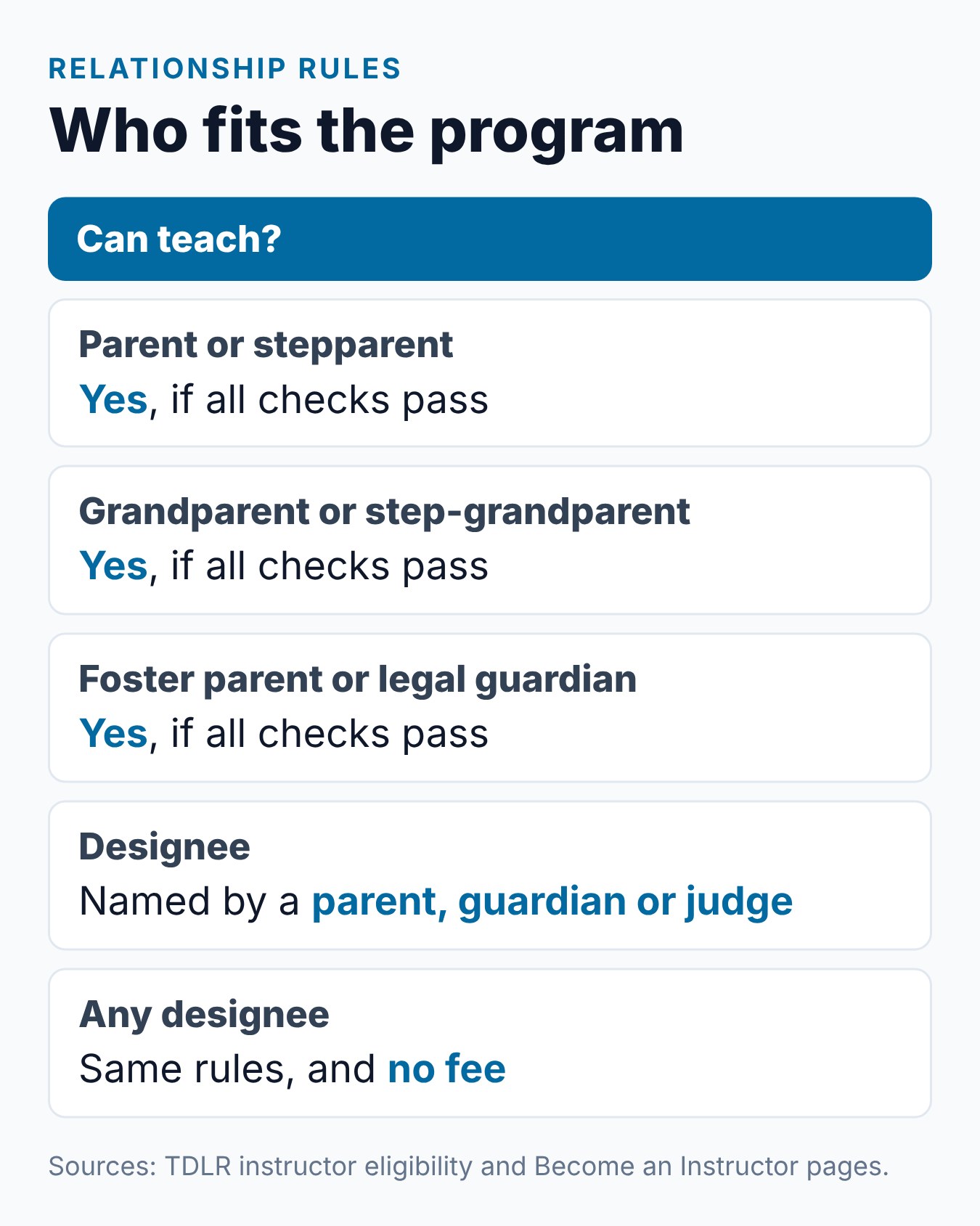
The first question on TDLR’s instructor eligibility page is about relationship. These relationships fit the program:
- Parent or stepparent.
- Grandparent or step-grandparent.
- Foster parent.
- Legal guardian.
- A person designated by a parent, legal guardian or judge.
The last group is the designee, which TDLR also calls an alternate instructor. TDLR’s Become an Instructor page says the alternate must meet the same qualifications as the parent. The alternate also may not charge a fee.
So a person outside the listed roles, such as an aunt or a family friend, can teach only as a designee. They still have to pass every check below.
The Full Parent Taught Drivers Ed Texas Requirements
After relationship, TDLR’s eligibility questions turn to age, license history and record. This table lists each check:
| Check | The instructor passes if | Time window |
|---|---|---|
| Age | They are at least 25 | Now |
| License history | They have held a license at least 7 years | Total |
| Current license | They have held a valid license without a break | Past 3 years |
| Criminally negligent homicide | They have never been convicted | Ever |
| DWI | They have no conviction | Past 7 years |
| Suspension, revocation or forfeiture | None for traffic violations | Past 3 years |
| At-fault crashes | Fewer than 2 | Past 3 years |
| Moving violations | Fewer than 3 | Past 3 years |
| B restriction | Their license does not carry it | Now |
The B restriction rule comes from the Become an Instructor page. It says a driver license with the B restriction means the person will not be a qualified instructor. That page does not explain the code, so check the restriction codes on the license and ask DPS if you are unsure.
How the Look-Back Windows Work
Each record question looks back a set number of years. Reading them right keeps you from guessing. Simple math helps.
The seven-year DWI window. A DWI conviction six years ago is inside the window, so it disqualifies. A conviction eight years ago is outside the window for this question.
The three-year windows. Suspensions, at-fault crashes and moving violations each look back three years. Two at-fault crashes in that span disqualify, but one does not trip that question on its own.
The moving violation question works the same way. Three or more in three years disqualify, while two do not fail that question by themselves.
The ever question. Criminally negligent homicide has no window. Any conviction at any time disqualifies.
The two license questions. Seven years of total license history is one test. A valid license held with no break for the past three years is a second, separate test.
Dates to Gather Before the Questions
Each question turns on a date. Having these on hand makes the answers quick and accurate:
- First license date. This shows whether you reach seven years of license history.
- Any license gaps. Note any time in the past three years when your license was not valid.
- Ticket dates. List each moving violation from the past three years.
- Crash dates. List each crash in the past three years where you were found at fault.
- Any DWI date. Note the conviction date if there is one in the past seven years.
- Restriction codes. Read the restriction codes printed on your license.
Who Cannot Teach
Read the other way, the rules point to clear stops. A person cannot be the PTDE instructor if any of these is true:
- They are under 25.
- They have held a license for less than seven years.
- Their license lapsed at some point in the past three years.
- They hold a license with the B restriction.
- They were ever convicted of criminally negligent homicide.
- They have a DWI conviction in the past seven years.
- They have two or more at-fault crashes, or three or more moving violations, in the past three years.
If one parent fails a check, the other parent or another listed relative may still qualify. A parent, legal guardian or judge can also name a designee who passes.
What the Instructor Will Teach
The checks exist because the instructor carries real teaching hours. TDLR’s getting started page lists the course as 24 hours of classroom instruction, 7 hours of observation and 7 hours of behind-the-wheel training. The 30 practice hours come on top of that.
The instructor works inside set limits. TDLR’s classroom page caps instruction at six hours a day, with no more than two hours behind the wheel. In-car lessons wait until the student holds a learner license.
Some families split the work. TDLR’s hybrid instruction page says the classroom hours can come from a driving school or a public high school. The parent then teaches only the in-car portion, but still has to be an eligible instructor.
Checks After Approval
Passing the quiz once does not end the review. TDLR’s Become an Instructor page says DPS checks the instructor’s driving record twice. One check is at the learner license visit, and one is at the provisional license visit.
A record that no longer qualifies has real effects. TDLR says DPS will deny the student’s license application. Hours logged after the instructor became ineligible will not count.
TDLR calls pulling your own driving record optional. It recommends a record check for anyone who has had a moving violation or been in a crash.
Practice Supervisors Are a Different Role
The instructor teaches the course. The 30 hours of supervised practice follow a different rule. The TDLR behind-the-wheel page says any person 21 or older can supervise practice.
That supervisor must have been licensed for at least one year. For a minor, a parent or guardian certifies the practice hours. 16 TAC 84.500 sets the same 21-year age and one-year license rule.
This means a second adult can help with practice drives. That adult does not need to pass the instructor checks. Our PTDE driving log guide explains how those hours are recorded.
If No One in the Family Qualifies
A failed check closes one door, not all of them. The rules leave a few paths open:
- Another listed relative. A second parent, a stepparent or a grandparent may pass where the first person did not.
- A designee. A parent, legal guardian or judge can name another adult who meets every rule.
- A driving school. A TDLR-licensed school can teach the course instead, with the same hour rules.
Our pillar guide to parent taught drivers ed in Texas compares these routes at a high level.
The Student Has Requirements Too
The instructor rules are only half the picture. TDLR’s Become an Instructor page sets school rules for students under 18 without a diploma or equivalent:
- School enrollment: enrolled in public, home or private school for at least the past 80 days.
- Equivalency program: or enrolled in a high school equivalency program for at least the past 45 days.
The student must also make satisfactory progress in school and meet attendance rules. The DPS Choosing a Driver Education Course page says classroom study can start at 14.
What Instructors May Not Do
A few limits apply to every instructor, parent or designee:
- Charge a fee. TDLR says parent-taught instructors may not charge a fee for the course.
- Teach before approval. TDLR’s classroom page says instruction begins after you get confirmation of the designation.
- Skip the DPS visits. TDLR says instructors must go with the student to a DPS office on two occasions.
Applying Once You Qualify
When the instructor passes every check, the next move is TDLR’s online application. The fee is $20, and it is non-refundable. Each child needs a separate application.
If you name an alternate instructor, add that person’s information on the form. Our Program Guide article covers the application and what TDLR sends next.
Still deciding whether a parent should teach at all? Our PTDE vs commercial drivers ed guide weighs the two routes.
What We Found on the Eligibility Page
On the TDLR eligibility page we checked on October 26, 2026, the questions came in a set order. Relationship came first, then age, license history, continuous licensing, criminal history, DWI, suspensions, crashes and moving violations.
The relationship question also offered answers such as relative, friend and power of attorney holder. The page did not show a result after the questions. For a firm answer on your case, TDLR lists its customer service line at (512) 463-6599.
Common Mistakes With Instructor Eligibility
These errors come from misreading TDLR’s rules:
- Counting from the wrong date. Each record question has its own window: ever, seven years or three years.
- Assuming a friend can teach directly. A friend can teach only as a designee who meets every rule.
- Missing a license gap. A break in the past three years fails the continuous license check.
- Forgetting the B restriction. Check the codes on your license before you apply.
- Paying the alternate. Designees may not charge a fee.
- Ignoring later tickets. DPS checks the record again at the provisional license visit.
How Requirements Can Vary
Texas driver education rules come from TDLR, and driver license rules come from Texas DPS. They apply statewide, but what you need depends on the student’s age, the course method, and whether the classroom part comes from a parent-taught course, a driving school, or a public school.
Fees, forms, and office procedures can change. Check the TDLR parent-taught pages and the DPS driver license pages before each step, and follow the instructions from your course provider.
Frequently Asked Questions
Can a grandparent teach parent taught drivers ed in Texas?
Yes. TDLR lists grandparents and step-grandparents as eligible relationships. They must still pass the age, license and driving record checks.
Can a family friend be the instructor?
Only as a designee. A parent, legal guardian or judge must name them, and they must meet the same rules as a parent.
How old does the PTDE instructor have to be?
At least 25. The instructor must also have held a driver license for at least seven years.
Does an old DWI disqualify me?
TDLR’s question covers DWI convictions in the past seven years. A conviction inside that window disqualifies. The other record checks still apply.
Can the instructor have one at-fault crash?
The crash question disqualifies two or more at-fault crashes in the past three years. One crash does not fail that question by itself, but every other check must also pass.
Who can supervise the 30 practice hours?
TDLR says any person 21 or older who has been licensed at least one year. For a minor, a parent or guardian certifies the hours.
Can the instructor be paid?
No. TDLR says parent-taught instructors, including alternates, may not charge a fee for the course.
Conclusion
Parent taught drivers ed Texas requirements come down to three things: the right relationship, age 25 with seven years of licensing, and a clean recent driving record without the B restriction. Check each one on TDLR’s eligibility page before you pay the $20 application fee. Driving Logic’s Texas Parent Taught Drivers Ed course is coming soon, and TDLR’s provider search lists licensed parent-taught courses now.
Related Articles
- Parent Taught Drivers Ed Texas: The Complete PTDE Guide
- Texas PTDE Program Guide Packet: What It Is, How to Get It, and Why You Need It
- Parent Taught vs Commercial Teen Drivers Ed in Texas: Which Is Right for Your Family?
- Texas PTDE Driving Log: How to Track Your Teen’s Behind-the-Wheel Hours
Sources
- TDLR — Parent-Taught Instructor Eligibility
- TDLR — Become a Parent-Taught Instructor
- TDLR — Parent-Taught Driver Education (Getting Started)
- TDLR — Parent-Taught Classroom Instruction
- TDLR — Parent-Taught Behind-the-Wheel Instruction
- TDLR — Parent-Taught Learner License
- TDLR — Parent-Taught Provisional License
- 16 Tex. Admin. Code § 84.500 — Courses of instruction (24 classroom hours)
- Texas DPS — Choosing a Driver Education Course
Billy Forte is the owner of Driving Logic, a state-approved driver improvement course provider serving Texas and other U.S. states.
This article is general information, not legal advice. Texas driver education and licensing rules are set by TDLR, Texas DPS, and Texas law, and can change. Check the official TDLR and DPS websites for current requirements.