
Updated June 2026 · Reviewed by Billy Forte
Choosing between parent-taught and commercial teen drivers ed in Texas comes down to cost, time, and who teaches the driving: PTDE is the lower-cost, flexible option where a qualifying parent or adult teaches, while commercial TDE has a licensed school handle the in-car hours for a higher fee. PTDE typically runs the course fee plus the $20 program guide, whereas a commercial school often costs several hundred dollars and includes professional in-car instruction. Both follow the same teen licensing path, so the decision is really about your budget, schedule, and instructor availability.
Applies to Texas teen driver education and licensing (ages 14–17). Requirements are set by TDLR (driver education) and the Texas DPS (licensing) and can change.
Key Facts
- Cost: PTDE is usually the lowest-cost path (course fee + $20 program guide); commercial TDE typically costs more.
- Who teaches: PTDE uses a qualifying parent or adult; commercial TDE uses a professional instructor.
- Time and control: PTDE offers schedule flexibility and parent involvement; TDE offloads the in-car teaching.
- Same licensing path: Both lead to a learner’s permit, the 6-month hold, and a provisional license.
- Teen-only: Both are for teens under 18; adults 18+ use the separate Adult Driver Education course.
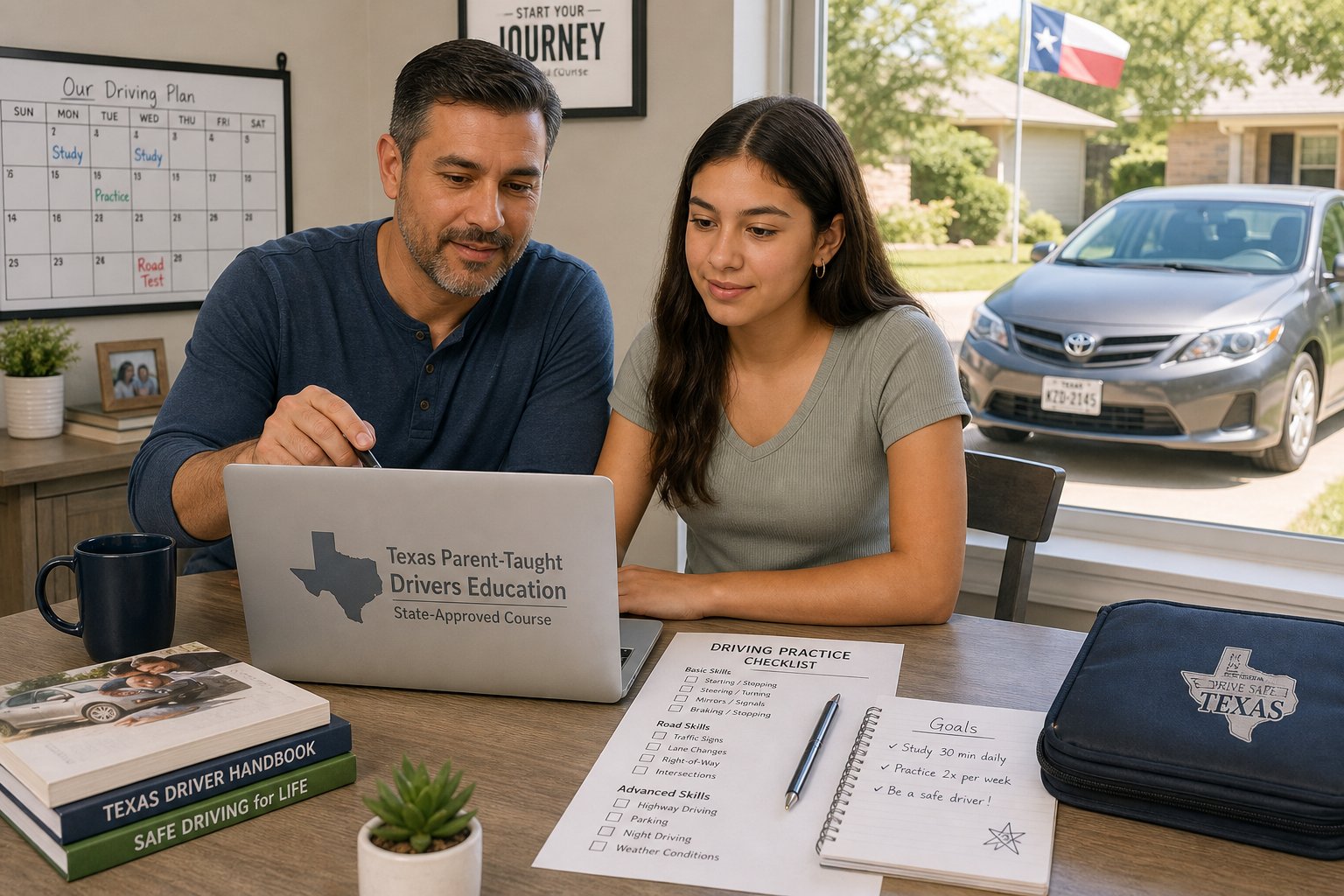
What Parent-Taught Drivers Ed In Texas Is And Who It’s Best For
Parent Taught Drivers Ed (PTDE) is a Texas teen driver education option for students under 18. Instead of a driving school teaching the course, a parent or another qualified adult handles the instruction.
The course still follows state rules. It is approved through the Texas Department of Licensing and Regulation, often called TDLR. And the license itself still comes from Texas DPS, not a school.
PTDE works best when your family wants:
- Lower cost
- A flexible schedule
- More parent involvement
- At-home online learning
It is often the better fit for budget-conscious families. The course itself is usually much cheaper than a commercial school. But that lower price comes with a tradeoff: you do more of the work at home.
That matters most in the behind-the-wheel phase. A parent or approved adult must plan practice drives, track hours, and make sure the teen finishes the required training. If your schedule is packed or you do not feel ready to teach driving skills, a commercial school may be easier.
So, when people ask about the best parent taught drivers ed texas families can choose, the real answer is not just about the course screen or app. It is about whether your household has the time, patience, and follow-through to manage the process well.
One more point: PTDE is for teens under 18. It is not the same thing as ADE, which is a separate adult course for people 18 and older.
Texas PTDE Requirements Every Family Needs To Know Before Enrolling
Texas has clear rules for PTDE, and families should know them before signing up. Missing one step can slow down the permit or license process.
Here are the basics:
- The teen must usually be 14 to 17 to enroll
- The teen must be at least 15 to get a learner license
- The course includes 24 hours of classroom instruction
- The course also includes 44 hours of behind-the-wheel work
- Those 44 hours include observation, instruction, and practice driving
The adult instructor must also qualify. In many cases, that can be a parent, step-parent, grandparent, guardian, or another designated adult. The person must meet Texas rules for age, driving history, and license status.
Before instruction starts, families must get the PTDE Program Guide from TDLR. That fee is $20. As of January 2026, TDLR sends it by email only, not as a printed packet. That detail trips people up, especially if they expect something in the mail.
There are also time rules. Texas does not allow families to rush the whole course in a day or two. Daily instruction limits apply, and the work must be spread out over the required time.
And remember the document names:
- DE-964E = partial completion certificate for Module 1 only, used for the learner permit
- DE-964 = full completion certificate for the provisional license
Always check current rules and fees on TDLR and TxDPS before you start. State requirements can change.
How The Texas Parent-Taught Process Works From Permit To License
The Texas PTDE process is not hard, but it has several steps. Doing them in the right order makes things much smoother.
First, enroll in a TDLR-approved online PTDE course. Then request the PTDE Program Guide from TDLR and wait until you have that approval in place before moving ahead. That guide matters because it connects the student and instructor to the state-approved process.
Next, the teen completes the first part of the course. After the required early classroom work, the teen can take the permit test if the course includes it. Some online providers build the permit exam into the course, which saves time.
Then you go to Texas DPS with the needed documents. That is when the teen applies for the learner license. The current learner permit fee is $16, but it is smart to confirm the latest amount on TxDPS.
After the permit is issued, the teen finishes the rest of the course:
- Remaining classroom hours
- Required behind-the-wheel instruction
- Observation and practice driving
- Driving logs and records
Before the road test, the teen must also complete Impact Texas Teen Drivers. That is a free 2-hour TxDPS course. It is separate from PTDE itself, and it is not a substitute for the teen drivers ed program.
To move on to the provisional license, the teen must hold the permit for the required time, be old enough under Texas rules, and complete all course steps. At that point, the family uses the DE-964 full completion certificate.
If your family likes clear checklists and can stay organized, PTDE can work very well.
What To Look For In The Best Online Parent-Taught Drivers Ed Course
Not all online courses are equal, even if they all sound similar on a sales page. The best one makes the state process easier, not more confusing.
Start with the basics. The course should be TDLR-approved and clearly explain how you will get the needed completion certificate. If a provider is vague about approval, move on.
You should also look for:
- A built-in permit test, if available
- Simple PTDE instructions for parents
- Clear progress tracking
- Mobile-friendly access
- Easy login and resume features
- Good customer support
A strong course does more than show lessons. It helps your family avoid paperwork mistakes. That includes driving logs, hour tracking, and reminders about key steps like ITTD and DPS visits.
Pricing matters too. A low upfront price is great, but check what is included. Some families compare courses and later learn that certificate handling, exam access, or support is limited. A good PTDE course should tell you, in plain words, what you get.
For families using Driving Logic, that means looking for a course that fits busy schedules, works on any device, and keeps each step easy to follow. That kind of setup helps both teens and parents stay on track instead of guessing what comes next.
Course Features That Make PTDE Easier For Busy Parents And Teens
Busy families need more than a legal course. They need one that works in real life.
The most useful features are:
- Self-paced online lessons
- Phone and tablet access
- Save-and-return progress
- Driving logs and checklists
- Fast certificate delivery
These features matter because PTDE puts more responsibility on the family. A clean dashboard, simple lesson flow, and parent tools can save time every week.
If you want a practical option, you can review the Texas teen course from Driving Logic and compare its format, support, and flexibility with other providers.
Common Mistakes To Avoid When Comparing Texas PTDE Options
Families often focus on price first. That makes sense, but price alone can hide problems.
The biggest mistake is starting too early. If you begin instruction before handling the PTDE Program Guide step with TDLR, you can create a paperwork issue later. Follow the state order from the start.
Another common problem is choosing a provider that is not clearly approved. Always confirm the course is accepted under Texas rules. Do not assume every online driver ed site is valid for Texas teens.
Watch out for these mistakes too:
- Not checking whether the parent qualifies to teach
- Forgetting the daily instruction limits
- Mixing up DE-964E and DE-964
- Confusing PTDE with ADE for adults 18+
- Thinking ITTD is the teen drivers ed course itself
That last one is very common. Impact Texas Teen Drivers is required before the driving test, but it is a separate free TxDPS course. It does not replace PTDE or classroom hours.
Families also underestimate the time commitment. PTDE saves money, but it asks more from you. You will need to supervise driving, keep records, and stay consistent over time.
If your family is already stretched thin, the cheapest option may not be the easiest one. The better question is not just “What costs less?” It is “What can we actually finish without stress or delays?”
Parent-Taught Vs Instructor-Led Drivers Ed In Texas
When comparing parent taught vs commercial drivers ed texas options, the right choice depends on your time, budget, and comfort level.
Both paths are valid for Texas teens under 18. Both must meet state rules. Both can lead to the same required certificates and the same next step with Texas DPS.
Here is the practical difference for most families:
- PTDE costs less: often about $60 to $100 for the course, plus the $20 PTDE Program Guide
- Commercial school costs more: often about $200 to $500+
- PTDE takes more parent time: especially for behind-the-wheel instruction
- Commercial school takes less parent teaching time
- PTDE offers full schedule control
- Commercial school follows the school’s calendar and drive times
The quality standard is closer than many people think. The curriculum is still state-based. The certificates still matter. And the teen must still complete the required work. A more expensive school is not automatically “more official.”
So which should you choose?
Choose PTDE if:
- You want to save money
- You can commit time to teaching and practice driving
- You want full control over the schedule
Choose a commercial driving school if:
- Your schedule is tight
- You do not feel confident teaching behind-the-wheel skills
- You want more of the process handled by instructors
For many families, PTDE is the best value. For very busy households, a commercial school may be worth the extra cost.
If you are ready to compare a flexible online option, take a look at the Texas teen drivers ed course from Driving Logic and review the current state details on TDLR and TxDPS before you enroll.
FAQ
Is parent-taught or commercial drivers ed better in Texas?
Neither is universally better. PTDE is cheaper and flexible if you have a qualifying instructor; commercial TDE provides professional in-car training for a higher fee. Both reach the same licenses.
How much does each option cost?
PTDE is typically the online course fee plus the $20 TDLR program guide; commercial teen driver education often runs several hundred dollars because it includes in-car instruction.
What if no parent can teach the driving?
Then commercial TDE is the natural fit, since a licensed school provides the required in-car hours. PTDE requires a qualifying parent or adult to teach and log the driving.
Do both options meet the same Texas requirements?
Yes. Both must be TDLR-approved and lead a teen through the learner’s permit, the 6-month holding period, and the provisional license.
Conclusion
The parent-taught versus commercial choice is mostly about resources: PTDE saves money and keeps families in control when a qualifying adult can teach, while commercial TDE buys professional in-car instruction and less parent time. Map the two against your budget, your schedule, and whether you have an eligible instructor, and the right answer usually becomes obvious. Both are legitimate, TDLR-approved roads to the same provisional license.
If parent-taught is your pick, start the classroom hours with a TDLR-approved Texas parent-taught drivers ed course online.
Related Articles
- Texas Parent Taught Drivers Ed (PTDE): The Complete Guide
- Texas Teen Driver Education (TDE): What It Is and How It Compares to PTDE
- Texas Parent Taught Drivers Ed Cost: What to Expect
- How to Choose a Texas Parent Taught Drivers Ed Course Online
Sources
Billy Forte is the owner of Driving Logic, a TDLR-approved Texas driver education provider. Driving Logic offers the online Texas parent-taught and teen driver education course that helps Texas teens complete the 32-hour classroom requirement and work toward a learner’s permit and provisional license.
This article is general information about Texas teen driver education and licensing, not legal advice. Requirements, fees, and procedures are set by TDLR and the Texas DPS and can change, so confirm current details with official Texas sources before you enroll or visit a DPS office.