
Updated June 2026 · Reviewed by Billy Forte
To choose a Texas parent-taught drivers ed course online, start with the non-negotiable: TDLR approval, which you can verify on the TDLR website, and confirm the course issues both the DE-964E and DE-964 certificates. From there, look for clear behind-the-wheel parent guides, progress tracking, and support that matches how your family will work through the 32 hours. A good course makes the certificates, forms, and steps obvious so the program guide and DPS visits go smoothly.
Applies to Texas teen driver education and licensing (ages 14–17). Requirements are set by TDLR (driver education) and the Texas DPS (licensing) and can change.
Key Facts
- TDLR approval is required: Verify the course is TDLR-approved before enrolling — this is non-negotiable.
- Issues both certificates: Confirm it provides the DE-964E (Module 1) and DE-964 (full completion).
- Parent guidance: Look for behind-the-wheel guides that help the parent instructor teach and log driving.
- Progress tracking: A course that tracks the 32 hours and modules keeps the process organized.
- Fit and support: Choose a provider whose format and support match your family’s schedule.
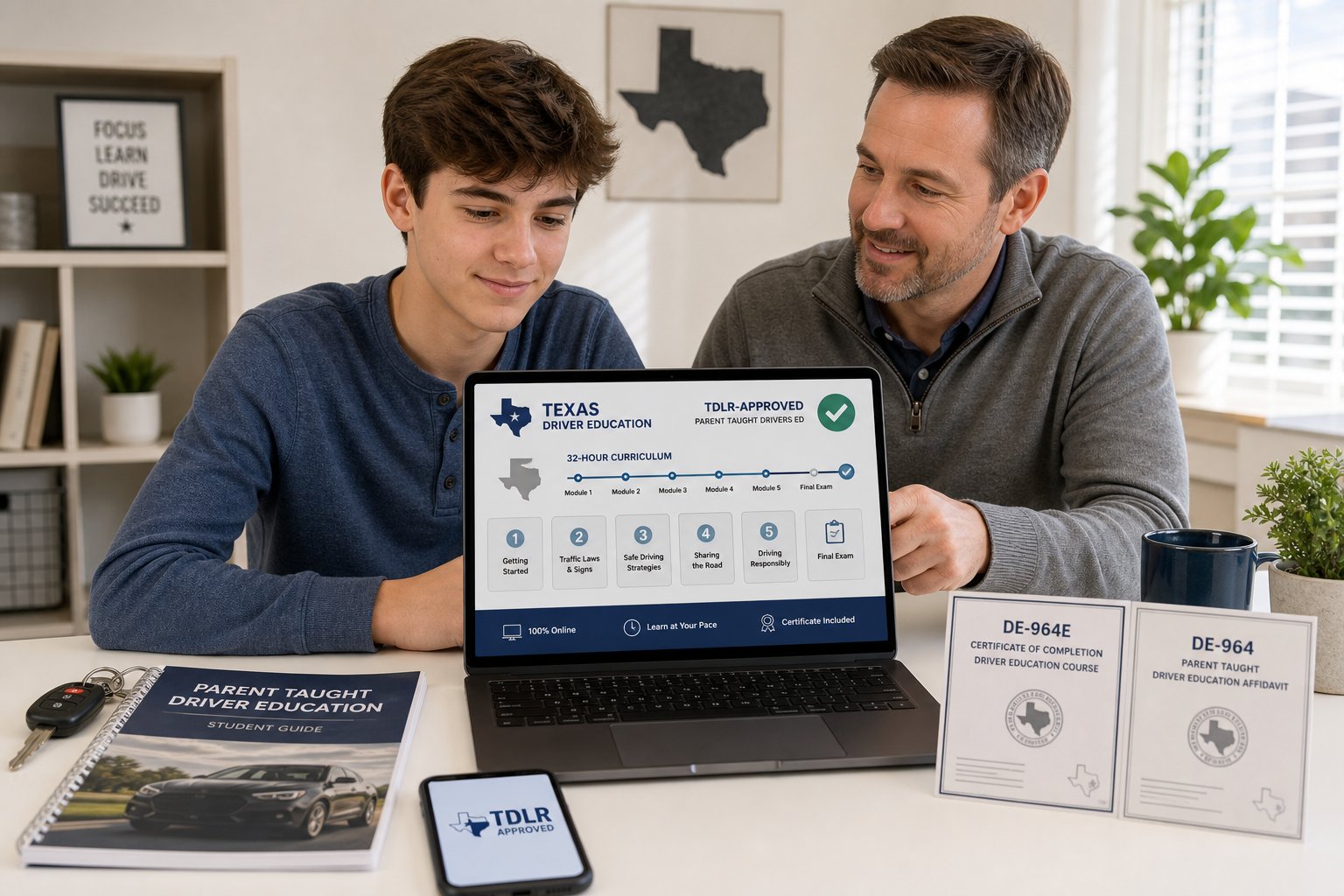
What TDLR-Approved Parent-Taught Drivers Ed Online Means
TDLR-approved parent taught drivers ed online means the classroom part of driver education is offered online by a provider approved by the Texas Department of Licensing and Regulation (TDLR), while the driving practice is taught by an eligible parent or other approved adult. This option is for teens under 18. It is not the same as Adult Driver Education (ADE), which is a separate course for adults 18 and older.
Approval matters more than anything else. If a course is not approved by TDLR, your teen may finish lessons and still not receive valid paperwork for the next step. That is why TDLR approval is the first thing to check, not the design, not the ads, and not the price.
Here is the key fact many families miss: all TDLR-approved PTDE courses must teach the same state-required 32-hour classroom curriculum. That means one approved course is not “more official” than another. The differences are usually practical:
- How simple the lessons are to follow
- Whether the course works well on a phone or tablet
- If the DE-964E and DE-964 certificates are included
- Whether a behind-the-wheel parent guide is included
- If the practice permit test or permit exam is built into the course
- How fast and helpful customer support is
You should also know that TDLR approves courses, while TxDPS issues permits and licenses. Those are separate roles. And one more important point: ITTD, or Impact Texas Teen Drivers, is a free 2-hour course required later by TxDPS. It is separate from the PTDE course itself.
Who Can Take The Course And Who Can Teach It
Texas Parent Taught Drivers Ed (PTDE) is for teens ages 14 to 17. A teen can usually start the course at 14, but the learner license step comes later through Texas DPS once age and course requirements are met. If your teen is 18 or older, PTDE is not the right program.
Not every adult can serve as the instructor. Texas allows certain people to teach the behind-the-wheel part if they meet state rules. Common examples include:
- Parent
- Stepparent
- Grandparent
- Step-grandparent
- Foster parent
- Legal guardian
In some cases, another designated adult may qualify, but families should review the current rules in the PTDE Program Guide and TDLR materials before moving forward. Eligibility can depend on relationship, driving history, and other state conditions.
This is where many people make a costly mistake. They assume any adult with a license can teach. That is not a safe assumption. The adult instructor must meet Texas requirements before instruction begins, and the required PTDE Program Guide should be obtained first.
As of January 2026, the PTDE Program Guide packet costs $20 from TDLR and is sent by email only. There is no physical packet mailed out. If a site says the state packet is free or ships in paper form, that is a red flag and worth checking against the official TDLR website.
How The Texas PTDE Process Works From Enrollment To License
The Texas PTDE process is not hard, but the order matters. If you do steps out of order, you can create delays at TxDPS.
A simple version looks like this:
- Choose a TDLR-approved online PTDE course.
- Buy the PTDE Program Guide from TDLR.
- Enroll your teen in the course.
- Complete the first required classroom portion.
- Take the permit test if your course includes it.
- Go to Texas DPS for the learner license when your teen is eligible.
- Begin supervised behind-the-wheel driving.
- Complete the rest of the classroom and driving requirements.
- Finish the separate ITTD course before the driving test stage.
- Apply for the provisional license through TxDPS.
The big thing to remember is that PTDE is split into two parts: the 32 hours classroom portion and the supervised driving portion. A good online course helps you move through the classroom part at your own pace, which is useful if your family has a busy schedule.
For many families, the smoothest path is to choose a provider that keeps everything organized in one place. That means progress tracking, certificate access, and clear parent instructions. For example, Driving Logic offers a Texas PTDE/TDE course built for online use on different devices, which can make scheduling easier for busy households. Convenience does not replace state rules, but it can make it much easier to follow them correctly.
The PTDE Packet, Learner Permit, And Written Test Requirements
The PTDE Program Guide is required. It is not optional, and instruction should not count until the family has obtained it through TDLR. This guide explains who can teach, what forms are needed, and how to document progress.
As of January 2026, the packet costs $20 and is delivered by email only. That matters because some families still expect a printed packet in the mail and wait for something that will never arrive.
For the learner permit stage, your teen must complete the required first part of the course before going to TxDPS. Many online PTDE programs include the permit exam inside the course, which can save time. But do not assume every provider handles it the same way. Check before you buy.
You should also confirm that the course provides the correct certificates:
- DE-964E: partial completion certificate for Module 1 only and the learner permit step
- DE-964: full completion certificate for the provisional license step
These names matter. They are not interchangeable. If a provider is vague about certificates, ask questions before enrolling.
This is also a good place to repeat one common point of confusion: ITTD is separate. The free Impact Texas Teen Drivers course is required by TxDPS later in the licensing process, but it is not the same as the PTDE course, and it does not replace any part of your teen’s classroom or driving instruction.
What The Course Includes And How Online Learning Makes It Easier
Since all approved PTDE courses teach the same state classroom content, the best choice often comes down to ease of use. That is why families looking for the best parent taught drivers ed Texas option should compare features, not just marketing claims.
Look for these basics:
- TDLR approval you can verify yourself
- DE-964E and DE-964 included
- A clear behind-the-wheel parent guide
- A built-in permit test or strong permit test prep
- Mobile-friendly lessons
- Straightforward pricing
- Responsive customer support
A mobile-friendly format matters more than it sounds. Teens often switch between a laptop, tablet, and phone. If the course works well on all of them, it is easier to stay on track and finish lessons without friction.
Parent guides matter too. The driving part is where many families feel unsure. Good course providers explain how to handle lesson order, required practice, and logs in plain language.
Support is another big separator. Even a simple course can hit a snag. Maybe a certificate question comes up, or a parent needs help understanding the next step. Fast support can save hours.
If you want a simpler online option, Driving Logic’s Texas PTDE/TDE course is built for flexible scheduling and device access. Still, whatever provider you choose, verify approval on TDLR before you enroll.
Behind-The-Wheel Hours, Progress Tracking, And Parent Responsibilities
The classroom course is only part of PTDE. The adult instructor must also supervise the required driving practice. Sources commonly describe 44 hours of driving and observation work as part of the process, and families should follow the current state guide and provider materials carefully.
This part takes planning. It is not just casual driving around the block. Your teen needs guided practice over time, and the parent or eligible instructor must track it correctly.
Your main responsibilities usually include:
- Supervising practice sessions
- Following the state lesson order
- Keeping accurate driving logs
- Making sure classroom work and driving progress match state rules
- Preparing the teen for safe, legal driving habits
Progress tracking matters because missing records can cause problems later. A good course makes this easier with printable or downloadable logs and clear instructions. That is one reason user experience matters even when the curriculum is the same.
Parents also need to know their role has limits. You are teaching and supervising the driving part, but TxDPS still controls permit and license issuance, and TDLR controls course approval. So if a rule question comes up, check the official source instead of guessing.
And again, this is for teens under 18. Do not mix PTDE rules with adult licensing rules. They are different programs with different course types.
Parent-Taught Vs. Instructor-Led Driver Education: Which Is Better
Neither option is better for every family. The right choice depends on your schedule, budget, and how comfortable the parent feels teaching driving skills.
Parent-taught driver education usually gives you:
- More schedule freedom
- At-home online classroom work
- Driving practice when it fits your family calendar
- Often lower total cost than school-based programs
Instructor-led driver education usually gives you:
- Set class times
- Professional in-car instruction
- A more structured environment
- Less teaching responsibility for parents
PTDE works well if you want flexibility and can stay organized. It is often a strong fit for busy families who need to spread out lessons and driving practice over different days and times.
Instructor-led programs can work better if the parent does not want the teaching role or if the teen learns best with a formal classroom setting and outside instructor.
If you choose PTDE, focus on the basics that make the process smoother: TDLR approval, correct certificates, parent guides, mobile access, permit test support, and solid customer service. Those details usually matter more than flashy promises.
If you are ready to start, you can review the online Texas PTDE/TDE option from Driving Logic and then confirm any course details against the official resources at TDLR, Texas DPS, and Impact Texas Teen Drivers.
FAQ
How do I pick a TDLR-approved PTDE course online?
Verify TDLR approval on the TDLR site, confirm the course issues the DE-964E and DE-964 certificates, and check for parent driving guides, progress tracking, and good support.
Why does TDLR approval matter?
Only TDLR-approved courses count toward Texas driver education and issue valid certificates. An unapproved course won’t satisfy the requirement or produce usable DE-964 forms.
What features make a PTDE course easier?
Clear behind-the-wheel parent guides, module progress tracking, mobile-friendly lessons, and responsive support for questions about forms and steps.
Does the course include the program guide?
No. The $20 PTDE Program Guide is purchased separately from TDLR. The course provides the classroom instruction and the DE-964E and DE-964 certificates.
Conclusion
Choosing a course comes down to one must-have and a few nice-to-haves: it has to be TDLR-approved and issue both DE-964 certificates, and beyond that you want strong parent guides, progress tracking, and support. Verify approval first so you never waste hours on a course that won’t count. Get that right and the rest of the parent-taught path has a dependable backbone.
For a TDLR-approved option built for families, your teen can complete the classroom hours through this Texas parent-taught drivers ed course online.
Related Articles
- Texas Parent Taught Drivers Ed (PTDE): The Complete Guide
- Parent Taught vs Commercial Teen Drivers Ed in Texas: Which Is Right for Your Family?
- How Texas Parent Taught Drivers Ed Works Online: Step-by-Step
- Texas Parent Taught Drivers Ed Cost: What to Expect
Sources
Billy Forte is the owner of Driving Logic, a TDLR-approved Texas driver education provider. Driving Logic offers the online Texas parent-taught and teen driver education course that helps Texas teens complete the 32-hour classroom requirement and work toward a learner’s permit and provisional license.
This article is general information about Texas teen driver education and licensing, not legal advice. Requirements, fees, and procedures are set by TDLR and the Texas DPS and can change, so confirm current details with official Texas sources before you enroll or visit a DPS office.