
Updated October 2026 · Reviewed by Billy Forte
The online parent taught drivers ed Texas families use follows ten steps in a set order, from checking who can teach to getting a provisional license at 16. Some steps happen online, like the TDLR application and the classroom lessons. Others happen in a car or at a Texas DPS office, so no family can finish the whole program on a screen.
Key Facts
- Ten steps: each one unlocks the next, so order matters. See the ten steps.
- Online parts: the TDLR application, the Program Guide, the classroom lessons and ITTD. See online vs in person.
- First driving: behind-the-wheel hours start only after the learner license is issued. See step 6.
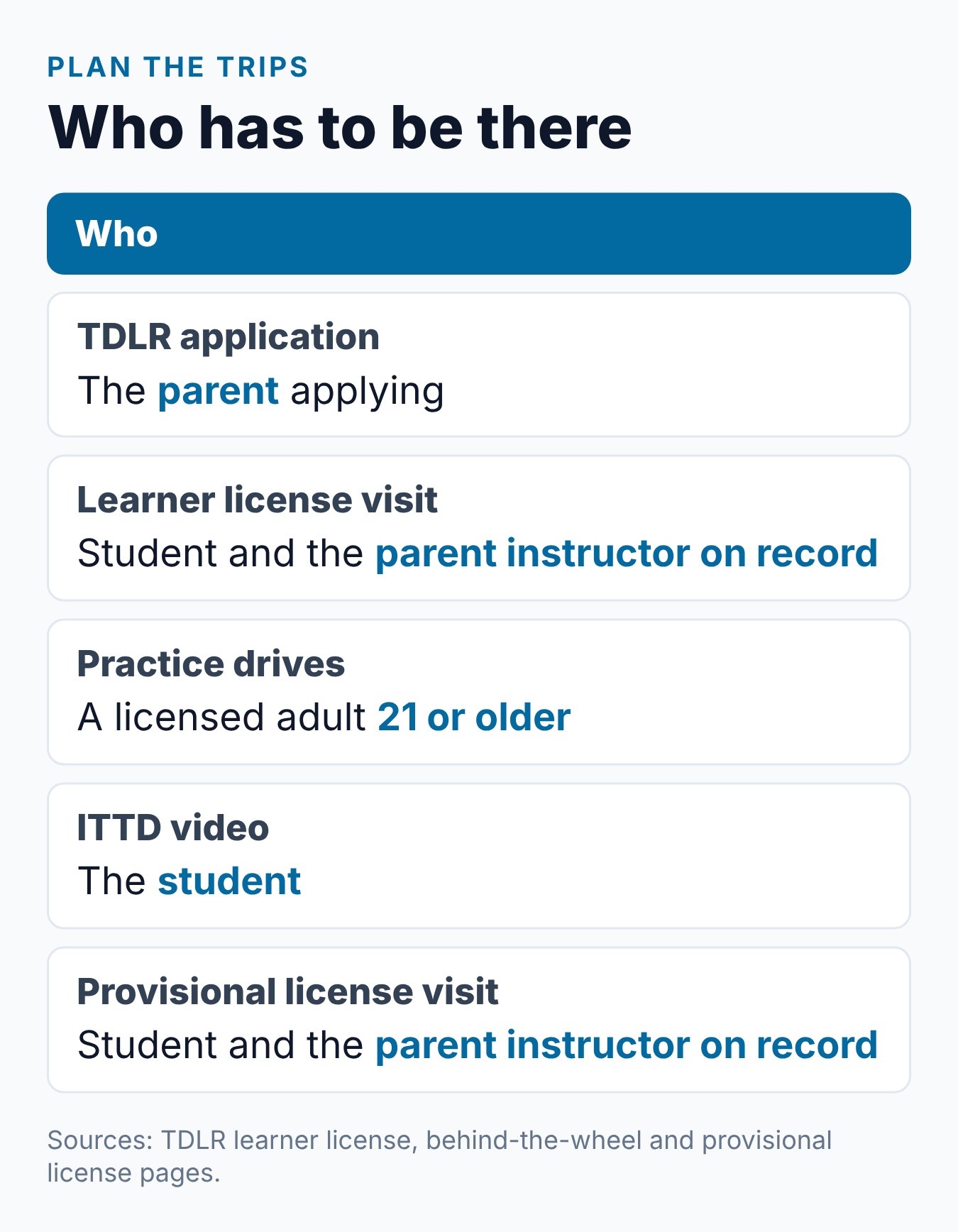
- DPS visits: the parent instructor on record goes with the student twice. See step 5.
- Finish line: a provisional license at 16, after six months with a learner license. See step 10.
How Online Parent Taught Drivers Ed Texas Works
The DPS Choosing a Driver Education Course page lists parent-taught as one of four options. In PTDE, the parent is the instructor. The course content comes from a licensed provider.
“Online” mostly describes the paperwork and the classroom phase. TDLR takes the instructor application online only. When a provider sells its classroom phase as an online course, the student does those lessons on a device.
The in-car phase is different. Those hours happen in a real car on real roads. The learner license and the driving test also take an in-person trip to a DPS office or a third-party test site.
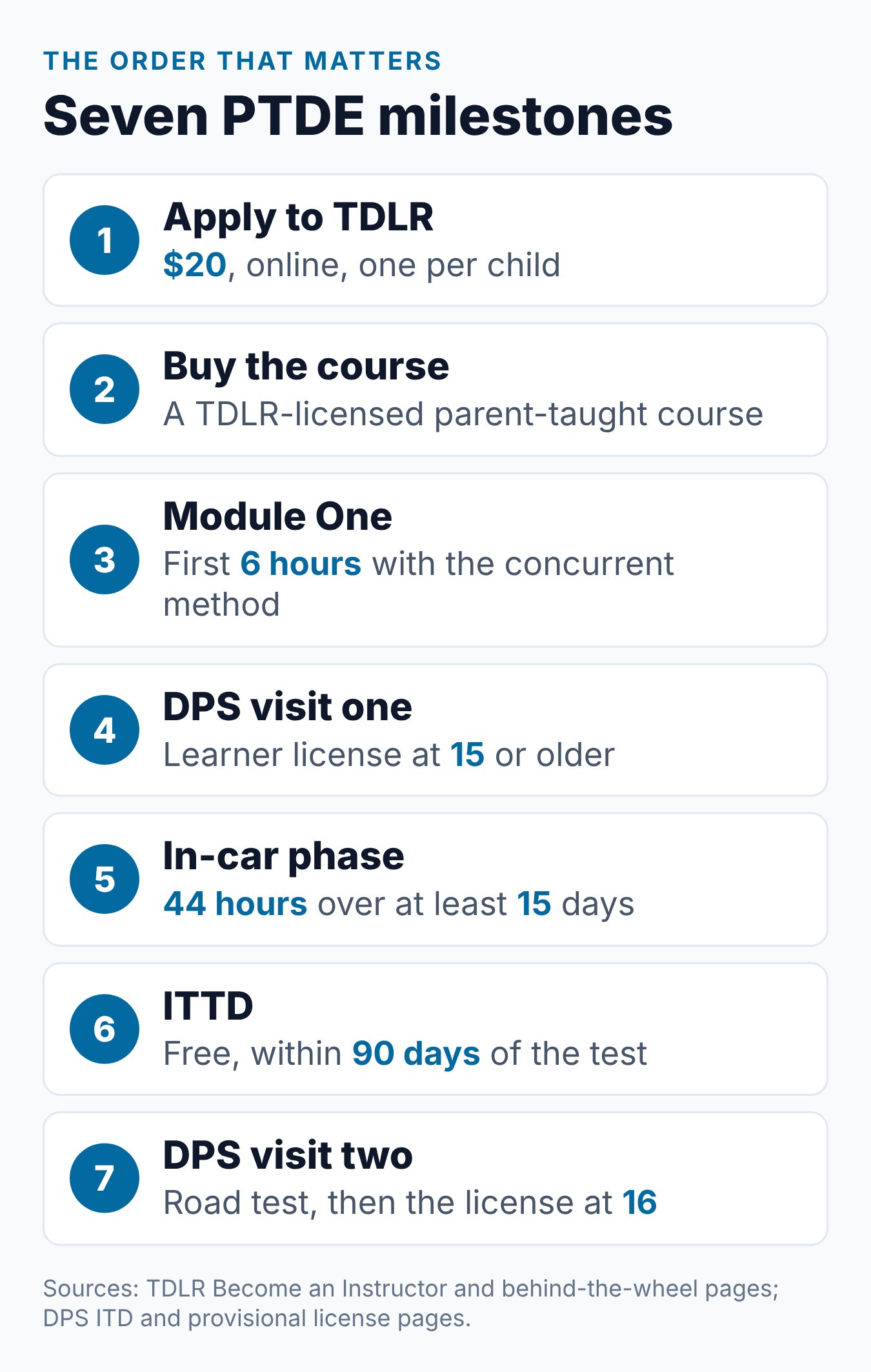
The Ten Steps at a Glance
Here is the full order. Each step has its own section below.
- Check that the instructor and student are both eligible.
- Apply to TDLR for instructor designation and get the Program Guide.
- Buy a course from a provider with the parent-taught endorsement.
- Finish Module One, or all 24 classroom hours for the block method.
- Get the learner license at DPS at age 15 or older.
- Finish the classroom hours and the 44 in-car hours.
- Get the driver license portion of the DE-964.
- Complete Impact Texas Teen Drivers within 90 days of the test.
- Pass the driving test at DPS or with a third-party tester.
- Get the provisional license at 16 or older.
Step 1: Check Eligibility
Two people need to qualify. The first is the instructor. TDLR’s eligibility page asks about the instructor’s relationship to the student, age, license history and driving record.
A few rules screen people out fast. The instructor must be at least 25 and must have held a license for at least seven years.
A license with the B restriction disqualifies the person. Our instructor requirements guide covers each question.
The second is the student. TDLR says a student under 18 without a diploma or equivalent must have been in school for at least the past 80 days. For a high school equivalency program, the rule is at least the past 45 days.
Step 2: Apply to TDLR and Get the Program Guide
The parent applies on TDLR’s Become an Instructor page. The fee to apply is $20, and it is non-refundable. TDLR does not take paper applications.
Fill it out with care:
- One application per child. A parent teaching two teens files twice.
- Exact legal name. The student’s name must match the birth certificate.
- Alternate instructor. If you name one, add that person’s details on the form.
After you apply, TDLR sends an email. The Program Guide comes by email, and you can download it any time from the Parent Instructor Portal. See our Program Guide article for more on this step.
Step 3: Buy a Course From an Endorsed Provider
TDLR’s getting started page says to buy curriculum from a licensed provider with the parent-taught endorsement. You can look one up with TDLR’s parent-taught provider search.
TDLR says it cannot recommend specific courses. It also says it will not text or email you to send you to a provider. A message that does that did not come from TDLR.
The student also needs the Texas Driver Handbook. TDLR says it is online only, in English and Spanish.
Step 4: Finish the First Classroom Hours
The method you pick decides how many classroom hours come before the learner license. DPS describes both:
- Concurrent method: take the first 6 hours of classroom instruction, then apply for the learner license.
- Block method: complete all 24 hours of classroom instruction first.
Once the student finishes enough hours, the provider issues the learner license portion of the DE-964. Our concurrent vs block guide helps you pick.
The knowledge exam may happen here too. TDLR says the provider may include it in the course. If not, the student takes it at the DPS office.
Step 5: Get the Learner License at DPS
The student must be at least 15. TDLR’s learner license page says the first step is to make an appointment. DPS takes bookings at txdpsscheduler.com up to six months ahead.
On top of the standard DPS documents, TDLR lists items that apply to parent-taught students:
- Proof of Texas vehicle registration.
- Proof of vehicle insurance, or a signed statement if the student does not own a vehicle.
- The receipt from the parent-taught instructor designation.
- The DE-964 learner license portion from the provider.
The parent instructor on record must go with the student. A Verification of Enrollment and Attendance form is valid for 30 days, or 90 days if issued June through August. The learner license fee for a teen is $16 on the DPS fees page.
For the full document list, see our learner license documents checklist.
Step 6: Finish the Classroom and In-Car Hours
With the learner license issued, driving can begin. Under 16 TAC 84.50, behind-the-wheel instruction and practice may not start before that point.
A concurrent student also finishes the last 18 classroom hours now, while practicing. The in-car phase adds up to 44 hours:
- 14 hours of instruction: 7 hours of in-car observation and 7 hours behind the wheel.
- 30 hours of practice: at least 10 of them at night.
The TDLR behind-the-wheel page sets the pace. Students may get no more than 2 hours of behind-the-wheel instruction and 2 hours of supervised practice a day. The in-car course cannot be finished in fewer than 15 calendar days.
Practice drives need a licensed adult 21 or older who has held a license for at least one year. For a minor, a parent or legal guardian certifies the hours. The 30 practice hours go on TDLR’s log form, which our driving log guide explains.
Step 7: Get the DE-964 Driver License Portion
When the whole course is done, the provider issues the “For Driver License Only” portion of the DE-964. That rule is in 16 TAC 84.43.
TDLR no longer sells paper certificates. Providers buy certificate numbers instead. If a provider will not send the certificate, TDLR says to contact its customer service with the student’s full name and the course name.
Step 8: Complete ITTD Within 90 Days
Impact Texas Teen Drivers (ITTD) is a free, two-hour video program on distracted driving. The DPS ITD program page says to complete it after behind-the-wheel training and before the skills test.
The certificate is valid for 90 days. Print it and bring it to the test. DPS says the test cannot be taken without it.
Teens take ITTD on the Impact Texas Drivers site. The adult version, ITAD, is a different program for drivers 18 and older.
Step 9: Pass the Driving Test
The student has two choices for the road test. One is a DPS office, booked online by choosing “Class C” under Road Skills Test. Bring proof of current registration and insurance for the test vehicle.
The other is a third-party provider. Those results reach DPS in a sealed envelope or through the TPST Submission Portal, the DPS provisional license page says.
The knowledge test is waived if the student passed it during the course. The student must also pass a vision exam.
Step 10: Get the Provisional License
The student must be 16 or 17 and must have held the learner license for at least six months. A learner license suspension adds its days to that six months. The fee is $16.
TDLR’s provisional license page says the parent instructor on record must come to the office. DPS checks the instructor’s record again on this visit.
The provisional license carries under-18 limits on phones, passengers and late-night driving. It expires on the 18th birthday. Our guide to provisional license restrictions covers each one.
What Happens Online and What Does Not
This table sorts the steps by where they take place:
| Step | Where it takes place | Notes |
|---|---|---|
| Instructor application | Online at TDLR | Paper is not accepted |
| Program Guide | Email and the Parent Instructor Portal | Download it any time |
| Classroom lessons | Set by the provider’s format | 24 hours minimum |
| Learner license | DPS office, by appointment | Parent instructor attends |
| In-car hours | In a car with the student | 44 hours, 15 days or more |
| ITTD | Online on the DPS site | Free, two hours |
| Driving test | DPS office or third-party provider | Bring vehicle papers to DPS |
Common Mistakes Along the Way
These slip-ups come from skipping a rule on a TDLR or DPS page:
- Starting lessons early. TDLR’s classroom page says parent-taught instruction begins after you get the designation confirmation.
- Using an old VOE form. The form expires after 30 days, or 90 days in summer.
- Taking ITAD instead of ITTD. The teen program is ITTD.
- Testing too late. An ITTD certificate older than 90 days will not work.
- Swapping instructors quietly. To change instructors, TDLR asks for the student’s full name and date of birth, the new instructor’s name and the original receipt number.
How Requirements Can Vary
Texas driver education rules come from TDLR, and driver license rules come from Texas DPS. They apply statewide, but what you need depends on the student’s age, the course method, and whether the classroom part comes from a parent-taught course, a driving school, or a public school.
Fees, forms, and office procedures can change. Check the TDLR parent-taught pages and the DPS driver license pages before each step, and follow the instructions from your course provider.
Frequently Asked Questions
Can Texas PTDE be done fully online?
No. The TDLR application, the Program Guide and the classroom lessons can be online, and so can ITTD. The 44 in-car hours happen in a car, and the license steps happen in person.
How many times does the parent go to DPS?
TDLR says instructors must go with the student to a DPS office on two occasions. One is for the learner license, and one is for the provisional license.
When can my teen start driving practice?
Only after DPS issues the learner license. Under 16 TAC 84.50, behind-the-wheel instruction and practice may not begin before then.
Do we need a DPS appointment?
Yes. TDLR says making an appointment is the first step for the learner license. DPS books visits at txdpsscheduler.com up to six months ahead.
Where does my teen take the knowledge exam?
It depends on the course. TDLR says the provider may include it. If the course does not, the student takes it at the DPS office.
What if the provider does not send the DE-964?
Contact TDLR customer service. TDLR asks for the student’s full name and the name of the course.
Conclusion
Online PTDE works when you follow the ten steps in order: eligibility, the TDLR application, the course, Module One, the learner license, the in-car hours, the DE-964, ITTD, the test and the provisional license. The online parts save trips, but the driving and the DPS visits still happen in person.
Driving Logic’s Texas Parent Taught Drivers Ed course is coming soon. For now, TDLR’s provider search lists licensed parent-taught courses.
Related Articles
- Parent Taught Drivers Ed Texas: The Complete PTDE Guide
- Texas PTDE Program Guide Packet: What It Is, How to Get It, and Why You Need It
- Texas PTDE: Concurrent vs Block Method — Which Should Your Family Choose?
- How Long Does Texas Parent Taught Drivers Ed Take to Complete?
Sources
- TDLR — Parent-Taught Driver Education (Getting Started)
- TDLR — Become a Parent-Taught Instructor
- TDLR — Parent-Taught Classroom Instruction
- TDLR — Parent-Taught Learner License
- TDLR — Parent-Taught Behind-the-Wheel Instruction
- TDLR — Parent-Taught Provisional License
- 16 Tex. Admin. Code § 84.50 — Parent-taught program requirements
- 16 Tex. Admin. Code § 84.43 — Driver education certificates
- Texas DPS — Choosing a Driver Education Course
- Texas DPS — Texas Learner License as a Teen
- Texas DPS — Texas Provisional License as a Teen
- Texas DPS — Impact Texas Drivers (ITD) Program
- Texas DPS — Driver License Services Appointments
- Texas DPS — Driver License Fees
Billy Forte is the owner of Driving Logic, a state-approved driver improvement course provider serving Texas and other U.S. states.
This article is general information, not legal advice. Texas driver education and licensing rules are set by TDLR, Texas DPS, and Texas law, and can change. Check the official TDLR and DPS websites for current requirements.