
Updated June 2026 · Reviewed by Billy Forte
Texas PTDE can be completed two ways: the concurrent method, where the teen finishes Module 1, gets the learner’s permit, and then continues the classroom alongside behind-the-wheel practice, or the block method, where all 32 classroom hours are finished before any driving. About 80% of families choose concurrent because it lets the teen start logging real driving sooner. The right choice depends on your schedule and how soon you want your teen behind the wheel, since both lead to the same DE-964 and provisional license.
Applies to Texas teen driver education and licensing (ages 14–17). Requirements are set by TDLR (driver education) and the Texas DPS (licensing) and can change.
Key Facts
- Concurrent method: Complete Module 1, get the learner’s permit (DE-964E), then continue classroom and driving together.
- Block method: Finish all 32 classroom hours first, then move into the driving phase.
- Most pick concurrent: About 80% of families choose concurrent to start supervised driving sooner.
- Same destination: Both methods end in full completion (DE-964) and a provisional license at 16.
- Permit timing matters: Either way, the learner’s permit must be held at least 6 months before the provisional license.
What The Texas PTDE Concurrent Method Means
The texas ptde concurrent method is one of the two ways to complete Parent Taught Drivers Ed in Texas. PTDE is for teens under 18. It lets a parent or legal guardian teach the state-required driver education course by using a TDLR-approved program.
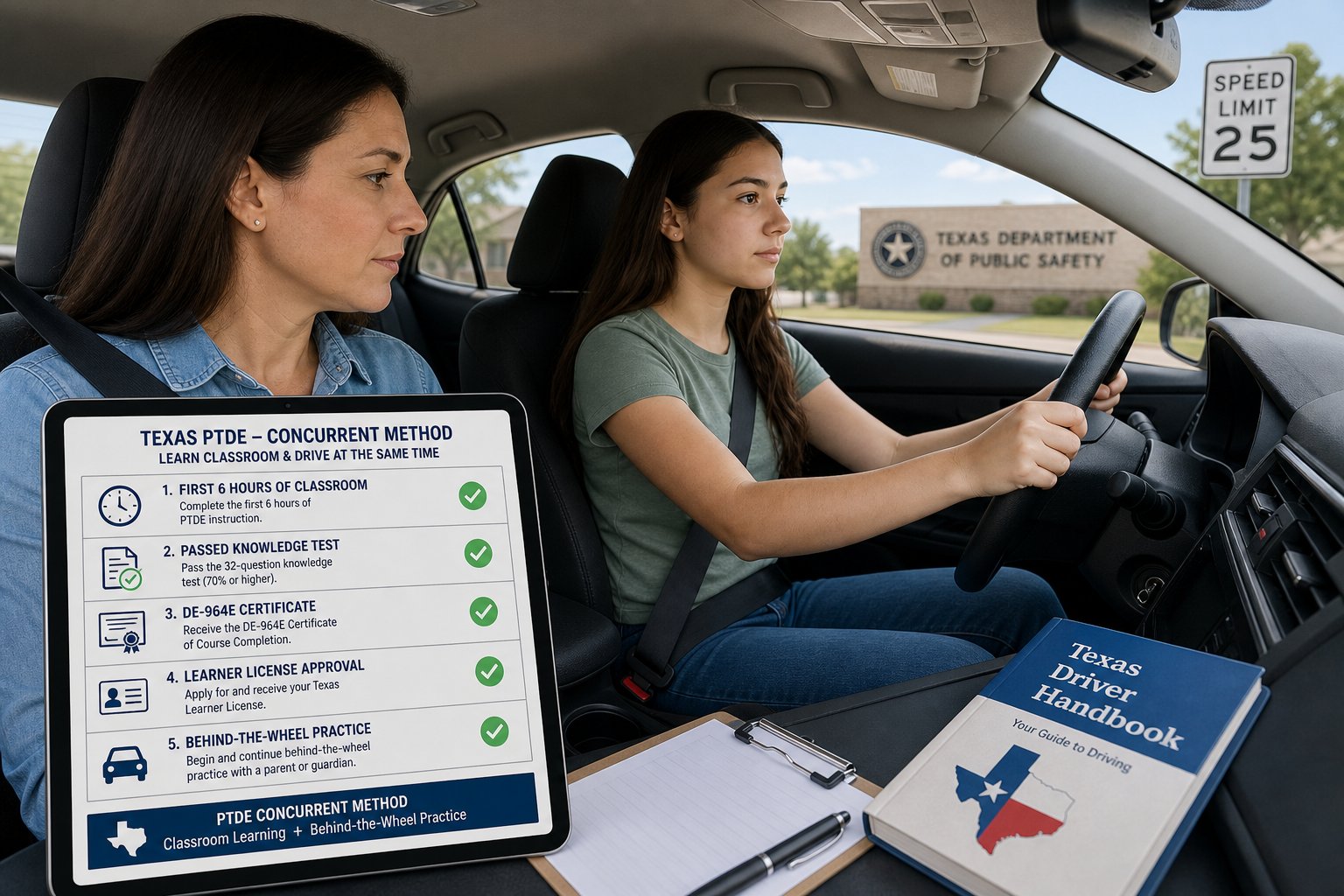
With the concurrent method, your teen starts with the first 6 hours of classroom work. After that, your teen can take the knowledge test if the course offers it, receive the DE-964E partial completion certificate, and apply for a learner license with Texas DPS once age requirements are met.
That is the big reason families pick it. Your teen can begin real driving practice sooner instead of waiting until all classroom work is done.
In plain terms, the process works like this:
- Complete the first 6 classroom hours
- Pass the permit test, if included in the course
- Get the learner license at age 15 or older
- Keep working through the rest of the classroom lessons
- Do the required behind-the-wheel practice at the same time
Most families like this setup because classroom ideas connect better to real driving. If your teen studies turns, signs, or right-of-way one day, they can practice those same skills soon after with a parent in the car. That often helps the lessons stick.
One more point matters. The state agencies are not the same. Texas Department of Licensing and Regulation approves PTDE courses and handles the PTDE Program Guide. TxDPS handles permits and licenses. And no, PTDE is not the same as adult driver education. ADE is for adults 18 and older, while PTDE is only for teens.
Concurrent Vs. Block Method: The Key Differences For Texas Teens
The choice in concurrent vs block method PTDE Texas comes down to timing. Both methods can meet state requirements. But they do not move at the same speed.
With the concurrent method, your teen does the first 6 hours of classroom work first. Then, once your teen is old enough and has the needed documents, they can get the learner license and begin behind-the-wheel practice while still finishing the rest of the class.
With the block method, your teen must complete all classroom hours first before getting the permit and starting driving practice. That delay is the main downside.
Here are the key differences:
- Concurrent: permit after the first 6 hours
- Concurrent: driving practice starts earlier
- Concurrent: classroom and driving happen together
- Block: all classroom work comes first
- Block: permit comes later
- Block: driving starts later too
For most families, concurrent is the better fit. It usually feels faster because it is faster to the permit stage. It also works better for memory. Teens often learn more when they can apply a lesson soon after studying it.
Still, the block method may help in a few cases. If your family wants to finish the full classroom part first before any driving, block can feel simpler. Some parents prefer one task at a time. But that simpler structure comes with a tradeoff: more waiting before your teen gets road time.
A practical rule is this: if your goal is to help your teen start safely practicing as soon as allowed, choose concurrent. That is why about 80% of Texas families use it.
Who Is Eligible For PTDE And Who Can Be The Parent Instructor
PTDE has rules for both the teen and the parent instructor. These rules matter because the course must be set up correctly from the start.
For the student, PTDE is for teens under 18. A teen can usually enroll between ages 14 and 17. But enrolling is not the same as getting a permit. Your teen must be at least 15 years old to apply for the learner license through TxDPS.
For the instructor, Texas generally requires the teacher to be the teen’s:
- Parent
- Legal guardian
- Court-appointed guardian
The parent instructor must also meet state eligibility rules. That usually means having a valid driver license and not having a driving or legal record that blocks approval. The details are covered in the PTDE Program Guide from TDLR.
The PTDE Program Guide is not optional. It is required before you start the course. It costs $20 from TDLR, and as of January 2026 it is delivered by email only. There is no physical packet mailed out now.
That point trips up some families. If you start classroom work before getting the PTDE Program Guide and setting up the process the right way, you can create problems later.
You also need to keep the certificates straight:
- DE-964E = partial completion certificate for Module 1 only
- DE-964E is used to help get the learner license
- DE-964 = full completion certificate for the provisional license
Those names look similar, but they are not the same document. Using the wrong one can slow things down.
How The Step-By-Step PTDE Concurrent Process Works
The concurrent path is not hard, but you do need to do the steps in the right order. If you skip ahead, TxDPS may not accept your paperwork.
Start by getting the required state approval piece from TDLR. Then enroll in a TDLR-approved PTDE course. A provider like Driving Logic can give you the online classroom and help you move at a steady pace on your own schedule.
After that, your teen begins the first part of the class. Once the first 6 hours are done, the permit step opens up, assuming your teen is old enough. Then your family can work on classroom lessons and driving practice at the same time.
That overlap is the whole point of the concurrent method. It helps many families finish faster because they are not waiting for one part to be fully done before starting the next.
What You Need To Start, Including The PTDE Packet And Required Forms
Before anything else, buy the PTDE Program Guide from TDLR. It costs $20 and, as of January 2026, it is sent by email only. Do not start PTDE before you have it.
You will also need:
- A TDLR-approved PTDE course
- The parent instructor information required by the state
- The teen’s identity and school-related documents for the permit visit
- A way to track classroom and driving progress
For certificates and forms, remember this split:
- DE-964E is the partial completion certificate
- It is used after Module 1 for the learner license step
- DE-964 is the full completion certificate
- It is used later for the provisional license
Many families also need the driving log ready from day one. That makes it easier to record hours as they happen instead of trying to rebuild the log later.
When it is time for the permit visit, check current document rules directly with TxDPS. Requirements can change, and your local office may have process details worth checking before you go.
When You Can Get A Permit, Complete Driving Hours, And Apply For A License
In the concurrent method, your teen can move toward the permit after the first 6 classroom hours are done. But age still matters. Your teen must be at least 15 to get the learner license.
After getting the permit, your teen can begin the required behind-the-wheel work. Texas requires a total of 44 driving hours, which includes:
- 7 hours of in-car instruction
- 7 hours of observation
- 30 hours of practice
- At least 10 night hours within that practice total
Texas also has daily limits. A teen cannot just cram everything into a few long days. That is one reason the process still takes time, even with the faster concurrent path.
To apply for the provisional license, your teen must generally:
- Be at least 16
- Hold the learner license for at least 6 months
- Finish the classroom and driving requirements
- Complete Impact Texas Teen Drivers
ITTD is important but separate. It is a free, 2-hour TxDPS course. It is not the same as PTDE or TDE. It is an extra step required before the road test, not a replacement for driver education.
Typical Timeline, Costs, And Common Mistakes To Avoid
For many families, the concurrent method is the fastest legal path. A common timeline looks like this:
- First 1 to 3 weeks: finish the first 6 hours and prepare for the permit step
- Next several months: complete classroom lessons and driving hours together
- Overall: often about 6 to 9 months, depending on pace and scheduling
The total time depends on age, daily limits, family schedule, and how quickly you log driving practice. The concurrent method helps because it removes the wait between early classroom work and road practice.
Costs come from a few places, but they are not all part of the course itself:
- $20 for the PTDE Program Guide from TDLR
- Tuition for the TDLR-approved PTDE course provider
- State fees charged by TxDPS for permit and license steps
Do not guess on current fees. Check the official agency sites before you pay anything.
The most common mistakes are simple:
- Starting before buying the PTDE Program Guide
- Mixing up DE-964E and DE-964
- Forgetting to log driving hours as you go
- Treating ITTD like part of PTDE instead of a separate step
- Waiting too long to line up the road test
If your family wants a smoother path, use a state-approved online course that keeps the steps clear. Driving Logic’s Texas PTDE/TDE course is built for busy families who want flexible access, simple progress tracking, and a faster path through the legal requirements without classroom attendance.
FAQ
What’s the difference between concurrent and block PTDE?
Concurrent completes Module 1, gets the permit, then runs classroom and driving together. Block finishes all 32 classroom hours before driving. Most families choose concurrent.
Which method is faster?
Concurrent often feels faster because driving practice starts right after the permit, but both must respect the 6-month permit holding period before a provisional license.
Why do most families choose concurrent?
It lets the teen begin supervised behind-the-wheel practice as soon as the permit is issued, spreading the driving over the classroom period rather than after it.
Does the method change the requirements?
No. Both require the program guide, 32 classroom hours, the DE-964E and DE-964 certificates, the logged driving, and the 6-month permit period.
Conclusion
Concurrent versus block is really a scheduling decision, not a difference in what your teen must complete. Concurrent gets a new driver practicing sooner and is what most Texas families pick; block keeps the classroom and driving phases cleanly separate. Either way you’ll satisfy the same hours, certificates, and the 6-month permit period, so choose the rhythm that fits your family’s calendar.
Whichever method you choose, the 32 classroom hours can be done through a TDLR-approved Texas parent-taught drivers ed course online.
Related Articles
- Texas Parent Taught Drivers Ed (PTDE): The Complete Guide
- How Texas Parent Taught Drivers Ed Works Online: Step-by-Step
- How Long Does Texas Parent Taught Drivers Ed Take to Complete?
- Texas PTDE Driving Log: How to Track Your Teen’s Behind-the-Wheel Hours
Sources
Billy Forte is the owner of Driving Logic, a TDLR-approved Texas driver education provider. Driving Logic offers the online Texas parent-taught and teen driver education course that helps Texas teens complete the 32-hour classroom requirement and work toward a learner’s permit and provisional license.
This article is general information about Texas teen driver education and licensing, not legal advice. Requirements, fees, and procedures are set by TDLR and the Texas DPS and can change, so confirm current details with official Texas sources before you enroll or visit a DPS office.