
Updated June 2026 · Reviewed by Billy Forte
The Texas PTDE driving log is the form, included in the PTDE Program Guide, where you record each behind-the-wheel practice session your teen completes with a qualifying adult. For every session you note the date, time or duration, and conditions such as day, night, or weather, building toward the supervised practice Texas requires (commonly 30 hours, including 10 at night). Keeping the log accurate and complete is what prevents delays when it’s time to apply for the provisional license.
Applies to Texas teen driver education and licensing (ages 14–17). Requirements are set by TDLR (driver education) and the Texas DPS (licensing) and can change.
Key Facts
- Where it comes from: The driving log forms are part of the PTDE Program Guide from TDLR.
- What to record: Date, duration, and conditions (day, night, weather) for each supervised session.
- Practice target: Texas commonly requires 30 hours of supervised practice, including 10 at night.
- Who supervises: A qualifying parent or adult instructor must be present for logged practice.
- Accuracy matters: A complete, consistent log helps avoid delays when applying for the provisional license.
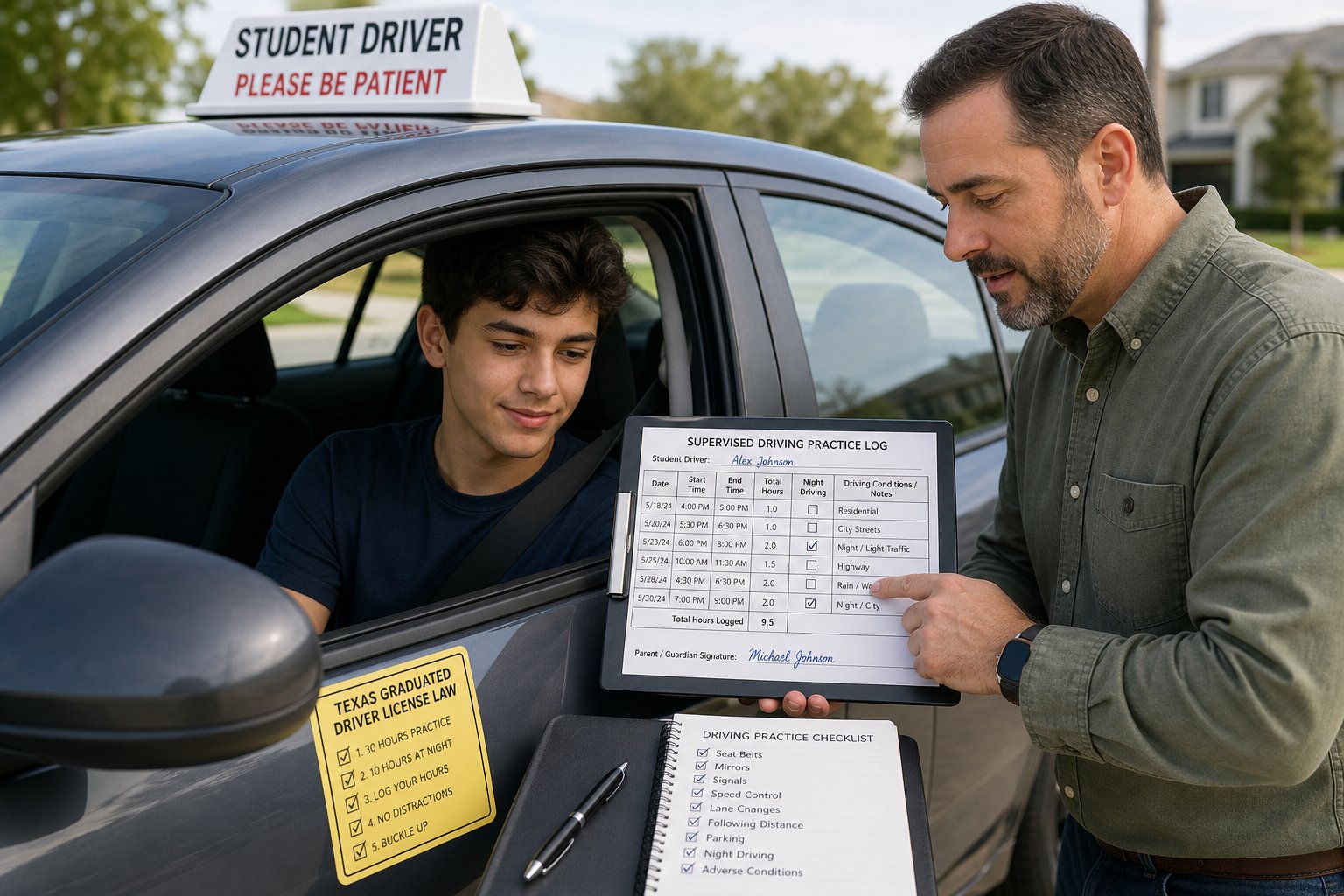
What The Texas PTDE Driving Log Is And Why It Matters
The texas ptde driving log is the written record of your teen’s supervised driving practice. It is part of the Parent Taught Drivers Ed process for teens under 18. Texas DPS may review it when your teen moves from a learner license to a provisional license.
The main log comes from the PTDE Program Guide. That guide is tied to the Parent Taught Driver Education program approved by the Texas Department of Licensing and Regulation (TDLR). TDLR approves the course path. TxDPS handles the license.
This log matters because it shows two things at once:
- Your teen practiced the required hours
- The practice happened under supervision
- The drives covered real skills and conditions
Without a clear log, you risk delays at the license step. A missing night total, a blank date, or an unofficial sheet can create problems you do not need.
The log also helps you train in a smart order. You can start with easy streets, then move to traffic, highways, parking, and night driving. That makes the record useful, not just required.
For PTDE, do not mix this up with adult driver education. ADE is for adults 18 and older. PTDE and TDE are for teens under 18. Different rules apply.
If you are starting fresh, buy the PTDE Program Guide from TDLR first. The packet costs $20 and, as of January 2026, it is delivered by email only.
Texas Driving Hour Requirements For Parent-Taught Driver Education
Texas PTDE has more than one bucket of hours. That is where many parents get stuck.
First, your teen must complete the course work. That includes 32 hours classroom instruction in the teen driver education course. Then there is the in-car part.
The supervised driving total is 44 hours. That breaks down like this:
- 14 hours of in-car course work
- 30 hours of extra behind-the-wheel practice
- At least 10 of the 30 extra hours must be at night
The 14 in-car hours are usually split into:
- 7 hours observation
- 7 hours behind-the-wheel instruction
Many families track those 14 hours on the DL-91B Instruction Log. It is often treated as optional, but it is very helpful. It gives you a clean record of the formally observed and supervised instruction time.
Then there is the separate 30-hour driving log. This is the big one for extra practice. A key rule matters here: only 1 hour per calendar day can count toward those 30 hours. Your teen can drive longer, of course. But for the official 30-hour requirement, only one hour counts each day.
That rule is easy to miss. It is also one of the top reasons a ptde driving hours log texas review can get messy.
Use the PTDE Program Guide as the final word on the exact forms and layout. It is the official source for the required logs and hour tracking.
What To Record On A Texas PTDE Driving Log
Every entry should be clear and complete. If you wait days to fill it in, small details get lost fast.
On the official 30-hour log, record:
- Date of the drive
- Start and stop time or total time
- Whether it was day or night
- Driving conditions or location type
- Skills practiced
- Supervising adult’s name
For conditions, be specific. Good examples include:
- Neighborhood streets
- Busy city traffic
- Rural roads
- Highway driving
- Parking lots
- Parallel parking areas
For skills, write what your teen actually practiced. Examples:
- Right and left turns
- Lane changes
- Backing up
- Parking
- Speed control
- Merging
- Stopping smoothly
- Using mirrors
Keep your wording simple. You do not need long notes. Short, honest details are better than vague entries like “general driving.”
If you also use a DL-91B for the 14 in-car hours, keep it neat and consistent with the course schedule. That log helps show the observation and instruction portion was completed.
Use the official format from the PTDE packet whenever possible. A homemade sheet may leave out details Texas DPS expects to see. If your course provider offers printable tracking help, use it as a helper, but match it to the official PTDE Program Guide records.
How To Complete The Log Step By Step During Behind-The-Wheel Practice
The best way to handle the log is simple: fill it out right after each drive. Do not save it for the end of the week.
Here is a clean step-by-step process:
- Start with the official 30-Hour Driving Log from your PTDE Program Guide.
- After each supervised drive, write the date.
- Add the start and end time, or total minutes.
- Mark whether the drive was daytime or nighttime.
- Note the road type or driving setting.
- List the main skills practiced.
- Keep a running total of overall hours and night hours.
One more rule matters a lot: do not count more than 1 hour per day toward the 30-hour requirement. Even if your teen drove 90 minutes, only 60 minutes counts for that specific log total.
A simple routine helps. Keep the log in the car or save a printed copy at home with a pen nearby. Some parents jot quick notes on their phone after each drive, then transfer them to the official form the same day.
Try to spread practice across real situations. For example:
- Week 1: quiet streets and turns
- Week 2: traffic lights and lane changes
- Week 3: parking and backing
- Week 4: higher-speed roads
- Later: highway and night practice
That makes your teen safer, and it makes the log look complete and believable. Texas DPS wants to see a real training record, not a rushed stack of entries made the night before the appointment.
Related Forms And Course Requirements You May Need Before Licensing
The driving log is only one part of the full PTDE file. Your teen will need other forms and course records before the license step.
Here are the main items to know:
- PTDE Program Guide from TDLR
- DL-92 Parent-Taught Driver Education Affidavit
- DE-964E for partial completion after Module 1
- DE-964 for full course completion
- 30-Hour Driving Log
- DL-91B Instruction Log for the 14 in-car hours
- VOE from school
- ITTD certificate
A few of these cause confusion.
DE-964E is the partial completion certificate. It is used after Module 1 so a teen can move toward the learner license step. DE-964 is the full completion certificate used later for the provisional license.
Also, Impact Texas Teen Drivers (ITTD) is separate from PTDE. It is a free, 2-hour TxDPS course. It is not the teen driver education course itself. You complete it through Impact Texas Teen Drivers.
For agency roles, keep this straight:
And never call it the Texas DMV. Texas uses TDLR and TxDPS for these steps.
If you want an online teen course option, Driving Logic’s Texas PTDE/TDE course can help you complete the classroom side on your schedule.
Common PTDE Driving Log Mistakes That Can Slow Down Approval
Most log problems are simple. That is the frustrating part. Small errors can slow down a license appointment.
Common mistakes include:
- Missing dates or times
- No clear day or night mark
- Night hours not totaled correctly
- Using a non-official format with missing fields
- Writing more than 1 hour per day toward the 30-hour total
- Leaving entries unsigned or unclear
- Forgetting the DE-964 or ITTD certificate
Another issue is messy records. If handwriting is hard to read, or entries all look written on the same day, the log may raise questions. Keep it neat and fill it in as you go.
Some parents also confuse the 14 in-car course hours with the 30 extra practice hours. They are related, but they are not the same log. The DL-91B helps with the 14-hour instruction piece. The 30-hour log tracks the added practice requirement.
And remember, PTDE is for teens under 18. Do not use adult course forms or ADE records. They do not replace PTDE documents.
A good final check before your Texas DPS visit:
- Count total 30-hour practice time
- Confirm at least 10 hours are at night
- Review dates for gaps or errors
- Make sure certificates are present
- Bring the official forms, not rough notes
Ten extra minutes of review at home can save a wasted trip later.
When The Driving Log Is Finished And How To Move On To The License Application
When your teen finishes the required practice, the next step is getting ready for the Texas DPS license process.
Before moving on, make sure your teen has:
- Held the learner license for at least 6 months
- Completed the full course and received the DE-964
- Finished the official 30-hour log
- Logged at least 10 night hours within that 30-hour total
- Completed ITTD within the required time window before the road test
Then gather the main records for Texas DPS. These often include:
- Learner license
- DE-964 completion certificate
- Completed 30-Hour Driving Log
- DL-91B if you have it
- VOE from school
- Required ID documents and state fees
Texas DPS will use these items to verify eligibility for the provisional license step. In short, your log is not just a notebook. It is part of the proof that your teen completed Parent Taught Drivers Ed the right way.
If you still need the course side of PTDE or TDE, Driving Logic offers a Texas teen driver education option built for busy families who want flexible online access. That can make it easier to finish the classroom requirements while you stay on top of the behind-the-wheel log at home.
FAQ
What goes on a Texas PTDE driving log?
Each supervised session’s date, duration, and conditions — day, night, and weather — signed off as your teen builds the required supervised practice hours.
How many practice hours does Texas require?
Texas commonly requires 30 hours of supervised behind-the-wheel practice, including 10 at night, in addition to the course’s in-car instruction. Confirm current figures with TxDPS.
Who can supervise logged driving?
The qualifying parent or adult instructor who meets the license-length and clean-record requirements. The same supervision rules as the rest of PTDE apply.
What log mistakes cause delays?
Missing dates, incomplete night hours, or gaps in the record. Keep entries consistent and complete so the log supports the provisional license application cleanly.
Conclusion
The driving log is where PTDE practice becomes official, so treating it carefully pays off at license time. Record every session as you go — date, duration, conditions — and make sure the night hours add up, because reconstructing a log later is where families lose time. A clean log turns the provisional license application into a formality.
The log forms come with your program guide; your teen can complete the classroom hours through a TDLR-approved Texas parent-taught drivers ed course online.
Related Articles
- Texas Parent Taught Drivers Ed (PTDE): The Complete Guide
- Texas Driver Education Certificate DE-964: What It Is and How to Use It
- Texas PTDE: Concurrent vs Block Method — Which Should Your Family Choose?
- How Texas Parent Taught Drivers Ed Works Online: Step-by-Step
Sources
Billy Forte is the owner of Driving Logic, a TDLR-approved Texas driver education provider. Driving Logic offers the online Texas parent-taught and teen driver education course that helps Texas teens complete the 32-hour classroom requirement and work toward a learner’s permit and provisional license.
This article is general information about Texas teen driver education and licensing, not legal advice. Requirements, fees, and procedures are set by TDLR and the Texas DPS and can change, so confirm current details with official Texas sources before you enroll or visit a DPS office.