
Updated June 2026 · Reviewed by Billy Forte
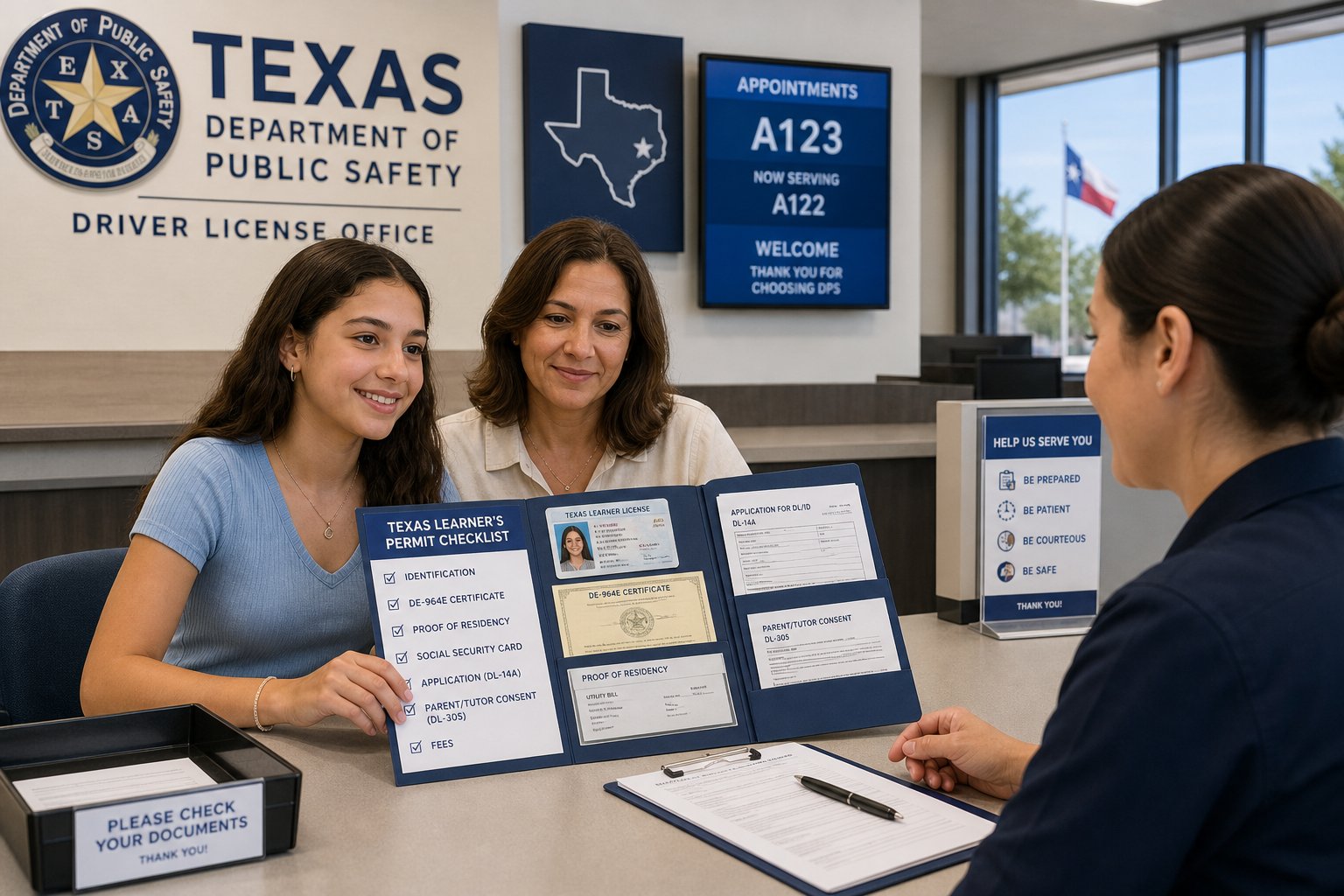
For a Texas learner’s permit, your teen must bring proof of identity, proof of Texas residency, their Social Security number, a Verification of Enrollment (VOE) showing they are in school, and the DE-964E certificate from Module 1. DPS uses these to confirm identity, residency, and school attendance, and a missing item is the most common reason a permit trip turns into two. Assembling the originals before the appointment is the simplest way to avoid a delay.
Applies to Texas teen driver education and licensing (ages 14–17). Requirements are set by TDLR (driver education) and the Texas DPS (licensing) and can change.
Key Facts
- Proof of identity: A primary document such as a U.S. birth certificate or valid passport.
- Texas residency: Documents showing your Texas address, such as utility bills or a lease.
- Social Security number: Provide the SSN (the card is the simplest proof).
- Verification of Enrollment (VOE): Proof the teen is enrolled and attending school, required under 18.
- DE-964E certificate: The Module 1 partial-completion certificate from the driver ed course.
Who Needs A Texas Learner’s Permit And Basic Eligibility Rules


If you have never had a license before in Texas, the first step is often a learner’s permit, also called an instruction permit or learner license. In Texas, teens age 15 to 17 must get this permit before they can move on to a provisional license.
The basic rule is simple. You must be at least 15 years old to apply. You also need to meet Texas DPS rules for identity, residence, lawful presence, and driver education.
Here are the main eligibility points:
- Be at least 15
- Be a Texas resident
- Show lawful presence in the U.S.
- Provide a Social Security number or approved proof
- Complete the required part of driver education
- Pass the vision exam
- Pass the knowledge test, unless your course handles that requirement in an approved way
If you are under 18, a parent, guardian, or other qualified adult usually must sign the application. That consent matters. A missing signature is one of the easiest ways to turn one DPS trip into two.
Texas does not use the term “Texas DMV” for this process. The agency that issues permits is Texas DPS, also called TxDPS. The Texas Department of Licensing and Regulation approves driver education providers, but it does not issue your permit.
One more rule matters later: you must hold the learner license for a 6-month holding period before taking the road test for a provisional license, if you are in the teen licensing path. That clock starts after the permit is issued, not when you start class.
Driver Education Requirements By Age In Texas
Texas splits driver education by age, and this is where many families get mixed up. Teens under 18 follow the teen path. Adults 18 and older follow a different path.
If you are 14 to 17, you must take a state-approved teen driver education course before getting a learner’s permit. That can be:
- Parent Taught Drivers Ed (PTDE)
- A commercial driving school course
- A public school driver education course
For a permit, the key record is the DE-964E. That is the partial completion certificate tied to Module 1. It is not the same as the DE-964, which is used later for the provisional license stage after full course completion.
That difference matters a lot. Bringing the wrong certificate can delay your application.
If you choose PTDE, you must first get the PTDE Program Guide from TDLR. The guide costs $20, and as of January 2026 it is delivered by email only. No paper packet is mailed.
Also important: PTDE/TDE is for teens. ADE, or Adult Driver Education, is a separate course for people 18 and older. They are not the same program.
And don’t confuse the main driver ed course with ITTD. Impact Texas Teen Drivers is a free, 2-hour TxDPS course. It is separate from PTDE or other teen driver education. You can review current ITTD details at Impact Texas Teen Drivers.
If you want a flexible online option, Driving Logic offers Texas PTDE/TDE training built for busy schedules. That can help if you need to fit class time around work, school, or family plans.
Texas Learner’s Permit Document Checklist
Here is the core texas learners permit checklist for your DPS visit. Bring original documents when possible, and make sure names and addresses match.
You will usually need:
- Driver license application (DL-14A)
- Proof of identity
- Proof of U.S. citizenship or lawful presence
- Social Security card or Social Security number
- Two proofs of Texas residency
- DE-964E from your teen driver education course
- Parent or guardian consent if you are under 18
- Verification of Enrollment (VOE), diploma, or GED if required
- PTDE records if you are in Parent Taught Drivers Ed
- Payment for the $16 learner license fee
Texas DPS uses Verifiable Identity Document rules, often called VID requirements. In plain English, that means DPS must be able to verify that your identity documents are real, current when required, and tied to you. A blurry copy, a damaged record, or a name mismatch can cause problems.
Common VID mistakes include:
- Bringing a copy instead of a certified original
- Using documents with different names and no legal name-change proof
- Forgetting the second residency document
- Bringing an expired record when a current one is required
What To Bring As Proof Of Identity, Residency, Enrollment, And Insurance
For proof of identity, common choices include a certified birth certificate or a U.S. passport. For lawful presence, some applicants use the same record, while others may need immigration documents such as a permanent resident card.
For Texas residency, bring two documents that show your name and Texas address. Good examples include:
- Utility bills
- Bank statements
- Lease papers
- School records, when accepted by DPS
If you are under 18, school status can matter too. Bring a VOE if needed. It must be current, and older forms can be rejected.
If you are bringing your own car for any part of the process, carry proof of liability insurance and current Texas registration. Check the latest official list at TxDPS.
How To Apply At The DPS And Take The Knowledge Test
Start by booking a DPS appointment online. Walk-in service may be limited, and appointment rules can change by office. Checking ahead saves time.
At your appointment, bring every document in your checklist. If you are under 18, go with your parent or guardian unless DPS rules allow another valid option.
The usual steps look like this:
- Check in at Texas DPS
- Submit your documents
- Give your photo and biometrics
- Pay the $16 permit fee
- Take the vision exam
- Take the knowledge test if needed
- Receive a temporary paper permit if approved
Some students meet the testing rule through their driver education provider, depending on the course and DPS policy. But do not assume. Confirm what applies to you before the appointment.
Bring your documents in a folder and in a smart order. Put identity and lawful presence first, then Social Security, then residency, then school and driver ed forms. That sounds small, but it makes the counter visit faster.
Study before you go. The Texas Driver Handbook and your approved course lessons are the best place to start. If you need a state-approved online teen course, Driving Logic can help you complete the class portion on your own schedule.
After approval, DPS will usually give you a temporary paper permit. Your plastic card is mailed later. If anything is missing, the office may not finish your application that day, so double-check every item before you leave home.
Texas Learner’s Permit Restrictions And Practice Driving Rules
A learner’s permit lets you practice driving, but not alone. Texas has clear rules, and they are not optional.
The biggest rule is supervision. You must have a licensed driver age 21 or older in the front passenger seat any time you drive. If that person is not there, you cannot legally drive.
Texas also limits phone use for teen permit holders. No cell phone use while driving, including hands-free use, except in an emergency. That rule is easy to forget because many adults use in-car tech all the time. For a teen driver, the safer move is simple: put the phone away.
If you are on the teen path, you must keep the permit for at least the 6-month holding period before taking the road test for a provisional license. Days lost to a suspension can extend that timeline.
Another key point: the permit generally expires on your 18th birthday. If you wait too long, you may need to switch to the adult licensing path.
Practice should be steady, not rushed. Short drives help. Quiet streets first, then bigger roads, then harder traffic. That pattern builds skill without piling on too much stress at once.
Keep your permit with you when driving. Also keep insurance and registration in the car when needed. If you use a family car, make sure the supervising adult knows the rules too. Many permit problems happen because the teen was ready, but the adult in the car was not.
Common Reasons Applications Get Delayed And How To Avoid Them
Most learner’s permit delays come from paperwork, not driving skill. The good news is that most are easy to prevent.
The biggest problem is missing documents. A lot of applicants bring one residency paper instead of two, or they forget a Social Security record. Others bring the wrong driver education certificate.
Watch for these common issues:
- Missing proof of identity
- Missing second Texas residency document
- Wrong or missing DE-964E
- Old VOE form
- No parent signature for applicants under 18
- No DPS appointment
- Name mismatch across documents
The VOE issue is common for teens. If your school gives you one, make sure it is still valid when you go. An older form may not work.
PTDE students should be extra careful. Make sure your PTDE Program Guide setup is complete and that your course records match what DPS expects. Remember, DE-964E is for the learner’s permit. DE-964 is for the later license step.
You should also avoid mixing up agencies. TDLR approves the course. TxDPS issues the permit. If you need official lists, check TDLR for program rules and TxDPS for permit documents and fees.
If you want a simpler path, use a state-approved online teen course from Driving Logic and gather your paperwork before you schedule the appointment. That helps answer the big question behind what to bring to dps for learners permit texas without guessing at the counter.
FAQ
What documents do I need for a Texas learner’s permit?
Proof of identity, Texas residency, your Social Security number, a Verification of Enrollment (VOE), and the DE-964E certificate from Module 1 of your driver ed course.
What is a VOE and why do I need it?
A Verification of Enrollment confirms a teen is enrolled and attending school. Texas requires it for applicants under 18 as part of the permit application.
Do I need the DE-964E for the permit?
Yes. The DE-964E is the partial-completion certificate from Module 1 and is required to apply for the learner’s permit.
What counts as proof of residency?
Documents showing your Texas address, such as utility bills, a lease, or bank statements. Check the current DPS list for acceptable residency documents.
Conclusion
The document list is the part most within your control, so getting it exactly right is the easiest way to guarantee a single DPS visit: identity, residency, SSN, the VOE, and the DE-964E. The school-enrollment VOE is the one families forget, so confirm it early. Bring the originals, and the permit appointment becomes a formality.
Your teen earns the required DE-964E by completing Module 1 of a TDLR-approved Texas parent-taught driver education course online.
Related Articles
- Texas Learner’s Permit: How to Get It, What You Need, and What It Allows
- How to Get a Texas Learner’s Permit at 15: Step-by-Step Guide
- How to Book a Texas DPS Appointment for Your Learner’s Permit
- Texas Learner’s Permit Knowledge Test: What’s on It and How to Prepare
Sources
Billy Forte is the owner of Driving Logic, a TDLR-approved Texas driver education provider. Driving Logic offers the online Texas parent-taught and teen driver education course that helps Texas teens complete the 32-hour classroom requirement and work toward a learner’s permit and provisional license.
This article is general information about Texas teen driver education and licensing, not legal advice. Requirements, fees, and procedures are set by TDLR and the Texas DPS and can change, so confirm current details with official Texas sources before you enroll or visit a DPS office.