
Updated June 2026 · Reviewed by Billy Forte
The Texas learner’s permit knowledge test covers Texas traffic laws, road signs, and safe-driving rules, drawn from the Texas Driver Handbook and the driver education course. It is a multiple-choice test, and you generally need to score at least 70% to pass. The best preparation is finishing the course material and reviewing the handbook, since the questions track exactly what those cover.
Applies to Texas teen driver education and licensing (ages 14–17). Requirements are set by TDLR (driver education) and the Texas DPS (licensing) and can change.
Key Facts
- What it covers: Texas traffic laws, road signs, and safe-driving rules.
- Format: Multiple-choice; you generally need about 70% to pass.
- Source material: The Texas Driver Handbook and your driver education course.
- Tied to the course: Module 1 content prepares teens for the knowledge test.
- Confirm specifics with DPS: Question counts and procedures can vary, so check current DPS details.
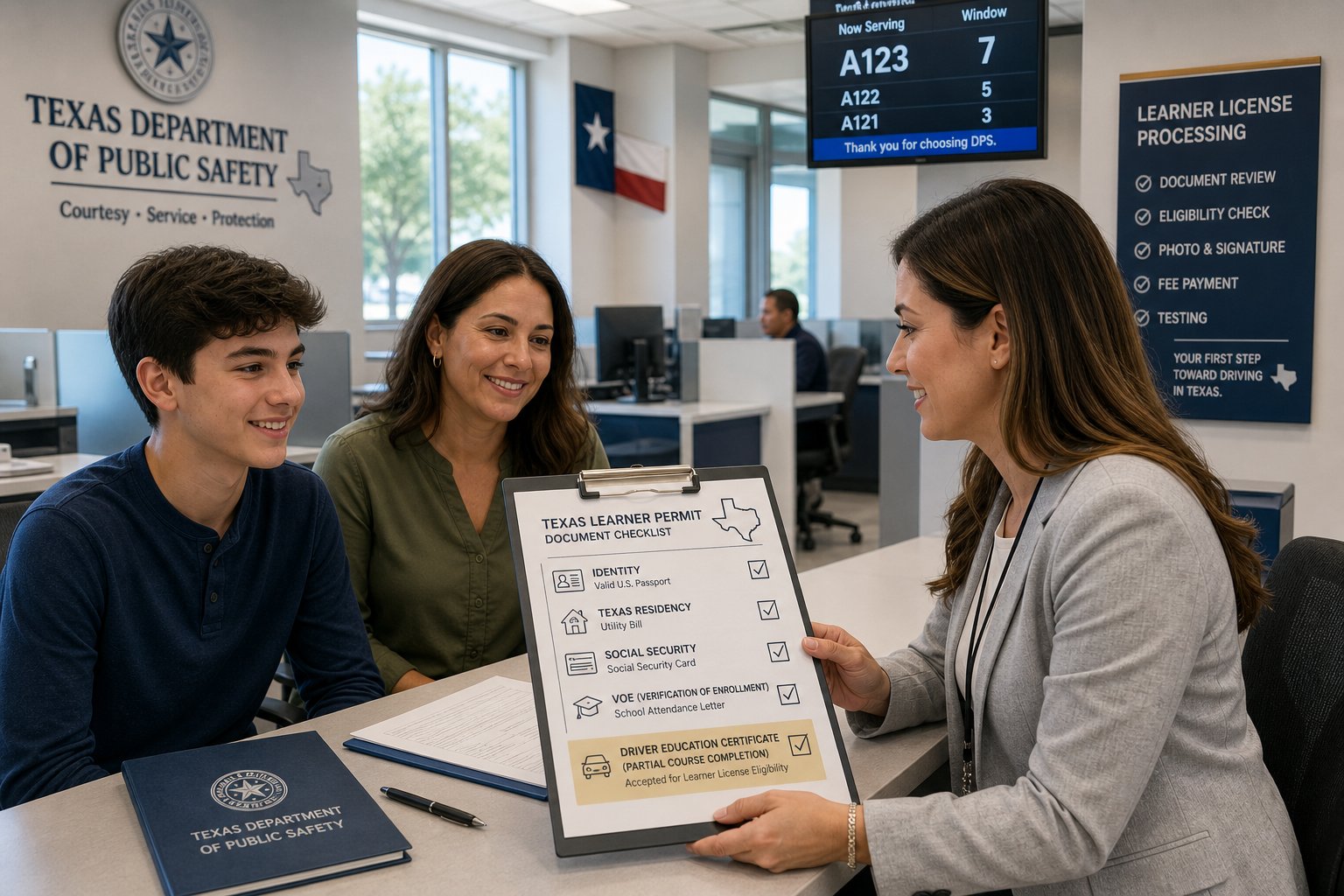
Who Needs A Texas Learner’s Permit And Basic Eligibility Rules
In Texas, most teens 15 to 17 need a learner’s permit before they can work toward a full license. Texas often calls it a learner license or instruction permit. If you are under 18, you cannot skip this step.
To get a permit at age 15 or older, you must be in an approved teen driver education program. That means either PTDE or Parent Taught Drivers Ed, or a licensed TDE course from a school approved by the Texas Department of Licensing and Regulation. Adults 18 and older follow different rules, and ADE is a separate course for adults, not teens.
Teens usually need to show several documents at their Texas DPS appointment:
- Proof of identity
- Proof of lawful presence in the U.S.
- Proof of Texas residency
- Social Security number
- A school VOE form, diploma, or GED if required
- Driver education paperwork, such as the right certificate for your stage
One point matters a lot here. The permit stage uses the DE-964E, which is the partial completion certificate tied to Module 1. The DE-964 is for full course completion later, when you move toward the provisional license.
If you plan to do PTDE, the PTDE Program Guide must come from TDLR, and as of January 2026 it costs $20 and is sent by email only. There is no physical packet mailed out.
It also helps to remember the split between agencies. TDLR approves courses. TxDPS issues the permit and license. People still say “DMV” out of habit, but in Texas that is not the right agency name for this process.
How The Texas Learner’s Permit Test Works
The texas learners permit test is the written knowledge exam used to check if you know the rules of the road before you start driving with a permit. For most applicants, there is also a vision exam at TxDPS when you apply.
The written exam is generally 30 questions. You need 21 correct answers to pass, which is 70%. Questions are multiple choice and focus on basic driving knowledge, not behind-the-wheel skill.
For many teens, the test connects directly to driver education. If you take an approved teen course, you may be able to complete the permit test through the course after Module 1, which is about 6 hours of instruction. That can save time and make your DPS appointment easier.
If you do not take the exam through driver education, you take it at Texas DPS. And if you try the exam online through an approved course and do not pass, you may need to retake it in person at DPS.
What Topics Are Covered On The Written Exam
The questions cover the basics every new Texas driver must know. Most items come from the Texas Driver Handbook.
Expect questions on:
- Texas traffic laws and common road rules
- Road signs and pavement markings
- Right-of-way rules
- Speed limits and safe following distance
- Sharing the road with bikes, motorcycles, and large trucks
- Alcohol and drug laws
- Emergency situations and safe responses
This is why the handbook matters so much. The test is not trying to trick you. It checks whether you know the core rules that keep people safe.
Can You Take The Permit Test Online Or At The DPS?
In many cases, yes, you can take the knowledge test online through an approved teen driver education provider. This option is common in PTDE and other approved TDE programs after Module 1 is complete.
That said, not everyone takes it online. Some families still choose to test at TxDPS, and some applicants must do that based on their situation. If the online test is not passed, the next step is often an in-person retake at DPS.
Always check your course instructions and current TxDPS rules before your appointment. Requirements can change, and the exact paperwork must match your course status.
How To Apply For A Permit Without Delays
A smooth permit visit usually comes down to one thing: bring the right forms the first time. Texas DPS can only process your learner’s permit if your identity documents, school records, and driver ed records all line up.
Start by booking a DPS appointment through TxDPS. Waiting until the last minute can make the process harder, especially in busy areas.
Before your visit, gather your paperwork carefully. Most teen applicants need:
- A completed DL-14A application
- The correct driver education certificate, often DE-964E for the permit stage
- A VOE form, diploma, or GED if required
- Proof of identity
- Proof of lawful presence
- Proof of Texas residency
- Social Security documentation
- Parent or guardian signatures where required
Double-check dates, names, and signatures. Small errors cause big delays. A missing middle name, an unsigned form, or the wrong certificate can turn one trip into two.
If you are using PTDE, make sure you first obtained the PTDE Program Guide from TDLR. That guide is part of the required setup for Parent Taught Drivers Ed. And again, teens under 18 should not confuse PTDE/TDE with ADE, which is for adults.
At the appointment, you may also complete the vision screening and submit payment for the permit. Texas DPS handles the permit issue itself, while TDLR handles course approval. Keeping those roles straight helps you know where to go when a problem comes up.
The Best Ways To Study And Practice Before Test Day
The best prep plan is simple. Read the handbook, finish your course work, and take more than one texas learners permit practice test.
Start with the Texas Driver Handbook from TxDPS. Read it in short sessions. Ten to fifteen minutes at a time works well for most teens. Focus on signs, right-of-way, speed rules, and common safety laws.
Then use practice questions. A good practice test helps you spot weak areas fast. If you miss questions about signs, go back and review signs only. If right-of-way trips you up, study intersections and turns.
A strong study plan looks like this:
- Read one handbook section
- Take a short practice quiz
- Review every missed answer
- Repeat the next day
Do not just memorize answers. Learn the rule behind the answer. That matters because the real test may phrase the question in a new way.
If you are in PTDE or another approved teen course, finish the lessons and quizzes carefully. Module 1 is especially important because it prepares many teens for the permit exam and leads to the DE-964E. If you rush through it, you usually feel that on test day.
Also keep ITTD separate in your mind. Impact Texas Teen Drivers is a free, 2-hour course from TxDPS, available at impacttexasdrivers.dps.texas.gov. It is not the same thing as PTDE or TDE, and it does not replace the permit study work.
If you want a flexible option, Driving Logic offers a Texas PTDE/TDE course built for busy families who want to study on their own schedule. That can help if you need phone, tablet, or laptop access without sitting in a classroom.
Permit Restrictions And The Next Step Toward A Provisional License
Getting the permit is a big step, but it comes with limits. In Texas, a learner’s permit does not let you drive alone. You must have a licensed driver age 21 or older in the front seat whenever you drive.
Texas also bars teens with a permit from using a cell phone while driving, even hands-free, except in an emergency. That rule is easy to overlook, but it matters.
The permit period is meant for practice. You build time behind the wheel while learning safe habits with adult supervision. That practice period also leads to the next stage.
To move toward a provisional license, a teen must usually:
- Be at least 16
- Hold the permit for at least 6 months
- Finish the required teen driver education steps
- Meet TxDPS testing and document requirements
At that later stage, the full course completion document is the DE-964, not the DE-964E. That difference causes a lot of confusion, so it is worth repeating.
A provisional license also has limits. These commonly include:
- No driving from midnight to 5 a.m., except for limited reasons allowed by law
- No more than one passenger under 21 who is not a family member
- No wireless device use while driving
And one more important item: teens will also need ITTD before the driving test for the provisional stage. Since Impact Texas Teen Drivers is free and separate from PTDE/TDE, do not wait until the last minute to complete it.
If you want a simpler path through the education side, Driving Logic offers a state-approved Texas teen course that fits busy schedules. You can learn more and get started through Driving Logic, then line up your course progress, documents, and DPS appointment with less stress.
FAQ
What’s on the Texas learner’s permit knowledge test?
Texas traffic laws, road signs, and safe-driving rules, drawn from the Texas Driver Handbook and the driver education course. It’s multiple-choice and generally requires about 70% to pass.
How should my teen study?
Complete the driver education course material and review the Texas Driver Handbook. The test questions track the laws, signs, and safe-driving topics those cover.
What score do I need to pass?
Generally about 70%. Confirm the current passing score and question count with DPS, since procedures can change.
Where is the knowledge test taken?
Depending on the path, it may be administered through the course or at DPS. Your driver education provider and DPS confirm how and where you take it.
Conclusion
The knowledge test rewards the same work the course already requires: learn the signs, laws, and safe-driving habits, and the multiple-choice questions follow. Pair the course material with a handbook review and most teens pass comfortably on the first try. Treat the test as a checkpoint on material you’ve already studied, not a separate hurdle.
The course content that prepares your teen lives in Module 1 of a TDLR-approved Texas parent-taught driver education course online.
Related Articles
- Texas Learner’s Permit: How to Get It, What You Need, and What It Allows
- Texas Learner’s Permit Online Course: What the First 6 Hours Cover
- How to Get a Texas Learner’s Permit at 15: Step-by-Step Guide
- What Documents Do You Need for a Texas Learner’s Permit?
Sources
Billy Forte is the owner of Driving Logic, a TDLR-approved Texas driver education provider. Driving Logic offers the online Texas parent-taught and teen driver education course that helps Texas teens complete the 32-hour classroom requirement and work toward a learner’s permit and provisional license.
This article is general information about Texas teen driver education and licensing, not legal advice. Requirements, fees, and procedures are set by TDLR and the Texas DPS and can change, so confirm current details with official Texas sources before you enroll or visit a DPS office.