
Updated June 2026 · Reviewed by Billy Forte
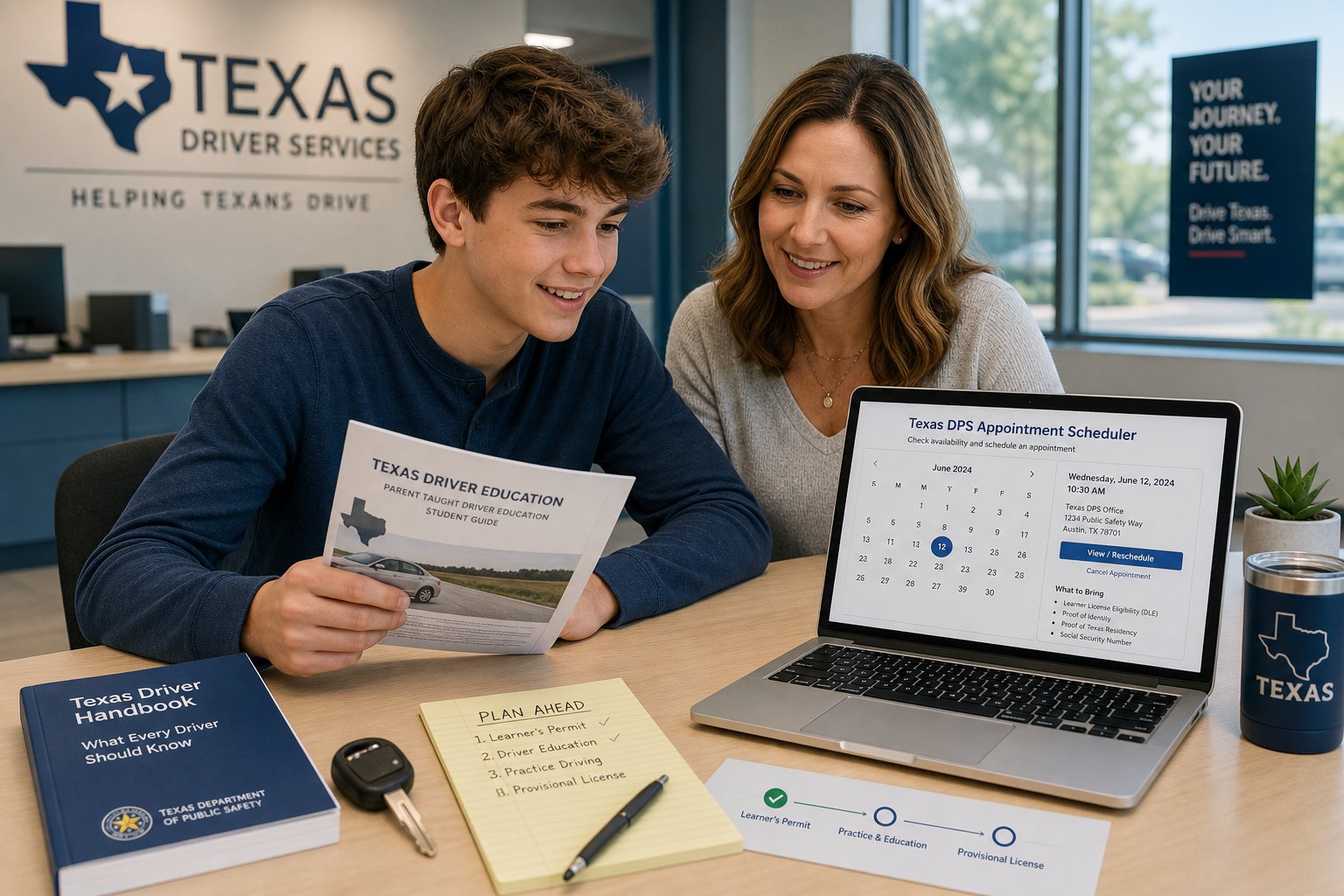
You book a Texas DPS appointment for a learner’s permit online through the TxDPS appointment scheduler, after your teen has completed Module 1 and has the DE-964E. Appointment availability varies widely by location and can be booked weeks out in busy areas, so schedule early and bring the full document set. At the appointment your teen takes the vision and knowledge tests and pays the $16 fee, so arriving prepared turns it into a single visit.
Applies to Texas teen driver education and licensing (ages 14–17). Requirements are set by TDLR (driver education) and the Texas DPS (licensing) and can change.
Key Facts
- Book online: Schedule through the official TxDPS appointment system.
- Finish Module 1 first: Have the DE-964E in hand before the appointment.
- Waits vary: Availability ranges from days to weeks by location, so book early.
- Bring documents: Identity, residency, SSN, VOE, and the DE-964E.
- At the visit: Vision and knowledge tests, plus the $16 permit fee.
Who Needs A Texas Learner’s Permit And When To Apply
A Texas learner’s permit is for new drivers who need supervised practice before they can move on to a license. In Texas, teens usually apply at age 15 once they have started an approved driver education course.
Texas may also call it an instruction permit or learner license. It lets a teen drive with a qualified adult in the vehicle, but it is not a full license.
For teens under 18, timing matters. You do not want to wait until the last minute, because a Texas DPS appointment learners permit visit can be hard to get in some areas. In busy cities, open slots may be far out, so planning ahead is smart.
A few key age points help:
- Age 15: earliest common age to apply for the permit after starting teen driver education
- Under 18: teen rules apply, including driver education steps
- After the permit: there is usually a 6-month holding period before moving toward a provisional license
That holding period is important for families making a driving timeline. If your teen wants a license soon after turning 16, it helps to start the permit process early.
And one more point: adults 18 and older follow a different path. They do not use teen programs like PTDE or standard teen TDE requirements. Adult applicants may need ADE, which is a separate course for adults, not a teen permit course.
What To Complete Before You Schedule Your DPS Appointment
Before you schedule anything, finish the basics first. This is the easiest way to avoid a wasted trip.
For teens, the biggest step is starting a state-approved driver education course. Texas uses the Texas Department of Licensing and Regulation (TDLR) to approve courses, while TxDPS issues the permit.
You should also prepare the driver license application, often called DL-14A, and gather your documents before booking. If you wait until after you get an appointment, you may end up scrambling.
For many teens, the pre-appointment checklist includes:
- Start an approved teen driver education course
- Get the right course certificate for the permit stage
- Gather ID, Social Security, and residency documents
- Get a current Verification of Enrollment (VOE) if required
- Make sure a parent or legal guardian can attend if needed
The permit-stage school certificate is important. For many teen programs, the document used to show permit eligibility is the DE-964E or another accepted partial completion form for Module 1. For the later license stage, the full completion certificate is DE-964.
If your family is using PTDE, remember that the PTDE Program Guide comes from TDLR. As of January 2026, that packet costs $20 and is sent by email only.
Driver Education Options For Teens And Adults
Teens under 18 and adults 18+ do not follow the same course path.
Teens under 18 may use:
- A licensed driver training school
- Parent Taught Drivers Ed (PTDE)
- Some public school driver education programs
Adults 18+ may need Adult Driver Education (ADE). That is a separate course for adults and should not be confused with PTDE or teen driver education.
Also, ITTD matters later. Impact Texas Teen Drivers is a free, 2-hour TxDPS course at impacttexasdrivers.dps.texas.gov. It is separate from the teen course itself and is not the same thing as PTDE or TDE.
How To Schedule A Texas Learner’s Permit Appointment Online
To book a texas learners permit appointment, use the official Texas appointment system, not a third-party site. Start at the Texas DPS driver license services area on dps.texas.gov, which directs you to the online scheduler, or go straight to the state appointment tool at txapps.texas.gov.
The steps are simple:
- Open the official scheduler.
- Choose the option for a first-time Texas DL/Permit.
- Enter your city or ZIP code.
- Compare available offices.
- Pick a date and time.
- Confirm the appointment.
You should get a confirmation by email or text, depending on the system prompts.
The hard part is often not the booking itself. It is finding a time that works. Texas DPS appointment learners permit wait times vary a lot by location. In many major metro areas, openings can be limited for weeks or even months.
A few practical tips can help:
- Check offices in nearby cities, not just the closest one
- Look early in the morning for better slot options
- Recheck often, because canceled appointments can appear
- Be flexible on day and location if you need something sooner
If your teen is on a school-year timeline, book as early as you can. A delayed permit appointment can push back practice hours and the later provisional license date.
If you still need a teen course, this is a good time to line it up too. Driving Logic offers Texas-approved online options that fit busy schedules, which can make the permit process easier to manage.
Documents To Bring To Your Texas DPS Appointment
Bring original documents whenever possible. Missing paperwork is one of the most common reasons a permit visit gets delayed.
For a typical Texas learner’s permit appointment, you may need:
- DL-14A application
- Proof of identity
- Proof of date of birth
- Proof of U.S. citizenship or lawful presence
- Social Security number document
- Two proofs of Texas residency
- Correct driver education certificate
- VOE, diploma, or GED if required for a teen
- Parent or legal guardian, if required
- Payment for the state fee
A certified birth certificate or valid passport is often used for identity and birth date. A Social Security card or another accepted official document may be needed for the SSN check.
For residency, Texas commonly asks for two documents. Examples can include a utility bill, lease, mortgage paper, bank statement, or voter registration card, depending on what TxDPS accepts at that time.
Course paperwork must match the student’s legal name. That is a small detail, but it causes big problems. If your teen is in a public school or teen driver program, make sure the correct permit-level form is ready. For permit issuance, that often means DE-964E or another accepted partial completion document. The full DE-964 is for the later license step, not the first permit visit.
Before you go, check the latest document rules at Texas DPS. Requirements can change, and local staff will follow the current state checklist.
What Happens At The Appointment, Including The Vision And Knowledge Tests
Most DPS permit visits follow the same basic order. You check in, turn in documents, complete identity steps, and then take any needed tests.
At the office, you can usually expect to:
- Check in for your appointment
- Submit your documents
- Give a signature and thumbprints
- Have your photo taken
- Take the vision exam
- Take the knowledge test if you did not complete it through your course
- Pay the fee
The vision test comes first for many applicants. If your teen does not pass it, the permit cannot move forward that day.
The knowledge test may or may not happen at DPS. Some approved course providers include the written test in the course. If that applies to your teen, bring the right proof of completion. If not, TxDPS may have your teen take the test at the office.
It helps to study the Texas Driver Handbook ahead of time. That reduces the chance of a failed test and a return trip.
If everything is approved, your teen can receive a restricted learner’s permit. That permit allows supervised driving, not solo driving.
Keep the next steps straight too. The later road-to-license process may require the full DE-964 and the free Impact Texas Teen Drivers course. You can take ITTD through the official TxDPS site at impacttexasdrivers.dps.texas.gov. It is separate from PTDE or any other teen driver ed course.
Common Mistakes That Delay Permit Approval And How To Avoid Them
The biggest permit delays are usually preventable. Most happen because of missing papers, wrong forms, or poor timing.
One common problem is incomplete documents. A family may bring one proof of residency instead of two, or forget the VOE, or use a document with the wrong name.
Another problem is driver education confusion. Texas uses different forms for different stages. DE-964E is the permit-stage completion proof in the cases where that form applies, while DE-964 is for full course completion tied to the later license step. And for PTDE, families also need to handle the TDLR Program Guide correctly.
To avoid delays:
- Use the current TxDPS checklist before your visit
- Bring originals and a few backup documents
- Make sure names and dates match across all forms
- Get a fresh VOE close to the appointment date
- Arrive about 15 to 30 minutes early
- Study before any knowledge test
Timing mistakes also matter. If you show up too late, your appointment may be lost. If you wait too long to book, metro-area backlogs can push your date far out.
One final tip: keep the teen and adult tracks separate. PTDE and teen TDE are for applicants under 18. ADE is for adults 18 and older.
If you still need a flexible state-approved teen course, Driving Logic offers online Texas PTDE/TDE options that can fit a busy family schedule. You can start here: Driving Logic Texas teen driver education.
FAQ
How do I book a Texas DPS appointment for a learner’s permit?
Use the official TxDPS appointment scheduler online. Book after completing Module 1, and bring your documents and the DE-964E to the appointment.
Why can’t I find an appointment nearby?
DPS availability varies and can be booked weeks out in busy areas. Check several nearby offices and look for newly released slots, and book as early as you can.
What happens at the appointment?
Your teen takes a vision screening and the knowledge test, presents the documents and DE-964E, and pays the $16 fee. Passing both tests completes the permit.
What should I do before scheduling?
Complete Module 1 for the DE-964E and gather all documents, including the VOE. Booking before these are ready risks a wasted appointment.
Conclusion
The appointment itself is straightforward; the planning around it is what matters. Finish Module 1 for the DE-964E, gather every document including the VOE, and book early because waits vary. Show up fully prepared and your teen leaves with a learner’s permit after a single visit.
Get the DE-964E ready first by completing Module 1 of a TDLR-approved Texas parent-taught driver education course online.
Related Articles
- Texas Learner’s Permit: How to Get It, What You Need, and What It Allows
- How to Get a Texas Learner’s Permit at 15: Step-by-Step Guide
- What Documents Do You Need for a Texas Learner’s Permit?
- Texas Learner’s Permit Knowledge Test: What’s on It and How to Prepare
Sources
Billy Forte is the owner of Driving Logic, a TDLR-approved Texas driver education provider. Driving Logic offers the online Texas parent-taught and teen driver education course that helps Texas teens complete the 32-hour classroom requirement and work toward a learner’s permit and provisional license.
This article is general information about Texas teen driver education and licensing, not legal advice. Requirements, fees, and procedures are set by TDLR and the Texas DPS and can change, so confirm current details with official Texas sources before you enroll or visit a DPS office.