
Updated June 2026 · Reviewed by Billy Forte
The Missouri Driver Improvement Program does not automatically reduce points or dismiss a ticket; point reduction happens only when a court or the Fine Collections Center authorizes it, you complete the 8-hour course, and the DOR receives Form 4444 within 60 days. Before enrolling, confirm who authorized the course and where your completion proof must go, because the outcome depends on that authorization rather than on finishing the class. Used correctly the course can keep points off an eligible ticket, but on its own it cannot erase an existing conviction or guarantee any court result.
This article covers Missouri requirements only.
Key Facts
- Missouri DIP is authorization-based.
- Court, FCC, or DOR paperwork controls the next step.
- The final conviction and Form 899 point treatment matter.
- Completion proof should be kept after finishing.
- Do not rely on a course for legal outcomes unless the correct authority accepts it.
What The Missouri Driver Improvement Program Does And When It Helps
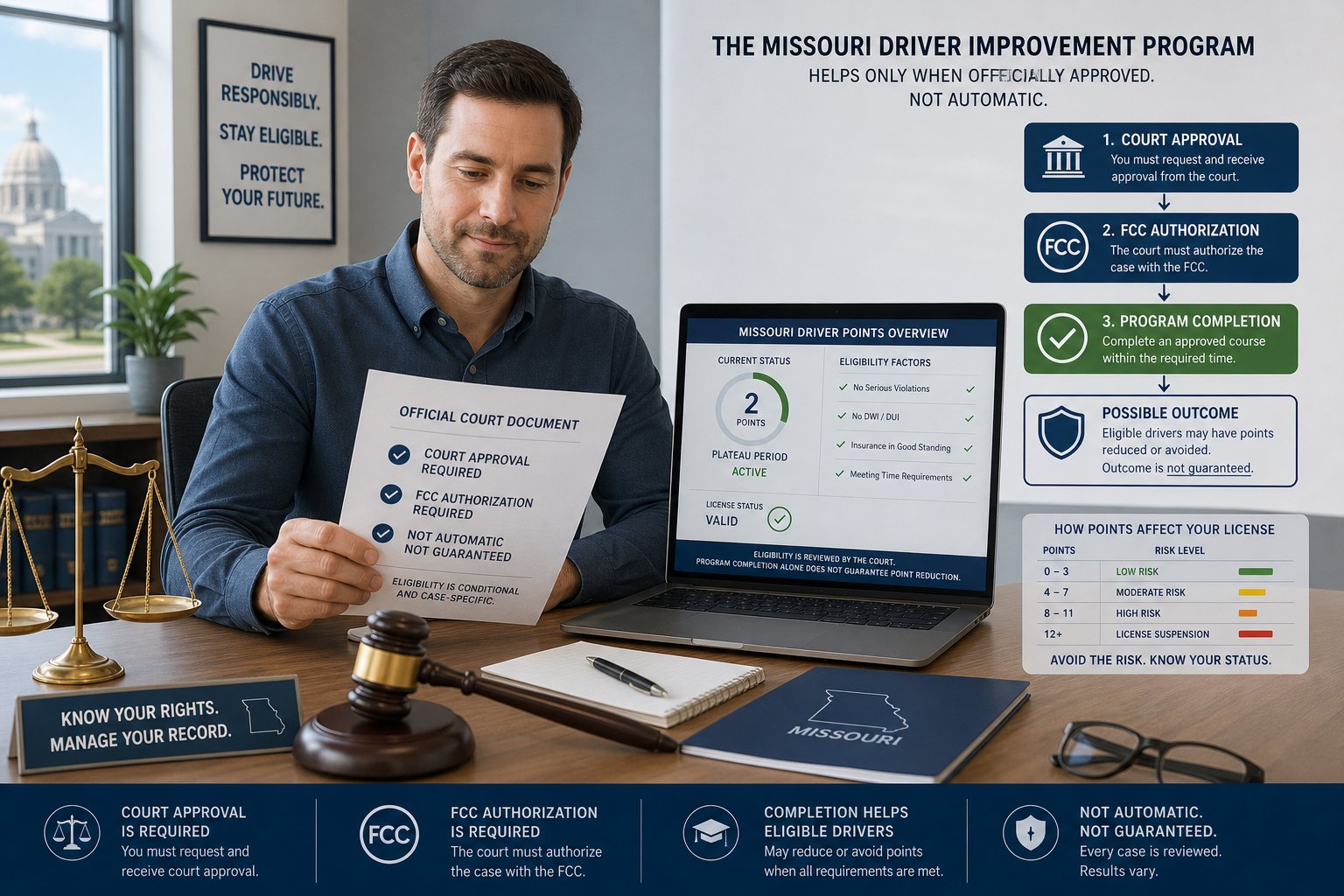
The key fact is simple: the Missouri Driver Improvement Program (DIP) does not work by itself. It helps only when a court order or FCC authorization allows you to use the 8-hour course for a moving violation.
When that happens, DIP may help in two main ways. First, it may let you avoid new points for an eligible moving violation. Second, in some cases, it may be used for a point reduction if the court or Fine Collections Center approves that option. But the outcome is not automatic, and it is not the same in every county.
That matters because Missouri uses a point system to track driving violations. If points keep adding up, your license can move closer to suspension or revocation. So even a small break on points can make a real difference.
Here is what DIP can sometimes do when properly approved:
- Help prevent points from being assessed for an eligible moving violation
- Help reduce points if the court or FCC specifically allows that use
- Help lower the risk of point-based license action
- Help limit the impact that new points may have on insurance
And here is what it cannot do on its own:
- It cannot dismiss your ticket automatically
- It cannot erase a conviction by itself
- It cannot change your record unless the court or FCC has approved the DIP process and required filings are made
Because rules can vary by court, always confirm the exact DIP terms in your case before you enroll.
Who Qualifies For DIP And Which Violations May Be Eligible
Not every driver or ticket will qualify for DIP. In Missouri, eligibility is tied to your case, your violation, and the decision of the court or FCC.
In general, you need a moving violation and approval from the court handling the case or from the Fine Collections Center. Without that approval, taking a course on your own usually does not change points.
A few common limits matter a lot.
- CDL drivers cannot use DIP for point avoidance
- DIP is generally limited to once every 36 months
- Some courts may reject DIP for certain serious violations
- Non-moving violations may not fit DIP at all
This is where many drivers get tripped up. They assume any traffic ticket can be handled with a class. That is not how Missouri handles DIP. One county may allow it for a routine speeding case, while another may be more limited. The specific facts of the stop and the court’s policy both matter.
If you are dealing with a ticket through the FCC, ask whether your case is eligible for the Driver Improvement Program and what paperwork is required. If your case is in a local court, check the judge’s order or clerk instructions carefully.
The safest rule is this: confirm eligibility first, then enroll. That helps you avoid paying for a course that does not count for your case.
How Missouri’s Point System Works And Why DIP Matters
Missouri assigns points for traffic convictions, and those points go on your driving record with the Missouri Department of Revenue (DOR). That is why the missouri driver improvement program points question matters so much: the course may help keep points from being added, but only when it is properly approved.
Some common point examples include:
- Speeding: 3 points
- Careless and imprudent driving: 4 points
Those numbers may not sound huge at first. But they add up faster than many drivers expect. One more ticket after a prior violation can push you into warning or suspension territory.
Missouri uses several key thresholds:
- 4 points in 12 months: advisory letter
- 8 points in 18 months: suspension
- 12 points in 12 months: revocation
- 18 points in 24 months: revocation
- 24 points in 36 months: revocation
This is why DIP matters. If the court or FCC authorizes DIP instead of normal point assessment, you may stay under a threshold that would otherwise trigger bigger trouble. That does not mean the ticket vanishes. It means the point result may change if all steps are completed the right way.
For current point rules and license actions, review the Missouri Department of Revenue information at dor.mo.gov and Missouri law at revisor.mo.gov.
When Points Can Lead To Suspension, Revocation, Or Higher Costs
Once points build up, the effect can go beyond a warning letter. Eight or more points in 18 months can lead to a suspension, and higher totals can lead to revocation.
The main revocation levels are:
- 12 or more points in 12 months
- 18 or more points in 24 months
- 24 or more points in 36 months
That can disrupt work, school, and basic errands fast. And after reinstatement, the process is not always over. Missouri may reset your record to 4 points after reinstatement, and then points can drop over time with violation-free driving. In general, they reduce after one year, then again after two years, and can reach zero after three years without new violations.
Points can also raise other costs. Insurance companies often look at convictions and point history when setting rates. Some employers do too, especially if driving is part of the job.
So DIP can matter even when you are worried about more than the ticket itself. If it is approved, it may help you avoid adding points that push you into license action or higher costs. But again, approval is case-specific, and the course alone does not guarantee that result.
How The DIP Process Works From Court Approval To Completion
The process starts with the ticket, not with the course. If you want DIP to affect points, you usually need court authorization or FCC authorization first.
A common path looks like this:
- You get a ticket for a moving violation.
- You contact the court or the Fine Collections Center and ask if DIP is allowed in your case.
- If approved, you enroll in a Missouri-approved 8-hour Driver Improvement Program.
- You complete the course within the deadline set in your case.
- You submit or arrange submission of the completion form or reporting instruction named in your court, FCC, or DOR paperwork to the Missouri Department of Revenue within 60 days.
That 60-day deadline is a big deal. If the form is not submitted on time, points may be assessed as if no DIP had been completed.
Also, the course provider is only one part of the process. Even if you finish the class, the point result still depends on the court or FCC instructions being followed. In other words, course completion alone is not enough.
If you need a flexible option, Driving Logic’s Missouri DIP course may fit busy schedules, but you should confirm with your court or FCC before enrolling. That one step can save time and prevent mistakes.
Online Vs In-Person DIP: What Busy Drivers Should Know
Both online and in-person DIP options can satisfy a court requirement if the provider is accepted for your case. The better choice usually comes down to court acceptance, your schedule, and how fast you can finish.
Online DIP is popular for obvious reasons. You can work from home, use your phone or laptop, and fit the course around work or family time. For many drivers, that is much easier than finding an evening class across town.
Online courses may offer:
- Self-paced lessons
- 24/7 access
- Faster start times
- Flexible breaks during the 8-hour program
In-person classes still have a place. Some courts may prefer them, and some drivers learn better in a room with an instructor. But classroom schedules are fixed, and that can be hard if you are juggling shifts, child care, or travel.
No matter which format you choose, the same core rules still apply:
- The provider must be accepted for your Missouri case
- The course must meet state and court requirements
- You still must follow all court and DOR deadlines
So do not choose based on convenience alone. First, confirm that the provider works for your court or FCC case. Then pick the format you can complete on time.
What DIP Does Not Do For Your Ticket, Record, And Reinstatement Needs
This is the part many drivers need most: DIP does not automatically fix everything tied to a traffic case. Even when approved, it has limits.
First, DIP does not automatically dismiss your ticket. It also does not erase the conviction from your driving record just because you took an 8-hour class. The court or FCC decides what effect, if any, the course has in your case.
Second, DIP does not automatically remove old points. A missouri dip point reduction must be specifically allowed, and it still depends on proper approval and filing. Taking the course on your own does not force the Missouri DOR to change your record.
Third, DIP does not replace reinstatement steps after a suspension or revocation. If the Missouri Department of Revenue requires fees, proof of insurance, or other conditions, DIP is not a substitute for those items.
It also does not guarantee lower insurance rates. Fewer points may help, but insurers can still rate based on the violation itself.
The practical takeaway is simple: DIP is a useful tool, but only within the limits set by the court, the FCC, and the Missouri Department of Revenue. If your case may qualify, verify the terms first, complete the 8-hour course, and make sure the completion form or reporting instruction named in your court, FCC, or DOR paperwork is submitted within the deadline.
Related Articles
- Missouri Driver Improvement Program for a Speeding Ticket: What You Need to Know
- How to Submit DOR the required completion form to Reduce Points on Your Missouri Driving Record
- Missouri Driver Improvement Program Eligibility: Who Can Use the DIP?
- Missouri Court-Ordered Driver Improvement: What It Means and What to Do
Sources
- Missouri DOR — Tickets and Points FAQ
- Missouri DOR — Form 899, Driver Record Traffic Violation Descriptions and Points Assessed
- Missouri DOR — Driver License
- Missouri Revised Statutes § 304.010 — Speed Limits
- Missouri Revised Statutes § 304.012 — Careless and Imprudent Driving
Billy Forte is the owner of Driving Logic, a state-approved driver improvement course provider serving Missouri and other U.S. states. Driving Logic offers online driver improvement and defensive driving courses for drivers handling court orders, ticket requirements, and state requirements.
This article is general information, not legal advice. Missouri DOR rules, court orders, Fine Collections Center instructions, deadlines, insurance decisions, and case facts can differ. Use official Missouri DOR and court sources for current requirements, and consult a qualified Missouri attorney for legal guidance specific to your situation.
FAQ
Does the DIP remove points from my Missouri record?
Only when a court or the Fine Collections Center authorizes it, you complete the 8-hour course, and the DOR receives Form 4444 within 60 days. Without that authorization, points are not reduced.
Can the DIP dismiss my ticket?
No. It does not dismiss tickets or erase convictions. It can only support point reduction on an eligible, authorized ticket.
What does the DIP not do?
It does not guarantee a court result, remove an existing conviction, or apply automatically just because you finished the class.
How often can I use it for point reduction?
Once every 36 months for DOR point reduction. A court can still order it separately at any time.
Conclusion
Handle this Missouri DIP issue by starting with the official paperwork, not a guess. Confirm authorization, deadline, reporting path, and point impact before enrolling. If DIP is accepted for your case, complete the course on time and keep proof.