
Updated June 2026 · Reviewed by Billy Forte
Florida adds points to your driver record when you are convicted of most moving violations, and your license can be suspended if you reach 12 points in 12 months, 18 points in 18 months, or 24 points in 36 months. Most common violations add 3, 4, or 6 points, and the exact value depends on the offense listed in Florida law and FLHSMV rules. In many cases, you generally have 30 days to pay, contest, or elect an eligible Basic Driver Improvement course, but points are not removed from past tickets and local court instructions can differ by county and case type.
This article covers Florida requirements only.
Key Facts
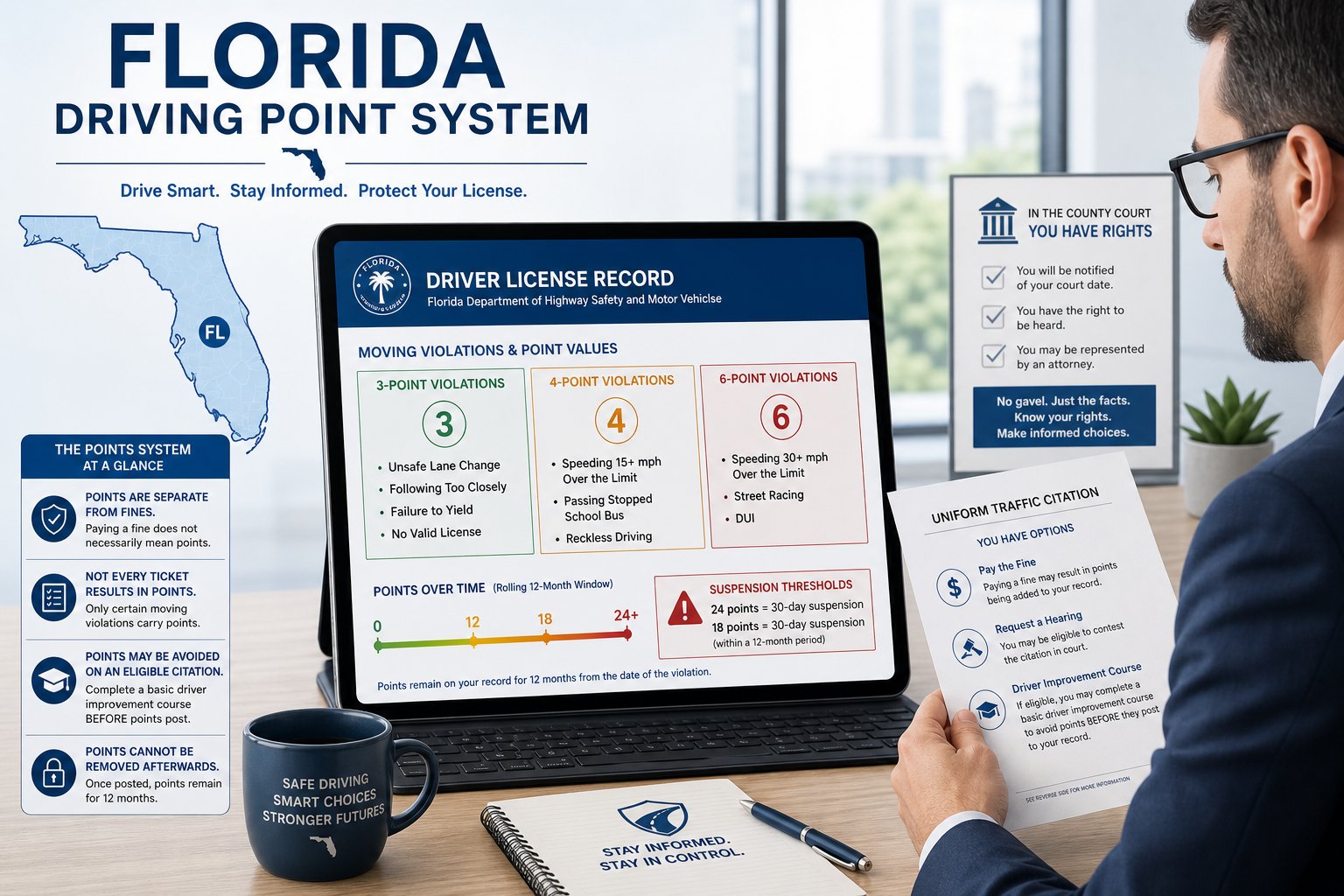
- Point suspension: Florida may suspend a license at 12 points in 12 months, 18 points in 18 months, or 24 points in 36 months.
- Common values: Many moving violations are 3 points, traffic-signal violations are 4 points, and certain crash-related violations can be higher.
- Offense dates: Florida computes point-suspension periods using the offense dates of convictions.
- BDI limit: An eligible BDI election can help prevent points on a current citation, but it does not erase old points.
- Clerk rules: Election deadlines, certificate filing, and court instructions can vary by county and citation.
If your goal is to prevent new points on an eligible current citation, review the Florida Basic Driver Improvement course before your clerk or court deadline.
Florida uses a demerit point system to track driving violations. When you are convicted of a moving violation, the Florida Department of Highway Safety and Motor Vehicles can add points to your record. In simple terms, more serious violations usually mean more points.
For most drivers, the point values you will see most often are 3 points, 4 points, or 6 points. A lower-level moving violation, like a less serious speeding ticket, may add 3 points. A more serious offense may add 4. If a violation involves a crash or leaving the scene of a minor crash, the point total can be higher.
This is why people search for florida driving points after a ticket. The issue is not just the fine. Points can affect your driving status, and they may matter to insurance companies too.
Florida’s point system is based on convictions, not just the stop itself. That distinction matters. If you simply pay a qualifying traffic ticket, that is usually treated as an admission, and the violation goes on your record with any related points. If you contest the ticket, the result of the case will control what happens next. If you are eligible and properly elect a Basic Driver Improvement course, that may help you avoid points for that ticket, but it does not erase points from older tickets.
The main legal framework appears in Florida Statutes section 322.27. Florida courts and clerks also publish local instructions, and those details can vary based on the citation, county, court, judge, and case type.
Common Florida Traffic Violations And Their Point Values
Florida does not use one flat number for every ticket. The point value depends on the violation. Here are common examples drivers often ask about:
- Speeding less than 15 mph over the limit, 3 points
- Speeding 15 mph or more over the limit, 4 points
- Speeding that results in a crash, 6 points
- Careless driving, 3 points
- Reckless driving, 4 points
- Failure to stop at a traffic signal, 4 points
- Passing a stopped school bus, 4 points
- Leaving the scene of a crash with property damage or minor injury, 6 points
These examples reflect common entries in Florida point schedules used by the state and court system. You can review official state material through FLHSMV and county court resources, and many counties also summarize driver options after a citation.
A few practical notes matter here. First, the wording on your citation matters. “Speeding” and “speeding resulting in a crash” are not treated the same way. Second, not every traffic issue is a moving violation that carries points. Some equipment or paperwork issues may work differently.
And third, the same ticket can have different consequences depending on what you do next. If you pay it, contest it, or elect an eligible course, the outcome may change. Always read the citation and the clerk or court instructions closely.
If you want to check the official source, start with Florida Statutes section 322.27 and your local clerk of court website.
When Points Lead To License Suspension
The biggest question for many drivers is how many points to suspend license in florida. The answer is set by state law.
If you reach:
- 12 points in 12 months, suspension for 30 days
- 18 points in 18 months, suspension for 3 months
- 24 points in 36 months, suspension for 1 year
These thresholds come from Florida law and are enforced through FLHSMV. The rule is about how many points you collect within a rolling time period, not just over your whole life as a driver.
That means timing matters. A driver who gets several tickets close together can hit a suspension threshold much faster than expected. This is especially common when someone pays multiple citations without realizing each one may add points.
It is also important to understand that a suspension is separate from the ticket itself. The ticket starts the process, but the suspension risk comes from the running total on your record. That is why one 3-point ticket may seem minor on its own but still cause a major problem if you already have points.
If you receive a notice from FLHSMV or a court, do not ignore it. Review the notice, check your driving record, and follow the instructions by the deadline. If your case involves court action, county procedures and judicial requirements may differ. Use the official FLHSMV driver license check tools and your local court or clerk website to confirm your status.
How Long Points Stay On Your Florida Driving Record
In Florida, Florida uses 12-, 18-, and 36-month windows to decide point suspensions, and it computes those windows from offense dates. Many drivers also hear that tickets can affect their record or insurance pricing for up to 5 years, depending on the insurer and the type of violation.
The exact timeline can be confusing because people often mix up three different things:
- How long the ticket stays on your record
- How long the points count for state purposes
- How long an insurer may care about the violation
Those are not always the same.
For state point tracking, Florida focuses on the time windows used for suspension review, such as 12, 18, and 36 months. But the underlying citation can remain visible on your record longer. That is one reason drivers should be careful before simply paying a ticket.
Many people also ask whether traffic school removes existing points. The key point is simple: BDI does not remove points already on your record. If you are eligible to elect traffic school for a current citation, it may help keep points from being added for that specific ticket. That is different from erasing prior convictions.
If you want to verify what is on your record, use official Florida sources rather than guessing based on old paperwork. A current copy of your Florida driving record is the best place to start.
What To Do After A Florida Traffic Ticket
In many Florida traffic cases, you generally have 30 days to respond. Your options usually fall into three basic paths:
- Pay the ticket
- Contest the ticket in court
- Elect traffic school if you are eligible
Paying the ticket is usually treated as an admission of the violation. That often means the case closes, but any related points are added to your record. Contesting the ticket means asking for a hearing or following the local court process. If you are eligible for a Basic Driver Improvement course, you may be able to elect that option instead of taking points for the ticket.
But details matter. Eligibility, deadlines, fees, court procedures, and clerk instructions can depend on the citation, county, court, judge, and case type. A civil moving violation may be handled differently from a more serious charge. Some tickets also come with special instructions on the citation itself.
Do not assume the same process applies in every county. Check the local clerk or court website, such as the Florida Courts system and the clerk for the county listed on your ticket. Read every notice carefully. Missing a deadline can create bigger problems than the original citation.
If you have a Florida ticket in hand, your next step is to read the citation and confirm the response deadline with the court listed on it.
Traffic School And Other Ways To Avoid Or Reduce Points
For many drivers, the most useful option is Basic Driver Improvement, often called BDI or traffic school. In Florida, if you are eligible and you properly elect the course for a qualifying citation, you may be able to keep points from being assessed for that ticket.
That said, there are important limits:
- It does not remove existing points
- It is not available in every case
- It is generally limited to once every 12 months
- It is limited to 5 elections in a lifetime
You should also avoid broad promises. Traffic school does not guarantee a specific insurance result, and court acceptance depends on the facts of the case and local procedures. In some situations, a judge or clerk process controls what you must do.
For busy drivers, online BDI can be the most practical fit because you can work on it around your schedule. DrivingLogic offers a Florida Basic Driver Improvement course online that is built for people who want a flexible, device-friendly option and fast completion reporting where applicable.
Before you enroll, confirm that your ticket is eligible and that you are following the instructions from the correct court or clerk. That small step can save a lot of hassle later.
Out-Of-State Tickets, Insurance Costs, And Special Rules For Minors
Florida drivers sometimes assume an out-of-state ticket will stay out of Florida. That is not always true. Florida participates in the Driver License Compact, so many moving violations from other states can be reported back and treated similarly to Florida offenses for point purposes.
This means a ticket you got while traveling may still matter once you get home. The exact handling can depend on the offense and reporting rules, but ignoring an out-of-state citation is a bad idea.
Insurance is another concern. Even one moving violation can lead to higher premiums, and multiple violations usually increase that risk. The exact cost change depends on the insurer, your record, and the violation. No one should promise a certain savings or rate outcome.
Minors face special rules. For drivers under 18, getting 6 or more points within 12 months can trigger a business-purposes-only restriction for 1 year. If more points are added, the restriction period can be extended. A learner’s license can also be affected by a moving violation, including an extension of the learner period in some cases.
If you are dealing with a youth license issue, an out-of-state ticket, or repeated violations, check official Florida sources first. This article is not legal advice.
FAQ
How does the Florida driver license points system work?
Florida tracks points assigned to your driving record for each moving violation conviction. Points accumulate over rolling time windows, and FLHSMV suspends your license if you reach certain thresholds under Florida Statute 322.27.
What are the Florida point suspension thresholds?
Under Florida Statute 322.27: 12 points in any 12-month period triggers a 30-day suspension; 18 points in any 18-month period triggers a 3-month suspension; 24 points in any 36-month period triggers a 1-year suspension.
How long do points stay on my Florida driving record?
Points remain on your Florida driving record for 3 years from the date of the violation — not the date you paid or were convicted. FLHSMV counts points within the applicable rolling windows for suspension purposes.
Does traffic school reduce points already on my record?
No. Florida traffic school (BDI) withholds adjudication for a new eligible citation, which means no points are added for that citation. It does not remove points already on your record from prior violations.
How many points do common violations cost?
Most moving violations are 3 points. Speeding 15 mph or more over the limit and reckless driving are 4 points. Careless driving resulting in an accident and leaving the scene of an accident are 6 points.
What happens when my license is suspended for points?
FLHSMV mails a notice and your license is suspended for the applicable period. After the suspension ends, you must reinstate through FLHSMV and pay any required fees. A restricted hardship license may be available for some drivers during the suspension period, depending on eligibility.
Conclusion
The Florida driver license points system is straightforward: points accumulate for each moving violation conviction, and crossing set thresholds triggers automatic suspension. Understanding the thresholds and knowing how BDI can prevent new points from being added are the two most practical tools available to Florida drivers.
Take the Florida BDI course online at Driving Logic
FAQ
How does the Florida driver license points system work?
Florida tracks points assigned to your driving record for each moving violation conviction. Points accumulate over rolling time windows, and FLHSMV suspends your license if you reach certain thresholds under Florida Statute 322.27.
What are the Florida point suspension thresholds?
Under Florida Statute 322.27: 12 points in any 12-month period triggers a 30-day suspension; 18 points in any 18-month period triggers a 3-month suspension; 24 points in any 36-month period triggers a 1-year suspension.
How long do points stay on my Florida driving record?
Points remain on your Florida driving record for 3 years from the date of the violation — not the date you paid or were convicted. FLHSMV counts points within the applicable rolling windows for suspension purposes.
Does traffic school reduce points already on my record?
No. Florida traffic school (BDI) withholds adjudication for a new eligible citation, which means no points are added for that citation. It does not remove points already on your record from prior violations.
How many points do common violations cost?
Most moving violations are 3 points. Speeding 15 mph or more over the limit and reckless driving are 4 points. Careless driving resulting in an accident and leaving the scene of an accident are 6 points.
What happens when my license is suspended for points?
FLHSMV mails a notice and your license is suspended for the applicable period. After the suspension ends, you must reinstate through FLHSMV and pay any required fees. A restricted hardship license may be available for some drivers during the suspension period, depending on eligibility.
Conclusion
The Florida driver license points system is straightforward: points accumulate for each moving violation conviction, and crossing set thresholds triggers automatic suspension. Understanding the thresholds and knowing how BDI can prevent new points from being added are the two most practical tools available to Florida drivers.
Take the Florida BDI course online at Driving Logic
Related Articles
- How Long Do Points Stay on Your License in Florida?
- How to Check Points on Your Florida Driver’s License
- How Many Points Is a Speeding Ticket in Florida?
- Florida Traffic Violation Points Chart: How Many Points for Each Offense
Sources
- Florida Statute 322.27 — Driver License Suspension and Point System
- Florida Statute 318.14 — Traffic Infractions and BDI Election
- FLHSMV — Driver Improvement Schools
- FLHSMV — Driver License Check
- Florida Clerks of Court
Billy Forte is the owner of Driving Logic, a state-approved driver improvement course provider serving Florida and other U.S. states. Driving Logic offers FLHSMV-approved online BDI courses for drivers handling traffic tickets, court orders, and state requirements.
This article is general information, not legal advice. Eligibility, deadlines, court acceptance, license consequences, insurance decisions, and filing steps depend on the citation type, county, court, judge, and facts of your case. Use official Florida court and state sources for current requirements, and consult a qualified Florida attorney for legal guidance specific to your situation.