
Updated June 2026 · Reviewed by Billy Forte
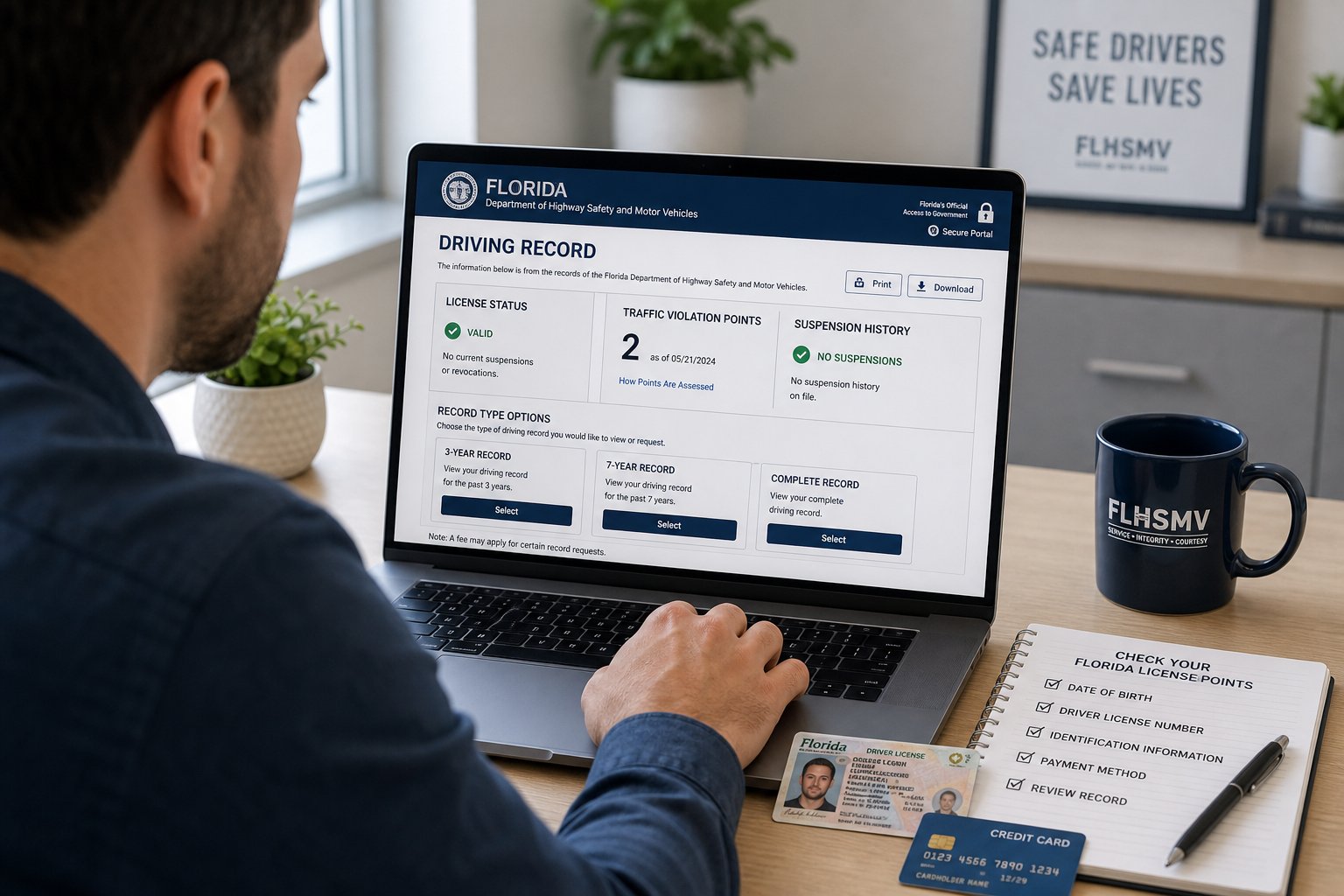
You can check how many points are on your Florida driver’s license by getting your Florida driving record from the Florida Department of Highway Safety and Motor Vehicles through the MyDMV Portal, by mail, or in person. Your driving record can show convictions, demerit points, license status, and suspension history, while the separate FLHSMV license check tool is better for a quick status check than a full point review. In Florida, points are tied to moving violation convictions, and license suspension can happen at 12 points in 12 months, 18 points in 18 months, or 24 points in 36 months under state rules.
This article covers Florida requirements only.
Key Facts
- Point suspension: Florida may suspend a license at 12 points in 12 months, 18 points in 18 months, or 24 points in 36 months.
- Record check: Use official FLHSMV tools or an official driver record request to confirm what is actually on your record.
- Offense dates: Florida computes point-suspension periods using the offense dates of convictions.
- BDI limit: An eligible BDI election can help prevent points on a current citation, but it does not erase old points.
- Clerk rules: Election deadlines, certificate filing, and court instructions can vary by county and citation.
If your goal is to prevent new points on an eligible current citation, review the Florida Basic Driver Improvement course before your clerk or court deadline.
The fastest way to see Florida points on license records is to order your official driving record from FLHSMV. That is the record that shows the point-related history you need, not a random third-party summary.
If you only want a quick look at whether your license is valid, suspended, or canceled, you can use the FLHSMV driver license check. But that tool is not the best source for a full point count. For that, you want your driving history.
Your Florida driving record may show:
- Moving violation convictions
- Demerit points tied to those convictions
- License status
- Prior suspensions
- Departmental actions
Points are usually added after a conviction is reported. So if you just got a ticket, your record may not show points yet. First the case has to be closed through payment, court action, or another final outcome.
Where To Get Your Record Through FLHSMV And What To Request
Use the official FLHSMV MyDMV Portal if you want to order a Florida driving record online. You can also request one in person at a local office or by mail through FLHSMV options listed on the state site.
Ask for an official driving record or driving history abstract if you want to check points. If you need it for court, work, or another formal use, you may need a certified driving record instead.
Florida offers different record ranges, and that matters:
- A 3-year driving record shows recent history and is often enough for checking active point issues.
- A 7-year driving record shows a longer history and may include older suspensions or convictions that still matter for review purposes.
If you are checking your record because of a ticket, compare the violation date, court result, and point entry. If anything looks wrong, contact the Clerk of Court in the county where the ticket was handled and then FLHSMV if needed.
How Florida License Points Work And Why They Matter
In Florida, demerit points are added after a conviction for many moving violations. They are not based only on getting a ticket. The court result is what matters.
That point system matters for two big reasons. First, too many points can lead to a license suspension. Second, insurance companies may review violations on your driving record when setting rates.
Florida uses time windows to track point totals. The state also keeps point-bearing convictions on your record for review. In general, points tied to a moving violation are tracked for 36 months from the violation date for suspension purposes.
A few key things to know:
- Not every ticket means points if you use an allowed option that keeps points off the record.
- Serious violations often carry more points.
- Multiple small violations can add up faster than drivers expect.
This is why it helps to check your record after a case closes. If you assumed a ticket was minor, but a conviction posted with points, you want to know soon.
Florida rules on traffic cases and elections are tied in part to Florida Statute 318.14. Also, deadlines, eligibility, and requirements can depend on the citation type, county, court, judge, and your case facts. So always read the ticket and any court notice closely.
Common Florida Traffic Violations And Their Point Values
Florida assigns different point values to different traffic violation points offenses. The exact result depends on the charge and the final conviction entered on your record.
Common examples include:
- Speeding
- Careless driving
- Improper lane change
- Running a red light
- Reckless driving
Many common moving violations carry 3 points. More serious offenses may carry 4 points or more. For example, some speeding convictions can be 3 points, while higher-speed cases can be 4 points. Leaving the scene of a crash involving property damage can carry more.
The safest way to confirm the exact point value is to check the official Florida schedule and your final record, because what matters is the offense that appears after the case is resolved.
A simple example helps. If you had a 3-point speeding conviction last year and then a 3-point careless driving conviction this year, you may already be halfway to the 12-point threshold. That is why checking your record is useful even if each ticket seemed minor on its own.
If you want the legal source, review Florida statutes and FLHSMV materials rather than relying on a blog chart copied from somewhere else. Official sources are the best fit when you need to confirm how an offense may affect your license.
How Many Points Lead To A Suspension In Florida
Florida has clear suspension thresholds. If you reach them, FLHSMV can suspend your license based on your point total within a set time period.
The main thresholds are:
- 12 points in 12 months = 30-day suspension
- 18 points in 18 months = 3-month suspension
- 24 points in 36 months = 1-year suspension
Those numbers make checking your driving record important. You do not want to guess where you stand.
Here is a simple way to think about it. A few 3-point convictions in a short time can create a real problem. Four separate 3-point convictions within 12 months can put you at the 12-point threshold.
Your record may also show past suspension actions, reinstatements, and status updates. That history can matter if you are trying to understand whether your license is currently valid or whether a new ticket could create a bigger issue.
If your status is unclear, use both tools:
- Order your official driving record for the point history.
- Use the FLHSMV license status check for a quick current-status lookup.
And if you have a pending ticket, do not ignore it. Missing a deadline or required court date can create separate problems beyond points.
What To Do If You Want To Avoid Or Reduce Points
If you got an eligible Florida non-criminal moving violation, you may be able to elect a Basic Driver Improvement course, often called traffic school or a defensive driving course. In Florida, those terms often refer to the same FLHSMV-approved 4-hour BDI course.
For many eligible cases, making that election on time can keep points off your record for that ticket. But it is not automatic, and it is not open for every citation or every driver.
A few important rules often apply:
- You usually must elect within the required deadline, often tied to 30 days from the citation.
- You must follow the instructions from the county Clerk of Court.
- You may still have to pay a civil penalty.
- Some violations are not eligible.
- CDL holders usually cannot use this option to avoid points.
Because county process matters, check the local clerk through the Florida Court Clerks & Comptrollers system. Read every notice. Do not miss any court order or required appearance.
If you are eligible and need an online option that fits a busy schedule, you can take the Florida BDI course at Driving Logic. The course works on your device, and it is built for people who need to finish around work, family, and other time limits.
What To Know About Out-Of-State Tickets, Minors, And CDL Drivers
Florida point rules can still affect you even when the ticket was not issued in Florida. That surprises a lot of drivers.
For out-of-state tickets, Florida may assess points for an out-of-state conviction if the offense matches a Florida moving violation. So if you were ticketed while traveling, do not assume it stays out of your Florida record.
For drivers under 18, point totals can trigger extra limits sooner. Younger drivers can face license restrictions or suspension if they build up points, even with fewer violations than they expected. That makes record checks especially important after any moving violation.
For CDL drivers, the rules are stricter in practice. Commercial drivers generally are not eligible to elect the BDI course to avoid points for a ticket received while operating a commercial motor vehicle. In some cases, CDL status can affect options even in a non-commercial vehicle case. The exact result depends on the citation and case details.
So if any of these apply to you, use official sources first:
- FLHSMV
- Your county Clerk of Court
- The relevant Florida Statutes
That will give you the best answer on reporting, point treatment, deadlines, and what steps you can still take.
This information is for general education only and is not legal advice.
FAQ
How do I check how many points are on my Florida license?
Request your official driving record from FLHSMV at flhsmv.gov. You can order it online, by mail, or in person at a county tax collector office that provides FLHSMV services. The 3-year driving record shows all moving violation convictions and associated points within that period.
What does a Florida driving record show?
Your FLHSMV driving record shows moving violation convictions, the point value for each violation, your current license status, any suspensions or revocations, and endorsements. The 3-year record covers the most recent 3 years; the complete record covers a longer history.
How much does it cost to check points on my Florida license?
A 3-year driving record from FLHSMV typically costs approximately $10. A complete driving record costs approximately $25. Fees may vary — confirm current fees on the FLHSMV website before ordering.
Can I check my Florida points online for free?
FLHSMV charges a fee for official driving records. Some county tax collector offices provide record lookups in person. Third-party websites that claim to provide free Florida driving records may not reflect current FLHSMV data — use the official source for accurate point information.
How long does it take to get my Florida driving record?
Online requests through FLHSMV are typically processed quickly — often the same day or within a few business days. Mailed requests take longer. In-person requests at a county tax collector office providing FLHSMV services may be available immediately.
Will checking my own driving record affect my license?
No. Requesting your own Florida driving record does not affect your license, your point total, or your insurance in any way. It is a personal record inquiry.
Conclusion
Checking your Florida driving record is straightforward through FLHSMV’s online portal or a county tax collector office. Pull your record before assuming your point total — it is the only authoritative way to know exactly where you stand and how close you are to a suspension threshold.
Take the Florida BDI course online at Driving Logic
FAQ
How do I check how many points are on my Florida license?
Request your official driving record from FLHSMV at flhsmv.gov. You can order it online, by mail, or in person at a county tax collector office that provides FLHSMV services. The 3-year driving record shows all moving violation convictions and associated points within that period.
What does a Florida driving record show?
Your FLHSMV driving record shows moving violation convictions, the point value for each violation, your current license status, any suspensions or revocations, and endorsements. The 3-year record covers the most recent 3 years; the complete record covers a longer history.
How much does it cost to check points on my Florida license?
A 3-year driving record from FLHSMV typically costs approximately $10. A complete driving record costs approximately $25. Fees may vary — confirm current fees on the FLHSMV website before ordering.
Can I check my Florida points online for free?
FLHSMV charges a fee for official driving records. Some county tax collector offices provide record lookups in person. Third-party websites that claim to provide free Florida driving records may not reflect current FLHSMV data — use the official source for accurate point information.
How long does it take to get my Florida driving record?
Online requests through FLHSMV are typically processed quickly — often the same day or within a few business days. Mailed requests take longer. In-person requests at a county tax collector office providing FLHSMV services may be available immediately.
Will checking my own driving record affect my license?
No. Requesting your own Florida driving record does not affect your license, your point total, or your insurance in any way. It is a personal record inquiry.
Conclusion
Checking your Florida driving record is straightforward through FLHSMV’s online portal or a county tax collector office. Pull your record before assuming your point total — it is the only authoritative way to know exactly where you stand and how close you are to a suspension threshold.
Take the Florida BDI course online at Driving Logic
Related Articles
- Florida Driver License Points System: Suspensions, Point Values, and BDI Options
- How Many Points Is a Speeding Ticket in Florida?
- How Long Do Points Stay on Your License in Florida?
- Florida Traffic Violation Points Chart: How Many Points for Each Offense
Sources
- Florida Statute 322.27 — Driver License Suspension and Point System
- Florida Statute 318.14 — Traffic Infractions and BDI Election
- FLHSMV — Driver Improvement Schools
- FLHSMV — Driver License Check
- Florida Clerks of Court
Billy Forte is the owner of Driving Logic, a state-approved driver improvement course provider serving Florida and other U.S. states. Driving Logic offers FLHSMV-approved online BDI courses for drivers handling traffic tickets, court orders, and state requirements.
This article is general information, not legal advice. Eligibility, deadlines, court acceptance, license consequences, insurance decisions, and filing steps depend on the citation type, county, court, judge, and facts of your case. Use official Florida court and state sources for current requirements, and consult a qualified Florida attorney for legal guidance specific to your situation.