
Updated June 2026 · Reviewed by Billy Forte
Drivers under 18 in Florida can face limits on their license sooner than adults, because 6 points can restrict a teen license even though the standard adult-style suspension levels are 12 points in 12 months, 18 points in 18 months, and 24 points in 36 months. For drivers ages 15 to 17, the Florida Department of Highway Safety and Motor Vehicles can place the license on Business Purposes Only status for 12 months or until age 18, whichever is longer, after 6 points. Florida also keeps traffic violation points on a driving record for 36 months from the date the case is closed, and a teen may be able to elect a Basic Driver Improvement course in some cases to avoid points if eligible and completed on time.
This article covers Florida requirements only.
Key Facts
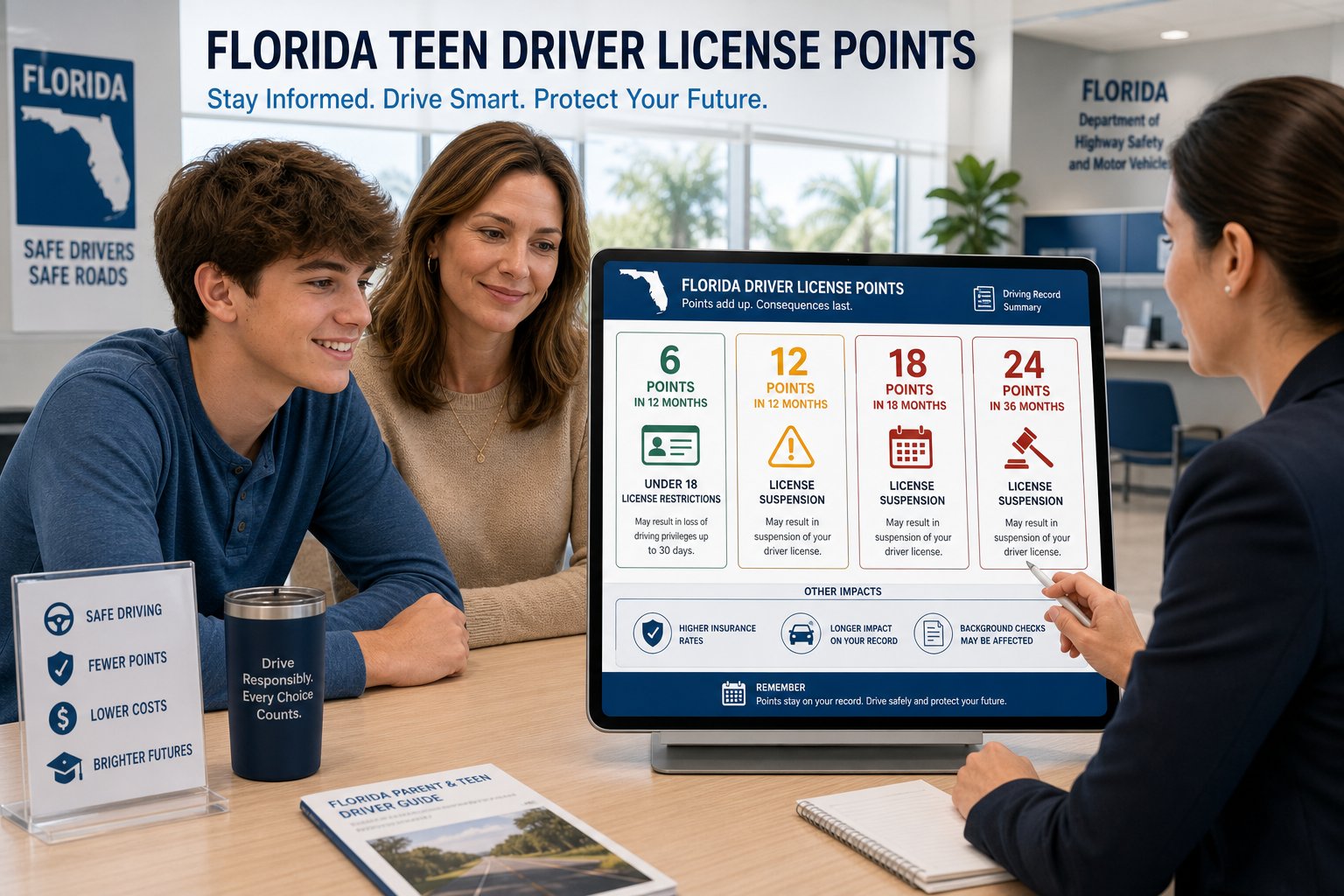
- Point suspension: Florida may suspend a license at 12 points in 12 months, 18 points in 18 months, or 24 points in 36 months.
- Teen drivers: Drivers under 18 face lower point-related restrictions than adult drivers.
- Offense dates: Florida computes point-suspension periods using the offense dates of convictions.
- BDI limit: An eligible BDI election can help prevent points on a current citation, but it does not erase old points.
- Clerk rules: Election deadlines, certificate filing, and court instructions can vary by county and citation.
If your goal is to prevent new points on an eligible current citation, review the Florida Basic Driver Improvement course before your clerk or court deadline.
Florida teen driver license points work a lot like adult points at first. The state assigns demerit points for moving violations. Those points go on your driving record and stay there for 36 months from the date the case is closed.
The basic Florida point system uses these levels:
- 12-point threshold in 12 months: 30-day suspension
- 18-point threshold in 18 months: 3-month suspension
- 24-point threshold in 36 months: 1-year suspension
These are the standard statewide rules used by the Florida Department of Highway Safety and Motor Vehicles and shown by FLHSMV. You can review official record and point information through FLHSMV.
For teens, the key difference is that the point system is not the whole story. A young driver on a restricted license can face trouble sooner. So while the same point chart applies, the real-world effect is often harsher for drivers under 18.
That matters because a ticket can do more than add points. It can change when, where, and why you may drive. And if you keep getting violations, the regular suspension levels still apply on top of teen rules.
Also, points do not vanish just because you served a suspension. If they are still inside the 36-month window, they still count toward later action by FLHSMV.
Special Point Rules And Restrictions For Florida Teen Drivers
Florida has stricter thresholds for drivers under 18. This is the main difference most families miss. If you are 15, 16, or 17 and you get 6 points, your license can be restricted to Business Purposes Only.
That restriction lasts for 12 months or until you turn 18, whichever is longer. In plain terms, that usually means you may drive only for limited needs, such as:
- School
- Work
- Church
- Medical reasons
- Other essential trips allowed by the state
This is not the same as the normal 12-point suspension rule. It happens sooner. That is why florida under 18 license suspension questions often cause confusion. In many teen cases, the first major penalty is a restriction, not a full suspension.
Still, if your record later reaches the standard 12-point threshold, 18-point threshold, or 24-point threshold, FLHSMV can suspend your license under the normal point rules too.
The effect also differs by license type. A teen with a limited license may lose driving freedom much faster because the state can narrow the license to business use. A driver with a full adult license usually stays fully licensed until the normal suspension totals are reached.
Because teen rules depend on age, license class, and the case facts, check the ticket and court instructions closely. Rules can also depend on the county, judge, and citation type.
Common Florida Traffic Violations And Their Point Values
Many common Florida tickets carry either 3, 4, or 6 points. That means two tickets can be enough to trigger a teen restriction.
Common traffic violation points include:
- Speeding less than 15 mph over: 3 points
- Speeding 15 mph or more over: 4 points
- Speeding that causes a crash: 6 points
- Reckless driving: 4 points
- Moving violation causing a crash: often 3 to 4 points
- Passing a stopped school bus: 4 points
- Leaving the scene of a crash with property damage of $50 or more: 6 points
- Child restraint violation: 3 points
You can see why this adds up fast. For example, one 4-point speeding ticket and one 3-point moving violation can put a 16-year-old over the 6-point teen limit.
Not every ticket adds points. Parking tickets usually do not. But most moving violations do, and the exact point count depends on the charge entered on the record.
If you want the legal basis for how Florida handles traffic citations and election options, start with Florida Statute 318.14. The final result can still depend on the county court and how the citation is resolved.
When Points Lead To Suspension Or Loss Of Driving Privileges
Points can lead to either a license suspension or a loss of full driving rights. For teens, the loss of rights can start at 6 points. For all drivers, the standard suspension levels are still:
- 12 points in 12 months: 30 days
- 18 points in 18 months: 3 months
- 24 points in 36 months: 1 year
The teen rule matters because it changes the timeline. A driver under 18 may not be fully suspended at 6 points, but the state can still limit the license to Business Purposes Only. That can affect school, work, sports, and family routines.
A full suspension is more severe. If FLHSMV suspends your license under the point system, you cannot drive unless the state gives you a lawful privilege to do so. Do not assume a restricted teen license works the same as a suspended adult license. These are different statuses with different limits.
Also, points remain for three years and do not reset after suspension. So if you serve a penalty and then get more violations inside that 36-month period, the old points may still count.
That is why fast action matters after a citation. Read the ticket. Watch the deadline. And check whether you have a traffic school option through the court or Clerk.
Do Out-Of-State Tickets And Learner’s License Violations Count?
Yes, they often do. Florida generally receives reports of many out-of-state moving violations, and those violations can post to your Florida record with Florida point treatment. So if you get a speeding ticket in another state, it may still affect your Florida license.
This often applies to violations such as:
- Speeding
- Reckless driving
- Other moving violations
Non-moving issues, like most parking tickets, usually do not add points.
Learner’s license violations can also matter. If you have a learner’s permit and you commit a moving violation, it can be treated like a regular moving violation for point purposes. That means the violation may count toward the teen 6-point rule and later point totals.
This surprises many parents. They assume a permit ticket is “less serious.” Usually, it is not. If the citation is a moving violation, it can affect the permit holder’s driving record in the same basic way.
The exact posting of an out-of-state case can depend on the offense and how it is reported. So if you are unsure, order your Florida record and confirm what appears there before you assume nothing happened.
How To Check Your Driving Record And Respond To A Florida Ticket
You can check your record through the Florida Department of Highway Safety and Motor Vehicles. FLHSMV offers driving record options, including a 3-year, 7-year, or complete record. Start with FLHSMV driving record services.
If you get a Florida ticket, you usually need to act by the deadline on the citation. Your options may include:
- Pay the fine, which often means points are added
- Elect traffic school, if you are eligible
- Contest the ticket in court
The local Clerk of Court often handles the election and payment process. You can find the right office through the Florida Clerks of Court directory.
For many drivers, the key question is not just the fine. It is whether the result will add points and hurt your license. Teens need to be extra careful because a single bad result can move them close to the 6-point limit.
Do not miss a required court date or ignore a ticket. Eligibility, deadlines, and court steps can depend on the county, court, judge, citation type, and the facts of your case.
When A Basic Driver Improvement Course May Help
A Basic Driver Improvement course may help you avoid points for some Florida tickets if you are eligible and you elect it on time. In Florida, BDI, traffic school, and a defensive driving course often mean the same state-approved 4-hour course.
For many non-criminal moving violations, a proper BDI election can prevent points from being assessed. Florida generally allows this once every 12 months, up to 5 times in your lifetime, but your exact eligibility can depend on the violation and your license type.
Some violations may come with different rules, and in some cases BDI can be mandatory. If ordered and not completed, a license suspension may follow. That is why you should read the citation, court notice, and Clerk instructions carefully.
If you need a flexible option, you can take the Florida BDI course online through Driving Logic. The site is built for busy drivers and works on your phone, tablet, or computer.
Before you enroll, confirm that your case allows the election. Court and county rules can vary, and individual facts matter.
Not legal advice.
FAQ
Do teen drivers have different point rules in Florida?
Yes. Drivers under 18 face lower thresholds. Accumulating 6 or more points in any 12-month period triggers a 30-day license restriction — travel is limited to school, work, and church only. This is lower than the 12-point threshold that triggers a 30-day suspension for adult drivers.
What happens after a teen’s license is restricted for points in Florida?
After the initial 30-day restriction for 6 points in 12 months, each additional point accumulated triggers a 90-day extension of the restriction. This means continued violations can significantly extend the period during which a teen’s driving is limited.
When do adult point thresholds apply to Florida teen drivers?
At age 18, the standard adult point thresholds under Florida Statute 322.27 apply: 12 points in 12 months triggers a 30-day suspension, 18 points in 18 months triggers a 3-month suspension, and 24 points in 36 months triggers a 1-year suspension.
Are point values different for teen drivers in Florida?
No. Teen drivers receive the same point values as adult drivers for each violation type — 3 points for most moving violations, 4 points for speeding 15 mph or more over the limit or reckless driving, and 6 points for careless driving resulting in an accident.
Can a teen driver elect traffic school in Florida?
Yes. Teen drivers may elect traffic school for eligible citations under the same general rules as adult drivers — the election must be made through the Clerk of Court within the election window, and an FLHSMV-approved BDI course must be completed by the completion deadline.
Why do teen drivers have lower thresholds in Florida?
Florida uses lower thresholds for teen drivers to encourage safer driving habits during the early years of licensing. The restricted license framework is designed to limit driving privileges while still allowing access to school, work, and essential activities.
Conclusion
Florida applies lower point thresholds for teen drivers under 18 — 6 points in 12 months triggers a license restriction rather than the full suspension threshold used for adults. Teen drivers and their families should track point accumulation carefully, and use traffic school elections for eligible violations to prevent restrictions from triggering.
Take the Florida BDI course online at Driving Logic
FAQ
Do teen drivers have different point rules in Florida?
Yes. Drivers under 18 face lower thresholds. Accumulating 6 or more points in any 12-month period triggers a 30-day license restriction — travel is limited to school, work, and church only. This is lower than the 12-point threshold that triggers a 30-day suspension for adult drivers.
What happens after a teen’s license is restricted for points in Florida?
After the initial 30-day restriction for 6 points in 12 months, each additional point accumulated triggers a 90-day extension of the restriction. This means continued violations can significantly extend the period during which a teen’s driving is limited.
When do adult point thresholds apply to Florida teen drivers?
At age 18, the standard adult point thresholds under Florida Statute 322.27 apply: 12 points in 12 months triggers a 30-day suspension, 18 points in 18 months triggers a 3-month suspension, and 24 points in 36 months triggers a 1-year suspension.
Are point values different for teen drivers in Florida?
No. Teen drivers receive the same point values as adult drivers for each violation type — 3 points for most moving violations, 4 points for speeding 15 mph or more over the limit or reckless driving, and 6 points for careless driving resulting in an accident.
Can a teen driver elect traffic school in Florida?
Yes. Teen drivers may elect traffic school for eligible citations under the same general rules as adult drivers — the election must be made through the Clerk of Court within the election window, and an FLHSMV-approved BDI course must be completed by the completion deadline.
Why do teen drivers have lower thresholds in Florida?
Florida uses lower thresholds for teen drivers to encourage safer driving habits during the early years of licensing. The restricted license framework is designed to limit driving privileges while still allowing access to school, work, and essential activities.
Conclusion
Florida applies lower point thresholds for teen drivers under 18 — 6 points in 12 months triggers a license restriction rather than the full suspension threshold used for adults. Teen drivers and their families should track point accumulation carefully, and use traffic school elections for eligible violations to prevent restrictions from triggering.
Take the Florida BDI course online at Driving Logic
Related Articles
- Florida Driver License Points System: Suspensions, Point Values, and BDI Options
- How Long Does a Speeding Ticket Stay on Your Florida Driving Record?
- Will My Florida Traffic Violations Show Up on a Background Check?
- Your Florida Driving Record: How to Get It and What It Shows
Sources
- Florida Statute 322.27 — Driver License Suspension and Point System
- Florida Statute 318.14 — Traffic Infractions and BDI Election
- FLHSMV — Driver Improvement Schools
- FLHSMV — Driver License Check
- Florida Clerks of Court
Billy Forte is the owner of Driving Logic, a state-approved driver improvement course provider serving Florida and other U.S. states. Driving Logic offers FLHSMV-approved online BDI courses for drivers handling traffic tickets, court orders, and state requirements.
This article is general information, not legal advice. Eligibility, deadlines, court acceptance, license consequences, insurance decisions, and filing steps depend on the citation type, county, court, judge, and facts of your case. Use official Florida court and state sources for current requirements, and consult a qualified Florida attorney for legal guidance specific to your situation.