
Updated June 2026 · Reviewed by Billy Forte
Your main options after getting a Florida traffic ticket are to pay the ticket, elect traffic school if you qualify, or ask for a hearing to contest it, and most drivers must choose within 30 days from the citation date. For many standard speeding citations in Florida, paying is treated as an admission and usually adds points, while a timely election of a state-approved Basic Driver Improvement (BDI) course can keep points off your record for that citation if the court allows it. The exact deadline, fee, school eligibility, and court steps can change based on the citation, county, clerk, court, judge, and case type, so you should follow the instructions on your ticket and the county clerk’s official website.
This article covers Florida requirements only.
Key Facts
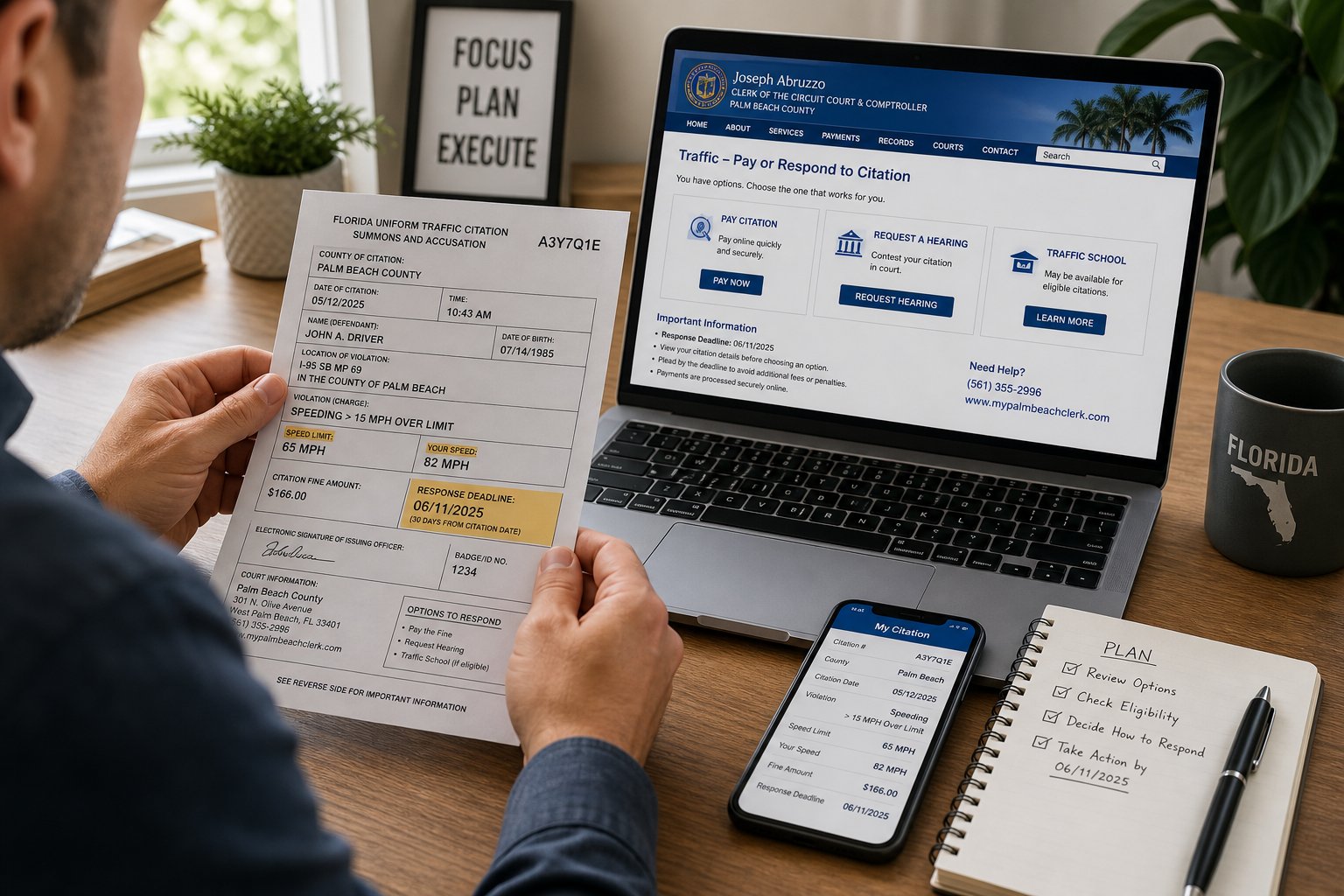
- Option 1 — Pay: Resolves the ticket quickly; points are assessed to your driving record
- Option 2 — Elect traffic school: Withholds adjudication; no points added for that citation; requires election with clerk within ~30 days
- Option 3 — Contest: Request a hearing to dispute the ticket; outcome depends on facts and court
- Election deadline: Typically 30 days from the citation date — this is the most time-sensitive step
- Traffic school limits: Maximum 8 lifetime elections; no more than once in any 12-month period
- CDL holders: Traffic school election generally not available for commercial vehicle violations
Key Facts
- Option 1 — Pay: Resolves the ticket quickly; points are assessed to your driving record
- Option 2 — Elect traffic school: Withholds adjudication; no points added for that citation; requires election with clerk within ~30 days
- Option 3 — Contest: Request a hearing to dispute the ticket; outcome depends on facts and court
- Election deadline: Typically 30 days from the citation date — this is the most time-sensitive step
- Traffic school limits: Maximum 8 lifetime elections; no more than once in any 12-month period
- CDL holders: Traffic school election generally not available for commercial vehicle violations
What To Do Right After You Get A Florida Speeding Ticket
Start with the ticket itself. Read every line before you do anything else.
Check the date you got the citation, the county, the violation listed, and whether the case is a civil traffic infraction or a criminal traffic citation. That difference matters a lot. A common speeding ticket is often a civil infraction, but some cases involve a required court appearance or more serious charges. If your citation says you must appear, do not assume you can just pay online.
Next, mark the 30-day response deadline on your calendar. In many Florida cases, that is the window to choose among the main florida speeding ticket options: pay, elect traffic school, or ask for a hearing. Missing that deadline can create bigger problems than the ticket itself.
Then go to the website for the clerk of court in the county where the ticket was issued. Florida procedures are not perfectly uniform. The clerk page usually lists payment methods, hearing request rules, traffic school instructions, and case lookup tools. You can also review statewide information from the Florida Courts and the Florida Highway Safety and Motor Vehicles.
A small but important point: check whether the ticket involves a school zone, construction zone, or crash. Those facts can affect fines, eligibility, or how the court handles the case.
If you are unsure what your citation requires, use the clerk instructions first and keep copies of anything you file or submit.
How Florida Speeding Tickets Affect Points, Insurance, And Your Driving Record
A speeding ticket is not just about the fine. It can affect your license points, your driving record, and sometimes your insurance costs.
In Florida, paying a moving violation usually means points are assessed to your license. The exact point value depends on the offense. Over time, too many points can lead to a suspension under rules explained by FLHSMV. That is why many drivers look closely at their florida ticket pay or contest decision instead of only focusing on the ticket amount.
Insurance is the part many people forget. A ticket may not feel expensive at first, but the long-term cost can be bigger if your insurer treats it as a higher-risk driving event. Rates do not move the same way for every driver or every company, so you should not assume the result. But it is fair to say that points and moving violations can matter beyond the court file.
Your driving record also affects things like future citations, court treatment, and whether you qualify for certain options later. For example, the right to elect a Basic Driver Improvement course is limited by Florida law and by case details. If you have used that option before, or if the ticket is not eligible, your choices may be narrower.
The legal framework for traffic infractions and elections appears in Florida Statutes Chapter 318. Reading the statute is not fun, but it helps explain why the same speeding ticket can lead to different next steps depending on the case.
Option 1: Pay The Fine And Accept The Consequences
Paying the ticket is usually the fastest path. It is also the simplest. For a lot of busy drivers, that is the main appeal.
Most counties let you pay online, by mail, by phone, or in person. But simple does not mean harmless. In many Florida speeding cases, paying the fine means you are resolving the citation as charged, which generally leads to adjudication and points for a moving violation. That can affect your record and may affect insurance.
The total amount due depends on the county and the speed alleged. Some clerk websites publish sample schedules. For example, county fine charts may show different amounts for 6 to 9 mph over, 10 to 14 mph over, and so on. Those numbers can change, and a higher-speed case may require court instead of standard payment, so always use the local clerk page tied to your citation.
This option tends to make the most sense when:
- You are not eligible for traffic school
- You do not want to contest the ticket
- The case is minor and you understand the likely record impact
- The clerk instructions clearly allow payment without appearance
What you should not do is pay first and research later. Once a ticket is resolved by payment, your other options may close.
If you want to compare this route against school or court, pull up your county clerk’s payment page and case details before you submit anything.
Option 2: Elect Traffic School To Avoid Points
For many drivers, this is the option worth checking first.
Florida often allows eligible drivers with a non-criminal speeding ticket to elect a Basic Driver Improvement (BDI) course. If the election is accepted and you complete the course on time, the usual result is no points for that citation. In many cases, adjudication is withheld. Florida law also includes protections tied to certain completed elections when no crash was involved, but the exact effect depends on the case facts and legal requirements.
Timing matters. In general, you must elect traffic school within 30 days of the citation. After that, you usually get a deadline to finish a state-approved 4-hour course. Some courts use about 60 days, and some may allow longer. The clerk instructions control.
There can also be a fine reduction in some cases, but do not treat that as automatic. The amount, if any, depends on the court and citation handling.
If you need a flexible online option, Driving Logic offers a Florida Basic Driver Improvement course designed for people who want to finish on their own schedule from any device.
Who Usually Qualifies For Traffic School
Traffic school is often available for non-criminal moving violations, including many standard speeding tickets. But it is not open to everyone.
You may not qualify if:
- The citation is criminal
- The court requires an appearance and does not allow the election
- You have already used the election too many times under Florida rules
- The facts of the ticket place it outside the normal BDI process
Florida limits how often this election can be used, and those limits matter. The safest approach is to confirm eligibility with the county clerk before you enroll. Then, if you elect the option, finish the course by the deadline and keep proof of completion.
Option 3: Contest The Ticket In Court Or With Legal Help
You also have the right to challenge a speeding ticket instead of paying it.
In Florida, that usually means requesting a hearing within the required deadline. At that stage, you may plead not guilty, and the court will set the matter for further handling based on local procedure. Some drivers represent themselves. Others hire a traffic attorney, especially if the speed was high, the record is already crowded, or the case may involve more than a routine civil infraction.
Why contest? Because the state still has to prove the violation. Depending on the facts, issues may involve the officer’s observation, the method used to measure speed, road signage, identification, or other evidence. That does not mean a challenge will succeed. It only means you have the option to require the case to be heard.
Possible outcomes vary. If the case is dismissed or you are found not guilty, you may avoid the fine and points tied to that citation. If you are found responsible, you may still owe the fine and may also face court costs. Attorney fees, if you hire counsel, are separate.
This is where readers often want a guaranteed answer, and there isn’t one. County practices, judge preferences, citation facts, and the type of charge all matter. A court contest can be worth it in the right case, but it takes time, paperwork, and some uncertainty.
If your ticket involves a mandatory appearance, a possible criminal issue, or facts you do not understand, review the clerk and court instructions carefully before you choose this route.
What Happens If You Miss The Deadline Or Ignore The Ticket
Ignoring a Florida speeding ticket is the worst option on the list.
If you do not pay, elect school, or request a hearing within the usual 30-day period, the problem can get more expensive and more serious. Courts may add late fees or other costs. Your driver license can be suspended until the case is cleared. Some unpaid cases may be sent to collections. And if the citation is criminal or requires a court appearance, failing to appear can create much bigger trouble, including a possible warrant.
There is another common mistake here: electing traffic school and then not finishing it on time. That can undo the benefit you were trying to get. Depending on the court and case, you may face points, added fees, suspension issues, and an order to complete the course anyway.
This is why deadlines matter so much. Florida traffic cases move on a calendar, not on your intention to deal with it later.
Your best next step is simple: pull out the citation, find the county clerk website, confirm your exact deadline and case type, and choose one valid option before the window closes.
Not legal advice.
How County Rules and Fines Can Vary
Florida traffic ticket fine amounts, court costs, and surcharges vary significantly by county. The base fine for a speeding violation is set by state law under Florida Statute 318.18, but county and local surcharges, court costs, and administrative fees can substantially increase the total amount due. Check with the Clerk of Court in the county where the ticket was issued for the exact total amount and any local requirements before paying or electing traffic school.
FAQ
What are my options after receiving a Florida traffic ticket?
For most noncriminal moving violations, Florida offers three options: pay the fine and accept the adjudication and points, elect traffic school through the Clerk of Court to withhold adjudication and keep points off your record, or request a hearing to contest the ticket before a judge or magistrate.
Which Florida traffic ticket option is best?
It depends on your situation. Electing traffic school is often the best choice for drivers who want to protect their driving record and still have elections available. Paying is quickest but adds points. Contesting makes sense only if you have a defensible basis for disputing the ticket. Consult a Florida traffic attorney if you are unsure.
What is the deadline to elect traffic school in Florida?
The election must generally be made with the Clerk of Court within 30 days of the citation date. This is the most time-sensitive step — if you miss the deadline, the election option is typically no longer available for that ticket.
What happens if I just pay my Florida traffic ticket?
Paying the fine without electing traffic school results in adjudication of the violation. Points are assessed to your driving record, which can increase insurance rates and — if points accumulate past thresholds — trigger a license suspension.
Can I contest a Florida traffic ticket without a lawyer?
Yes. You can request a hearing and represent yourself. However, for higher-point violations or if the ticket involves potential criminal charges, consulting a Florida traffic attorney is advisable.
What does “withhold of adjudication” mean in Florida?
Withhold of adjudication means the court does not formally enter a conviction for that citation. For traffic school elections, this means no points are added to your driving record for that specific violation. The election and withheld adjudication still appear on your record, but without a point entry.
Conclusion
Florida gives you three choices when you receive a traffic ticket — and the right choice depends on your record, how many elections you have left, and the specific violation. The election deadline is the most urgent factor: missing the 30-day window eliminates traffic school as an option for that ticket.
Take the Florida BDI course online at Driving Logic
Related Articles
- Florida Traffic Ticket: Costs, Points, and Traffic School Options
- Florida Speeding Ticket Cost: What Affects the Total?
- Florida Red Light Camera Tickets: Do They Add Points to Your License?
- Florida Speeding Ticket Fines: What Affects the Cost?
Sources
- FLHSMV — Driver Improvement Schools
- FLHSMV — Basic Driver Improvement Course Providers
- Florida Statute 318.14 — Noncriminal Traffic Infractions
- Florida Statute 322.27 — Authority of Department to Suspend or Revoke License
- Florida Clerks of Court
Billy Forte is the owner of Driving Logic, a state-approved driver improvement course provider serving Florida and other U.S. states. Driving Logic offers FLHSMV-approved online BDI courses for drivers handling traffic tickets, court orders, and state requirements.
This article is general information, not legal advice. Eligibility, deadlines, court acceptance, and filing steps depend on the citation type, county, court, judge, and the facts of your case. Use official Florida court and state sources for current requirements, and consult a qualified Florida attorney for legal guidance specific to your situation.