
Updated June 2026 · Reviewed by Billy Forte
Yes. Florida traffic violations and your driving record can show up on a job background check if the employer asks for your motor vehicle record, and many employers do that for jobs that involve driving. In Florida, the Florida Department of Highway Safety and Motor Vehicles keeps your driving record, and employers, courts, insurers, and other allowed users can get parts of it under state and federal rules.
This article covers Florida requirements only.
Key Facts
- Point suspension: Florida may suspend a license at 12 points in 12 months, 18 points in 18 months, or 24 points in 36 months.
- Record visibility: Traffic violations can appear on driving records used by employers, insurers, or background-screening companies.
- Offense dates: Florida computes point-suspension periods using the offense dates of convictions.
- BDI limit: An eligible BDI election can help prevent points on a current citation, but it does not erase old points.
- Clerk rules: Election deadlines, certificate filing, and court instructions can vary by county and citation.
If your goal is to prevent new points on an eligible current citation, review the Florida Basic Driver Improvement course before your clerk or court deadline.
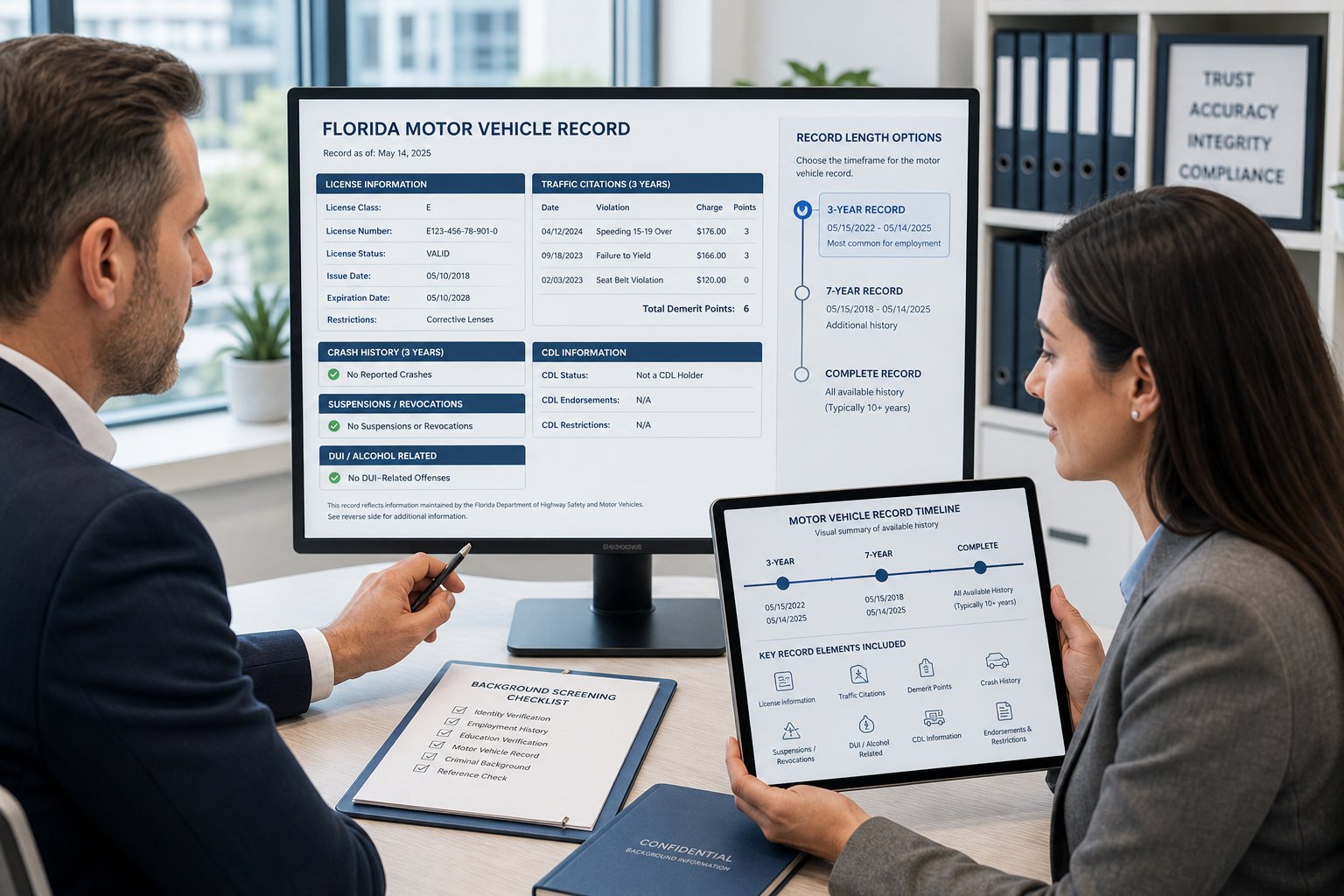
A Florida driving record background check is usually a copy of your motor vehicle record, often called an MVR. It is not the same as a full criminal background check. But it can still reveal a lot.
Your Florida MVR may show:
- Your license status: valid, canceled, suspended, or revoked
- License class and any restrictions
- Traffic violations and many citations
- Traffic violation points and total demerit points
- License suspension periods
- Crashes tied to a citation
- Some alcohol-related or criminal traffic offenses, such as DUI
- Traffic school or course completion entries in some cases
So, will your Florida traffic violations show up on a background check for a job? Often, yes. If the employer pulls an MVR, they may see moving violations, points, suspensions, and other driving history details.
A personal copy and an employer-requested record can differ in practice. A personal driving record helps you review what FLHSMV has on file. A certified MVR is often used when an employer, court, or insurer needs an official record. Certified copies are generally the formal records used to verify history.
The Main Types Of Florida Driving Records
Florida commonly offers these record types through FLHSMV:
- 3-year record
- 7-year record
- Complete record
A 3-year or 7-year record shows a limited time window. A complete record goes back much farther and can include items not shown on shorter reports, including some entries tied to traffic school handling.
That matters if you elected BDI, which is the same as traffic school or a defensive driving course in Florida. It is the FLHSMV-approved 4-hour course. In many cases, the related citation may be withheld from points on a shorter record, but the election or course history can still matter on a complete record. If you want to check your own status before a job search, start with FLHSMV’s Driver License Check for basic status, then order a fuller record if needed.
Why Drivers, Employers, And Courts Request Florida MVRs
People request Florida MVRs for different reasons, but the main goal is simple: to verify driving history.
Drivers request their own record to:
- Check for errors
- See point totals
- Confirm a suspension was cleared
- Review what a job or insurer may see
Employers request MVRs because a job applicant may drive a company car, use a fleet vehicle, carry passengers, transport goods, or hold a role where driving safety matters. Delivery jobs, sales roles, trucking, field service, home health, school transport, and many public sector jobs often involve MVR screening.
Even when driving is not the main duty, an employer may still pull an MVR if the role includes any company driving. That is one reason the answer to is your driving record available to the public in Florida needs a careful explanation. Florida records are public in a broad sense, but access to personal details is still limited by law.
Courts and Clerks of Court also use driving records. A judge may review prior history when deciding eligibility for traffic school or other case outcomes. The record can also help confirm whether a driver has prior point issues, missed obligations, or prior course elections. For court information, your local Florida Clerk of Court is a useful starting point.
Insurers use MVRs too. More violations, more points, or a recent suspension can affect underwriting and price.
How To Get A Florida Driving Record In Florida
You have a few ways to get your Florida driving record. The right option depends on how much detail you need.
The fastest basic check is the FLHSMV Driver License Check. It is useful for current status only. It can help you confirm whether your license is valid, suspended, or revoked. You can use it on the FLHSMV status check page.
If you need the actual record, you can request a 3-year, 7-year, or complete record from the Florida Department of Highway Safety and Motor Vehicles. Florida also allows requests through some local offices and approved third parties.
Common ways to get it include:
- Ordering through FLHSMV record request channels
- Visiting a driver license office or tax collector office
- Using an authorized provider
- Requesting records that a court or employer specifically asks for
If you need a formal copy for a case or employer, ask whether they want a certified record. That point matters.
Also, review your record before you apply for jobs that may check it. Look for:
- Old tickets still showing as open
- Wrong suspension status
- Missing completion entries
- Point totals that do not look right
If your record relates to a traffic citation, pay close attention to court dates and deadlines. Under Florida Statute 318.14, how you respond to a citation can affect points, hearings, and school options. Eligibility, deadlines, and requirements can depend on the citation type, county, court, judge, and the facts of your case.
What Florida Traffic Violations, Points, And Suspensions Mean
In Florida, many moving violations add traffic violation points to your license. These are often called demerit points. Too many points can lead to a license suspension.
The main Florida suspension thresholds are:
- 12-point threshold in 12 months = 30-day suspension
- 18-point threshold in 18 months = 3-month suspension
- 24-point threshold in 36 months = 1-year suspension
That makes point tracking very important before a job search. An employer who checks your MVR may focus on recent violations, a suspended license, repeated risky driving, or serious offenses.
How long entries stay can vary by item. In general:
- Standard moving or non-moving violations often remain for 3 to 5 years
- Many CDL-related violations can remain for 10 years or more
- DUI and other alcohol-related entries can remain for a very long time, often 75 years
- Some criminal traffic violations may be effectively permanent on the record
What about adjudication withheld after a BDI election? In Florida, BDI means the same 4-hour FLHSMV-approved traffic school or defensive driving course. If you were eligible and elected it, you may avoid points for that citation. But that does not mean the event vanishes from every record type forever. Shorter reports may omit some infractions handled that way, while a complete record can still show the history.
So if you are applying for a job with driving duties, do not assume a withheld case is invisible. Check your own record first.
Florida Driving Record Laws And Privacy Rules To Know
Florida driving records sit at the point where public records law and privacy law meet. That is why people often ask, is your driving record available to the public in Florida. The short answer is: parts of it may be available, but not all personal data is open without limits.
Florida public records law allows access to many government records. For motor vehicle records, one key state rule is Florida Statute 119.0712. But access is also shaped by the federal Drivers Privacy Protection Act, which limits disclosure of certain personal information.
That means some record data may be disclosed for permitted uses, while sensitive details may be restricted or redacted. In practice, employers, insurers, courts, and other allowed users can often get the driving information they need for a lawful purpose.
You should also know the difference between a broad public-record idea and a real-world screening request. A random person may not get the same access or detail level that an employer, insurer, or court can get through proper channels.
For your own records, use official Florida sources first:
- FLHSMV
- Florida Statutes
- Your local Clerk of Court
If a record affects your license status or court duty, act quickly and follow the instructions on the citation or court notice.
How A Driving Record Can Affect Traffic School, Insurance, And Job Screening
Your driving record can affect three big areas: traffic school options, insurance costs, and hiring.
First, traffic school. In Florida, BDI, traffic school, and a defensive driving course often mean the same FLHSMV-approved 4-hour course for eligible drivers. If the court or citation allows it, finishing the course may help you avoid points for one eligible non-criminal moving violation. But the rules are not one-size-fits-all. Eligibility and deadlines depend on the citation type, county, court, judge, and case facts.
Second, insurance. Insurers commonly review MVRs. More recent violations and suspensions usually mean more risk. That can raise rates or limit options.
Third, job screening. Employers often care most about:
- A current valid license
- Recent moving violations
- At-fault crash patterns tied to citations
- DUI or major offenses
- Any suspension history
If you want to prepare before applying, take these steps:
- Check your Florida license status.
- Order your record if the job may require driving.
- Fix any record errors through the proper channel.
- Complete any allowed course on time.
- Be ready to explain older issues clearly and truthfully.
If you need an approved Florida BDI course online, you can review options at Driving Logic. The site offers flexible online access for busy drivers who need to finish a required course on their schedule.
This article is for general information only and is not legal advice.
FAQ
Will a traffic ticket show up on my background check in Florida?
It depends on the type of ticket. Most standard traffic violations are civil infractions — they appear on your FLHSMV driving record but generally do not show on a standard criminal background check. Criminal traffic violations, such as DUI or reckless driving, appear on criminal background checks.
What is the difference between a civil traffic infraction and a criminal traffic violation?
A civil traffic infraction (like most speeding tickets or careless driving) is handled through the civil court or clerk process and results in fines and points. A criminal traffic violation (like DUI, reckless driving, or leaving the scene of an accident with injury) is a criminal charge processed through the criminal court system.
Does electing traffic school affect what shows on a background check?
Electing traffic school and completing a BDI course withholds adjudication — meaning the court does not formally convict you of that civil infraction. A withheld adjudication may not appear as a conviction on your driving record, though the citation may still appear.
Do employers see my Florida driving record?
Yes, if the employer specifically requests it. Employers in positions requiring driving often require authorization to pull your FLHSMV driving record as part of a background check. This is separate from a standard criminal background check.
How long do criminal traffic violations stay on my record in Florida?
Criminal traffic violations remain on your criminal record indefinitely without expungement or sealing. If you were convicted of a criminal traffic offense, consult a Florida attorney about whether expungement or sealing is available for your specific situation.
Can I expunge a traffic violation from my Florida record?
Expungement in Florida is generally available only for criminal charges that resulted in no conviction or in certain other limited circumstances. Standard civil traffic infraction convictions are generally not eligible for expungement. Consult a Florida attorney for guidance.
Conclusion
Most Florida traffic tickets are civil infractions that show on your driving record, not your criminal background check. Criminal traffic charges — DUI, reckless driving, and similar offenses — are a different matter entirely. Understanding which type of record each violation affects helps you respond appropriately.
Take the Florida BDI course online at Driving Logic
FAQ
Will a traffic ticket show up on my background check in Florida?
It depends on the type of ticket. Most standard traffic violations are civil infractions — they appear on your FLHSMV driving record but generally do not show on a standard criminal background check. Criminal traffic violations, such as DUI or reckless driving, appear on criminal background checks.
What is the difference between a civil traffic infraction and a criminal traffic violation?
A civil traffic infraction (like most speeding tickets or careless driving) is handled through the civil court or clerk process and results in fines and points. A criminal traffic violation (like DUI, reckless driving, or leaving the scene of an accident with injury) is a criminal charge processed through the criminal court system.
Does electing traffic school affect what shows on a background check?
Electing traffic school and completing a BDI course withholds adjudication — meaning the court does not formally convict you of that civil infraction. A withheld adjudication may not appear as a conviction on your driving record, though the citation may still appear.
Do employers see my Florida driving record?
Yes, if the employer specifically requests it. Employers in positions requiring driving often require authorization to pull your FLHSMV driving record as part of a background check. This is separate from a standard criminal background check.
How long do criminal traffic violations stay on my record in Florida?
Criminal traffic violations remain on your criminal record indefinitely without expungement or sealing. If you were convicted of a criminal traffic offense, consult a Florida attorney about whether expungement or sealing is available for your specific situation.
Can I expunge a traffic violation from my Florida record?
Expungement in Florida is generally available only for criminal charges that resulted in no conviction or in certain other limited circumstances. Standard civil traffic infraction convictions are generally not eligible for expungement. Consult a Florida attorney for guidance.
Conclusion
Most Florida traffic tickets are civil infractions that show on your driving record, not your criminal background check. Criminal traffic charges — DUI, reckless driving, and similar offenses — are a different matter entirely. Understanding which type of record each violation affects helps you respond appropriately.
Take the Florida BDI course online at Driving Logic
Related Articles
- Florida Driver License Points System: Suspensions, Point Values, and BDI Options
- How Long Does a Speeding Ticket Stay on Your Florida Driving Record?
- Your Florida Driving Record: How to Get It and What It Shows
- Florida Teen and Young Driver Point Rules: Lower Thresholds
Sources
- Florida Statute 322.27 — Driver License Suspension and Point System
- Florida Statute 318.14 — Traffic Infractions and BDI Election
- FLHSMV — Driver Improvement Schools
- FLHSMV — Driver License Check
- Florida Clerks of Court
Billy Forte is the owner of Driving Logic, a state-approved driver improvement course provider serving Florida and other U.S. states. Driving Logic offers FLHSMV-approved online BDI courses for drivers handling traffic tickets, court orders, and state requirements.
This article is general information, not legal advice. Eligibility, deadlines, court acceptance, license consequences, insurance decisions, and filing steps depend on the citation type, county, court, judge, and facts of your case. Use official Florida court and state sources for current requirements, and consult a qualified Florida attorney for legal guidance specific to your situation.