
Updated June 2026 · Reviewed by Billy Forte
If you were going 20 mph over the speed limit in Indiana, you will usually face a 16–25 mph over speeding charge, which commonly brings 4 Indiana BMV demerit points, a Class C infraction in most cases, and a total cost that often lands around $150 to $200 once fines and court costs are added. Indiana does not use one single statewide price for every Indiana speeding ticket, so the exact total depends on the court, county, city, and the facts listed on your citation or court notice. A 20 over speeding ticket Indiana case is usually below the practical reckless driving range of about 26+ mph over, but it still matters because 4 points can affect your record, and the Indiana BMV-approved Driver Safety Program (DSP) can earn a 4-point credit that may offset those points.
This article covers Indiana requirements only.
Key Facts
- 20 mph over matters: A 20-over speeding ticket can mean higher fines, court costs, and BMV points.
- Point impact: Indiana speeding points depend on the speed range and violation details.
- Insurance risk: Higher-speed tickets may affect insurance more than minor violations.
- DSP credit: An approved DSP can provide a 4-point credit when eligible.
- No erasure: The course does not delete the violation from your record.
If you need a BMV-approved online option, review the Indiana Driver Safety Program course and compare it with your ticket, court notice, or BMV requirement.
What A 20 Over Speeding Ticket Usually Costs In Indiana
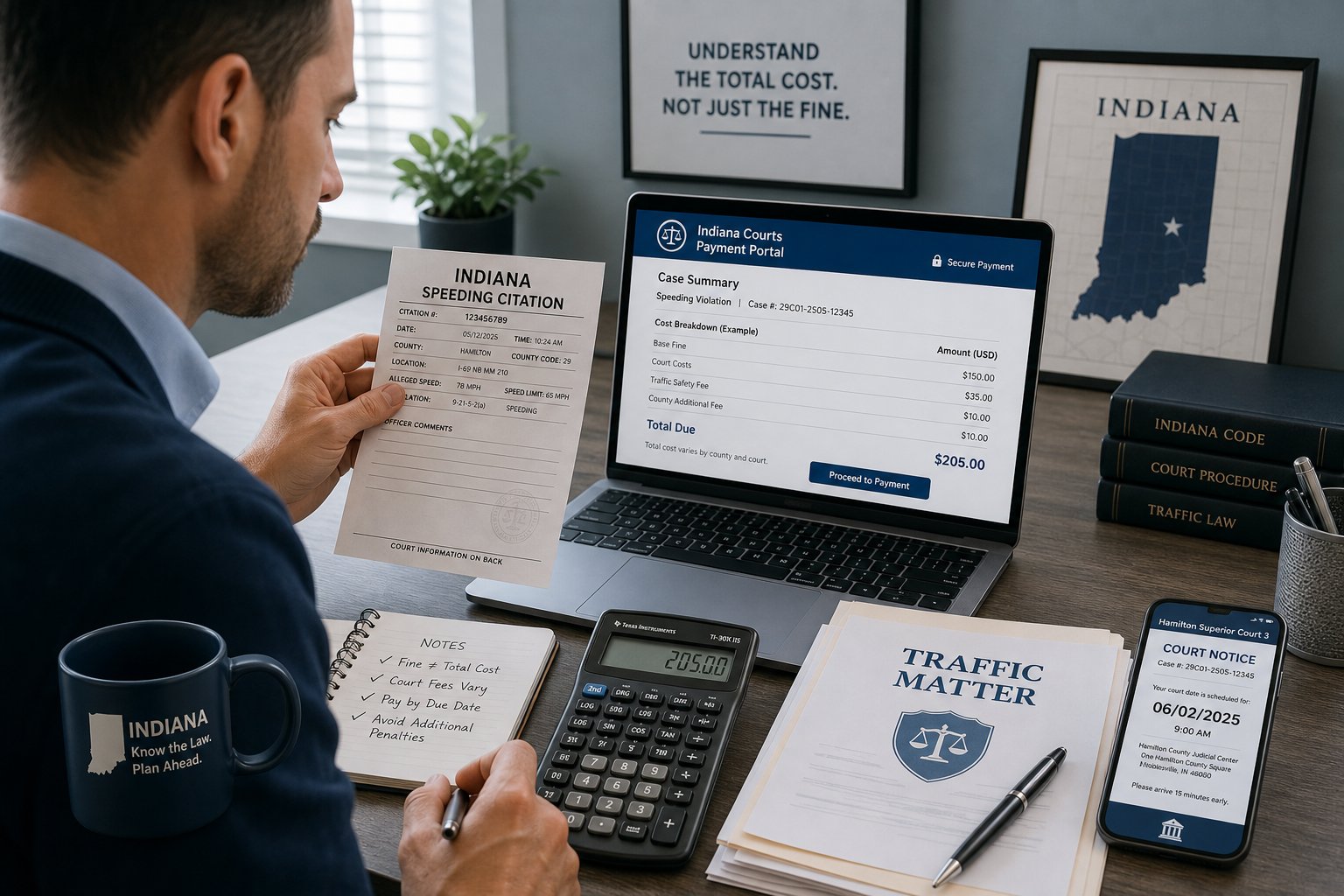
A 20 over ticket in Indiana usually costs more than the number printed as the fine alone. In many courts, the total for a 16–25 mph over violation often falls around $150 to $200, but there is no one statewide amount for every ticket.
That range comes from how Indiana courts and local units handle speeding cases. State guidance often shows a base fine around $64.50 for 16–25 mph over, yet that is only part of the bill. Local schedules can be much higher once fees are added.
Examples from Indiana sources show the difference clearly:
- Harrison County: $167 total for 16–25 mph over
- Town of Cedar Lake: $125.50 for 11–20 mph over
- General statewide guidance: base fine around $64.50 for 16–25 mph over, before added costs
So, how much is a 20 over speeding ticket in Indiana? A fair short answer is this: often about $150 to $200 total, but your actual number may be lower or higher depending on the court that issued the ticket.
You should check the amount on your citation, payment portal, or court notice. If the ticket requires a court date, the final amount may not be set until the case is handled. Official information can be found through the Indiana Bureau of Motor Vehicles and the court named on your citation.
Why The Total Can Be Higher Than The Base Fine
The base fine is not the full cost of an Indiana speeding ticket. In most cases, court costs and local fees are added on top, and those extra charges can make the total much higher than drivers expect.
This is why two drivers going the same speed can owe different amounts in different parts of Indiana. One county may follow a local schedule that is close to the state guidance. Another may use a higher set amount under its local ordinance or court schedule.
Common reasons the total goes up include:
- Court costs
- Administrative fees
- Local ordinance schedules
- City or county set amounts
- Case details tied to the exact charge
That matters because many people search for the fine and find only one number. But the number that affects your wallet is the full total due, not just the listed fine.
Also, if you miss a deadline or required appearance, the problem can get worse fast. Extra legal and licensing issues may follow, depending on the court order, your Indiana BMV notice, your license status, and the case facts.
For the legal framework behind Indiana traffic rules, you can review the Indiana Code and the Indiana Administrative Code. Make sure you read the ticket and any court paperwork closely, because the exact amount and next step depend on the issuing court.
How Indiana Classifies Speeding And When 20 Over Becomes More Serious
In Indiana, going 20 mph over is usually treated as a 16–25 mph over speeding violation. In most routine cases, that means a Class C infraction, not an automatic reckless driving charge.
That distinction matters. A standard speeding infraction is serious, but it is not the same as a more severe driving offense. For many drivers, 20 over falls into the middle range of speeding violations.
Indiana speeding levels are often understood like this:
- Up to 15 mph over: lower point speeding violation
- 16–25 mph over: mid-level speeding violation, which includes 20 over
- More than 25 mph over: can become more serious and may lead to a reckless driving charge in some cases
In practical terms, about 26 mph over and higher is where the risk rises a lot. At that point, the charge may move beyond a basic speeding ticket, depending on the road, facts, and officer’s decision. A reckless driving allegation can carry heavier penalties and more BMV points.
So if you were cited for 20 over, you are usually below the practical reckless driving threshold, but you are still in a range that Indiana treats as meaningful. The ticket can still affect your driving record, insurance, and future penalties if you get another violation.
You can review Indiana traffic laws through the Indiana Code and point-related rules through the Indiana Administrative Code. The exact charge on your citation controls, so read that line first.
How Many Points A 20 Over Ticket Adds To Your Indiana Driving Record
A 20 over speeding ticket in Indiana usually adds 4 demerit points to your Indiana BMV driving record. That is because 20 over normally fits the 16–25 mph over category under Indiana’s point system.
Those 4 points are a big part of why this ticket matters. The fine is only one piece. The points can affect your record for two years, and if you build up too many points in that period, the Indiana BMV may take action.
Indiana states that reaching 18 points in two years can lead to probation or suspension. So one 20 over ticket will not usually suspend your license by itself, but it can move you much closer if you already have other violations.
Here is the key fact many drivers miss: the official Indiana course is the BMV-approved Driver Safety Program (DSP), and it can earn a 4-point credit. That credit can directly offset the 4 points from a 20 over ticket.
A few important limits apply:
- The DSP credit does not remove the conviction
- It does not erase the violation from your record
- It works as a point credit, not a deletion of the ticket
- Your eligibility can depend on your BMV notice, court order, ticket, driver record, and license status
Indiana’s official BMV information is the best place to confirm point rules and eligibility: Indiana BMV Driver Safety Program and the Indiana Administrative Code.
Other Consequences Beyond The Ticket Price
The cost of the ticket is only the first layer. A 20 over ticket can also affect insurance, your driving record, and future penalties.
Insurance is often the biggest long-term cost. Data often cited for Indiana shows average annual premiums rising from about $1,515 to $2,207 after a speeding ticket. Your actual rate change can differ, but even one ticket can make coverage more expensive.
Other possible effects include:
- A less favorable driving record
- Higher insurance costs at renewal
- More risk if you get another ticket soon
- BMV action if your points add up
- Extra concern if you hold a CDL or drive for work
If you already have recent violations, a new 4-point ticket can matter a lot more. The same is true if the case facts suggest something beyond simple speeding. Courts, judges, and prosecutors may look at the whole record, not just this one event.
For that reason, you should not focus only on the dollar amount. A cheap-looking fine can still become costly over time.
Check your citation and your Indiana BMV record carefully. If the ticket could affect your job, commercial driving status, or a weak point total, it may be worth getting legal help before you decide how to respond.
Your Options After Getting A 20 Over Speeding Ticket In Indiana
After a 20 over ticket in Indiana, you usually have more than one option. The right path depends on the ticket, the court, your record, your license status, and whether a court appearance is required.
Common options include:
- Pay the ticket
- Contest the ticket in court
- Ask about a possible reduction
- Seek another allowed outcome, such as a deferred judgment where available
- Consult a traffic attorney if the stakes are high
If you pay the ticket, that is usually treated as admitting the violation. That can mean the case ends, but the BMV points and insurance effects may still follow.
If you contest it, you may be able to challenge the charge or seek a lower-speed or non-moving result, depending on the court and facts. Some courts or prosecutors may allow another outcome, but you should never assume that will happen.
An attorney may help if:
- You have several recent tickets
- You drive for work
- You have a CDL
- The facts could support a more serious charge
- You are close to license probation or suspension
Do not ignore any Indiana BMV notice, citation, deadline, court order, or required hearing. Read the paperwork and follow the instructions from the issuing court.
When A Driver Improvement Or Defensive Driving Course May Help
A driver improvement course may help when the Indiana BMV or a court allows it. In Indiana, the official course is the BMV-approved Driver Safety Program (DSP), and it is a 4-hour course.
For many drivers, the biggest benefit is the 4-point credit. If your 20 over ticket adds 4 demerit points, that credit can directly offset those 4 points. But again, it does not remove the ticket or conviction from your record.
A course may come up in different ways:
- The Indiana BMV may require or allow it
- A court order may require it
- A prosecutor or court may consider it in resolving a case
- You may choose it to help with point credit if eligible
The rules are not the same in every case. Requirements can depend on your BMV notice, court order, citation, driver record, license status, court, judge, and case facts.
If you need a flexible option, Driving Logic offers the Indiana Driver Safety Program online through MyDrivingLogic.com. It is built for busy drivers who need to complete a state-approved course on their own schedule and on almost any device.
You should confirm that the course matches what your notice or court requires before you enroll.
Not legal advice.
FAQ
Can a Driver Safety Program remove my speeding ticket?
No. The Indiana DSP does not erase the speeding ticket or conviction. It may provide a 4-point credit when you complete a BMV-approved course and meet the rules.
Can I take the Indiana DSP online?
Yes. Indiana BMV-approved Driver Safety Program providers may offer online courses. Confirm that the course matches your court or BMV requirement before enrolling.
Do I still need to follow my court deadline?
Yes. A course does not replace court instructions or deadlines. Follow the citation, court order, clerk instructions, or BMV notice tied to your case.
Will my insurance change after a speeding ticket?
Maybe. Each insurance company uses its own rating rules. Ask your insurer how a conviction, point credit, or course completion may affect your policy.
Conclusion
20 Over Speeding Ticket in Indiana: What to Know About Cost and Points is easier to handle when you know the Indiana BMV point rules, court deadline, and the limits of the Driver Safety Program. The DSP may provide a 4-point credit when eligible, but it does not erase the ticket, conviction, or violation. Review your citation or court notice before you act.
Take the Indiana Driver Safety Program course online when you are ready to begin.
Related Articles
- Indiana Speeding Ticket: Costs, Points, and What to Know
- Indiana Speeding Ticket Fines: What Affects the Cost?
- When Does an Indiana Speeding Ticket Become Reckless Driving?
- How Does an Indiana Speeding Ticket Affect Your Car Insurance?
Sources
- Indiana BMV — Citation Points and Driver Safety Program
- Indiana BMV — Driver Record Points
- myBMV — Indiana BMV Online Services
- Indiana Code and Administrative Rules
Billy Forte is the owner of Driving Logic, a state-approved driver improvement course provider serving Indiana and other U.S. states. Driving Logic offers online driver safety and driver improvement courses for drivers handling BMV notices, court orders, and state requirements.
This article is general information, not legal advice. Indiana BMV rules, court orders, deadlines, provider reporting, insurance decisions, and case facts can differ. Use official Indiana BMV and court sources for current requirements, and consult a qualified Indiana attorney for legal guidance specific to your situation.