
Updated June 2026 · Reviewed by Billy Forte
An Indiana speeding ticket can raise your car insurance by about $225 a year on average, or roughly 24%, but some drivers see little change while others pay much more. Insurers often find the ticket when they review your motor vehicle record at renewal, and a speeding conviction can affect rates for 3 to 5 years even though Indiana BMV points may last 2 years on your driving record. The exact increase depends on your insurer, your full driving history, how fast you were going, and whether the charge stays a Class C infraction or becomes something more serious like reckless driving.
This article covers Indiana requirements only.
Key Facts
- Insurance impact varies: Each insurer decides how a speeding ticket affects rates.
- Record reviews matter: Insurers may review your motor vehicle record at renewal or underwriting.
- Point credit is separate: A DSP 4-point credit does not guarantee an insurance discount.
- Severity matters: Higher-speed or repeated violations can create more risk.
- Ask your insurer: Confirm discount or rating rules directly with the company.
If you need a BMV-approved online option, review the Indiana Driver Safety Program course and compare it with your ticket, court notice, or BMV requirement.
How A Speeding Ticket Affects Car Insurance In Indiana
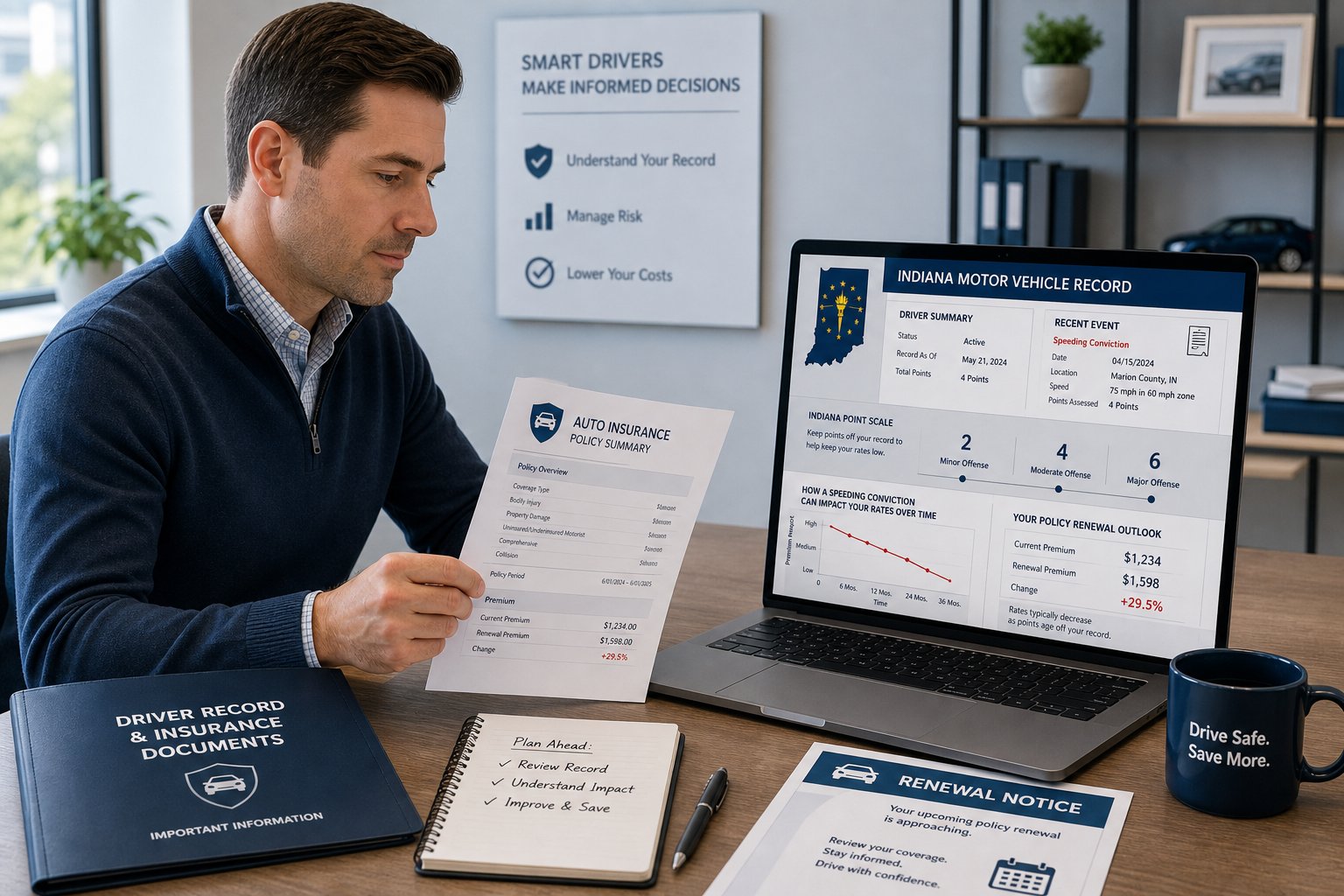
A speeding ticket affects insurance because it shows your insurer that you may be more likely to file a claim. In Indiana, a speeding conviction can be reported to your driving record, and insurers commonly check that record through a motor vehicle record (MVR) review.
That review usually happens when you start a policy or when your policy renews. So the increase may not hit right after the ticket. But it can show up later, which catches many drivers off guard.
Indiana also uses a point system through the Indiana Bureau of Motor Vehicles. For speeding, the listed BMV points can vary by how far over the limit you were:
- 2 points for 1 to 15 mph over
- 4 points for 16 to 25 mph over
- 6 points for 26+ mph over
Those points matter for your driving status. But insurers do not price risk from BMV points alone. They look at the whole record, including:
- Prior tickets
- Recent accidents
- Gaps in coverage
- Driver age and location
- Whether the violation was reduced or amended
In many cases, a first Indiana speeding ticket causes a smaller increase than repeat violations. And if your record is otherwise clean, some insurers may be more forgiving. Still, once there is a conviction, you should assume it may affect your premium.
Indiana law and BMV rules can change, so it helps to review the official Indiana BMV resources and your policy terms.
How Much Insurance Rates Can Increase After An Indiana Speeding Ticket
For many drivers, the speeding ticket insurance increase in Indiana is real but not fixed. Reported averages show an increase of about $225 per year, while other rate studies show drivers with a speeding ticket paying around 24% more than drivers with no violation.
One cited comparison shows average annual premiums of about $2,207 after a speeding ticket versus $1,515 with a clean record. That kind of gap shows why there is no single answer for every driver.
Your actual increase depends on several things:
- Your insurer’s rating rules
- Whether this is your first ticket
- Your age and zip code
- The speed alleged on the citation
- Whether you also had an accident
- Whether the charge is reduced or upheld in court
A driver with one low-level speeding ticket may see only a modest increase, or even none at the next review. But a driver with prior violations may get hit much harder.
Also, fines and court costs are separate from insurance. The ticket itself can cost money right away, and then the insurance effect may follow at renewal. Indiana speeding offenses are often handled as Class C infractions, but the insurance impact still depends on the conviction and the insurer’s rules.
If you want a firm number, the most useful step is simple: call your insurer and ask how a speeding conviction affects your rate class, surcharge period, and discount eligibility.
How Long A Speeding Ticket Can Affect Your Driving Record And Premiums
An Indiana speeding ticket can affect your driving record and your insurance for different lengths of time. That difference matters.
Under Indiana’s point system, many moving violations stay active for 2 years for BMV point purposes. The insurer side often lasts longer. Many insurance companies use a 3 to 5 year lookback for pricing, depending on the carrier and the policy cycle.
So even after BMV points are no longer active, the conviction may still matter to your insurer. That is why some drivers still pay more long after the court case is over.
The Indiana BMV point system is explained in state materials and rules, including the Indiana Administrative Code and other BMV resources. Indiana traffic laws are also available through the Indiana Code.
A key detail: a Driver Safety Program course does not erase the ticket or remove the conviction. If you qualify, the official Indiana BMV-approved DSP is a 4-hour course that can provide a 4-point credit. That credit reduces your point total, but it does not delete the underlying violation from your record.
Because insurers have their own rules, you should confirm with your company how long a speeding conviction remains chargeable under your policy.
What To Do After Getting A Speeding Ticket In Indiana
After you get an Indiana speeding ticket, read the ticket and any court papers closely. Deadlines, payment rules, and court dates matter, and the right step depends on the notice you received.
Your next steps may depend on:
- The ticket or citation details
- Any Indiana BMV notice
- A court order
- Your driver record
- Your license status
- The court, judge, and case facts
Do not ignore a required court appearance or a response deadline. Missing one can make a bad situation worse.
Then look at the charge level. Many speeding cases are basic infractions, but some facts can make the case more serious. If the allegation involves very high speed or unsafe conduct, insurance risk can rise much more.
You can also check whether you may be allowed or ordered to complete the Indiana BMV-approved Driver Safety Program (DSP). The official DSP is a 4-hour course. In some situations, the 4-point credit may help reduce active BMV points, and some insurers may also offer a discount program tied to defensive driving or safe-driver education. That part varies by company, so ask first.
If you need an online option, Driving Logic offers the Indiana Driver Safety Program for busy drivers who want flexible scheduling on any device.
Ways To Lower Your Insurance Costs After A Ticket
The main way to lower your insurance cost after a ticket is to prevent another one. One ticket may be manageable. Two or three can move you into a much higher-risk group.
There are a few practical ways to limit the damage:
- Keep a clean record going forward
- Ask your insurer about accident-free or safe-driver discounts
- Ask whether a driver safety course helps with discounts
- Shop rates again before renewal
- Raise deductibles only if you can afford them
If you are eligible, the Indiana Driver Safety Program may help on the BMV side by giving a 4-point credit. Some insurers also recognize approved safety courses for discount programs, but eligibility and savings depend on the insurance company and your driving history.
This is where many drivers miss a chance to save. They pay the higher renewal bill without checking for a better rate elsewhere. Since each company weighs violations differently, another carrier may price your record more favorably.
If you were told to complete a course, or if you want to see whether it may help with points or discounts, review your notice and then compare it with the course details at MyDrivingLogic.com.
When A Speeding Ticket Becomes A More Serious Insurance Problem
A speeding ticket becomes a bigger insurance problem when it is not just a simple one-time violation. Insurers react much more strongly to patterns and to serious driving behavior.
For example, one minor speeding ticket is usually treated very differently from:
- Multiple speeding convictions
- Very high speeds
- A ticket tied to a crash
- A charge upgraded to reckless driving
- Racing or aggressive driving behavior
A reckless driving conviction can raise rates more sharply than a basic speeding infraction because it signals higher risk. It may also affect your ability to get preferred rates at all. Some drivers may even have fewer insurer options after serious convictions.
Indiana reckless driving laws and related offenses appear in the Indiana Code. The exact charge in your case matters, because insurers often classify offenses by severity.
This is also why the fine alone does not tell the whole story. A driver may focus on court costs, but the long-term insurance effect can be much larger than the ticket payment itself. If your citation involves high speed or conduct that could be seen as dangerous, it is wise to understand the charge level and confirm how your insurer handles it.
Other Indiana Violations That Can Raise Your Insurance Premiums
Speeding is not the only Indiana violation that can raise your premium. Insurers look at many moving violations because each one can suggest a higher chance of future claims.
Common violations that may increase rates include:
- Distracted driving
- Red-light violations
- Illegal turns
- Tailgating
- Driving without a license
- Hit-and-run
- Reckless driving
- Racing
- DUI
- At-fault accidents
Some of these are much more serious than a basic speeding ticket. A DUI, hit-and-run, or reckless driving offense can lead to larger increases and more coverage issues than a standard speeding case.
That is why your full record matters more than any single label. A driver with one small speeding ticket may still get a fair rate. A driver with several moving violations, even if each one seems minor alone, often pays much more.
If you are trying to limit future costs, treat each new notice from the Indiana BMV or the court as important. Follow any deadlines. Check whether you have a course requirement or point issue. And if you need a state-approved online option, Driving Logic’s Indiana DSP can be a useful next step for eligible drivers.
Not legal advice.
FAQ
Can a Driver Safety Program remove my speeding ticket?
No. The Indiana DSP does not erase the speeding ticket or conviction. It may provide a 4-point credit when you complete a BMV-approved course and meet the rules.
Can I take the Indiana DSP online?
Yes. Indiana BMV-approved Driver Safety Program providers may offer online courses. Confirm that the course matches your court or BMV requirement before enrolling.
Do I still need to follow my court deadline?
Yes. A course does not replace court instructions or deadlines. Follow the citation, court order, clerk instructions, or BMV notice tied to your case.
Will my insurance change after a speeding ticket?
Maybe. Each insurance company uses its own rating rules. Ask your insurer how a conviction, point credit, or course completion may affect your policy.
Conclusion
How Does an Indiana Speeding Ticket Affect Your Car Insurance? is easier to handle when you know the Indiana BMV point rules, court deadline, and the limits of the Driver Safety Program. The DSP may provide a 4-point credit when eligible, but it does not erase the ticket, conviction, or violation. Review your citation or court notice before you act.
Take the Indiana Driver Safety Program course online when you are ready to begin.
Related Articles
- Indiana Speeding Ticket: Costs, Points, and What to Know
- Indiana Speeding Ticket Fines: What Affects the Cost?
- How Long Does a Speeding Ticket Stay on Your Record in Indiana?
- Indiana BMV Points System Explained
Sources
- Indiana BMV — Citation Points and Driver Safety Program
- Indiana BMV — Driver Record Points
- myBMV — Indiana BMV Online Services
- Indiana Code and Administrative Rules
Billy Forte is the owner of Driving Logic, a state-approved driver improvement course provider serving Indiana and other U.S. states. Driving Logic offers online driver safety and driver improvement courses for drivers handling BMV notices, court orders, and state requirements.
This article is general information, not legal advice. Indiana BMV rules, court orders, deadlines, provider reporting, insurance decisions, and case facts can differ. Use official Indiana BMV and court sources for current requirements, and consult a qualified Indiana attorney for legal guidance specific to your situation.