
Updated June 2026 · Reviewed by Billy Forte
An Indiana speeding ticket out of state can affect your license because you still must resolve the ticket in Indiana, and your home state may add points or other penalties under its own rules after Indiana reports the case. Indiana and many other states share traffic case results through interstate systems, so paying the ticket can count like a guilty plea and may reach your home DMV or BMV. If the Indiana court or Indiana Bureau of Motor Vehicles requires action, missing the deadline can lead to added costs, a suspension issue, or trouble renewing your license in your home state.
This article covers Indiana requirements only.
Key Facts
- Indiana ticket stays in Indiana: You still must respond to the Indiana court or payment instructions.
- Home-state effects vary: Your home state may treat the conviction under its own rules.
- Deadlines still apply: Out-of-state drivers should not ignore Indiana due dates.
- DSP rules: Course eligibility depends on the court, BMV, and your license situation.
- Keep proof: Save payment, court, and course completion records.
If you need a BMV-approved online option, review the Indiana Driver Safety Program course and compare it with your ticket, court notice, or BMV requirement.
How Indiana Handles Out-Of-State Speeding Tickets
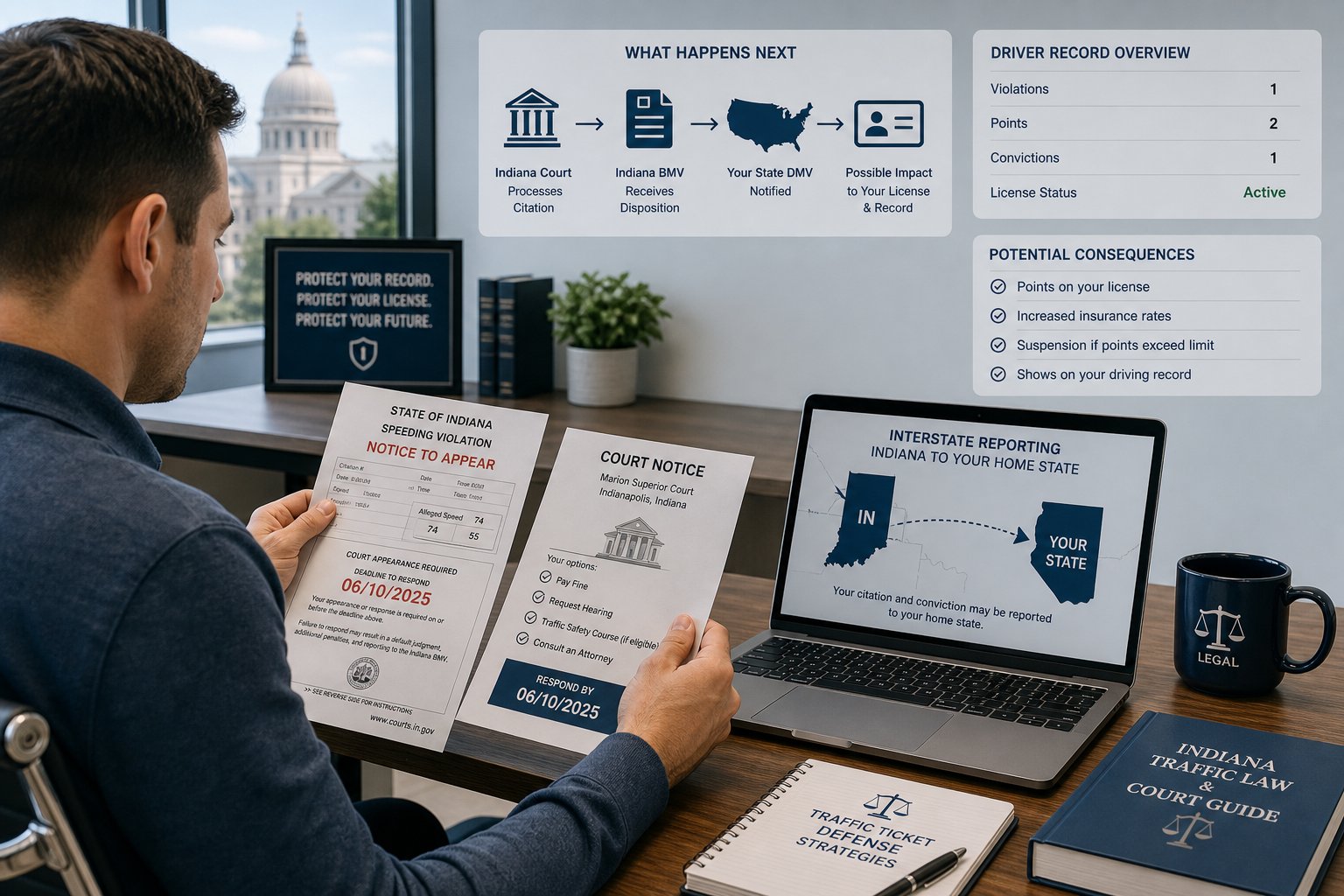
Indiana treats an out-of-state driver much like an Indiana driver. If you get an Indiana speeding ticket, you must respond to the court listed on the citation. In many cases, a basic speeding charge is a Class C infraction, but the exact charge depends on the facts on your ticket.
If you pay the ticket, you usually admit the violation. If you want to challenge it, you must follow the court process and deadlines. And if the ticket orders a court appearance, you should not skip it.
Indiana courts handle the fine, court costs, and case result. Then the result can be reported through state systems. Indiana may also report related information to the Indiana BMV.
If you later take Indiana’s official BMV-approved Driver Safety Program (DSP), that course completion is reported to the Indiana BMV. The DSP is a 4-hour course. It may help with Indiana BMV points by giving a 4-point credit, but it does not erase the conviction or remove the underlying violation from your record.
Requirements can change based on the Indiana BMV notice, court order, citation, driver record, license status, court, judge, and case facts. So the paper you received matters.
Why Your Home State May Still Find Out About The Ticket
Your home state may still learn about the ticket because Indiana shares traffic case results with other states. The main system people talk about is the Driver License Compact. Under that kind of reporting, your home DMV usually decides what to do under its own rules.
That means Indiana does not control how your home state scores the violation. Your state may add points, record the conviction, or take another action allowed by local law. Some states match the conduct to a similar home-state offense.
Indiana can also cause bigger trouble if you ignore the ticket. Through interstate enforcement systems such as the Non-Resident Violator Compact, your home state may be asked to suspend your license until you clear the Indiana case. That is why an out of state driver speeding ticket Indiana case can follow you home even though it happened far away.
You can review Indiana’s official sources at the Indiana BMV and state law through the Indiana General Assembly.
What Happens If You Pay, Ignore, Or Miss The Deadline
If you pay the ticket, that usually ends the Indiana court case fast. But it often means you accept guilt. The court keeps the fine and court costs, and the conviction can be sent to your home state.
That matters because your home state may then post points or another penalty. It may also show up to your insurer at renewal time. Fast is not always cheap in the long run.
If you ignore the ticket or miss the due date, the risk grows. Indiana can take action on the case, and your driving status may be affected through interstate reporting. In some cases, that can mean a suspension problem tied to your home license until the Indiana matter is fixed.
Possible results of missing the deadline include:
- extra fees or added court action
- a failure-to-appear or failure-to-comply issue
- a license hold or suspension issue
- trouble renewing or keeping your home-state license valid
So read the citation closely. Check the court name, due date, and whether appearance is required. If you received a notice from the Indiana Bureau of Motor Vehicles or a court, respond before the deadline. That one step prevents a small speeding case from turning into a bigger record problem.
How An Out-Of-State Speeding Ticket Can Affect Your License, Points, And Insurance
An Indiana ticket can affect three things at once: your license, your points, and your insurance. The first key point is simple. Indiana may report the result, but your home state decides how to treat it.
That is why two drivers can get the same Indiana speeding ticket and see different results at home. One state may assign points. Another may record the conviction without the same point count. Either way, the event can still matter.
Indiana also has its own point system. The Indiana BMV uses demerit points for certain moving violations. If you are dealing with Indiana license issues, a Driver Safety Program completion can create a 4-point credit on the Indiana record. But again, that credit does not erase the conviction.
For an out-of-state driver, that DSP credit may not change the home-state record at all. The completion is reported to the Indiana BMV. Your own DMV may or may not care about that course unless your state has a separate rule.
Insurance is the third concern. Many insurers review traffic convictions during renewals. A reported speeding conviction can raise premiums, though the amount varies by insurer, driving history, and state rules. If the ticket was serious, such as reckless driving instead of simple speeding, the effect can be stronger.
For official Indiana point information, check the Indiana BMV point schedule and the Indiana Administrative Code.
Your Main Options For Resolving The Ticket
You usually have a few main options. The right one depends on the charge, your record, the court, and what the ticket says.
Your common paths are:
- Pay the ticket by the listed method, if allowed
- Contest the ticket in court
- Ask whether the court offers a deferral or local traffic program
- In some cases, complete the Indiana BMV-approved Driver Safety Program if ordered or allowed
Paying is the simplest path, but it usually means a conviction. Contesting takes more effort, yet it may be worth it if the speed alleged is high, your home state points are severe, or your job depends on a clean record.
A deferral can sometimes help because it may let you avoid a conviction if you meet the court’s terms. But courts set their own rules, and not every county handles this the same way.
If a court or BMV notice requires the Indiana DSP, use a state-approved provider. Driving Logic offers the Indiana Driver Safety Program online in a format built for busy drivers. You can review the course at DrivingLogic.com.
When Traffic School Or A Deferral May Help
Traffic school or a deferral may help when you want to limit record damage, but they are not automatic. Indiana courts decide what they allow, and out-of-state drivers may or may not qualify under local rules.
A key point here is accuracy. The Indiana Driver Safety Program is a 4-hour, BMV-approved course. If you complete it for Indiana purposes, the completion is reported to the Indiana BMV. It can provide a 4-point credit against Indiana BMV points. It does not remove the speeding conviction or delete the violation.
A deferral works differently. If the court grants one, you may have to pay fees, avoid new violations, or meet other terms for a set time. If you succeed, the case may be dismissed or handled under the local program terms. Because courts differ, always check the ticket, court notice, or judge’s order for the exact rules.
How To Fight An Indiana Speeding Ticket When You Live In Another State
You can fight an Indiana speeding ticket even if you live elsewhere. The first step is to contact the court on the citation and ask what procedures are allowed in that county.
Some courts may allow written filings, remote hearings, or attorney appearances for certain cases. Others may require you to appear. The answer depends on the court, the judge, the charge, and the case facts.
If the ticket is minor, you may decide the time and travel are not worth it. But if the speed is high, the charge is more serious, or your home state has strict point rules, fighting the case may make sense.
Many out-of-state drivers hire an Indiana traffic lawyer for this reason. A local lawyer may be able to appear for you, ask for a reduction, or seek a deferral if the court allows it. No outcome is guaranteed, and each court has its own practice.
Before you decide, gather these details:
- the full citation number
- the court name and county
- your deadline or hearing date
- the exact charge listed
- your recent driving record issues
Then compare the likely costs. Look at the fine, court costs, travel, possible points at home, and insurance impact. If Indiana or the court orders the Driver Safety Program, complete it on time with an approved provider and keep your records. For state-approved course details, Indiana lists driver safety information through the Indiana BMV and traffic laws through the Indiana Code.
This information is general only and is not legal advice.
FAQ
Can a Driver Safety Program remove my speeding ticket?
No. The Indiana DSP does not erase the speeding ticket or conviction. It may provide a 4-point credit when you complete a BMV-approved course and meet the rules.
Can I take the Indiana DSP online?
Yes. Indiana BMV-approved Driver Safety Program providers may offer online courses. Confirm that the course matches your court or BMV requirement before enrolling.
Do I still need to follow my court deadline?
Yes. A course does not replace court instructions or deadlines. Follow the citation, court order, clerk instructions, or BMV notice tied to your case.
Will my insurance change after a speeding ticket?
Maybe. Each insurance company uses its own rating rules. Ask your insurer how a conviction, point credit, or course completion may affect your policy.
Conclusion
Indiana Speeding Ticket from Out of State: What Happens to Your License is easier to handle when you know the Indiana BMV point rules, court deadline, and the limits of the Driver Safety Program. The DSP may provide a 4-point credit when eligible, but it does not erase the ticket, conviction, or violation. Review your citation or court notice before you act.
Take the Indiana Driver Safety Program course online when you are ready to begin.
Related Articles
- Indiana Speeding Ticket: Costs, Points, and What to Know
- Indiana Speeding Ticket: What to Know Before You Pay or Contest It
- How Long Does a Speeding Ticket Stay on Your Record in Indiana?
- Indiana Driver Safety Program: The Complete Guide
Sources
- Indiana BMV — Citation Points and Driver Safety Program
- Indiana BMV — Driver Record Points
- myBMV — Indiana BMV Online Services
- Indiana Code and Administrative Rules
Billy Forte is the owner of Driving Logic, a state-approved driver improvement course provider serving Indiana and other U.S. states. Driving Logic offers online driver safety and driver improvement courses for drivers handling BMV notices, court orders, and state requirements.
This article is general information, not legal advice. Indiana BMV rules, court orders, deadlines, provider reporting, insurance decisions, and case facts can differ. Use official Indiana BMV and court sources for current requirements, and consult a qualified Indiana attorney for legal guidance specific to your situation.