
Updated June 2026 · Reviewed by Billy Forte
In Indiana, there is no fixed speed that automatically turns a speeding ticket into reckless driving. State law looks at whether your speed was unreasonably high and whether it put other people in danger, not just the number on the sign. In real cases, speeds around 26 mph or more over the limit often get closer review for a reckless driving charge, but that is a practical pattern, not a rule in the statute.
This article covers Indiana requirements only.
Key Facts
- No single magic number: Indiana reckless driving depends on unsafe conduct and case facts, not just one posted speed.
- Speed still matters: Very high speed can increase the chance of a more serious charge.
- Legal risk: Reckless driving questions are legal-adjacent and may need attorney guidance.
- DSP role: The Driver Safety Program may help with point credit, but it does not guarantee a court result.
- Check documents: Your ticket or court notice controls what you must do next.
If you need a BMV-approved online option, review the Indiana Driver Safety Program course and compare it with your ticket, court notice, or BMV requirement.
Does Indiana Have A Specific Speed For Reckless Driving?
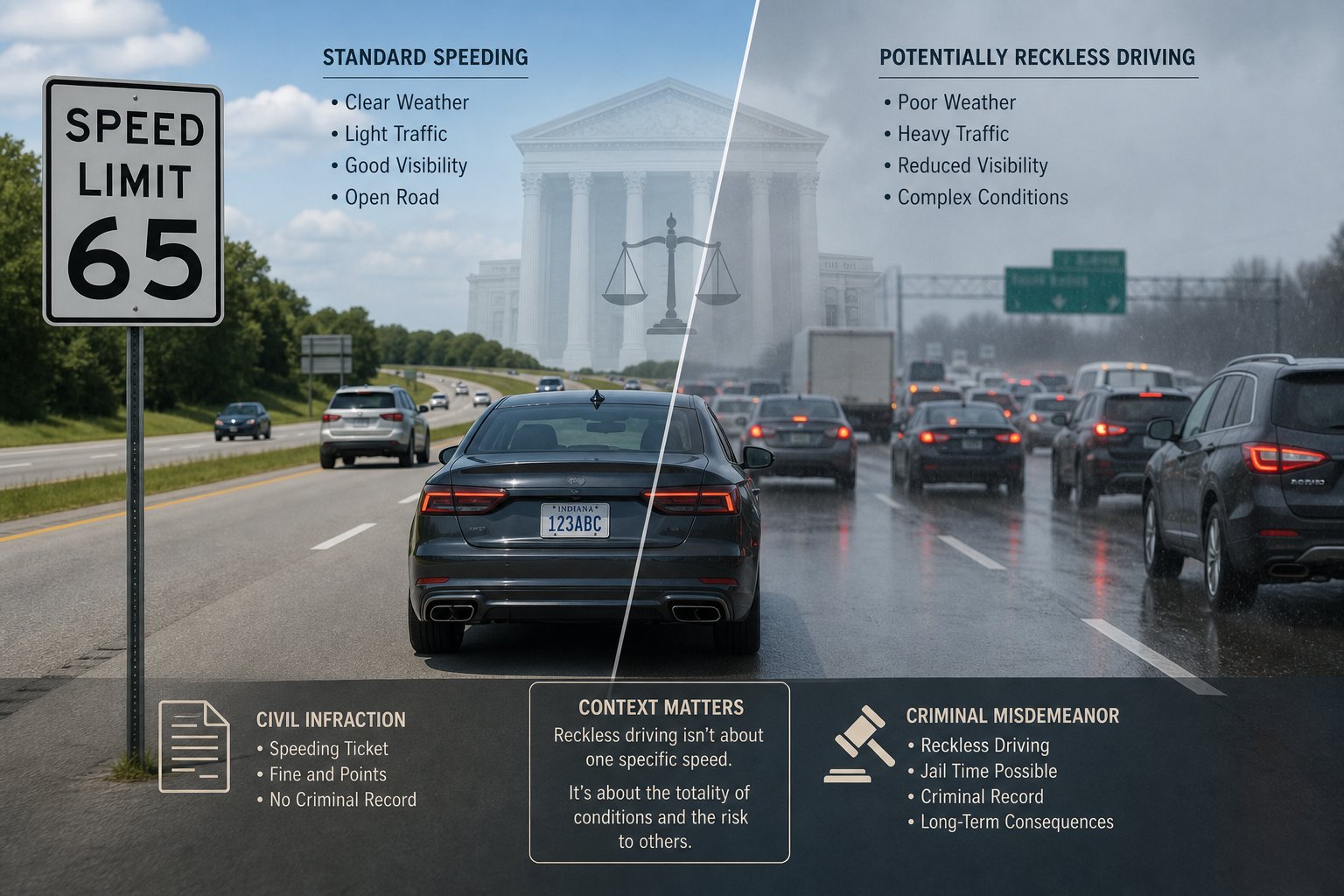
No. Indiana does not set one exact mph number that always counts as reckless driving.
Under Indiana Code 9-21-8-52, reckless driving is based on how you drove. The law includes driving at an unreasonably high or low speed that endangers safety or blocks the normal flow of traffic. That means the state looks at the full situation.
So, what speed is reckless driving in Indiana? The honest answer is: it depends on the facts. A driver going 80 in a 55 may draw much more attention than someone going 40 in a 30 on a clear road, but speed alone is not the whole test. Traffic, weather, road design, visibility, and nearby drivers all matter.
In practice, many drivers hear that 25 or 26 mph over the limit is where things can start to move beyond a standard Indiana speeding ticket. That can happen. But it is not a written legal threshold. A prosecutor may file reckless driving below that range if the driving was dangerous. And a higher speed does not create an automatic charge in every case.
This is the key split:
- Standard speeding is usually a Class C infraction
- Reckless driving is generally a Class C misdemeanor
- An infraction is civil
- A misdemeanor is criminal
That difference matters because a criminal charge can affect more than fines and court costs. It can also affect your record, your time in court, and how seriously the case is handled.
What Counts As Reckless Driving Beyond Speeding
Speed is only one part of reckless driving in Indiana. The law also lists other driving acts that can support the charge.
Under the same Indiana statute, reckless driving can include:
- Passing on a curve or hill where your view is blocked
- Weaving in and out of traffic
- Speeding up when another driver is trying to pass
- Refusing to give half the road to a passing vehicle
- Driving too fast or too slow in a way that puts others at risk
That means indiana reckless driving speed is not the only issue. An officer may look at your lane changes, the space around your car, and whether your actions forced other drivers to brake or swerve.
For example, going 20 mph over the limit on an empty, dry highway is still serious. But going 20 mph over while weaving through cars in rain may look much worse. The same goes for a lower speed in a school zone, a work zone, or heavy traffic.
This is why two drivers with the same posted speed violation may face different charges. One may get a normal Indiana speeding ticket. Another may face reckless driving because the conduct looked dangerous as a whole.
You can review the Indiana law directly through the Indiana General Assembly and check driver record and point information through the Indiana Bureau of Motor Vehicles.
When Speeding Can Turn Into A Reckless Driving Charge
Speeding can turn into reckless driving when the state believes your speed was unreasonably high and endangered other people. That is the basic line.
A normal Indiana speeding ticket is often handled as a Class C infraction. That is not a crime. But if the officer or prosecutor believes your driving was dangerous enough, the case may be filed as reckless driving, which is usually a Class C misdemeanor.
Common facts that can push a speeding case higher include:
- Driving far above the posted limit
- Weaving or tailgating at the same time
- Passing in unsafe places
- Heavy traffic or poor weather
- A near crash or actual crash
- Risk to walkers, cyclists, or road workers
Many people ask whether 26 mph over is the cutoff. It is better to think of that as a common practical warning zone, not a firm rule. Some courts and officers treat that range as more serious. Still, Indiana law does not say that 26 over always equals reckless driving.
Your exact result can depend on the officer report, the citation, the local court, and the case facts. It can also depend on whether the charge stays as written or is changed later by a prosecutor.
If your notice or court papers mention a driving course, Indiana’s official course is the BMV-approved Driver Safety Program (DSP), which is a 4-hour course. Whether you may take it can depend on your Indiana BMV notice, court order, driver record, license status, and the court involved.
Penalties And License Consequences In Indiana
The penalties are much different once a speeding case becomes reckless driving. That is why the charge label matters so much.
A standard speeding ticket in Indiana is usually a Class C infraction. That means it is a civil offense. You may still face a fine, court costs, and BMV points, but it is not a criminal conviction.
Reckless driving is generally a Class C misdemeanor. Under Indiana law, that can carry:
- Up to 60 days in jail
- Up to a $500 fine
- A criminal record if you are convicted
Indiana BMV consequences may also follow. Sources commonly report 6 demerit points for reckless driving, and some cases may involve a license suspension. You should check the current point table and record rules with the Indiana BMV and the related Indiana Administrative Code.
If you are allowed or ordered to take a course, the Indiana Driver Safety Program may help in some cases. The DSP gives a 4-point credit that lowers your point total. It does not erase the conviction, remove the ticket, or remove the underlying violation from your record.
Because court rules vary, always read your ticket, court papers, and Indiana BMV notice closely. Requirements can depend on the judge, court, citation, and your driving history.
Criminal Penalties Vs. Civil Liability After A Crash
A reckless driving charge and a crash claim are not the same thing. One is criminal. The other is civil.
The criminal case is about whether the state says you broke Indiana traffic law. If convicted, you may face a misdemeanor penalty, fine, jail exposure, court costs, and BMV points.
A civil claim is about money losses after a crash. That may include:
- Car repair or replacement
- Medical bills
- Lost wages
- Other property damage
A reckless driving charge does not automatically prove civil fault. But it can still matter. If the facts show unsafe speed, weaving, or other dangerous acts, those facts may also be used in an injury or insurance claim.
This matters when a speeding stop becomes more than a ticket. If there was a crash, the evidence can grow fast. Photos, witness names, body cam footage, dashcam video, scene diagrams, and medical records may all become important.
So if your case involves both a citation and a crash, treat each part seriously. The court handles the traffic charge. Insurance carriers and civil lawyers may deal with injury or damage claims on a different track. The two can overlap, but they are not the same case.
What To Do If You Are Stopped Or Involved In A Reckless Driving Incident
Start with safety and follow the process. Small steps matter a lot here.
If you are stopped, stay calm. Pull over safely, keep your hands visible, and provide the documents the officer asks for. Do not argue on the roadside.
If there is a crash or dangerous incident, take these steps if you can do so safely:
- Call police
- Get medical care if needed
- Exchange basic information
- Take photos of cars, damage, and the road
- Get witness names and contact details
- Save dashcam or phone video
- Keep copies of your ticket and all notices
Be careful with what you say. Give basic facts, but do not guess and do not make statements that admit fault.
Then read every paper you get. Your next step may depend on the citation, court order, or Indiana BMV notice. Some drivers may be told to appear in court. Others may have deadlines tied to payment, records, or a course.
If you are eligible or ordered to complete Indiana’s 4-hour BMV-approved Driver Safety Program, you can review the online option at Driving Logic. Make sure the course fits the notice or order you received before you enroll.
How To Avoid A Reckless Driving Charge In Indiana
The best way to avoid a reckless driving charge is simple: drive in a way that does not look dangerous. In Indiana, that means more than just watching your speed.
Start with the basics:
- Follow the posted speed limit
- Slow down for rain, fog, and traffic
- Leave enough space behind other cars
- Do not weave through lanes
- Do not pass on curves or hills with blocked view
- Do not speed up when another car passes
- Yield proper space when required
Also, remember that the same speed can be judged differently in different places. A speed that seems minor on an open highway may look much worse in a school area, near road work, or in dense traffic.
If you already have an Indiana speeding ticket or BMV point issue, pay close attention to any approved course option. The Indiana Driver Safety Program (DSP) is the state’s official 4-hour program. If your notice, court, or record allows it, an online course can be the easiest fit for a busy schedule.
Driving Logic and MyDrivingLogic.com offer online completion built for drivers who need flexibility across devices and faster proof of completion. Before you sign up, match the course to your Indiana BMV notice, court order, and case details.
Not legal advice.
FAQ
Can a Driver Safety Program remove my speeding ticket?
No. The Indiana DSP does not erase the speeding ticket or conviction. It may provide a 4-point credit when you complete a BMV-approved course and meet the rules.
Can I take the Indiana DSP online?
Yes. Indiana BMV-approved Driver Safety Program providers may offer online courses. Confirm that the course matches your court or BMV requirement before enrolling.
Do I still need to follow my court deadline?
Yes. A course does not replace court instructions or deadlines. Follow the citation, court order, clerk instructions, or BMV notice tied to your case.
Will my insurance change after a speeding ticket?
Maybe. Each insurance company uses its own rating rules. Ask your insurer how a conviction, point credit, or course completion may affect your policy.
Conclusion
When Does an Indiana Speeding Ticket Become Reckless Driving? is easier to handle when you know the Indiana BMV point rules, court deadline, and the limits of the Driver Safety Program. The DSP may provide a 4-point credit when eligible, but it does not erase the ticket, conviction, or violation. Review your citation or court notice before you act.
Take the Indiana Driver Safety Program course online when you are ready to begin.
Related Articles
- Indiana Speeding Ticket: Costs, Points, and What to Know
- 20 Over Speeding Ticket in Indiana: What to Know About Cost and Points
- Is an Indiana Speeding Ticket a Misdemeanor or Just a Traffic Infraction?
- Indiana Speeding Ticket for CDL Holders: Federal Rules Apply
Sources
- Indiana BMV — Citation Points and Driver Safety Program
- Indiana BMV — Driver Record Points
- myBMV — Indiana BMV Online Services
- Indiana Code and Administrative Rules
Billy Forte is the owner of Driving Logic, a state-approved driver improvement course provider serving Indiana and other U.S. states. Driving Logic offers online driver safety and driver improvement courses for drivers handling BMV notices, court orders, and state requirements.
This article is general information, not legal advice. Indiana BMV rules, court orders, deadlines, provider reporting, insurance decisions, and case facts can differ. Use official Indiana BMV and court sources for current requirements, and consult a qualified Indiana attorney for legal guidance specific to your situation.