
Updated June 2026 · Reviewed by Billy Forte
Virginia teen drivers face lower tolerance for point problems and may receive DMV action sooner than experienced adult drivers. This article is for Virginia drivers who need a clear answer before checking a record, taking a course, or responding to a DMV or court notice. You will learn what the rule means, how a Driver Improvement Clinic may fit, and what to verify before your next step.
This article covers Virginia requirements only.
Key Facts
- DMV action: Virginia DMV may act when points or repeat convictions reach certain thresholds.
- Notices matter: A DMV letter, court order, or suspension notice controls your next step.
- Course role: A Driver Improvement Clinic may be required or may help with safe driving points.
- No erasure: A clinic does not remove the underlying conviction.
- Act early: Check deadlines before the notice or suspension date.
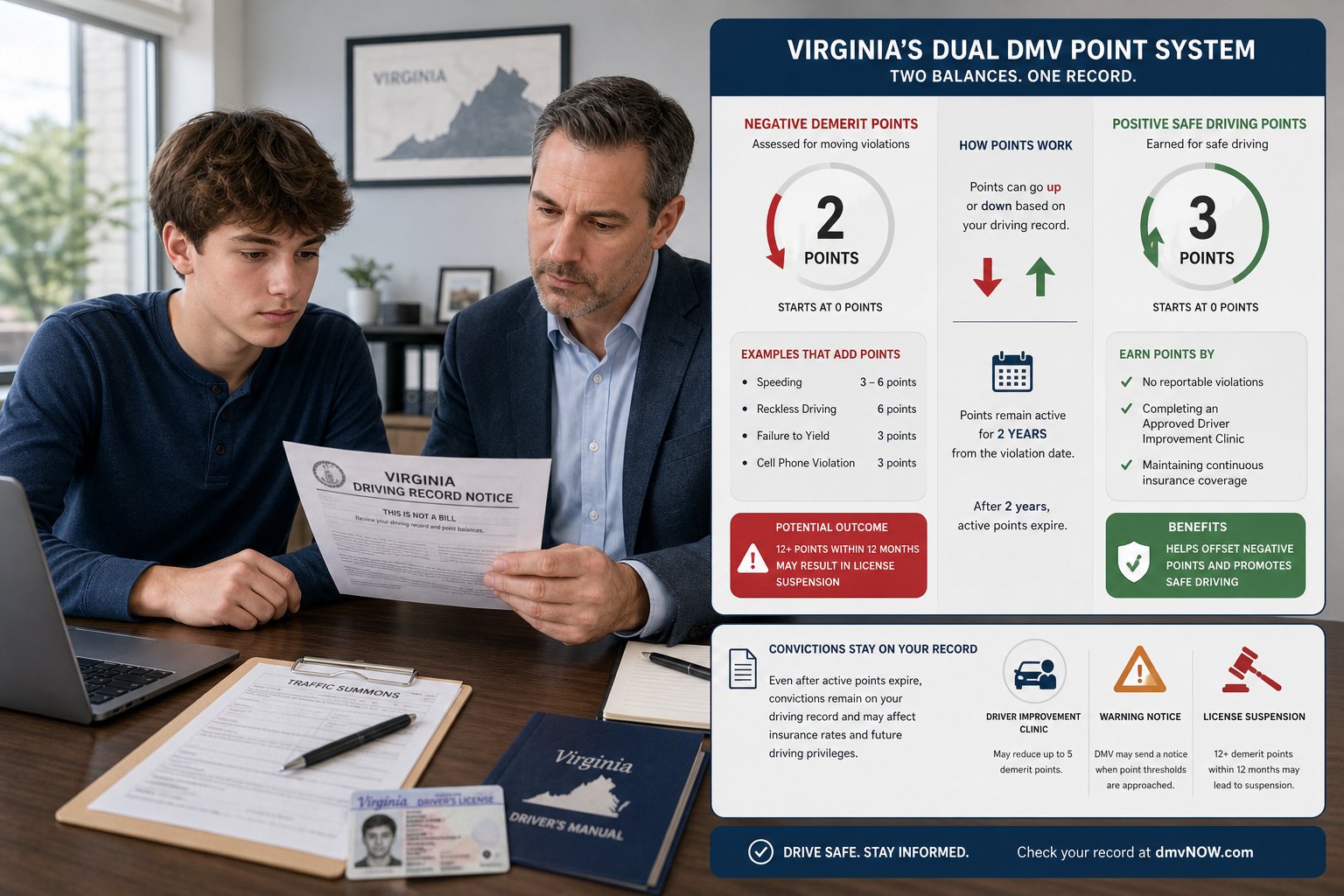
How Virginia’s DMV Point System Works For Teenagers
Virginia uses a dual point system for teens and adults. That means your record can show both demerit points and safe driving points at the same time.
If you need an approved online option, review the Virginia Driver Improvement Course and compare it with your Virginia DMV notice, court order, or driver record goal.
A teen starts with 0 points. Then Virginia DMV adds demerit points after certain convictions. The DMV also gives +1 safe driving point for each full year with no violations, up to +5 total safe driving points.
For a teen driver, the big issue is not just the point balance. It is that drivers under 18 have lower punishment thresholds tied to convictions. A single qualifying conviction can trigger a Driver Improvement Clinic requirement. More convictions can lead to license suspension or revocation faster than many parents expect.
Demerit points from a conviction stay active for two years from the offense date. But the conviction itself can stay on your driving record longer, depending on the offense. So, a teen may still feel the effect even after the active points end.
Virginia DMV uses the record to decide when to send notices, require action, or take away driving privileges. Because of that, families should read every DMV notice, court paper, and ticket closely. The exact result can depend on the DMV notice, court order, citation, driver record, license status, court, judge, locality, and case facts.
Demerit Points Vs. Safe Driving Points
Demerit points are the negative points. Virginia adds them after a conviction for unsafe driving. Most point values are 3, 4, or 6 points.
Safe driving points are the positive points. They reward clean driving or, in some cases, a completed DMV-approved clinic. These points can improve your point balance, but they do not remove the conviction from your record.
That difference matters. A teen can earn safe driving points and still face a school, court, or insurance problem because the conviction still exists on the record.
Common Virginia Traffic Violations That Add Points For Teens
Most teen driver points in Virginia come from the same traffic violations that affect adults. The point values are set by the Virginia Department of Motor Vehicles, and they can add up fast.
Common examples include:
- Speeding 1 to 9 mph over: 3 demerit points
- Speeding 10 to 19 mph over: 4 demerit points
- Speeding 20+ mph over: often 6 demerit points
- Running a red light or stop sign: often 4 points
- Following too closely: often 4 points
- Improper passing or improper turn: often 3 or 4 points
- Reckless driving-related offenses: often 6 points
For teens, even a lower-point offense can carry extra weight because of the under-18 rules. Also, Virginia has special youth restrictions. These include passenger limits and a midnight to 4 a.m. driving curfew for many under-18 drivers. A violation of those rules can create more trouble beyond simple points.
Parents should also know that Virginia treats seat belt and child restraint convictions seriously for under-18 drivers in this context. Those offenses can count toward the stepped penalties that apply to juveniles, even if they are not the kind of moving violation many people think about first.
If you want to confirm the current point value for a charge, check the official Virginia DMV point system page or the case papers from the court.
What Happens After A Teen Gets A Ticket Or Point-Triggering Conviction
A ticket alone does not always mean points. In most cases, Virginia DMV demerit points are tied to a conviction, not just the citation. Still, a teen should never ignore the ticket, court date, or any DMV letter.
For a violation committed while under age 18, Virginia uses strict step penalties for demerit-point convictions and certain seat belt or child restraint convictions.
Here is the basic pattern:
- First conviction: the teen must complete a DMV-approved Driver Improvement Clinic within 90 days
- If the clinic is not completed in time: the license or learner’s permit can be suspended until completion
- Second conviction: automatic 90-day suspension
- Third conviction: revocation for one year or until age 18, whichever is longer
That is why the answer to “how do Virginia DMV points work differently for teen and young drivers” is simple: teens can lose their license faster than adults because the state applies added under-18 penalties on top of the normal point system.
A court may also order other requirements. In some cases, the Virginia Courts process, the judge, or the locality can affect what happens next. The safest move is to check the exact court paperwork, the DMV notice, and the teen’s current driving record right away.
Special Rules And Penalties For Drivers Under 18 In Virginia
Virginia gives young drivers less room for repeat mistakes. That is the main difference.
For adults, DMV action often depends more on the total point pattern over time. For drivers under 18, Virginia law also uses an escalating conviction system. So even if the ticket seems minor, the under-18 status can trigger a bigger license problem.
A teen with a provisional license should be extra careful. Virginia’s youth license comes with rules that adults do not have, such as:
- Passenger limits
- Curfew limits between midnight and 4 a.m.
- General probation-style scrutiny of the young driver’s record
If a teen breaks these rules, the effect may go beyond normal demerit points. The court and DMV can both matter. So can the driver’s age on the offense date.
Another key point is the Driver Improvement Clinic, often called a DIC. In Virginia, the official course is a DMV-approved Driver Improvement Clinic, and it is an 8-hour course. For an under-18 driver, a DIC may be court-ordered or DMV-required after a conviction. It can also be taken voluntarily in some cases.
But the reason for the clinic matters. A required clinic is mainly about meeting a legal or DMV condition. A voluntary clinic is different and may help with safe driving points if the teen is eligible.
How Driver Improvement Clinics Can Help Teen Drivers
A Driver Improvement Clinic can help, but it does not do the same thing in every case. In Virginia, the course must be DMV-approved, and the standard clinic is 8 hours.
If the clinic is required by the court or Virginia DMV, the main benefit is compliance. Completing it can help a teen avoid a continuing suspension or meet a condition tied to the case or license status. But a required clinic does not automatically mean safe driving points will be added.
If the clinic is taken voluntarily, the result may be different. Virginia DMV says a voluntary approved clinic can add +5 safe driving points, up to the +5 cap. Those safe points can help offset demerit points in the teen’s point balance. Still, they do not erase the conviction from the driving record.
For some under-18 situations, course credit rules can depend on the notice or order. That means families should confirm:
- Whether the clinic is court-ordered or voluntary
- Whether the teen is eligible for safe driving points
- The deadline on the DMV notice or court paper
- Whether the provider reports completion to Virginia DMV
If you need a flexible option, you can review the Virginia Driver Improvement Course online from Driving Logic and compare it with the exact terms on your notice before you enroll.
How Points Affect Insurance, Driving Privileges, And Your Next Steps
For teens, points can affect insurance costs, license status, and future driving freedom. A bad point balance can signal risk to insurers, while repeat convictions can trigger DMV penalties that stop a teen from driving at all.
The biggest effects usually include:
- Higher insurance premiums after convictions
- Required Driver Improvement Clinic attendance
- License suspension after repeat under-18 convictions
- Revocation after a third qualifying conviction under 18
- A weaker driving record when schools, employers, or families review it
Safe driving points can help your point balance, but they are not a reset button. They do not wipe out a conviction, and they do not cancel a court order or DMV requirement.
Your next steps should be practical:
- Check the teen’s Virginia DMV driving record and current point balance
- Read every DMV notice, court order, and citation closely
- Complete any required 8-hour Driver Improvement Clinic on time
- Consider a voluntary clinic if the teen is eligible for safe driving points
- For serious or repeat cases, review the matter with a Virginia traffic lawyer familiar with juvenile cases
You can verify details through the Virginia Department of Motor Vehicles and the Virginia Judicial System.
Not legal advice.
FAQ
Can a Virginia Driver Improvement Clinic remove a ticket from my record?
No. A Virginia Driver Improvement Clinic does not erase a ticket or conviction from your driving record. When eligible, it may add safe driving points that help your overall point balance.
How many safe driving points can I earn from a Virginia clinic?
Eligible drivers may receive 5 safe driving points after completing an approved clinic. Voluntary clinic credit is generally limited to once every 24 months.
Should I follow the DMV notice or the court order?
Follow the document that applies to your situation. A DMV notice, court order, citation, or insurance request may have different instructions and deadlines.
Where should I check my Virginia point balance?
Use your official Virginia DMV driving record. Do not rely only on memory, insurance paperwork, or an old copy of your record.
Conclusion
Virginia DMV Points for Teen Drivers: Lower Thresholds and Different Rules depends on your official Virginia DMV record, the specific violation, and any court or DMV notice you received. A Driver Improvement Clinic may help with safe driving points when eligible, but it does not erase the underlying ticket or conviction. Check the official record and deadline before you act.
Take the Virginia Driver Improvement Course online when you are ready to begin.
Related Articles
- Virginia DMV Points System Explained
- What Is a Safe Driving Points Balance in Virginia?
- How to Earn Safe Driving Points in Virginia (And Why the DIC Gives You 5)
- How Many Points Is a Speeding Ticket in Virginia?
Sources
- Virginia DMV — Driver Improvement
- Virginia DMV — Points System
- Virginia DMV — Moving Violations and Points
- Virginia Code § 46.2-494 — Safe Driving Points
- Virginia DMV — Driver Improvement Clinics
Billy Forte is the owner of Driving Logic, a state-approved driver improvement course provider serving Virginia and other U.S. states. Driving Logic offers online driver improvement and driver safety courses for drivers handling DMV notices, court orders, point concerns, and state requirements.
This article is general information, not legal advice. Virginia DMV rules, court orders, deadlines, insurance decisions, CDL rules, and case facts can differ. Use official Virginia DMV and court sources for current requirements, and consult a qualified Virginia attorney for legal guidance specific to your situation.