
Updated June 2026 · Reviewed by Billy Forte
Moving out of state does not automatically erase Virginia driving points, convictions, or DMV history. This article is for Virginia drivers who need a clear answer before checking a record, taking a course, or responding to a DMV or court notice. You will learn what the rule means, how a Driver Improvement Clinic may fit, and what to verify before your next step.
This article covers Virginia requirements only.
Key Facts
- Official record: Virginia DMV records are the source for your point balance and license status.
- Record details: A record may show convictions, points, suspensions, and status history.
- Court vs DMV: Court records and DMV records may update on different timelines.
- Course role: Driver Improvement Clinic completion may appear separately from the violation.
- Verify first: Use official DMV or court records before taking action.
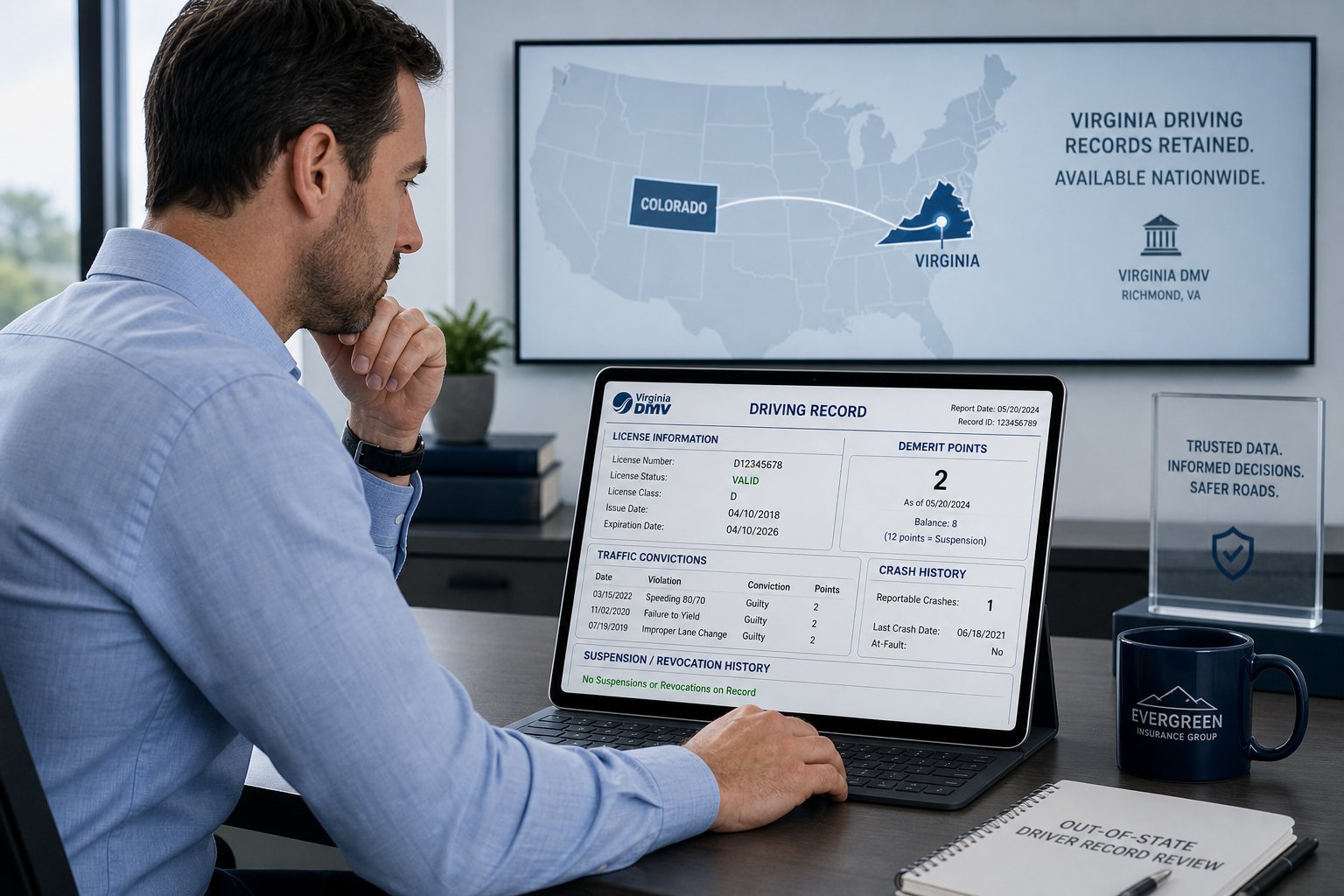
What A Virginia Driving Record Shows And Why Out-Of-State Drivers Need It
A Virginia driving record is Virginia DMV’s history file for your license and traffic record. If you once held a Virginia license, or got a Virginia ticket, that record stays with Virginia DMV even after you move.
If you need an approved online option, review the Virginia Driver Improvement Course and compare it with your Virginia DMV notice, court order, or driver record goal.
That record can show key items such as:
- Your name and identifying details
- License status
- Convictions
- Crashes reported to DMV
- Suspensions or revocations
- DMV actions
- Demerit points tied to convictions
- In some record types, a set look-back period
For many people, the main surprise is this: moving does not wipe the Virginia file clean. Your new state does not absorb the record and turn it into a new Virginia-style point balance. Instead, Virginia keeps its own record, and another state may review it when you apply for a new license.
That matters because your record can affect more than just old paperwork. An out-of-state DMV, court, employer, or insurer may want proof of your status or past violations. If Virginia shows an active suspension, unpaid compliance issue, or serious conviction, that can slow down or complicate your next step.
A Virginia record may also matter if you need to prove improvement efforts. For example, a DMV-approved Driver Improvement Clinic (DIC) is Virginia’s official course. It is an 8-hour course. In some cases, DIC completion may help under Virginia rules, but it does not mean another state must treat your record the same way Virginia does.
And that is the key idea for anyone moving out of state Virginia driving record questions usually come down to this: Virginia keeps the history, while your new state decides how to use what it sees.
Types Of Virginia Driving Records And Which One To Request
Virginia DMV offers more than one kind of driving record. The right one depends on why you need it.
Common record types include:
- Driver/Personal Use: up to 11 years
- Driver/Employment/School/Military: up to 7 years
- Driver/TNC: up to 7 years
- Driver/Insurance: summary, up to 5 years
- Driver/Habitual Offender Restoration: up to 11 years
If you simply want to check your own history before moving or before applying in a new state, the personal use record is often the best place to start. It gives a broader view of your past.
If an employer, school, military office, or rideshare company asked for a specific transcript, use the exact record type they named. If you send the wrong one, they may reject it.
If your concern is insurance, the Driver/Insurance version may be enough. If your issue involves a court petition or restoration matter, the Habitual Offender Restoration record may be more useful.
Also, do not assume every record shows the same details. A shorter summary may not show as much history as a personal-use record. So if you are trying to understand old Virginia convictions, point timing, or a past suspension, request the record with the look-back period that fits your problem.
If a court notice, DMV letter, or employer request names the record type, follow that instruction first.
How To Get Your Virginia Driving Record From Another State
You can still get your Virginia record after you leave Virginia. In most cases, you can do it online, by mail, or in person if you return to a Virginia DMV office.
Online
Virginia DMV offers online record access through its record request services. If you can verify your identity through DMV’s system, this is often the fastest option. Virginia DMV.
Online access is useful when you need to check your status before applying for a new license elsewhere. It can also help you confirm whether a suspension, conviction, or compliance item still appears on your file.
By mail
If online access does not work, you can request your record by mail. Virginia DMV allows requests using form CRD-93 or a written request with identifying information and the reason for the request. Virginia DMV lists mailing details through its customer records process at Virginia DMV customer records.
Mail requests usually require enough personal details to match the record, plus your signature and fee.
In person
If you are back in Virginia, you can visit a DMV office and request the record there. Bring identification and any details tied to the record type you need.
If your move is coming soon, it is often easier to pull your record before you leave so you can spot problems early.
Fees, Delivery Options, And What You Need Before You Order
Virginia driving record requests usually come with a fee. The amount is often about $9, but the exact fee can depend on the record type or request method, so confirm with Virginia DMV before you order.
Delivery depends on how you request the record:
- Online records may be available right away
- Online records may be viewable again for a short time after purchase
- Mail requests are often processed within about 5 business days after receipt
- In-person requests depend on office service and record type
Before you order, gather the basics:
- Your full legal name
- Date of birth
- Virginia license number if you have it
- Current address
- Any needed identifying details
- Payment method
- The reason you need the record, if required
Your address on file matters, especially if Virginia DMV mails anything to you. If you moved and the address is old, update it through DMV services first when possible. That can help avoid delays and missed notices.
This point is bigger than convenience. If Virginia DMV has sent a notice tied to your record, license suspension, or compliance issue, you do not want that going to an old address. Requirements can depend on the Virginia DMV notice, court order, ticket, citation, driver record, license status, court, judge, locality, and case facts.
So before you pay for a transcript, make sure your record can actually reach you.
How Virginia Traffic Violations Can Affect Your License In Another State
A Virginia ticket can still matter after you move. That is because states often share conviction information through interstate systems, including the Driver License Compact framework used by many states.
In simple terms, your new state may ask for or receive your Virginia history when you apply for a license there. If Virginia shows a conviction, suspension, or serious traffic offense, the new state may use its own law to decide what happens next.
Here is the part many drivers miss:
- Virginia demerit points belong to Virginia’s system
- Virginia safe driving points are also part of Virginia’s system
- Another state does not have to honor Virginia’s point balance the same way Virginia does
So if you earned safe driving points in Virginia, that usually does not transfer as a direct benefit to your new state. And if you completed a Driver Improvement Clinic, that does not mean your new state must give you the same credit Virginia might give under Virginia rules.
But Virginia violations can still show up when your record is pulled. That includes convictions for offenses that Virginia DMV reports on the transcript. If Virginia has suspended your privilege or posted a major issue, that can create trouble when you try to get licensed elsewhere.
This is why clearing up Virginia issues before moving is often the best move. If you have a notice, unpaid item, or required DIC, deal with it. If you need the Virginia course, you can review the online option from Driving Logic at Virginia Driver Improvement Course.
When You May Need Your Record For Court, Employment, Insurance, Or Traffic School
You may need your Virginia record long after you leave the state. Courts, employers, insurers, and traffic school programs often want the official DMV version, not a memory of what happened.
Court
Virginia Courts or another court may want your transcript for a traffic case, DUI matter, reckless driving case, or restoration issue. A court may use the record to confirm prior history, license status, or compliance. You can also check court information through the Virginia Judicial System.
Employment
If you drive for work, an employer may ask for a 5-year or 7-year record. This comes up with delivery jobs, government work, school transport roles, and rideshare screening.
Insurance
Insurers may review a record summary to price coverage or verify violations. If your record has an old Virginia item you forgot about, it can still matter when the insurer checks.
Traffic school or state-required course
Sometimes a court, DMV notice, or case outcome leads to traffic school. In Virginia, the official course is the DMV-approved Driver Improvement Clinic, an 8-hour course. Whether you are required to take it can depend on the notice, order, citation, record, and case facts.
If you need a state-approved Virginia course while living elsewhere, review the options at Driving Logic.
How To Review Your Record For Errors And Update Your Information
You should review your Virginia record line by line, especially before you apply for a new license in another state. Small errors can cause large delays.
Look for problems such as:
- A conviction that should not be there
- Wrong dates
- A suspension that was cleared but still appears
- Missing compliance information
- Personal details that are out of date
Also check your point balance carefully. In Virginia, safe driving points and demerit points follow Virginia’s own rules and timelines. Do not assume a point change means a conviction disappeared from the history. Those are different things.
If you find an error, contact Virginia DMV customer records and send proof. Good examples include:
- Court orders
- Case dispositions
- Payment records
- Compliance receipts
- Identity documents
If your name or address changed, update that information with Virginia DMV so notices and record copies go to the right place. That matters if you are still resolving an old Virginia issue after moving.
For many people, the best step is simple: pull your Virginia record, review it before your move or license application, and fix mistakes before another state sees them.
Not legal advice. Rules and outcomes can depend on Virginia DMV notices, court orders, citations, deadlines, license status, the court, the judge, the locality, and the facts of the case.
FAQ
Can a Virginia Driver Improvement Clinic remove a ticket from my record?
No. A Virginia Driver Improvement Clinic does not erase a ticket or conviction from your driving record. When eligible, it may add safe driving points that help your overall point balance.
How many safe driving points can I earn from a Virginia clinic?
Eligible drivers may receive 5 safe driving points after completing an approved clinic. Voluntary clinic credit is generally limited to once every 24 months.
Should I follow the DMV notice or the court order?
Follow the document that applies to your situation. A DMV notice, court order, citation, or insurance request may have different instructions and deadlines.
Where should I check my Virginia point balance?
Use your official Virginia DMV driving record. Do not rely only on memory, insurance paperwork, or an old copy of your record.
Conclusion
What Happens to Your Virginia Driving Points If You Move Out of State? depends on your official Virginia DMV record, the specific violation, and any court or DMV notice you received. A Driver Improvement Clinic may help with safe driving points when eligible, but it does not erase the underlying ticket or conviction. Check the official record and deadline before you act.
Take the Virginia Driver Improvement Course online when you are ready to begin.
Related Articles
- Virginia DMV Points System Explained
- What Is a Safe Driving Points Balance in Virginia?
- How to Earn Safe Driving Points in Virginia (And Why the DIC Gives You 5)
- How Many Points Is a Speeding Ticket in Virginia?
Sources
- Virginia DMV — Driver Improvement
- Virginia DMV — Points System
- Virginia DMV — Moving Violations and Points
- Virginia Code § 46.2-494 — Safe Driving Points
- Virginia DMV — Driver Improvement Clinics
Billy Forte is the owner of Driving Logic, a state-approved driver improvement course provider serving Virginia and other U.S. states. Driving Logic offers online driver improvement and driver safety courses for drivers handling DMV notices, court orders, point concerns, and state requirements.
This article is general information, not legal advice. Virginia DMV rules, court orders, deadlines, insurance decisions, CDL rules, and case facts can differ. Use official Virginia DMV and court sources for current requirements, and consult a qualified Virginia attorney for legal guidance specific to your situation.