
Updated June 2026 · Reviewed by Billy Forte
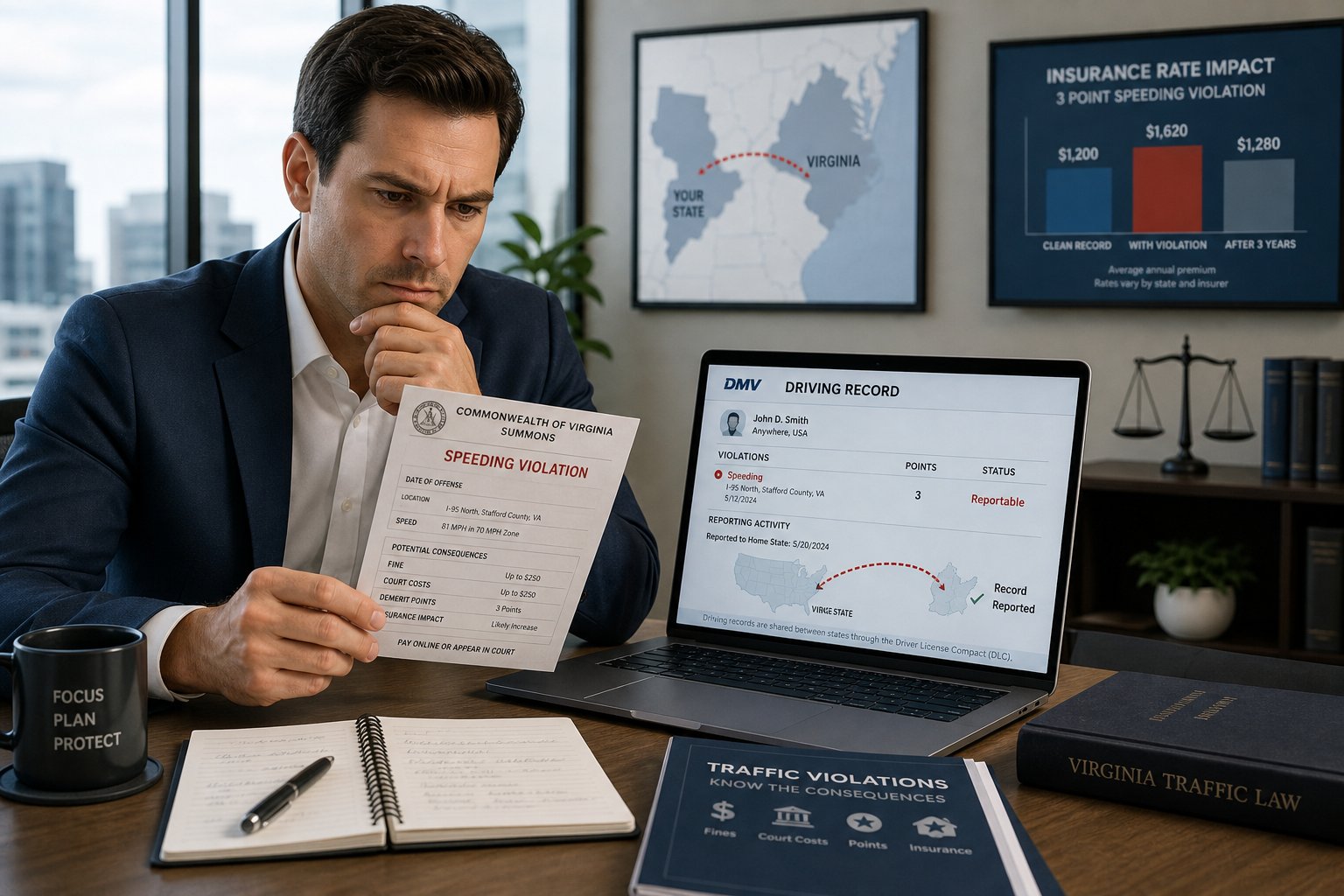
A Virginia speeding ticket can still affect an out-of-state driver because the court case happens in Virginia and the conviction may be reported to the driver’s home state. This article is for nonresidents who received a Virginia ticket and need to understand license, points, and record issues. You will learn what to check with Virginia and your home-state DMV before choosing your next step.
This article covers Virginia requirements only.
Key Facts
- Virginia case: The court case is handled in Virginia even if you live elsewhere.
- Home-state record: Your state may handle the conviction under its own rules.
- Points vary: Virginia safe points may not reduce your home-state point total.
- Deadline: Follow the Virginia court or clerk deadline on the ticket.
- DIC role: A voluntary clinic reports to Virginia DMV when eligible.
If your court, DMV notice, or personal record goal allows a course option, review the Virginia driver improvement course before your deadline.
Why a Virginia Speeding Ticket Can Affect You After You Leave the State
A Virginia ticket does not always stay in Virginia. If you are convicted, the case can be sent to your home state and placed on your driving record there.
That matters because your home state controls your license. Virginia can report the offense, but your state decides whether to assess points, mark a conviction, require a course, or take other action under its own law. In plain terms, a ticket from a road trip can still cause trouble months later when your DMV updates your file.
Virginia is strict about traffic cases. Even a basic Virginia speeding ticket can carry demerit points in Virginia’s system, and the court can add fines and court costs if you are convicted. If you just pay a prepaid ticket, that usually counts as a conviction. So for many drivers, the issue is not only the money. It is what happens after the report reaches home.
Insurance can be part of the problem too. Many insurers check motor vehicle records at renewal. If an out-of-state conviction appears, rates can rise. That depends on the company and your record, but the risk is real.
The details can change based on the ticket, court, judge, locality, driver record, and license status. So two drivers with similar speeds may still face different results.
How Virginia Reports Tickets to Your Home State
Virginia usually reports convictions through interstate data-sharing. The main system people hear about is the Driver License Compact, which most states use in some form to exchange traffic conviction information.
After a conviction, information from the Virginia Courts and the Virginia Department of Motor Vehicles can be transmitted to your home state. Your state then reviews the offense and compares it to its own laws. If there is a similar offense under that state’s rules, it may post the violation and apply its own penalties.
This is why virginia speeding tickets out of state often do not disappear when you cross the border. The key event is usually the conviction, not the stop itself.
A few practical points matter here:
- Paying a prepaid ticket usually means you accept conviction.
- A court finding of guilt also creates a reportable result.
- A reduced charge may be treated differently by your home state.
- A dismissal is not the same as a conviction.
Virginia also has an official DMV-approved Driver Improvement Clinic (DIC). It is an 8-hour course. If you take it voluntarily, Virginia DMV may record course completion in Virginia. But that does not mean your home state will change its own record or remove points. Your state decides what, if anything, it does with the Virginia report.
For official information, check the Virginia DMV, the Virginia Judicial System, and your own state DMV.
What Can Happen to Your License, Record, and Insurance
The short answer is simple: your home state may treat the Virginia conviction under its own rules. That can affect your license, your driving record, and sometimes your insurance.
For your license, your home state may add points or start a suspension if your record is already weak. Some states assign points for out-of-state speeding. Others record the conviction without points. Some may require a class or other follow-up step.
For your record, the offense may show up as a moving violation. The label can vary by state. But once it posts, it can affect later cases, employer record checks, or insurance reviews.
For insurance, an out-of-state speeding conviction can still matter. Insurers often look at your full motor vehicle record, not just tickets from your home state. A single minor ticket may have a small effect, or none. A higher speed or a reckless driving conviction can be more serious.
Virginia has its own DMV points and demerit points system, but your out-of-state license is not governed by Virginia’s point system alone. That is where many drivers get confused. Virginia may record the case one way, while your home state applies its own point value.
Also, if Virginia sends you a notice, court date, payment deadline, or suspension warning, do not miss it. Missing a required step can create a separate problem from the ticket itself.
When Speeding in Virginia Becomes Reckless Driving
In Virginia, speeding can turn into reckless driving faster than many visitors expect. Under the Code of Virginia, driving 20 mph or more over the limit or driving over 80 mph regardless of the speed limit can lead to a reckless driving charge. That is much more serious than a routine infraction.
Reckless driving in Virginia is a Class 1 misdemeanor. According to Virginia law, the possible penalties can include:
- Up to 12 months in jail
- Up to a $2,500 fine
- Up to 6 months of license suspension
For out-of-state drivers, this matters a lot because a misdemeanor can follow you home in ways a simple ticket might not. Your home state may record it as a major offense, and insurers may treat it more harshly.
This is also where court procedure changes. A case above the reckless driving threshold is often handled in the General District Court and may require a court appearance. The facts matter, including speed, road conditions, prior record, and the specific court.
If a judge orders a Driver Improvement Clinic, remember that Virginia’s approved course is the 8-hour DIC. A court order, DMV notice, or case disposition will control what is required. Check the exact wording on your paperwork and follow each deadline carefully.
For the current law, see the Code of Virginia reckless driving statute.
Your Main Options: Pay the Ticket, Contest It, or Hire Help
Your main choices are usually pay, contest, or get help. Which one fits depends on the charge, your speed, your record, and whether the ticket is prepaid or requires court.
Pay the ticket: For some lower-level speeding charges, Virginia lets you prepay. That is easy, but it usually means a conviction. Once convicted, the case may be reported to your home state.
Contest the ticket: You can appear in the Virginia General District Court listed on the citation and plead not guilty. In court, the judge hears the officer and your side. The outcome can depend on the facts, the charge, and the local court.
Hire help: Some out-of-state drivers hire a Virginia traffic lawyer, especially for higher speeds or reckless driving. A lawyer may be able to appear for you in some cases, ask for a reduction, or explain local practice. No result is guaranteed.
If a course becomes part of the outcome, make sure it is the correct Virginia course. The official program is the DMV-approved Driver Improvement Clinic, which is 8 hours. If you need a Virginia course online, you can review the options at Virginia driver improvement course.
Do You Have to Return to Virginia for Court?
Sometimes no, but often yes for serious charges. Many routine prepaid speeding tickets do not require you to return if you choose to prepay.
But reckless driving and some higher-speed cases often involve a required court date. The citation, court notice, and local practice matter. Some judges may allow an attorney to appear for you in certain cases, while others may require your presence.
Read the ticket closely. Then confirm the court date with the Virginia Judicial System case information page or the clerk for that court.
What Happens If You Ignore a Virginia Speeding Ticket
Ignoring a Virginia ticket can make things worse. It does not usually go away because you live in another state.
If you fail to respond, Virginia may take action tied to the case and your privilege to drive in Virginia. Depending on the notice and the case facts, that can include added fees, collections, missed-court consequences, or a suspension of your privilege to drive in the Commonwealth.
Your home state may also react once it receives information about an unpaid or unresolved Virginia case. The exact result depends on your state’s law and DMV process. In some states, that can affect renewal, your record, or enforcement status.
This is why deadlines matter so much. Pay attention to:
- The citation and court date
- Any Virginia DMV notice
- Payment deadlines
- Required appearances
- Suspension warnings
If the court or Virginia DMV requires a course, use the exact course named in the order or notice. For a Virginia driver improvement requirement, that usually means the 8-hour DMV-approved Driver Improvement Clinic.
If you need a fast online option from a provider focused on busy drivers, you can Virginia driver improvement course.
Where A Virginia Driver Improvement Course May Fit
A Virginia driver improvement course can matter after a speeding ticket, but it has a limited role. Virginia DMV-approved clinics are 8-hour courses. When you complete a clinic voluntarily and meet DMV rules, you may receive 5 safe driving points once every 24 months.
That does not erase the ticket. It does not remove the conviction from your driving record. It also does not guarantee a court result, an insurance discount, or a change in how a judge handles your case.
The course is most useful when your goal is to improve your DMV point balance, satisfy a DMV requirement, or comply with a court order that specifically allows or requires driver improvement. If you are using the course for a court case, follow the court’s instructions first. If you are using it for DMV safe points, confirm that the provider is approved and that your timing fits DMV rules.
You can review the Virginia driver improvement course if your ticket, court order, DMV notice, or personal record goal makes a course appropriate.
FAQ
Can a Virginia driver improvement course help after a speeding ticket?
It may help with DMV safe driving points when eligible, or satisfy a court or DMV requirement. It does not erase the ticket or guarantee a court result.
Should I check my court paperwork first?
Yes. Your citation, court notice, DMV notice, and deadline control what you need to do next.
Does the course remove a conviction?
No. A Virginia driver improvement clinic does not remove a conviction from your DMV record.
Related Articles
- Virginia Speeding Ticket: Costs, Points, and What Happens Next
- How Long Does a Speeding Ticket Stay on Your Record in Virginia?
- Virginia Speeding Ticket for CDL Holders: Higher Stakes and Federal Rules
- Virginia Speeding Ticket: What to Know Before You Pay or Go to Court
Sources
- Virginia DMV — Driver Improvement Clinics
- Virginia DMV — Demerit Points
- Virginia Courts — Pay Traffic Tickets and Other Offenses
- Code of Virginia — Driver License Compact
Billy Forte is the owner of Driving Logic, a state-approved driver improvement course provider serving Virginia and other U.S. states. Driving Logic offers DMV-approved online driver improvement courses for drivers handling DMV notices, court orders, and state requirements.
This article is general information, not legal advice. Virginia DMV rules, court orders, deadlines, insurance decisions, CDL rules, and case facts can differ. Use official Virginia DMV and court sources for current requirements, and consult a qualified Virginia attorney for legal guidance specific to your situation.