
Updated June 2026 · Reviewed by Billy Forte
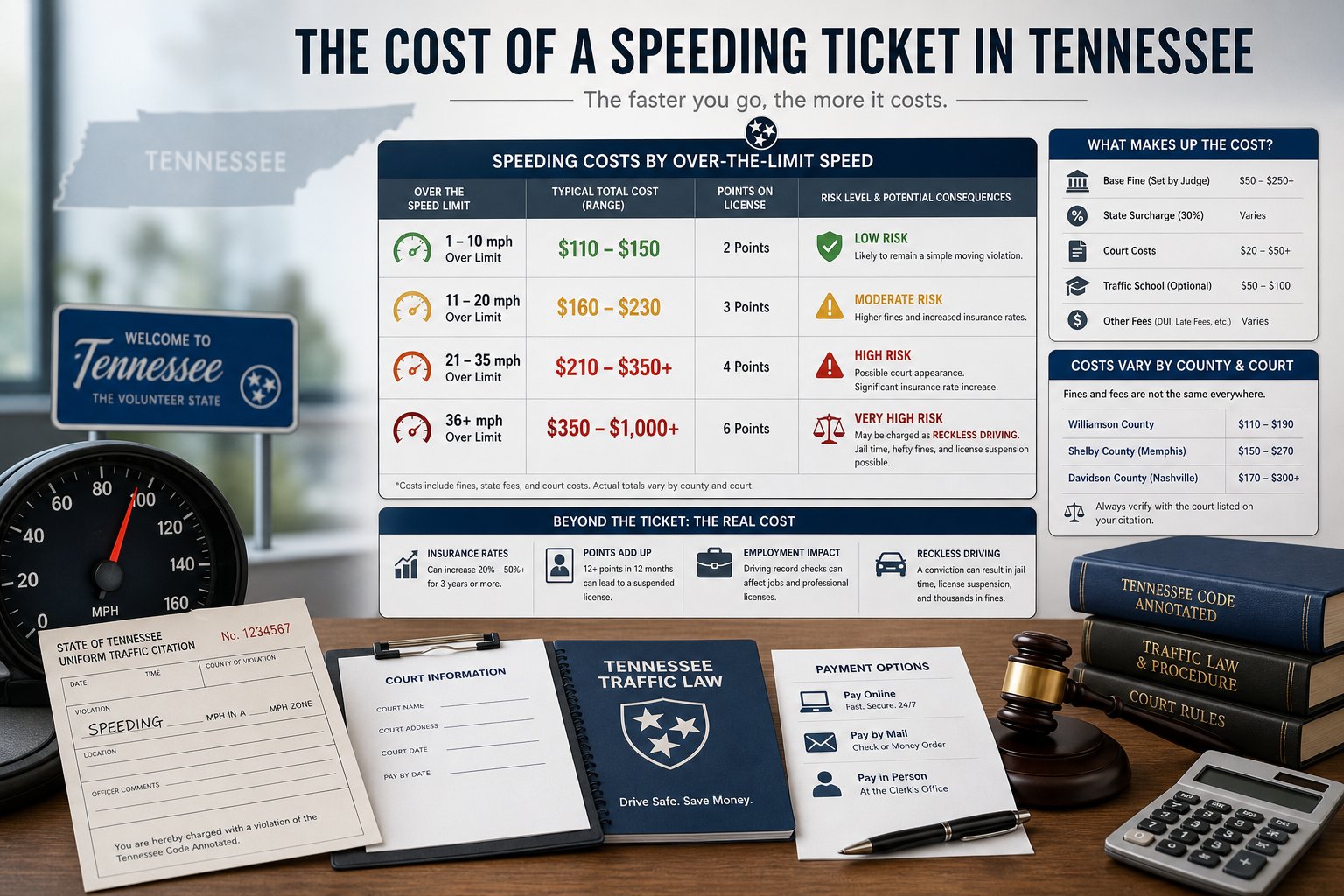
A Tennessee speeding ticket usually costs about $110 to $230 total for many basic cases, but the price often rises as your speed goes up, and 36+ mph over can bring reckless driving risk and much higher consequences. In Tennessee, the base fine is only part of the bill because court costs and litigation taxes often make the real total much higher than the fine listed in Tennessee Code Annotated. A speeding conviction can also add demerit points with the Tennessee Department of Safety and Homeland Security (TDOSHS), and that can raise your full Tennessee speeding ticket cost far beyond what you pay to the Clerk of Court.
This article covers Tennessee requirements only.
Key Facts
- Costs vary: Tennessee speeding-ticket totals depend on the county, court costs, and violation details.
- Points vary: The number of points depends on the speed range and offense.
- Driving school is court-dependent: A course only helps with a ticket if the court allows it.
- Deadlines matter: Follow the citation, clerk, or court instructions before enrolling.
- No guarantee: The course does not promise dismissal, point removal, or a lower insurance rate.
#
The short answer is that Tennessee speeding ticket cost depends on the court, county, and how fast you were going. There is no one flat statewide amount.
Still, source-backed local examples show a common pattern. In Goodlettsville, a speeding citation runs $108.75 for 1–9 mph over and 10–19 mph over, and $113.75 for 20+ mph over. In Franklin Municipal Court, the total is $139.50 for 0–10 over, $149.50 for 11–20 over, and $159.50 for 21–30 over. In Montgomery County, a state citation under TCA 55-8-152 has been listed at about $229.50.
That is why most drivers should think in ranges, not one fixed number. A common Tennessee speeding ticket total cost is often around $110 to $230, but some cases land above that.
Here is the practical speed-tier view most drivers want:
- 1–5 mph over: often at the low end of local totals: 1 point
- 6–15 mph over: often still in the basic ticket range, but some courts charge more: 3 points
- 16–25 mph over: total cost may rise with speed: 4 points
- 26–35 mph over: often treated more harshly: 5 points
- 36+ mph over: far more serious: 6–8 points and possible reckless driving issues
Most speeding offenses are treated as a Class C misdemeanor under Tennessee law, with a statutory fine cap that is much lower than what drivers actually pay after fees. So if you ask, “How much more does it cost when I was going faster?” the real answer is: usually somewhat more in direct ticket cost, and often much more once points, court action, or reckless driving risk enter the picture.
#
The base fine is not the whole bill. In many Tennessee courts, the bigger number comes from court costs, litigation taxes, and add-on fees.
For example, Goodlettsville lists $50 in court costs plus a $14.75 state litigation tax as part of the citation total. That helps explain why the final amount can feel high even when the statutory fine itself is limited.
This is where many drivers get surprised. They look up the offense and see a modest fine in the law, then the actual amount due is much higher at payment time.
Common added costs include:
- Court costs
- State litigation taxes
- Local fees
- Late penalties
- In some cases, costs tied to failure to appear
And late payment can make things worse fast. Some local courts add $50 late fees plus $50 per year overdue for each violation. So waiting can turn a manageable ticket into a much larger debt.
Special facts can push the amount up too. Work zones, school zones, repeat violations, or related charges may all change the outcome. If your citation requires court, the final amount may not be set until the judge enters it.
The best move is simple: check the exact amount with the Clerk of Court listed on your ticket and review your court’s payment rules through the Tennessee court system. If your case involves a hearing, do not assume the online amount is the final answer.
#
A speeding ticket in Tennessee does more than cost money. It can add demerit points to your driving record with the Tennessee Department of Safety and Homeland Security.
Tennessee uses a point system to track moving violations. The faster you were going, the more points you can get.
Here is the speed-based point breakdown referenced for Tennessee drivers:
- 1–5 mph over: 1 point
- 6–15 mph over: 3 points
- 16–25 mph over: 4 points
- 26–35 mph over: 5 points
- 36+ mph over: 6–8 points, with stronger risk of reckless driving treatment
That last tier matters a lot. At very high speeds, your case may stop looking like a routine traffic ticket and start looking like reckless driving, depending on the facts and the charge. Reckless driving in Tennessee is much more serious than a basic speeding citation.
Points stay important because they can lead to license suspension or revocation if you build up too many. Even one ticket may not suspend your license, but repeated violations can put you close to the line with TDOSHS.
Your driving record also matters in court. If you already have recent tickets, a new one may be treated less kindly. Judges often view a repeat pattern as a bigger safety issue.
You can check official license and point information through the Tennessee Department of Safety and Homeland Security. And if your speed was very high, read the charging language on the ticket closely. The difference between basic speeding and a more serious charge can affect points, penalties, and what options you may be offered in court.
#
For many drivers, insurance is the most expensive part of a speeding ticket. The court payment may hurt once, but a rate increase can hurt for years.
A single speeding ticket may raise insurance rates by roughly 15% to 50% for 3 to 5 years, depending on your insurer, your past record, and how serious the violation was. In dollars, that can mean about $900 to $3,000 more in premiums over time.
That is why the full Tennessee speeding ticket cost is often much higher than the amount on the citation.
Insurers often look at:
- How far over the limit you were
- Whether the charge was simple speeding or looked closer to reckless driving
- Your age and driving history
- Whether you already had claims or prior violations
- Whether you lose a safe-driver discount
A lower-tier speeding ticket may still raise your rate. A high-speed citation can do more damage, especially if it suggests risky driving behavior.
Not every insurer reacts the same way. Some forgive one minor violation. Others do not. But you should assume that a conviction can be seen by your insurer when your policy renews.
If avoiding insurance impact matters, it may be worth checking whether your court allows any form of diversion, reduction, or school option. Do not assume it will. Court acceptance depends on the specific Tennessee court and your case facts.
#
In some Tennessee cases, traffic school or a defensive driving course may help, but only if your court allows it. It is not automatic.
Some courts may offer a course as part of diversion, a reduced charge, or another outcome for eligible drivers. That can matter at any speed tier, including lower-speed tickets, if the court chooses to allow it. But the result depends on the court, the judge, the prosecutor, and your record.
Tennessee drivers should know there are commonly two course lengths mentioned in practice:
- 4-hour course: often used for court-ordered ticket diversion
- 8-hour course: often tied to TDOSHS-approved near-suspension situations
Whether a course can dismiss a ticket or reduce points depends entirely on the specific Tennessee court and case. Never count on dismissal. Never count on point reduction. And because online acceptance varies, confirm with your court before taking an online course.
Course fees can also add to your total cost. In some settings, defensive driving or traffic school may cost about $135 to $240, depending on the provider and program.
If your court approves online completion, a provider like Driving Logic’s Tennessee defensive driving course may fit a busy schedule better than a classroom. The main value is convenience. But again, the key step is court approval first.
#
Paying the ticket is usually treated as a guilty plea in Tennessee. That means you often give up your right to a hearing.
For some drivers, paying makes sense. It is faster. It ends the case. And if the ticket is minor and the total cost is manageable, that may be enough.
But paying can also lock in:
- Demerit points
- A conviction on your driving record
- Possible insurance increases
- Less room to ask for diversion or a reduced charge later
Fighting or trying to negotiate may make more sense when the facts are not clear. For example, maybe the speed reading seems wrong, the stop details are in dispute, or your record is otherwise clean and you want to protect it.
In some cases, the best outcome is not “win or lose.” It may be a reduction, a non-moving violation, or court-approved traffic school. That depends on the court and the facts.
If your ticket involves very high speed, a required appearance, or possible reckless driving under Tennessee Code Annotated, the stakes are higher. In that kind of case, it often makes sense to look closely at your options before you plead.
A good first step is to read the ticket, note the court date, and contact the court clerk to ask what options exist in your case.
#
Ignoring a Tennessee traffic ticket usually makes the problem worse, not cheaper. It does not make the case disappear.
If you fail to pay or fail to appear, the court may enter an automatic adjudication of guilt in some places. You may also face an added failure to appear issue, extra fees, and collection action.
Possible results include:
- Late fees and added penalties
- A court judgment against you
- A license suspension through the State of Tennessee
- Trouble renewing your license or clearing your record
- More time and money spent fixing the problem later
Some courts and cities also add steep overdue charges. That means a ticket that started near the low end of the normal range can become much more expensive over time.
If your case has a court date, go. If your ticket lists a payment deadline, meet it. If you think you may qualify for school or diversion, ask the court before the deadline passes. And if the court allows online traffic school, you can review Driving Logic as one possible option after you confirm acceptance.
*This information is general education only and is
FAQ
Can a Tennessee driver education course dismiss my ticket?
Only if your court allows that result. Tennessee courts and local instructions control whether a course affects a ticket, points, or court requirement.
Can I take the course online?
Maybe. Some Tennessee courts accept online courses, while others may require a specific format, so confirm with the court before enrolling.
Does the course remove points from my record?
Do not assume it removes points automatically. Any point or ticket benefit depends on the court, TDOSHS rules, and the facts of your case.
What should I check before enrolling?
Check your ticket, court notice, clerk instructions, deadline, and whether online completion is accepted. Then choose a course that matches those requirements.
Conclusion
What you pay for a Tennessee speeding ticket depends on your speed, the county, and added court costs, so two drivers with similar tickets can owe different totals. Check your citation and the court’s schedule before assuming a number. The fine is only part of the cost once insurance is factored in.
Take the Tennessee driver education course online with Driving Logic when you are ready to begin.
Related Articles
- Tennessee Speeding Ticket: Costs, Points, and What to Know
- Tennessee Reckless Driving vs. Speeding Ticket: Key Differences
- Tennessee First-Time Speeding Ticket: What to Expect
- Tennessee Traffic Ticket Options: Pay, Contest, or Ask About Driving School
Sources
- Tennessee Department of Safety and Homeland Security — Defensive Driving Schools
- Tennessee Department of Safety and Homeland Security — Driver Improvement / Traffic School
- Tennessee Code Annotated — Reckless Driving, TCA § 55-10-205
- Tennessee Department of Safety and Homeland Security
Billy Forte is the owner of Driving Logic, a state-approved driver improvement course provider serving Tennessee and other U.S. states. Driving Logic offers online driver education, defensive driving, and traffic school courses for drivers handling court, ticket, insurance, and state requirements.
This article is general information, not legal advice. Tennessee court rules, TDOSHS requirements, deadlines, insurance decisions, and case facts can differ. Use official Tennessee court and state sources for current requirements, and consult a qualified Tennessee attorney for legal guidance specific to your situation.