
Updated June 2026 · Reviewed by Billy Forte
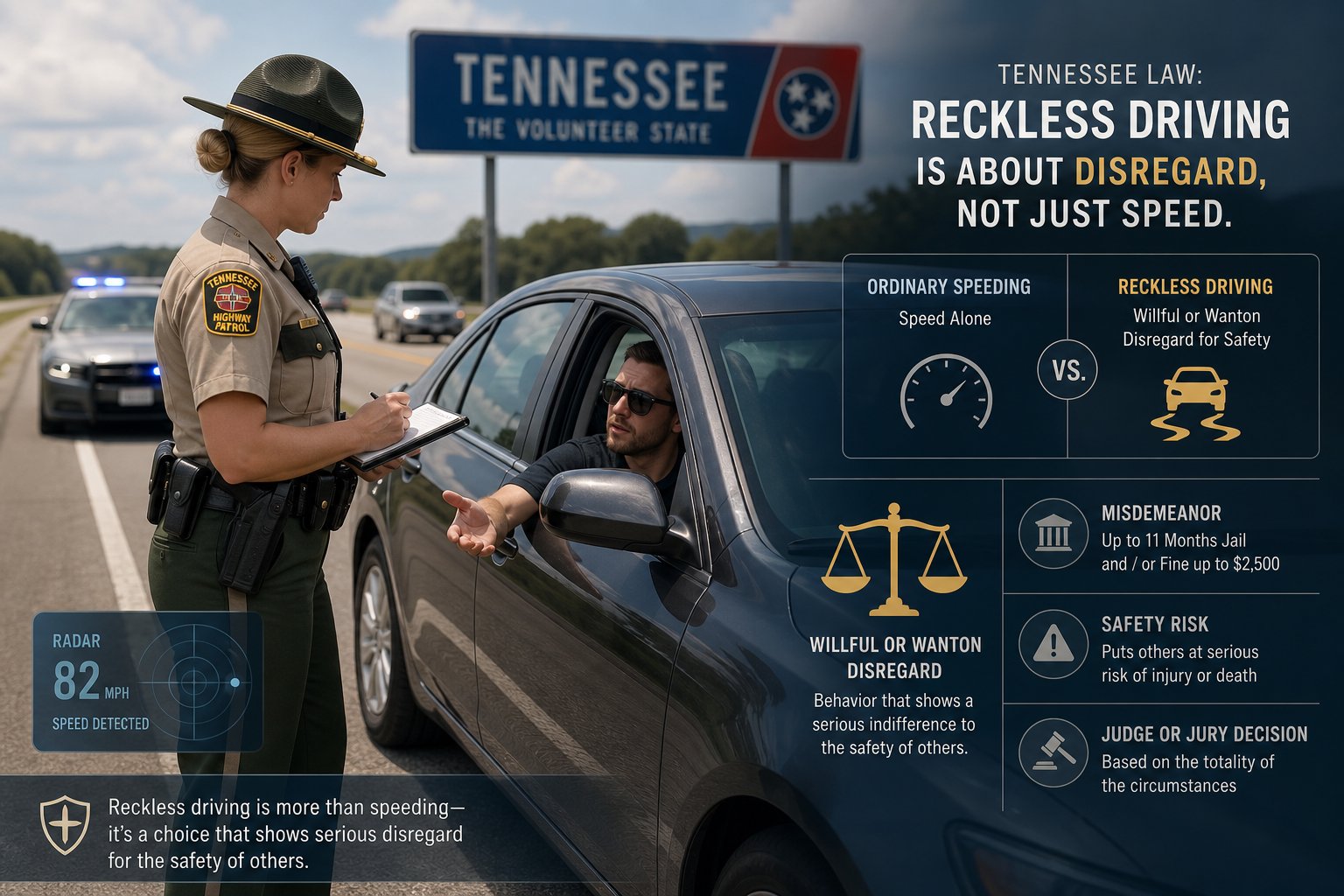
Reckless driving in Tennessee means driving with willful or wanton disregard for the safety of people or property under Tennessee Code Annotated § 55-10-205. The law does not set a fixed miles-per-hour number, but police and courts often treat 30+ mph over the limit or other plainly dangerous acts as possible reckless driving. Unlike a basic Tennessee traffic ticket for careless driving, reckless driving is a criminal charge, usually a Class B misdemeanor, and it can add 6 demerit points to your record with the Tennessee Department of Safety and Homeland Security.
This article covers Tennessee requirements only.
Key Facts
- Reckless-driving standard: Tennessee law focuses on willful or wanton disregard for safety.
- No fixed mph rule: A high speed can matter, but the statute does not set one automatic threshold.
- Criminal risk: Reckless driving can be treated differently from a standard speeding ticket.
- Course role: A driver education course may help only if the court accepts or orders it.
- No guarantee: The course does not erase charges, convictions, points, or court requirements.
#
The key part of the law is the phrase “willful or wanton disregard”. That means more than a simple mistake. It points to driving that shows a clear lack of care for what could happen to other people, cars, or property.
Under TCA § 55-10-205, reckless driving is based on behavior, not just speed. So, there is no line in the statute that says, for example, 25 mph over is always reckless or 30 mph over is always reckless. Still, in real Tennessee cases, very high speed often becomes part of the reason an officer writes a reckless driving citation.
This is also where many drivers mix up careless, negligent, and reckless driving. They are not the same:
- Careless or negligent driving is usually treated as a traffic offense
- It can carry 4 demerit points
- Reckless driving is more serious
- It is a criminal misdemeanor
- It can carry 6 demerit points
That distinction matters. A speeding ticket may be about the number on the radar. A reckless driving charge is about whether your conduct showed a serious disregard for safety. If an officer believes your driving put others at risk in an obvious way, the charge can go beyond ordinary speeding.
#
Speeding and reckless driving are not the same charge in Tennessee. A speeding ticket usually alleges that you drove above the posted limit. Reckless driving alleges that your actions showed willful or wanton disregard for safety.
That means you can speed without being charged with reckless driving. You also can be charged with reckless driving when speed is only part of the problem. For example, an officer may say your speed was dangerous because of traffic, rain, a school zone, or sharp lane changes.
Common differences include:
- Speeding ticket: usually a standard traffic offense
- Reckless driving: a Class B misdemeanor
- Speeding: often tied to one fact, your speed
- Reckless driving: looks at the full driving behavior
- Speeding: generally less severe point impact
- Reckless driving: 6 points on your Tennessee record
In practice, Tennessee officers often view very excessive speeding, especially 20 to 30 mph over or more, as possible reckless driving when other danger signs are present. School zones and work zones can make the situation worse.
So if you are asking what is considered reckless driving in Tennessee, the short answer is this: it is not just fast driving, but driving that appears plainly dangerous under the circumstances.
#
Tennessee reckless driving charges often come from conduct that looks aggressive, out of control, or plainly unsafe. The facts matter a lot. Officers usually look at the full scene, not one detail in isolation.
Examples that often lead to this charge include:
- Driving at an extremely high speed
- Weaving through traffic
- Tailgating in heavy traffic
- Passing in unsafe places
- Running through a school zone too fast
- Speeding through a construction zone
- Failing to yield and putting others at risk
- Losing control because of unsafe speed
A driver does not need to cause a crash to face a reckless driving citation. The risk itself can be enough if the conduct appears serious enough. That is one reason this charge can surprise people. They may think they only got a speeding ticket, but the officer writes something much more serious.
Road conditions also matter. Driving 80 on a clear highway is one thing. Driving the same speed in rain, near stopped traffic, or near pedestrians can look very different to law enforcement.
If your case involves a court date, check the citation carefully and review the county court information through the Tennessee court system. Missing a deadline can make a bad situation worse.
#
The State must prove more than bad driving. In court, prosecutors must prove the charge beyond a reasonable doubt. That is the criminal standard.
In general, the State must show three basic things:
- You were operating a motor vehicle
- You acted willfully or wantonly
- Your conduct showed disregard for the safety of persons or property
That middle part matters most. A simple error in judgment is not always enough. The prosecutor must show something stronger than ordinary carelessness. They may use the officer’s testimony, dashcam video, bodycam video, witness statements, road conditions, and speed evidence.
For example, if the claim is that you were driving far too fast while weaving around cars, the State may argue that the combined conduct shows willful disregard. If the facts are weaker, the case may turn on how clearly the conduct can be described as reckless rather than merely negligent.
Because this is a misdemeanor charge, the case can carry criminal consequences beyond the traffic ticket itself. That is why many drivers speak with a traffic or criminal defense attorney. You can also ask the Clerk of Court about your court date, filing steps, and basic case records, but court staff cannot give legal advice.
#
A reckless driving conviction in Tennessee can bring criminal penalties, license points, and long-term side effects. It is commonly charged as a Class B misdemeanor.
Possible penalties can include:
- Up to 6 months in jail
- A fine of up to $500
- A mandatory $50 assessment
- Court costs
- 6 demerit points on your driving record
The point issue matters because the TDOSHS point system can lead to license action if you build up too many points. In Tennessee, 12 points in 12 months can trigger a suspension review.
There can also be other effects that do not show up on the ticket itself:
- A criminal record entry
- Higher insurance costs
- Problems for CDL holders
- Employment or background check issues
- Trouble if you already have prior violations
Some drivers ask whether a Tennessee defensive driving course can help. Sometimes a court may allow a 4-hour course in a ticket diversion setting, and the 8-hour TDOSHS-approved course may matter in near-suspension cases. But whether a class will help with dismissal, reduction, or points depends on your specific court and case. And if you want to take a course online, confirm first that your court will accept online completion.
#
Some facts can turn a bad reckless driving case into a much more serious one. The biggest examples involve injury, alcohol or drugs, and vulnerable passengers or victims.
Aggravating factors often include:
- DUI or drug impairment at the same time
- A crash that causes injury or death
- A child passenger in the vehicle
- Dangerous conduct near children or pedestrians
- Repeat offenses
- Other traffic crimes charged with the same event
If someone is hurt, the case may move beyond reckless driving into more serious criminal charges. In those cases, the stakes rise fast. The same is true when the event is tied to alleged DUI.
Repeat conduct also matters. A prior record can affect how a prosecutor, judge, or insurer sees the case. Even when the current charge stays the same, the overall consequences can feel much heavier.
So, while the legal definition in the statute is short, the real-world impact depends a lot on the facts around the stop or crash. Small details, like location, traffic level, and whether anyone was endangered, can change how the case is handled.
#
Act fast and take the citation seriously. Reckless driving is not just another speeding ticket. It is a criminal charge, and your response matters.
A practical first step list looks like this:
- Read the citation carefully
- Note all court dates and deadlines
- Contact the Clerk of Court if you need scheduling or record details
- Get a copy of the police report if available
- Check whether video exists
- Consider speaking with a Tennessee traffic attorney
You can also ask whether the court allows any driving course option. In some cases, courts may consider a 4-hour defensive driving course for diversion-type outcomes. In other situations, the 8-hour TDOSHS-approved course may be relevant when a driver is close to suspension. But acceptance varies by court, and no course should be taken on assumptions alone.
If you need a course provider, Driving Logic’s Tennessee defensive driving course is built for busy drivers who want flexible online access on almost any device. Before you enroll, confirm with your specific court that an online course will be accepted in your case.
This page is for general information only and is .
FAQ
Can a Tennessee driver education course dismiss my ticket?
Only if your court allows that result. Tennessee courts and local instructions control whether a course affects a ticket, points, or court requirement.
Can I take the course online?
Maybe. Some Tennessee courts accept online courses, while others may require a specific format, so confirm with the court before enrolling.
Does the course remove points from my record?
Do not assume it removes points automatically. Any point or ticket benefit depends on the court, TDOSHS rules, and the facts of your case.
What should I check before enrolling?
Check your ticket, court notice, clerk instructions, deadline, and whether online completion is accepted. Then choose a course that matches those requirements.
Conclusion
Tennessee defines reckless driving by behavior — willful or wanton disregard for safety under TCA § 55-10-205 — not by a fixed speed. That makes the charge fact-specific and often a matter of officer and court judgment. If you are facing it, your citation and court paperwork, not a speed number, determine what happens next.
Take the Tennessee driver education course online with Driving Logic when you are ready to begin.
Related Articles
- Tennessee Speeding Ticket: Costs, Points, and What to Know
- Tennessee Reckless Driving vs. Speeding Ticket: Key Differences
- Tennessee Speeding Ticket Fines: What Affects the Cost?
- Tennessee First-Time Speeding Ticket: What to Expect
Sources
- Tennessee Department of Safety and Homeland Security — Defensive Driving Schools
- Tennessee Department of Safety and Homeland Security — Driver Improvement / Traffic School
- Tennessee Code Annotated — Reckless Driving, TCA § 55-10-205
- Tennessee Department of Safety and Homeland Security
Billy Forte is the owner of Driving Logic, a state-approved driver improvement course provider serving Tennessee and other U.S. states. Driving Logic offers online driver education, defensive driving, and traffic school courses for drivers handling court, ticket, insurance, and state requirements.
This article is general information, not legal advice. Tennessee court rules, TDOSHS requirements, deadlines, insurance decisions, and case facts can differ. Use official Tennessee court and state sources for current requirements, and consult a qualified Tennessee attorney for legal guidance specific to your situation.