
Updated June 2026 · Reviewed by Billy Forte
Yes, you can contest a Texas speeding ticket by pleading not guilty and requesting a trial, where you may challenge the evidence such as speed-measurement or calibration records before a judge or jury. Contesting can end in dismissal, reduction, or a finding of guilt with the fine and a conviction, so weigh your defense honestly. For many eligible drivers a Driver Safety Course is a more predictable way to avoid a conviction, and deferred disposition is another option — but the course must be requested before the appearance date, so decide early.
Applies to Texas. Court rules and deadlines vary by county.
Key Facts
- You can plead not guilty: Request a trial date and contest the ticket before a judge or jury.
- Possible defenses: Speed-measurement method, calibration records, and the circumstances of the stop.
- Outcomes vary: Contesting can lead to dismissal, reduction, or a guilty finding with the fine and a conviction.
- Alternatives exist: A Driver Safety Course (for eligible tickets) or deferred disposition can avoid a conviction more predictably.
- Mind the deadline: The DSC option must be requested before the appearance date on the citation.
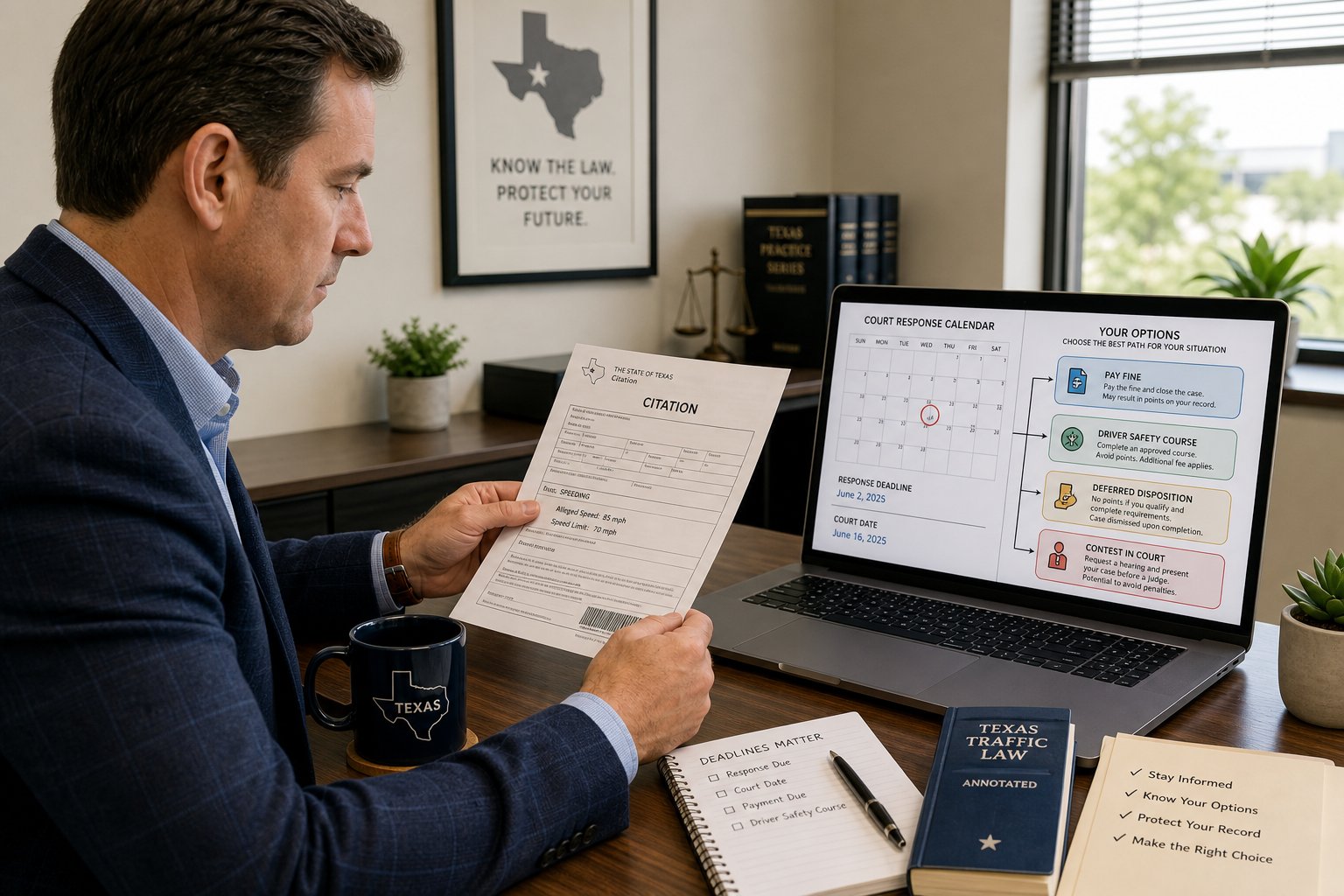
Know Your Main Options After A Texas Speeding Ticket
A Texas traffic ticket gives you more than one path. You do not have to just pay it, but you do need to act before the deadline on the citation.
Most drivers have four main options:
- Pay the fine and accept the conviction
- Ask for a Driver Safety Course (DSC) for ticket dismissal, if eligible
- Ask for deferred disposition
- Plead not guilty and contest the speeding ticket in court
Paying the fine is simple, but it usually means a conviction for a moving violation. That can affect your driving record and may have an insurance impact later. In Texas, driver licenses are handled by Texas DPS (TxDPS), while the Driver Safety Course is approved by the Texas Department of Licensing and Regulation (TDLR), not DPS.
The best choice depends on the facts. If the ticket is weak, court may be worth it. If the charge is eligible and you want a faster route, DSC may be easier. If you need time and can meet conditions, deferred disposition may help keep the case off your record.
The key point is simple: do not miss the court date or response date. If you want to contest the case, ask the court about its process right away.
When Dismissal, Deferred Disposition, Or Defensive Driving May Apply
Texas courts may offer ways to avoid a final conviction, but the rules are not the same in every court. Eligibility matters, and timing matters even more.
A Driver Safety Course (DSC) and defensive driving mean the same thing in Texas. It is the same TDLR-approved 6-hour course. If the court allows it and you complete all court steps on time, an eligible ticket may be dismissed under Texas Code of Criminal Procedure Art. 45.0511.
Common limits for DSC include:
- You must ask the court before the appearance date on the ticket
- You must have a valid non-CDL license
- You must show proof of insurance
- You generally cannot have used DSC for dismissal in the last 12 months
- The speed usually cannot be 25 mph or more over the limit
Deferred disposition is different. The court may place you on a set period with conditions. You may have to pay court costs, avoid new violations, and sometimes take a course. If you complete all terms, the case may be dismissed.
For some tickets, contesting in Texas speeding ticket court is more likely to help. For others, DSC is the simpler option.
Gather Evidence And Research The Court Before You Plead
Before you plead not guilty, gather facts. A strong defense starts with the ticket, the road, and the court’s own rules.
First, read the citation closely. Check the date, time, location, speed listed, and statute or charge code. Small errors do not always lead to dismissal, but they can matter when combined with other problems.
Next, check the court website. Texas speeding cases are often handled by a municipal court or justice court. Look for:
- Plea methods
- Appearance deadlines
- Trial request forms
- Rules for evidence or subpoenas
- Whether pretrial meetings are offered
Then collect proof. Helpful items may include:
- Photos of the speed limit signs or road area
- Dashcam video
- Passenger or witness details
- Notes about weather, traffic, or visibility
- Records related to radar or lidar calibration, if available
If your defense involves the speed reading, you may want to ask how the officer measured speed and whether records exist for the device used. Some drivers also raise a necessity defense, but that depends on the facts and should be reviewed carefully.
And check official sources when needed, such as Texas DPS for license-related questions and the local court for filing rules.
How To Enter A Not Guilty Plea And Request A Hearing
If you want to fight the ticket, you must plead not guilty before the due date. Do not wait and do not assume the court will extend the deadline.
Texas courts may let you enter a plea:
- In person
- By mail
- Online, in some courts
- Through an attorney
After the court gets your plea, it may set a pretrial date or a trial date. In many cases, you may also have a right to a jury trial unless you waive it. The court clerk can usually explain the local process, but cannot give legal advice.
Keep copies of everything you send. If you mail documents, use a method that gives proof of delivery. If the court has an online portal, save screenshots or confirmation emails.
When you request a hearing, be clear and brief. State that you are pleading not guilty and want a court date. Then watch for notices from the court.
If your schedule is tight or the ticket has bigger risks, a traffic attorney may be worth the cost. That is often true if you hold a job that depends on driving, have prior violations, or think the case may affect your license status.
What To Expect When Fighting The Ticket In Court
Court is usually straightforward, but you need to be ready. The judge will hear the officer, then hear your side.
In justice or municipal court, the officer or prosecutor presents the case first. Then you or your lawyer can ask questions and present your evidence. Keep your points short. Focus on facts, not anger.
Common issues drivers raise include:
- Problems with radar or lidar use
- Missing or blocked speed limit signs
- Weak visual estimate of speed
- Errors in the officer’s notes or ticket
- A necessity claim based on a true emergency
Bring printed copies of photos, records, and any other proof. If you have a witness, make sure the person knows the hearing date.
Possible outcomes include:
- Dismissal
- A reduced charge or fine
- Deferred disposition
- Permission to take a DSC, in some cases
- A guilty finding with fines and court costs
Hiring a lawyer may make sense when the facts are technical, the speed alleged is high, or you need help with local court practice. A lawyer can also help review defenses like device calibration issues or whether the officer can support the measured speed.
When Paying The Fine May Cost More Than You Think
Paying a ticket may feel fast, but the full cost can last longer. A conviction is more than the amount printed on the citation.
Once you pay, the case is usually closed as a conviction for a moving violation. That may affect your driving history and could lead to higher insurance rates at renewal. The exact effect depends on your insurer, your record, and the type of violation.
Other costs may include:
- The fine itself
- Court costs
- Higher insurance premiums
- Trouble for drivers with multiple recent tickets
- More risk if future violations happen
For some people, the long-term insurance impact is bigger than the ticket. That is why it helps to compare all options before you choose the fastest one.
This does not mean every ticket should be fought in court. Sometimes a DSC request is easier and cleaner. Sometimes deferred disposition is a better fit. But paying first and asking questions later can limit your choices.
If you are still within the court deadline, review your citation and confirm what options the court allows before you respond.
How A Texas Driving Safety Course Can Help Eligible Drivers
For many eligible drivers, a Texas Driver Safety Course (DSC) is the simplest path to ticket dismissal. It is the same thing as defensive driving in Texas, and the course must be approved by the Texas Department of Licensing and Regulation (TDLR).
If the court grants the request, you usually must complete the course and submit the required paperwork by the court’s deadline. Many courts give about 90 days, but always confirm your court order.
DSC may help you:
- Seek ticket dismissal for an eligible speeding ticket
- Avoid a conviction on your record for that case
- Reduce the chance of insurance problems from that ticket
- Finish the course online on your own schedule
Driving Logic offers a TDLR-approved Texas course built for busy drivers. You can take it on almost any device, move at your own pace, and get your certificate quickly when you finish. If you want to compare your court options with the easier course route, you can review the Texas defensive driving course at Driving Logic.
You can also confirm course rules through the Texas Department of Licensing and Regulation.
FAQ
Can you fight a speeding ticket in Texas?
Yes. You plead not guilty, request a trial, and can challenge the evidence before a judge or jury. The outcome may be dismissal, reduction, or a finding of guilt.
What defenses work against a Texas speeding ticket?
Common approaches question the speed-measurement method, the device’s calibration records, or the circumstances of the stop. Success depends on the specific facts and evidence.
Is contesting better than a Driver Safety Course?
It depends. Contesting can clear you but risks a guilty finding; for an eligible ticket, a Driver Safety Course is a more predictable way to avoid a conviction. Some courts also allow deferred disposition.
What if I lose at trial?
You would typically owe the fine and court costs, and a conviction is recorded. That is why many eligible drivers weigh the course or deferred disposition before choosing trial.
Conclusion
Contesting a Texas speeding ticket is a real option and sometimes the right one, especially when you have a genuine challenge to the evidence — but it carries the risk of a guilty finding and a conviction. For an eligible ticket, the Driver Safety Course offers a more predictable route to no conviction, and deferred disposition is a middle path. Whatever you choose, decide before the appearance date, since waiting can quietly remove the course option.
If you would rather avoid the uncertainty of trial, an eligible ticket can be dismissed with a TDLR-approved Texas Driver Safety Course when the court approves.
Related Articles
- Texas Speeding Ticket: Costs, Record Impact, and What to Know
- Texas Speeding Ticket Options: Pay, Contest, or Take Defensive Driving
- What Is Deferred Disposition in Texas? How It Compares to Defensive Driving
- Texas Defensive Driving for Ticket Dismissal: The Complete Guide
Sources
Billy Forte is the owner of Driving Logic, a state-approved driver safety and defensive driving course provider serving Texas and other U.S. states. Driving Logic offers online driver safety, defensive driving, and traffic-ticket courses for drivers handling court, license, and insurance-related requirements.
This article is general information, not legal advice. Texas court rules, TDLR requirements, deadlines, eligibility, and case facts can differ by county and court. Use official Texas court and state sources for current requirements, and consult a qualified Texas attorney for legal guidance specific to your situation.