
Updated June 2026 · Reviewed by Billy Forte
A Texas speeding ticket usually costs the state base fine plus county court costs and fees, so the total commonly runs well above the fine alone and varies significantly by court. You generally have three options: pay and accept the conviction, contest it in court, or — if the court approves and the citation is eligible — request a Driver Safety Course to have it dismissed under CCP Art. 45.0511. Texas has no points system, so the lasting impact of a conviction is on your record and your insurance rather than any point total, which is why dismissing an eligible ticket before it posts is often the most valuable move.
Applies to Texas. Court rules and deadlines vary by county.
Key Facts
- Total exceeds the fine: Cost is the base fine plus county court costs and fees, which vary widely and can rival or exceed the fine.
- Three paths: Pay (conviction recorded), contest in court, or request a Driver Safety Course for dismissal if eligible.
- Request before the appearance date: DSC dismissal requires asking the court before the appearance date on the citation (CCP Art. 45.0511).
- No points system: Texas repealed the Driver Responsibility Program in 2019; the impact is on your record and insurance, not points.
- Insurance effect lasts years: A conviction can raise premiums for roughly three to five years.
- Some tickets are excluded: Speeding more than 25 mph over the limit and certain other violations are not eligible for DSC dismissal.
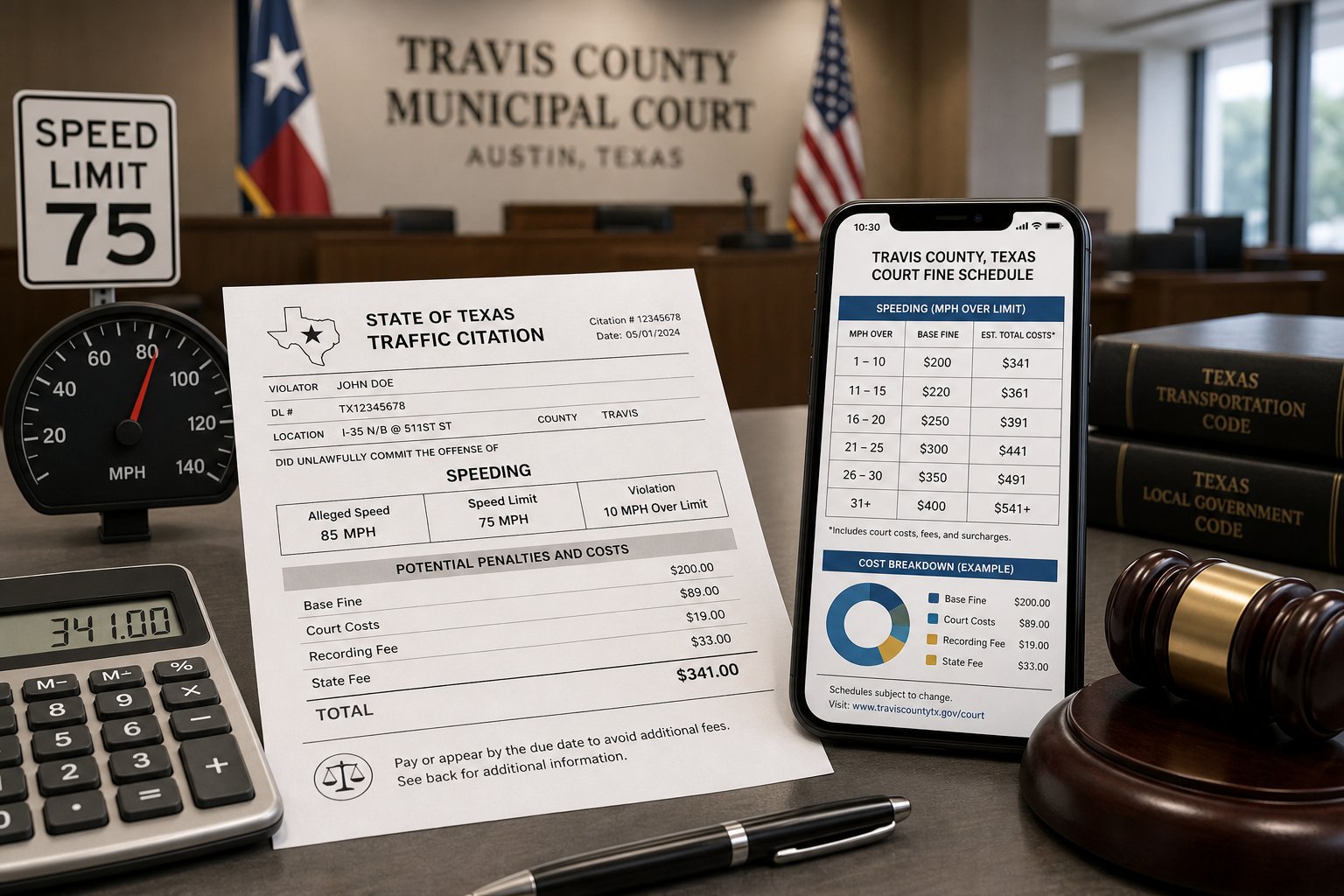
What A Speeding Ticket In Texas Usually Costs
The short answer to how much is a speeding ticket in Texas is this: most routine tickets land in the $150 to $300 range once court costs are included. But Texas does not use one flat statewide price for every moving violation. Each court can set its own schedule within the law, so the total on your Texas traffic ticket depends a lot on where you got it.
Here are a few real examples that show how much totals can vary:
- Williamson County: 1–10 mph over is $186: 16–20 over is $286: 25+ over is $331.
- Murphy, Texas: 1–10 over is $200: 15–19 over is $300: 20+ over is $325.
- Bexar County: 11–15 over is $215: 21–25 over is $265: 31+ over is $336.
So, if you are asking how much is a speeding ticket in Texas, the honest answer is it depends on the court and the speed listed on the citation. A ticket for a few miles over may stay near the lower end. A higher-speed ticket often climbs fast.
Also, the total amount is not always just a “fine.” Courts usually combine a base fine with court costs and fees. That is why two similar tickets in different counties may not match.
Your best next step is simple: look at the court named on your ticket and check its fine schedule or call the clerk right away.
What Can Make Your Fine Higher
The biggest factor is usually how far over the speed limit the officer says you were driving. Many Texas courts use tiered schedules. As your speed goes up, the total fine also goes up.
A few other things can raise the cost:
- The county or city court handling the case
- Very high speeds, such as 20+ or 25+ over
- Special zones with added penalties
- In some courts, prior violations or facts listed on the citation
This matters because a speeding ticket Texas driver gets in one town may cost much less than a similar ticket in another town. Courts are local, and local schedules differ.
High-speed cases can also limit your options. Some courts do not allow ticket dismissal through a Driver Safety Course or deferred disposition if the speed is too high. That does not mean you should guess. It means you should ask the court directly.
And remember, the price on the ticket is not the only cost. A conviction can affect your insurance impact later, which can end up costing more than the court amount itself.
School Zones, Work Zones, And Other Situations That Increase Penalties
Some places carry much steeper penalties. School zones and construction or work zones are the most common examples.
For example:
- Travis County charges $20 per mph over in a school zone, plus court costs, compared with $10 per mph over in a regular zone.
- Murphy, TX lists school-zone speeding at $264 for 1–10 over, compared with $200 in general areas.
- Williamson County lists some construction-zone tickets with workers present as high as $490, and some are not eligible for driving safety dismissal.
That is why the location matters almost as much as the speed. If your ticket mentions a school zone, work zone, or workers present, read it closely and contact the court.
What To Do After You Get A Speeding Ticket In Texas
First, read the citation and find the appearance date and court name. Then contact that court before the deadline. Do not ignore the ticket, and do not miss a required response.
Most Texas courts give you a few common options:
- Pay the ticket and accept the conviction
- Ask for a court date to contest it
- Request deferred disposition
- Request a Driver Safety Course (DSC) for dismissal, if you qualify
The DSC and a defensive driving course are the same thing in this context: a TDLR-approved 6-hour course. It is approved by the Texas Department of Licensing and Regulation, not by Texas DPS or TxDMV. Texas DPS handles driver licenses and records, while TxDMV handles vehicle registration. You can review license-related information at Texas DPS.
Timing matters a lot here. If you want to use the DSC for ticket dismissal, you must ask the court before the appearance date listed on the citation. That deadline is critical.
You may also need to show proof that you are eligible, such as a valid driver license and proof of insurance. Courts can have their own forms and fees. So the safest move is to contact the court clerk quickly and ask what is required for your exact ticket.
How To Fight The Ticket, Request Deferred Disposition, Or Take A Defensive Driving Course
You usually have three main paths after a Texas speeding ticket. The right one depends on your speed, your record, and what outcome you want.
Option 1: Pay the ticket. This is the fastest route, but it usually means you accept a conviction. That conviction can appear on your driving record and may affect insurance.
Option 2: Fight the ticket in court. If you think the ticket is wrong, ask for a hearing by the deadline. You might bring:
- Dashcam footage
- GPS or phone location data
- Photos of signs or road conditions
- Witness statements
- Notes about weather, traffic, or visibility
Some drivers challenge radar use, poor signage, or the facts in the citation. Court outcomes vary, so check the process with the court listed on the ticket.
Option 3: Request deferred disposition or a defensive driving course. Deferred disposition is like a probation period. If you meet the court’s terms, the case may be dismissed. Terms often include no new tickets for a set time, and some courts may require a course.
A defensive driving course in Texas is the same as a Driver Safety Course (DSC). Under Texas Code of Criminal Procedure Art. 45.0511, eligible drivers can ask the court for this option before the appearance date. If the court grants it and you finish all steps on time, the ticket can be dismissed instead of recorded as a conviction.
If the court allows a DSC, many busy drivers choose it because it is simple and often keeps the ticket off the record.
When A Driving Safety Course Can Help Dismiss A Texas Speeding Ticket
A Driving Safety Course can help when your ticket is eligible and you ask the court in time. In Texas, this course is also called defensive driving or DSC, and it is the same 6-hour TDLR-approved program.
This option is common because it can lead to ticket dismissal instead of a conviction. But it is not automatic. You must:
- Request it from the court before the appearance date on the citation
- Meet the court’s eligibility rules
- Pay any court-required fees
- Complete the course by the deadline
- Submit the required paperwork, often including the completion certificate and driving record
Texas law sets a minimum course price of $25 plus a $3 materials fee. You can verify approved providers through the Texas Department of Licensing and Regulation.
Some tickets may not qualify. Courts may deny DSC for certain high speeds, and some counties limit it for 25+ mph over or for construction zones with workers present. It is also generally limited to use once every 12 months for an eligible offense.
If your court approves the request, an online option can save time. For example, Driving Logic offers a TDLR-approved Texas course built for busy drivers who want flexible access on any device and quick certificate delivery. If you want this route, contact your court first, then review the Texas course options at Driving Logic.
How A Speeding Ticket Can Affect Your Record, Insurance, And Future Costs
The court fine is only part of the cost. A conviction for a speeding ticket in Texas can affect your driving record and raise what you pay later.
Texas no longer uses the old statewide point system, but convictions still matter. They can appear on your record through Texas DPS, and repeated violations can create bigger problems, including license issues in some cases. You can check official driver record information through Texas DPS.
Insurance is where many drivers feel the real hit. A single ticket may raise premiums by 10% to 15% or more, and some estimates put the average increase at about $533 per year. If that higher rate lasts for a few years, the true cost of one ticket can go well beyond the amount you paid to the court.
Multiple tickets can be worse. Insurers may label you high-risk, which can lead to:
- Higher premiums
- Fewer coverage options
- Loss of discounts
- Non-renewal in some cases
That is why many drivers look at DSC or deferred disposition when they are eligible. Avoiding a conviction may help limit the long-term cost, even if you still pay court fees or course fees upfront.
If you want to keep costs down, do not focus only on the ticket amount. Think about the full picture: the court total, the chance of a conviction, and the possible insurance impact over the next few years.
FAQ
How much is a speeding ticket in Texas?
The total is the state base fine plus county court costs and fees, so it often runs higher than the fine alone and varies by court. The exact amount appears on your citation or from the court.
What are my options after a Texas speeding ticket?
You can pay and accept the conviction, contest it in court, or — if eligible and the court approves — request a Driver Safety Course to dismiss it. Deferred disposition is sometimes available too.
Does a speeding ticket put points on my Texas license?
No. Texas ended its points-based program in 2019. A conviction still appears on your record and can raise insurance costs, but there are no points.
How long does a speeding ticket affect me?
A conviction can influence insurance pricing for about three to five years and remains part of your driving history. Dismissing it through a Driver Safety Course avoids the conviction entirely.
Can I keep the ticket off my record?
Yes, if it is eligible and the court approves a Driver Safety Course. You must request it before the appearance date, then complete the course and submit your certificate with a Type 3A record.
Conclusion
A Texas speeding ticket is really two questions at once: what it costs now, and what it costs later through your record and insurance. The fine is only part of the upfront total, and since Texas has no points, the longer tail is the conviction itself. That is why acting before the appearance date — to contest or to request a Driver Safety Course on an eligible ticket — usually matters more than the sticker price of the fine.
If your ticket is eligible and the court approves it, you can dismiss it with a TDLR-approved Texas Driver Safety Course completed online.
Related Articles
- Texas Speeding Ticket Options: Pay, Contest, or Take Defensive Driving
- How Does a Texas Speeding Ticket Affect Your Car Insurance?
- Texas Speeding Ticket Fines: What Affects the Cost?
- Texas Defensive Driving for Ticket Dismissal: The Complete Guide
Sources
- Texas Code of Criminal Procedure Art. 45.0511
- TDLR — Driver Safety
- Texas DPS — Online Driver Record System
Billy Forte is the owner of Driving Logic, a state-approved driver safety and defensive driving course provider serving Texas and other U.S. states. Driving Logic offers online driver safety, defensive driving, and traffic-ticket courses for drivers handling court, license, and insurance-related requirements.
This article is general information, not legal advice. Texas court rules, TDLR requirements, deadlines, eligibility, and case facts can differ by county and court. Use official Texas court and state sources for current requirements, and consult a qualified Texas attorney for legal guidance specific to your situation.