
Updated June 2026 · Reviewed by Billy Forte
A Texas speeding-ticket fine depends mainly on how far over the limit you were, but the amount you actually pay is the base fine plus county court costs and fees, which differ from court to court. Higher speeds raise the fine, and speeding more than 25 mph over the posted limit is treated more seriously and is generally not eligible for Driver Safety Course dismissal. Because Texas has no points system, the cost beyond the fine shows up in your insurance and record, so check your citation for the charged speed and confirm the total with the court rather than assuming a flat rate.
Applies to Texas. Court rules and deadlines vary by county.
Key Facts
- Speed drives the fine: The base fine rises with how far over the limit you were charged.
- Court costs add up: County court costs and fees are added to the base fine and vary widely by court.
- 25+ over is serious: Speeding more than 25 mph over the limit carries heavier penalties and is generally not DSC-eligible.
- Zones double fines: Active school zones and work zones with workers present can double the fine.
- No points, but lasting cost: Texas has no points; the longer-term cost is insurance and your record.
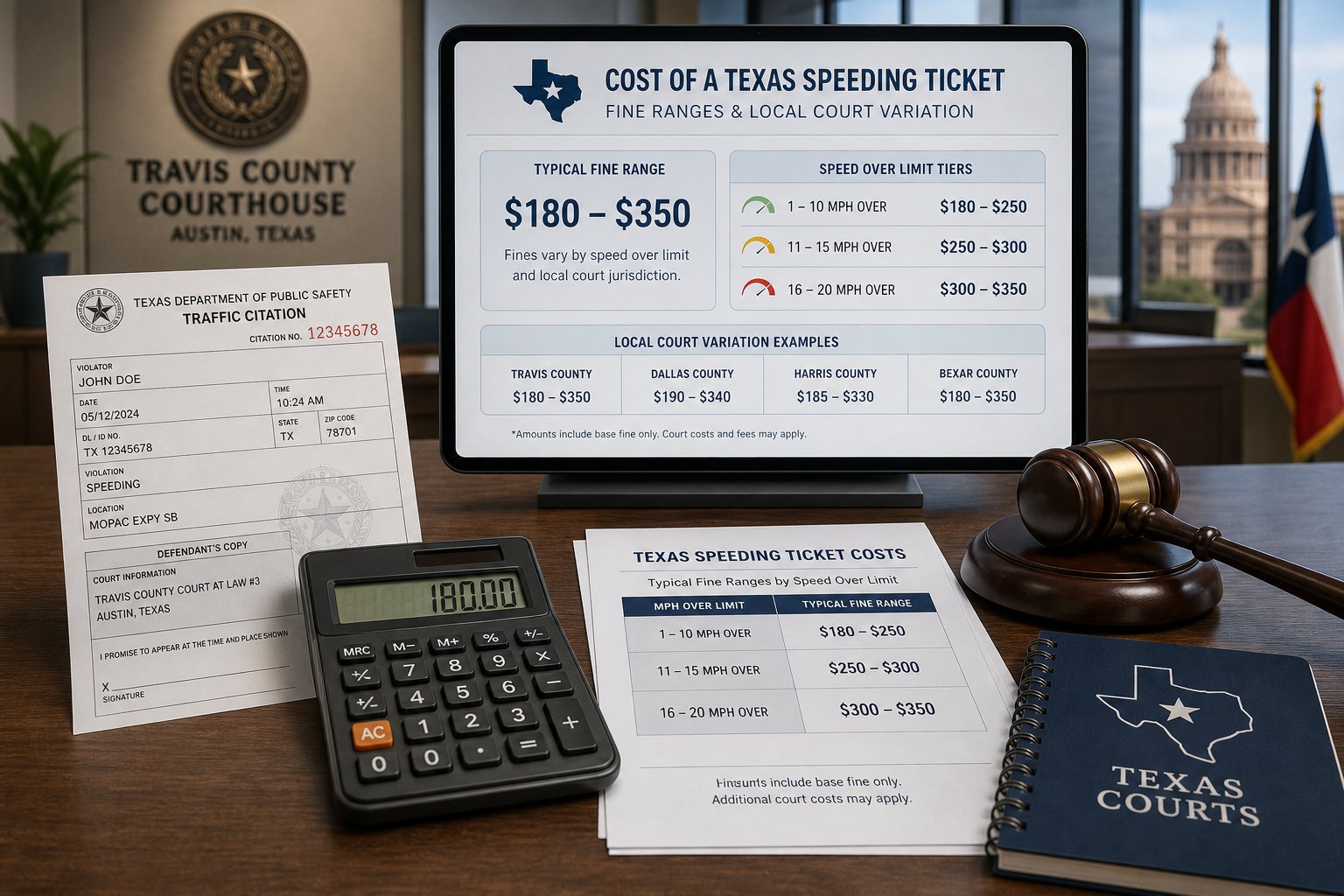
How Much A Texas Speeding Ticket Usually Costs
The short answer is this: most Texas speeding tickets land in the $180 to $350 range once the fine and court costs are added together. But there is no single statewide price chart. Texas traffic tickets are handled by local courts, so the total can change from one city or county to another.
Source-backed examples show how the speed tier affects the bill. In Williamson County, published totals have included:
- 1–10 mph over: $186
- 11–15 mph over: $211
- 16–20 mph over: $286
In Montgomery County JP4, posted amounts have included:
- 1–10 mph over: $200
- 16–20 mph over: $250
- 25–99 mph over: $325
So if you’re asking how much is a 20 over speeding ticket in Texas, a fair source-based estimate is often around $250 to $286, though your court may set a different amount.
That matters because the posted speed over the limit is only part of the math. The court also adds required costs and fees. In many courts, the “fine” you first think about is not the full amount you owe.
If you want to keep a qualifying ticket off your record, one option may be a Driver Safety Course, which is the same thing as a defensive driving course in Texas. It must be a TDLR-approved 6-hour course through the Texas Department of Licensing and Regulation, not Texas DPS or TxDMV. And you must ask the court for permission before the appearance date on your citation. TDLR, Texas DPS, and Texas Code of Criminal Procedure Art. 45.0511.
What Can Increase The Total Cost Beyond The Base Fine
The listed fine is often only the start. Court costs and administrative fees can add about $50 to $150 in many Texas courts. That is why two tickets for the same speed can have different totals.
A few things can push the final amount higher:
- Local court costs
- Administrative fees
- Late fees if you miss a deadline
- Payment plan fees
- Collection fees if the case goes unpaid
- Attorney fees if you hire help
And yes, missing the deadline can make a bad ticket cost more. Courts may add extra charges or send the matter to collections. So do not ignore the citation or court date.
The type of road and the facts on the ticket also matter. A moving violation in a school zone or work zone can carry a higher total than the same speed on a normal roadway. Some courts also treat very high speeds more harshly.
If you plan to ask for DSC dismissal, do that early. Under Texas Code of Criminal Procedure Art. 45.0511, the request must be made before your appearance date, and the court must approve it. Even when a violation seems eligible, not every court must grant DSC in every case. Always check with the specific court first.
If approved, the court may require court fees plus the course cost. The minimum course fee for the class itself is $25 plus a $3 materials fee under Texas law. That can still be much less costly than a conviction that stays on your record.
Insurance, Driving Record, And Other Long-Term Consequences
The ticket price is only the first cost. A speeding conviction can also raise your insurance rate and affect your driving record for years.
A typical moving violation conviction may add 2 points, and more can apply if a crash was involved. While Texas rules have changed over time, insurers still look at your record closely. One speeding ticket may raise premiums by about 10% to 15%, and repeat violations can cost much more over several years.
That is why the real Texas speeding ticket cost can be far more than the court amount. A $200 or $250 ticket may end up costing much more once higher premiums are added in.
Long-term effects can include:
- Higher insurance premiums
- A less clean driving record
- Problems if you get more tickets soon after
- Greater risk of license trouble depending on your history
For many drivers, avoiding a conviction matters more than shaving a few dollars off the fine. If you qualify, DSC or deferred disposition may help keep the case from ending as a final conviction. But approval is up to the court, and you must follow every deadline and filing step.
Texas licenses are handled by Texas DPS, not TDLR. TDLR approves the course provider. That split is important, because people often confuse the agencies. If you need a copy of your driving record for the court, check the Texas DPS site for current record request options.
When School Zones, Work Zones, And Higher Speeds Lead To Bigger Penalties
Some speeding tickets cost much more because the location or speed level makes the case more serious. In Texas, school zones, construction or work zones, and very high speeds often bring higher penalties.
Published court schedules show the jump can be steep. In Williamson County, a construction zone violation with workers present at 21+ mph over has been listed at $490. That is well above the amount for an ordinary speeding ticket.
These cases can also limit your options. Many courts make school zone or work zone speeding ineligible for DSC dismissal. And a key Texas rule matters here: if you were charged with speeding more than 25 mph over the posted limit, you are not eligible for dismissal through a Driver Safety Course. The same is true if you were charged with speeding over 95 mph.
That means the answer to “can I just take defensive driving?” is often no for the highest speed tiers. In Texas, defensive driving and Driver Safety Course (DSC) mean the same TDLR-approved 6-hour program, but that option has clear limits.
Also, higher speeds can make the case more expensive in ways the court total does not show right away. Insurance companies may view extreme speeding as a bigger risk. And if you already have other violations, the added damage can be serious.
So if your ticket involves a school zone, a work zone, 25+ mph over, or 95+ mph, read the citation closely and contact the court fast.
Your Main Options After Getting A Texas Speeding Ticket
After a Texas traffic ticket, you usually have four main paths: pay it, request DSC, ask for deferred disposition, or contest it in court. The best choice depends on your speed, your record, and the court’s rules.
Paying the ticket is the simplest step. But it usually means pleading guilty or no contest, and the speeding conviction may hit your record and insurance.
Deferred disposition is another common option. The court puts you on a probation-like period. If you follow the terms, the ticket may be dismissed at the end. Courts set their own rules for this, so ask what conditions apply.
If the speed and facts fit, DSC may be the most useful option for many drivers. But you must request it before the appearance date on the citation. Waiting too long can take that option away.
If the facts are disputed, you can plead not guilty and contest the ticket. That route may make sense when the alleged speed is high or the long-term cost could be severe.
How Defensive Driving Can Help Dismiss Or Reduce A Ticket
In Texas, a defensive driving course and a Driver Safety Course (DSC) are the same thing: a TDLR-approved 6-hour course. If the court approves your request, completing the course can allow an eligible speeding ticket to be dismissed.
Common limits include:
- More than 25 mph over the limit: not eligible
- Over 95 mph: not eligible
- CDL holders: usually not eligible
- School zone or work zone cases: often not eligible
You may also need to submit a certified driving record and your completion certificate by the court’s deadline. Courts can deny requests even when a case seems to qualify, so confirm first. If you need a flexible option, Driving Logic’s Texas DSC is built for busy drivers and works on most devices.
When It May Make Sense To Contest The Ticket In Court
Contesting the ticket may make sense when the charge is serious enough to create large insurance or record problems. That is especially true for high-speed cases, repeat tickets, or situations where you believe the citation has errors.
Issues that sometimes matter include:
- Mistakes on the ticket
- Questions about radar or laser accuracy
- Sign visibility problems
- Officer training or observation issues
If you face major long-term risk, a traffic attorney may be worth considering. That does not mean you should fight every ticket. But when the cost of a conviction could keep growing for years, it may be smart to look closely at your options.
FAQ
How much is a 20-over speeding ticket in Texas?
The base fine for higher speeds is larger, and county court costs are added on top, so the total varies by court. Check your citation for the charged speed and the court for the exact amount.
What makes a Texas speeding fine higher?
A faster charged speed, active school or work zones, and county court costs and fees all increase the total. Speeding more than 25 mph over is treated most seriously.
Is speeding more than 25 mph over different?
Yes. It carries heavier penalties and is generally not eligible for Driver Safety Course dismissal, so options are more limited. Confirm the exact charge on your citation.
Do points add to the cost?
No. Texas has no points system, so there are no point-based fees. The added long-term cost is typically higher insurance after a conviction.
Conclusion
The fine on a Texas speeding ticket is just the starting figure: the charged speed sets the base, court costs inflate the total, and zones can double it. With no points in Texas, the real multiplier over time is insurance once a conviction lands. Read the charged speed on your citation, confirm the total with the court, and weigh dismissal before assuming the printed fine is all it will cost.
If the ticket is eligible and the court approves, you can avoid the conviction with a TDLR-approved Texas Driver Safety Course online.
Related Articles
- Texas Speeding Ticket: Costs, Record Impact, and What to Know
- Texas Speeding Ticket Total Cost: What Affects the Amount?
- Texas School Zone and Work Zone Speeding Tickets: Higher Fines
- How Does a Texas Speeding Ticket Affect Your Car Insurance?
Sources
- Texas Transportation Code — Speed Restrictions
- TDLR — Driver Safety
- Texas Code of Criminal Procedure Art. 45.0511
Billy Forte is the owner of Driving Logic, a state-approved driver safety and defensive driving course provider serving Texas and other U.S. states. Driving Logic offers online driver safety, defensive driving, and traffic-ticket courses for drivers handling court, license, and insurance-related requirements.
This article is general information, not legal advice. Texas court rules, TDLR requirements, deadlines, eligibility, and case facts can differ by county and court. Use official Texas court and state sources for current requirements, and consult a qualified Texas attorney for legal guidance specific to your situation.