
Updated October 2026 · Reviewed by Billy Forte
Your Texas speeding ticket total cost is the sum of several parts: the fine your court sets, its court costs, two fines fixed by state law, and, on the driving safety course path, a few charges of its own. Each part is set by a different source, which is why no one can quote a statewide total. This guide lists every part with its legal source so you can build your own number with the court’s help.
Key Facts
- Fine: the general range is $1 to $200 when no other penalty applies, with no state speed tiers. See the components.
- State fines: $50 on a guilty or no contest plea, and $3 on a conviction. See the pay path.
- Course path: the course is at least $25, a Type 3A record is $10, and the court fee is up to $10 per eligible charge. See the course path.
- Court costs: every court sets its own. See why there is no total.
- Later costs: insurers may charge more after a ticket, and each sets its own amount. See later costs.
What Goes Into a Texas Speeding Ticket Total Cost
The table lists each part, when it applies, and the law or agency behind it. Amounts marked “varies” come from your court.
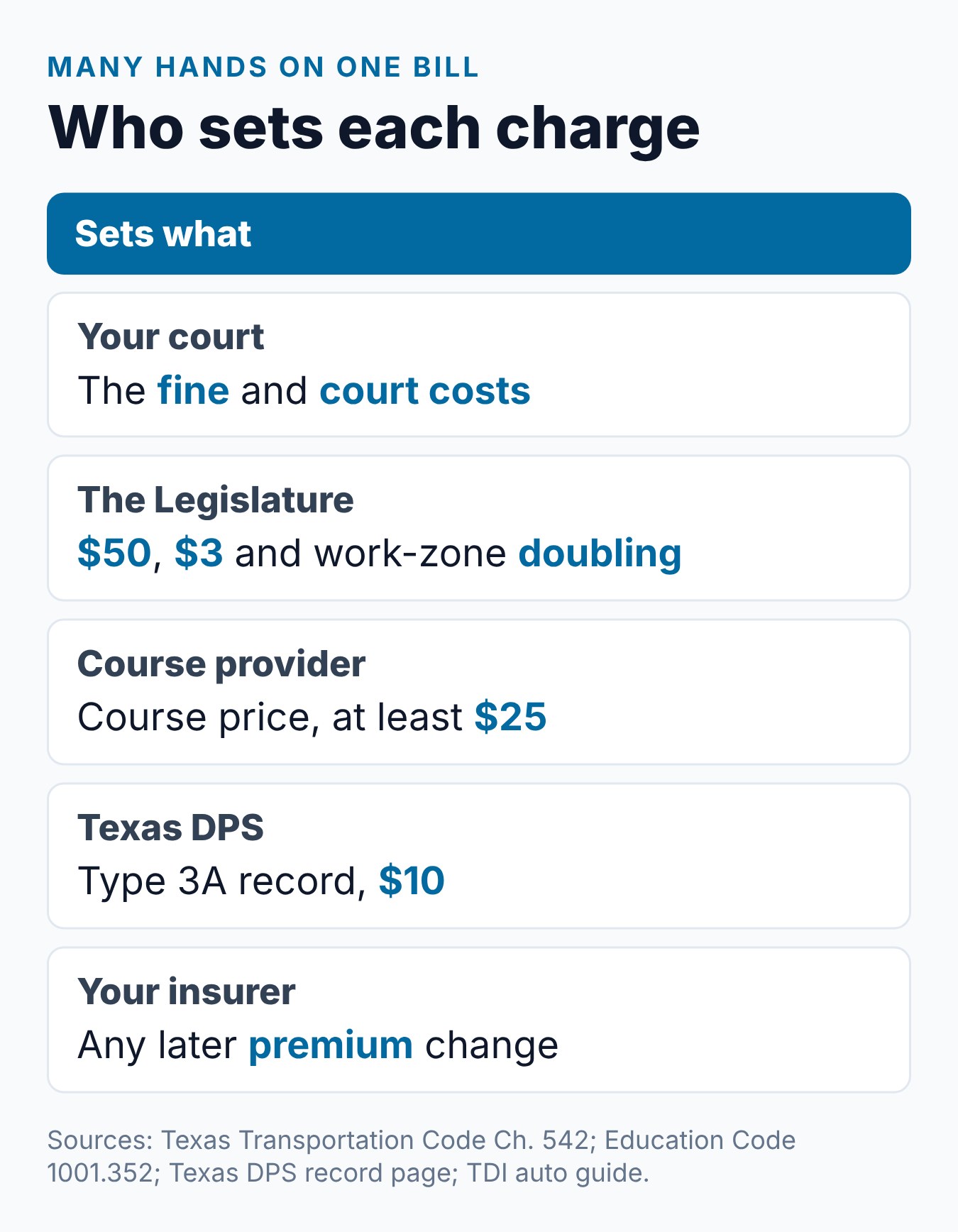
| Part of the total | When it applies | Amount | Set by |
|---|---|---|---|
| Fine | A conviction | $1 to $200 if no other penalty applies | Transp. Code 542.401 |
| Court costs | Set by each court | Varies | Your court |
| Conviction fine | A conviction | $3 | Transp. Code 542.403 |
| State traffic fine | A guilty or no contest plea, or a conviction | $50 | Transp. Code 542.4031 |
| Work-zone doubling | Workers present | Minimum and maximum fines doubled | Transp. Code 542.404 |
| Course price | Driving safety course path | At least $25 | Education Code 1001.352 |
| Court course fee | Course request | Up to $10 per eligible charge | CCP Art. 45A.358 |
| Driving record | If you supply it for the course | $10 for Type 3A | Texas DPS |
| Special expense fee | Deferred disposition | Up to the most the fine could be | CCP Art. 45A.302 |
No single driver pays every line. Which lines apply depends on the path you take and how your case ends.
Why No One Can Quote Your Total
The fine is a range, not a price. Transportation Code Chapter 542 sets $1 to $200 for most rules-of-the-road offenses and lets the court pick the amount. There are no state speed tiers in that rule.
Court costs differ by court as well. Put those two facts together and the total can differ from one court to the next, even for the same speed.
That is why this guide gives no total estimates. Your court is the only source for your figure.
Costs on the Pay Path
Paying is a plea of guilty or no contest, and it ends in a conviction. These parts can apply:
- The fine the court sets within the range.
- Court costs the court charges.
- The $3 fine that Section 542.403 adds on conviction.
- The $50 state traffic fine under Section 542.4031, owed on a guilty or no contest plea or a conviction.
- Doubling of the fine range if the offense was in a work zone with workers present.
A conviction also goes to Texas DPS within 7 days. That record can lead to costs later, covered below.
Costs on the Course Path
The driving safety course path has its own charges. They are set by three different sources.
The Course Price
Education Code Section 1001.352 says a provider “shall charge each student at least $25.” TDLR’s fee notice explains the rule. A former $3 add-on was removed on Sept. 1, 2025. Providers may charge more than $25.
The Court Course Fee
Under Code of Criminal Procedure Chapter 45A, the court may charge a fee of up to $10 for a course request. It is in addition to court costs. There is no refund if you request the course and then do not take it.
The Driving Record
Texas DPS sells the Type 3A record for $10. DPS calls it the only record type that can be used for a defensive driving course. Its ordering page has the details.
Some judges get the record themselves. Then the court may charge a fee equal to the certified record fee plus a state portal fee, instead of asking you for the record.
Several Charges From One Stop
Since Sept. 1, 2025, one course can dismiss each eligible charge from the same criminal transaction. The court may charge its fee for each charge.
Here is the math: with two eligible charges, the court fee can be up to $20. With three, it can be up to $30.
You still take one course for all of them. The course price does not multiply, though the court fee can.
A Late or Repeat Request
If you ask after the answer date, or took a course in the past 12 months, the course is up to the court. If the court allows it on that basis, it may charge a fine up to the maximum for the offense.
Costs on the Deferred Path
Deferred disposition is up to the judge. You plead guilty or no contest and pay all court costs.
The judge may also charge a “special expense fee” of up to the most the fine could be. That fee replaced the deferral “fine” on Dec. 4, 2025.
The fee is credited toward any fine imposed later. The judge may waive it for good cause. If the judge sets a course as a condition, the course price applies too.
Costs on the Contest Path
A not guilty plea leads to a trial. If you are found not guilty, there is no conviction. If you are found guilty, the pay-path parts can apply, including the fine and court costs.
The trial process and its own costs are covered in contesting a Texas speeding ticket in court.
Costs That Can Come Later
Some costs do not show up on the court’s bill. The Texas Department of Insurance says companies “will charge you more if you’ve had accidents or gotten tickets.” Each company sets its own amount, so there is no state figure.
The course path has a protection here. An insurer may not raise a premium or cancel a policy because of a course dismissal. For more, see speeding tickets and insurance.
Build Your Own Total
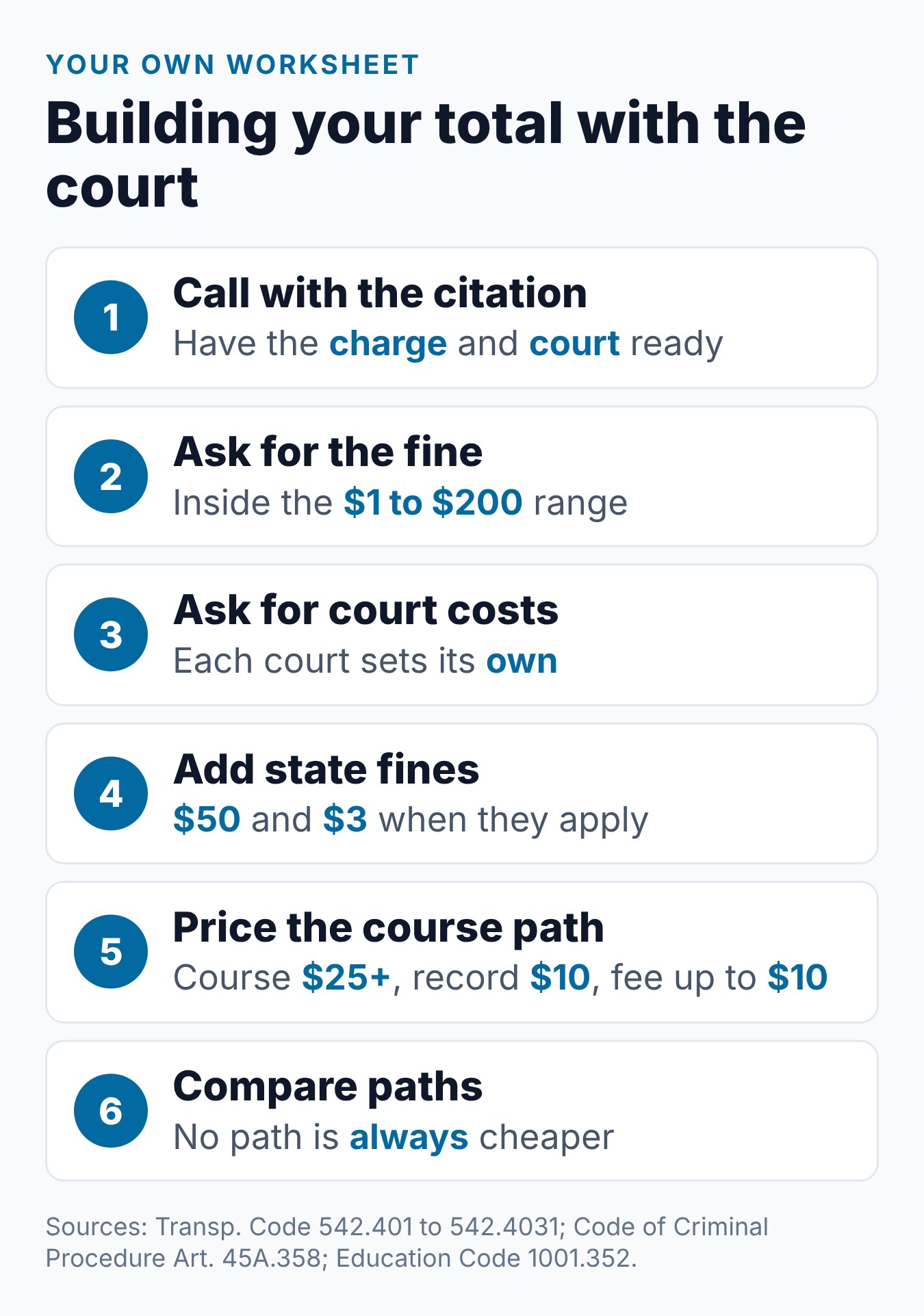
You can turn the table into a worksheet. Call the court with your citation in hand and fill in each line:
- Fine for my charge: ______
- Court costs: ______
- State fines that apply: ______
- Course request fee, if any: ______
- Course price from the provider I pick: ______
- Driving record, if the court wants me to supply it: ______
Add the lines for the path you are weighing. Do the same for a second path if you want to compare. Do not assume one path is always cheaper; the numbers depend on your court.
Time Costs Money Too
Some costs are measured in hours and days. They do not show up on a bill, but they shape your plan.
- Course length. The rules set a minimum of 360 minutes, with at least 300 minutes of instruction, under 16 TAC 84.504.
- The 90-day window. After the plea, you have 90 days to finish the course and turn in your papers.
- Record delivery. DPS says online orders can be printed or emailed right away, while mail orders take about three weeks.
Plan around these when you compare paths. A missed deadline can cost far more than any fee.
Paying Over Time
A large total does not always have to be paid at once. Chapter 45A lets a judge allow payments over time, community service, or a waiver in some cases when a person cannot pay right away.
Tell the court early if you expect trouble. For the details, see what affects a Texas speeding fine.
Questions to Ask About Costs
Use these when you call the court:
- Does the amount you quoted include court costs?
- Which state fines are part of that amount?
- What is the fee to request the driving safety course?
- Will the court want a Type 3A record from me, or get the record itself?
- Is the course fee charged for each charge on my citation?
Note each answer and the date you got it.
What We Found on the Official Pages
On the TDLR news page we checked on October 26, 2026, the August 2025 notice explained the $25 minimum course price. The Education Code text showed the HB 3012 history note for that change.
On the DPS record ordering page, Type 3A was listed at $10. The page described it as the only record type that can be used for a defensive driving course.
Common Mistakes to Avoid
Each point comes from a rule above:
- Treating the fine as the total. Court costs and state fines come on top.
- Trusting a speed-tier chart. State law sets a range, not tiers.
- Counting the old $3 add-on. It was repealed on Sept. 1, 2025.
- Assuming a refund. The court fee is not refunded if you request the course and skip it.
- Forgetting multiple charges. The court may charge its course fee for each eligible charge.
How Requirements Can Vary
The driving safety course rules come from Texas law and TDLR and apply statewide. Each justice or municipal court still sets its own fees, filing steps and contact methods, and the facts of your citation decide which options you have.
Laws, fees and court procedures can change. Check your citation, ask the court that handles your case, and use the TDLR and Texas DPS websites for current rules before you act.
Frequently Asked Questions
What makes up the total cost of a Texas speeding ticket?
The fine your court sets, its court costs, and fixed state fines of $50 and $3 when they apply. On the course path, add the course price, the court’s course fee and possibly a $10 driving record.
What are the Texas speeding ticket fees on the course path?
The court may charge up to $10 per eligible charge, plus court costs. The course must cost at least $25. A Type 3A record from DPS is $10 if you supply it.
Is the course path always cheaper than paying?
Not always. The totals depend on your court’s fine and costs. Fill in both paths with your court’s numbers and compare.
Is there still a $3 add-on for the course?
No. That add-on was removed on Sept. 1, 2025. Texas law now says a provider must charge at least $25 for the course.
Does the $50 state traffic fine apply to me?
It applies to a guilty or no contest plea, or a conviction, for a rules-of-the-road offense. Ask your court whether and how it applies in your case.
Why is my bill higher than the fine?
Court costs and fixed state fines are added to the fine. In a work zone with workers present, the fine range is also doubled.
Does the course fee replace court costs?
No. Chapter 45A says the course fees are in addition to court costs and fees set by other laws. Ask the court for both amounts.
Can the court get my driving record for me?
Some judges do. Chapter 45A lets a judge get the record from DPS and charge you a fee equal to the certified record fee plus a state portal fee. Ask your court which way it works.
Conclusion
A Texas speeding ticket total is built from the fine, court costs and state fines, plus course path charges if you take that route. Each piece has its own source, so only your court can give you the full number.
Use the worksheet above when you call. If the course is your path, Driving Logic’s online Texas driving safety course is one option for the course step.
Related Articles
- Texas Speeding Ticket: Costs, Record Impact, and What to Know
- Texas Speeding Ticket Cost: What Affects the Fine
- How Much Is Defensive Driving in Texas? Cost Breakdown
- Texas Speeding Ticket Insurance: What to Know
Sources
- Texas Transportation Code Chapter 542 — Rules of the Road, General Provisions (PDF)
- Texas Code of Criminal Procedure Chapter 45A (PDF)
- Texas Education Code Chapter 1001 — Driver and Traffic Safety Education (PDF)
- TDLR — Driving safety providers must charge students a fee
- Texas DPS — How to Order Your Driver Record
- Texas Department of Insurance — Auto insurance guide
- 16 Tex. Admin. Code § 84.504 — Driving safety course length
Billy Forte is the owner of Driving Logic, a state-approved driver improvement course provider serving Texas and other U.S. states.
This article is general information, not legal advice. Texas traffic and driving safety course rules are set by Texas law, TDLR, Texas DPS and each court, and they can change. Check with the court on your citation and the official TDLR and DPS websites for current requirements, and talk to a Texas lawyer about your specific case.