
Updated June 2026 · Reviewed by Billy Forte
Deferred disposition is a Texas traffic-court option under CCP Art. 45.051 where you plead guilty or no contest, pay a fee, and serve a short probation period (often 90–180 days); if you complete it without a new violation, the citation is dismissed with no conviction recorded. It is different from defensive driving: deferred disposition is a probation period set by the court, while the Driver Safety Course is a six-hour class you complete for dismissal under CCP Art. 45.0511. Ask the court which options your ticket qualifies for before the appearance date, since eligibility, fees, and conditions vary by court and by case.
Applies to Texas. Court rules and deadlines vary by county.
Key Facts
- What it is: A probationary period (often 90–180 days) under CCP Art. 45.051; finish it clean and the citation is dismissed.
- Different from defensive driving: Deferred disposition is court-set probation; the Driver Safety Course is a six-hour class — both can end in dismissal by different paths.
- Plea and fee: You plead guilty or no contest and pay a court-set fee to enter deferred disposition.
- Stay clean to earn dismissal: A new violation during the probation period can void it and lead to a conviction.
- Court decides eligibility: Availability, fees, and conditions vary by court — ask before the appearance date.
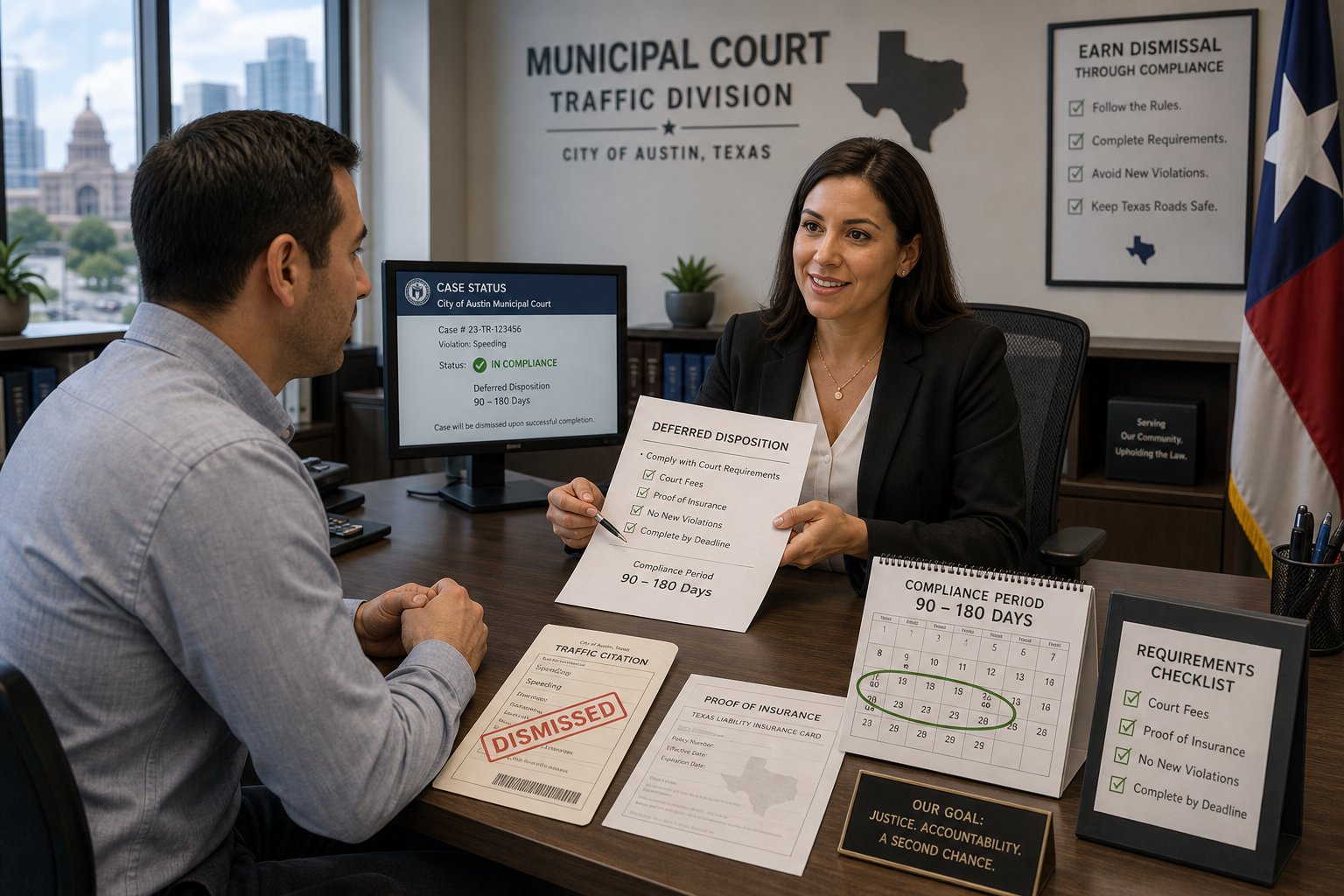
What Deferred Disposition Means In Texas Traffic Court
Deferred disposition means the court delays a final guilty finding on your ticket. If you meet the court’s terms, the speeding citation is dismissed instead of becoming a traffic conviction.
In Texas traffic court, this option is often used for Class C misdemeanors like speeding. You usually enter a plea of guilty or no contest, waive trial, and agree to follow the court’s order. Then the judge or clerk places you on a probation-like period, often around 90 to 180 days, though some courts use shorter terms.
During that time, the court can require several things:
- No new traffic violations
- Payment of court costs and fees
- Proof of insurance
- A class or other task ordered by the court
- Filing documents by a set deadline
If you complete everything, the case is dismissed. That means the ticket is not reported as a conviction on your driving record with Texas DPS.
That is the key idea behind the question, what is deferred disposition texas speeding ticket: it is not automatic forgiveness. It is a court-supervised chance to earn ticket dismissal by following rules for a set period.
And one more point matters. Deferred disposition is different from just paying a ticket. If you simply pay without a dismissal option, that often counts as a conviction. With deferred disposition, the goal is citation dismissal after successful compliance.
Who Can Qualify For Deferred Disposition On A Speeding Ticket
Many drivers can qualify, but not every speeding case will. Texas courts often allow deferred disposition for routine speeding tickets, but each court can apply its own rules.
In general, you may qualify if you:
- Have a Class C traffic offense
- Are willing to plead guilty or no contest
- Waive your right to trial
- Pay the required costs and fees
- Are not already violating another court order
Still, local courts may block or limit this option for serious speeding. Some courts do not allow it for speeds like 25 mph or more over the limit or 90 mph and above. Others may allow it only after a judge reviews your case.
Your driving history can matter too. A court may look more closely if you have recent citations, a commercial license issue, or a prior deferred case still open. That does not always mean you are denied, but it can change the process.
The best approach is to contact the court listed on your ticket before the appearance date. Ask if deferred disposition texas rules in that court apply to your speed and license type.
When A Judge Must Approve The Request
Some requests cannot be handled by a clerk alone. A judge may have to approve deferred disposition if you are under age 25, hold a provisional license, or were charged with very high speeding.
Courts often want a judge involved because those cases may need added conditions. For example, a young driver may be ordered to complete a Driver Safety Course plus to the probation period. That course is the same as a defensive driving course, and in Texas it must be approved by the Texas Department of Licensing and Regulation (TDLR), not TxDPS or TxDMV.
If your case needs a judge, do not wait. Ask the court what filing method they accept and when you must appear.
How Deferred Disposition Differs From Defensive Driving
Deferred disposition and defensive driving are not the same thing. Both can lead to dismissal, but they work in different ways.
First, the terms matter. In Texas, a defensive driving course and a Driver Safety Course (DSC) mean the same 6-hour program. For ticket dismissal, that course must be TDLR-approved.
Here is the basic difference:
- Deferred disposition: You plead guilty or no contest, pay fees, and complete a probation period with conditions.
- Driver Safety Course (DSC): You ask the court for permission, take the 6-hour course, get your completion certificate, and submit required documents.
The DSC has its own rule under Texas Code of Criminal Procedure Art. 45.0511. You must request it before the appearance date on the citation. Courts also commonly require a Type 3A driving record along with the completion certificate.
Deferred disposition usually does not require the 6-hour course unless the court adds that condition. It also depends more on court approval and local practice. By contrast, the DSC has a more specific legal process and eligibility rules.
So when does each make sense?
- DSC may fit if you qualify and would rather complete a course than sit through a probation term.
- Deferred disposition may fit if you are not eligible for the DSC or the court offers deferred terms that are easier for your situation.
- In some cases, a court may order both.
If the court allows the DSC, you can take the Texas course online through Driving Logic, which is built for busy drivers who want a simple path to completion.
How To Request Deferred Disposition In Texas
You usually must request deferred disposition on or before the appearance date on your ticket. If you miss that date, your options may shrink fast.
The exact method depends on the court. Many Texas courts allow requests in one or more of these ways:
- In person
- By mail
- By phone
- Online through the court portal
Most courts will ask you to take these steps:
- Enter a plea of guilty or no contest.
- Waive trial or jury trial.
- Pay court costs and any special fee the court sets.
- Sign or accept the court’s deferred order.
- Follow every condition by the listed deadlines.
Read the court papers with care. The order should state the probation length, the due dates, and what proof you must send in. Some courts set a 90-day deadline for certain documents or tasks, while others use a different schedule.
Do not confuse this process with the DSC request. If you want a Driver Safety Course, you must request that option before the appearance date too, and the court may require a Type 3A driving record and later a completion certificate.
Also, do not send documents to the wrong agency. TxDPS handles driver licenses and driving records. TDLR regulates approved driver safety course providers through tdlr.texas.gov. The court decides whether your ticket can be dismissed.
If you are comparing options, ask the court which dismissal path you may use before you respond.
What Conditions You May Have To Complete Before Dismissal
The court can set several conditions before it dismisses your speeding ticket. The exact list depends on the court, your age, your speed, and your license status.
Common conditions include:
- No new violations during the probation period
- Payment of all fines, costs, or fees
- Proof of financial responsibility
- A Driver Safety Course or other class
- Turning in forms by a strict deadline
For many drivers, the biggest rule is simple: do not get another ticket during the deferred period. Even a new moving violation can put your dismissal at risk.
Some drivers must do more. If you are under 25, the court may require a DSC, even when you are on deferred disposition. If you have a provisional license, the court may also order a DPS exam or another step tied to your license status.
For a DSC requirement, the class must be from a TDLR-approved provider. After you finish, you may need to submit your completion certificate and possibly a Type 3A driving record if the court asks for it.
Alcohol- or drug-related Class C cases can bring extra terms, such as awareness classes or community service, though that depends on the charge and the court.
Keep a copy of everything you send. That includes receipts, certificates, and any online confirmation page. Small paperwork mistakes can become big problems when a dismissal deadline passes.
What Happens If You Miss A Requirement Or Deadline
If you miss a deferred disposition requirement, the court can revoke the deal. That can turn a possible dismissal into a final conviction.
Courts may respond by setting a show cause hearing. At that hearing, you may have to explain why you did not complete a condition on time. If the court does not accept the reason, it can enter a final judgment of guilty.
That often means:
- The speeding conviction is reported to Texas DPS
- The ticket goes on your driving record
- Money already paid may be applied to the fine
- The case is no longer eligible for dismissal under that order
This is why deadlines matter so much. Deferred disposition only works if you finish every step exactly as ordered.
The same idea applies to a Driver Safety Course. If the court approved the DSC and you fail to turn in the completion certificate or Type 3A driving record on time, the court can deny dismissal. And if you never asked for the DSC before the appearance date, the court does not have to let you use that option later.
If you still have time and need a court-approved Texas course, Driving Logic’s online Driver Safety Course is built for busy drivers and works on any device.
FAQ
What is deferred disposition in Texas?
It is a traffic-court probation option under CCP Art. 45.051: you plead guilty or no contest, pay a fee, and if you complete a short probation period without a new violation, the citation is dismissed with no conviction.
How is it different from defensive driving?
Deferred disposition is a court-set probation period, while the Driver Safety Course is a six-hour class you complete. Both can end in dismissal, but they are separate options with different requirements.
Which is better for my ticket?
It depends on the court and your case — some tickets qualify for one, the other, or both. Ask the court before the appearance date which options apply and what each costs.
What happens if I get another ticket during probation?
A new violation during the deferred-disposition period can void it, leading the court to enter a conviction on the original citation. Drive carefully through the full probation window.
Conclusion
Deferred disposition and defensive driving are two roads to the same destination — a dismissed citation with no conviction — but they work differently: one is a probation period, the other a six-hour course. Which one fits depends on your ticket and your court, so ask before the appearance date rather than assuming. Whichever you choose, the dismissal depends on meeting the court’s conditions on time.
If your court points you toward the course route instead of probation, you can complete a TDLR-approved Texas defensive driving course online for an eligible citation.
Related Articles
- Texas Defensive Driving for Ticket Dismissal: The Complete Guide
- What Texas Traffic Violations Qualify for Defensive Driving Dismissal?
- What Happens If You Miss the Texas Defensive Driving Completion Deadline?
- Texas Speeding Ticket Options: Pay, Contest, or Take Defensive Driving
Sources
Billy Forte is the owner of Driving Logic, a state-approved driver safety and defensive driving course provider serving Texas and other U.S. states. Driving Logic offers online driver safety, defensive driving, and traffic-ticket courses for drivers handling court, license, and insurance-related requirements.
This article is general information, not legal advice. Texas court rules, TDLR requirements, deadlines, eligibility, and case facts can differ by county and court. Use official Texas court and state sources for current requirements, and consult a qualified Texas attorney for legal guidance specific to your situation.