
Updated October 2026 · Reviewed by Billy Forte
Texas defensive driving eligible violations are driving offenses under the Texas rules of the road that a justice or municipal court hears. Drivers younger than 25 can use the course for any moving violation in those courts. Some offenses and some drivers are left out, and the full list below comes from Code of Criminal Procedure Arts. 45A.351 to 45A.353.
Key Facts
- Three tests for the offense: the right court, a motor vehicle, and a covered law. See which offenses are covered.
- Under 25: any moving violation in a justice or municipal court can qualify. See the under-25 rule.
- Left out: CDL holders, high speeds, school bus passing, crash duties, serious traffic violations and work zones. See the exclusions.
- Driver conditions: a Texas license, no course in 12 months, and proof of insurance. See driver conditions.
- Court choice: a late or repeat request is up to the judge. See court discretion.
Texas Defensive Driving Eligible Violations: Three Tests
Art. 45A.351 sets three tests. An offense must pass all three to fall under the driving safety course (DSC) rules.
- The court. The case is within the jurisdiction of a justice court or a municipal court.
- The vehicle. The offense involves operating a motor vehicle.
- The law. The offense is defined by Subtitle C of Title 7 of the Transportation Code, by § 472.022, or by § 729.001(a)(3).
Subtitle C is the Texas rules of the road. It holds chapters such as Chapter 545, Operation and Movement of Vehicles. Section 472.022 covers obeying warning signs and barricades.
If the offense happened on a motorcycle, the course is a motorcycle operator training course instead.
Speeding Under the Caps
Speeding is a rules-of-the-road offense, so it can qualify. The law sets two caps. Speeding 25 mph or more over the posted limit does not give you the right, and neither does speeding at 95 mph or more.
Here is a simple example. On a road posted at 60 mph, a ticket for 84 mph is 24 over and can qualify. A ticket for 85 mph is 25 over and does not carry the right.
The Under-25 Rule
Art. 45A.351(b) widens the rule for younger drivers. If you are younger than 25, the course can cover any offense that is classified as a moving violation. The case must still be in a justice or municipal court and involve driving a motor vehicle.
The exclusions below still apply to drivers under 25. A young driver with a CDL, for example, is still left out.
What Is Not Covered
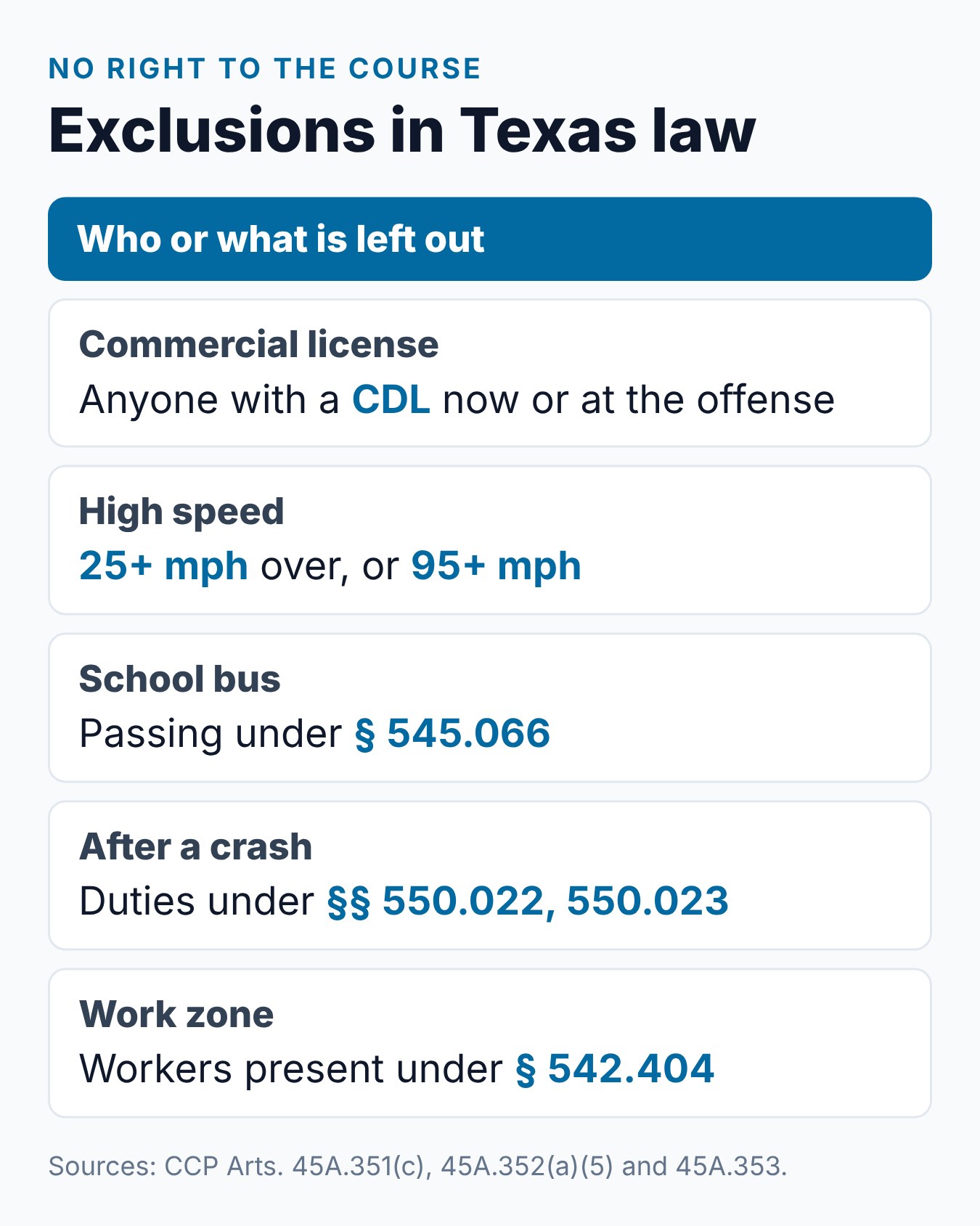
The law removes some drivers and some charges from the right to the course. Each row below names the rule that does it.
| Exclusion | Where it comes from | Notes |
|---|---|---|
| Holds a CDL, or held one at the offense | Art. 45A.351(c) | Applies in any vehicle, even a personal car |
| Speeding 25 mph or more over the limit | Art. 45A.352(a)(5) | Measured against the posted limit |
| Speeding 95 mph or more | Art. 45A.352(a)(5) | Applies on any road |
| Passing a stopped school bus | Art. 45A.353; Transp. Code § 545.066 | No right to the course |
| Crash duties | Art. 45A.353; Transp. Code §§ 550.022, 550.023 | Duties after a collision |
| A serious traffic violation | Art. 45A.353 | Ask the court how it applies the term |
| Work zone with workers present | Art. 45A.353; Transp. Code § 542.404 | Fines double in these zones |
DWI is not on the list because it is not a rules-of-the-road ticket at all. It is a Class B misdemeanor under the Penal Code, with at least 72 hours in jail, so the DSC process does not cover it.
A Note on Serious Traffic Violations
Art. 45A.353 uses the term “serious traffic violation” without defining it there. Texas defines the term in its commercial license law, Transportation Code Chapter 522. We could not confirm how courts apply that definition to drivers without a CDL.
If your ticket could be a serious traffic violation, ask the court before you file your request. Do not assume either way.
Work Zones with Workers Present
Transportation Code § 542.404 doubles the minimum and maximum fine for an offense in a construction or maintenance work zone when workers are present. The citation must say workers were present. For speeding, the zone must have a sign showing the speed limit.
When that section applies, Art. 45A.353 takes away the right to the course. It also blocks deferred disposition for the same offense.
The Driver Conditions
A covered offense is only half the test. Art. 45A.352(a) also looks at you as the driver. All of these must be true:
- License. You hold a Texas driver license or permit. Active-duty U.S. military members, their spouses and dependent children also qualify. See our out-of-state guide.
- No recent course. You did not complete an approved course in the 12 months before the offense date. Our 12-month rule guide explains how that works.
- Insurance. You give the court proof of financial responsibility under Transportation Code Chapter 601.
- Timing. You plead guilty or no contest and ask for the course on or before the answer date.
- No CDL. You do not hold a CDL and did not hold one at the time of the offense. See our CDL guide.
When every condition is met, the law says the judge “shall” require the course. The court cannot turn down a driver who qualifies.
How the Conditions Are Proven
The court checks the driver conditions with papers, not just your word. Under Art. 45A.356, you turn in three items within 90 days of the plea:
- A driving record. It shows you completed no approved course in the 12 months before the offense, unless the judge gets the record from DPS.
- An affidavit. You swear you were not taking a course when you asked, and you finished none in the prior 12 months that is missing from the record.
- The certificate. This proves you finished the course itself.
DPS records can show the fact of a past course, but not the reason. Our Type 3A record guide explains the record that DPS says courts generally want.
What the Court Must Tell You
Art. 45A.353 tells the court to advise a driver charged with a covered offense about the right to the course. Art. 45A.354 adds a notice rule for the citation itself.
The notice to appear must say, in substance, that you may be able to have the charge dismissed by taking a course. It must also say you lose that right if you do not ask on or before your appearance date. If the court did not give this notice, the right continues until it does or the case is decided.
More Than One Charge
Each charge from a stop is checked on its own. Since Sept. 1, 2025, SB 296 lets one course dismiss each charge from the same criminal transaction that would qualify by itself.
A stop can produce a mix. A charge that passes the tests can be dismissed by the course, while an excluded charge in the same stop cannot. That one has to be handled another way.
When the Court Can Still Allow It
Art. 45A.352(c) gives the court some room. Before the case is finally decided, the court may grant a course request even if you asked late or took a course within the past 12 months.
That room is limited. It covers only the timing condition and the 12-month condition, not the Texas license rule. It is also the judge’s choice, so the court may say no.
The Under-25 Rule in Deferred Disposition
Deferred disposition is a separate process, but it has its own course rule for young drivers. Under Art. 45A.304, if a driver younger than 25 gets deferred disposition for a moving violation, the judge must require a driving safety course.
Deferred disposition is not open to CDL holders for traffic offenses other than parking. It is also closed to work-zone offenses with workers present. Our deferred disposition guide covers the rest.
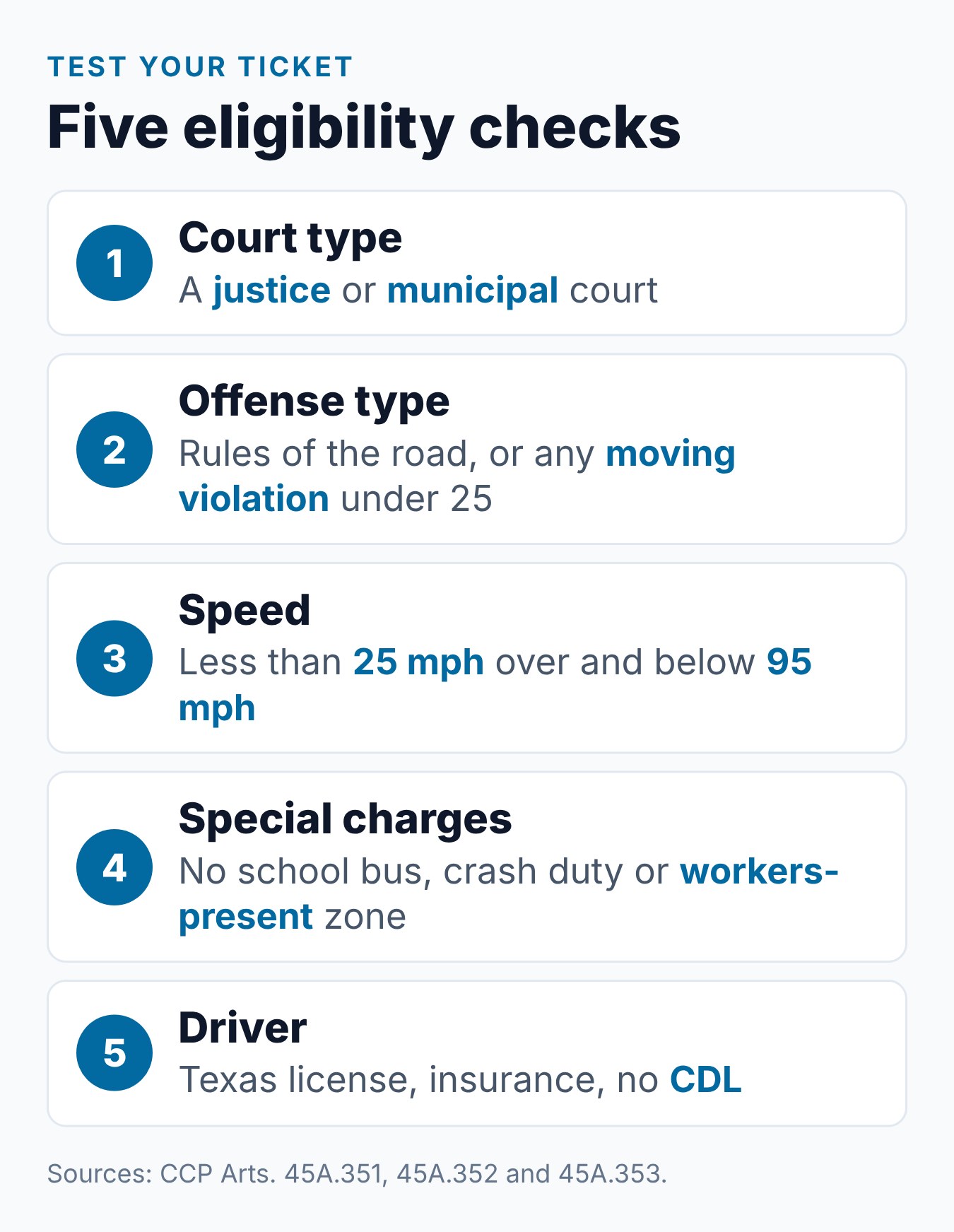
How to Check Your Own Ticket
Work through your citation one item at a time:
- Find the court name. Is it a justice court or a municipal court?
- Find the offense. Is it a rules-of-the-road charge, or any moving violation if you are under 25?
- For speeding, subtract the posted limit from your speed. Is it under 25 over and under 95 mph?
- Look for a work zone, a school bus, or a crash-related charge.
- Check your license, your insurance and the date of any past course.
If any answer is unclear, call the court before the answer date.
What We Found in the Statute
In the Legislature’s compiled text of Chapter 45A we checked on October 26, 2026, Art. 45A.353 told the court to advise a defendant of the right to the course. The same article then listed the charges with no right. Art. 45A.352 carried a 2025 history note for SB 296, while Art. 45A.353 showed no 2025 change.
Common Mistakes to Avoid
Each item below conflicts with Arts. 45A.351 to 45A.353:
- Thinking a CDL matters only in a truck. The exclusion covers any vehicle.
- Reading “over 25” loosely. Exactly 25 mph over is already excluded.
- Assuming every ticket in a stop qualifies. Each charge is tested on its own.
- Ignoring the work-zone note. Workers present on the citation means no right to the course.
- Forgetting the driver tests. A covered offense still needs a Texas license, insurance and no recent course.
For the full dismissal process, see our ticket dismissal guide.
How Requirements Can Vary
The driving safety course rules come from Texas law and TDLR and apply statewide. Each justice or municipal court still sets its own fees, filing steps and contact methods, and the facts of your citation decide which options you have.
Laws, fees and court procedures can change. Check your citation, ask the court that handles your case, and use the TDLR and Texas DPS websites for current rules before you act.
Frequently Asked Questions
Is a speeding ticket eligible for defensive driving in Texas?
Yes, if you were going less than 25 mph over the limit and less than 95 mph. You must also meet the driver conditions, such as a Texas license and no course in the past 12 months.
Can I use defensive driving for a work-zone ticket?
Not as a right when the work-zone fine rule applies with workers present. Ask the court about other options.
Can a CDL holder take defensive driving for a ticket in a personal car?
No. Texas law excludes anyone who holds a CDL, or held one at the time of the offense, in any vehicle.
Is DWI eligible for defensive driving dismissal?
No. DWI is a Class B misdemeanor under the Penal Code, not a rules-of-the-road ticket covered by the DSC process.
I am 22. Does that change anything?
Yes. Drivers younger than 25 can use the course for any moving violation in a justice or municipal court, as long as no exclusion applies.
Does a course I took for an insurance discount count against me?
It may. The 12-month rule refers to “an approved driving safety course,” and the law does not clearly say whether a course taken only for insurance counts. Ask the court before you file.
Can the court refuse if my ticket qualifies?
No. If your offense is covered and you meet every condition, the judge must require the course. The court has a choice only in limited cases, such as a late request.
Conclusion
A ticket qualifies when the court, the vehicle and the offense all pass the tests in Art. 45A.351, and no exclusion applies. You also need a Texas license or military status, proof of insurance, and no course in the 12 months before the offense.
Check your citation against the lists above and confirm with your court. If you qualify, you can take Driving Logic’s online Texas driving safety course.
Related Articles
- Texas Defensive Driving for Ticket Dismissal: The Complete Guide
- Texas CDL Holders and the Driver Safety Course: Why Commercial Drivers Can’t Use It
- Texas Defensive Driving for Out-of-State Drivers: What You Need to Know
- How Often Can You Take the Texas Driver Safety Course for Ticket Dismissal?
Sources
- Texas Code of Criminal Procedure Chapter 45A (PDF)
- Texas Transportation Code Chapter 542 — Rules of the Road, General Provisions (PDF)
- Texas Transportation Code Chapter 545 — Operation and Movement of Vehicles (PDF)
- TDLR — Taking a Driving Safety Course
- Texas SB 296 (2025), enrolled bill (PDF)
Billy Forte is the owner of Driving Logic, a state-approved driver improvement course provider serving Texas and other U.S. states.
This article is general information, not legal advice. Texas traffic and driving safety course rules are set by Texas law, TDLR, Texas DPS and each court, and they can change. Check with the court on your citation and the official TDLR and DPS websites for current requirements, and talk to a Texas lawyer about your specific case.