
Updated October 2026 · Reviewed by Billy Forte
Texas defensive driving out of state driver rules are strict: the right to have a ticket dismissed with a driving safety course (DSC) belongs only to drivers with a Texas license or permit, and to active-duty U.S. military members, their spouses and dependent children. If you hold another state’s license and none of those apply, Texas law does not give you that right. You can still contact the Texas court on or before your answer date and ask which options it offers.
Key Facts
- The license rule: the DSC right needs a Texas license or permit, or active-duty military family status. See the rule.
- Military families: members, spouses and dependent children qualify even with another state’s license. See military families.
- Court discretion: the judge’s power to allow late or repeat requests does not cover the license rule. See court discretion.
- Other options: ask the court about deferred disposition, which is up to the judge. See your options.
- Home state: Texas reports convictions of out-of-state drivers to their home state. See the compact.
The License Rule in Texas Law
The DSC dismissal rules are in Code of Criminal Procedure Chapter 45A. Art. 45A.352(a) lists the conditions that make the course a right. Condition (2) is about your license.
It says the defendant must either:
- Have a Texas driver’s license or permit, or
- Be a member, or the spouse or dependent child of a member, of the U.S. military forces serving on active duty.
If neither part fits you, condition (2) is not met. Without every condition, the judge is not required to allow the course.
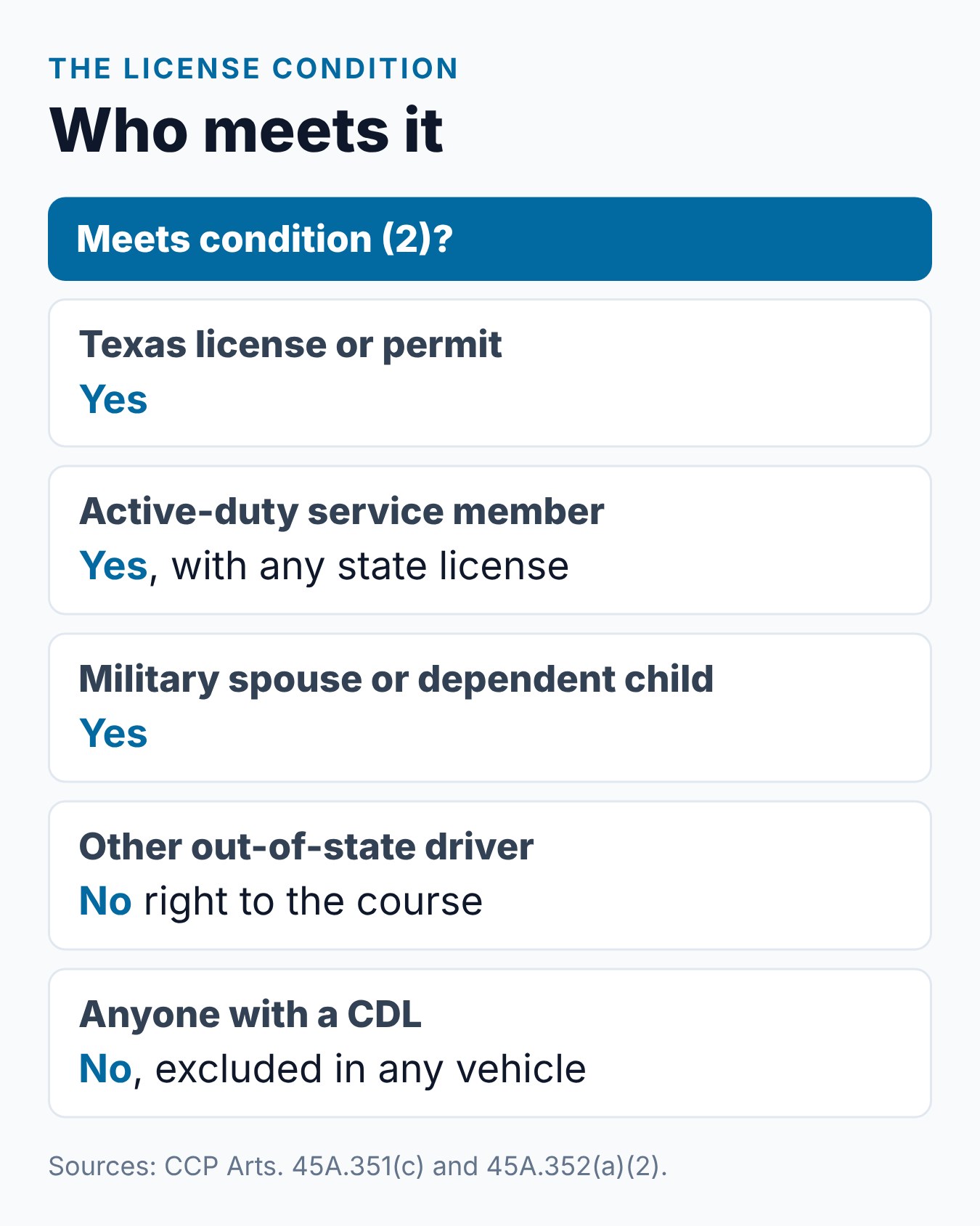
Texas Defensive Driving Out of State Driver Rules by License
The table below applies condition (2) to each kind of driver. The other conditions, such as insurance and the answer date, still apply to everyone.
| Driver | Meets the license condition? | Notes |
|---|---|---|
| Texas driver license holder | Yes | The most direct case |
| Texas learner or other permit holder | Yes | The statute says license or permit |
| Active-duty U.S. military member | Yes | Even with another state’s license |
| Spouse of an active-duty member | Yes | Named in the statute |
| Dependent child of an active-duty member | Yes | Named in the statute |
| Another state’s license, no military tie | No | No right to the course |
| Anyone who holds or held a CDL | No | Excluded by Art. 45A.351(c) in any vehicle |
A Texas license also does not help a CDL holder. Our CDL guide explains that separate exclusion.
Military Families
The military part of the rule reaches beyond Texas license holders. A service member on active duty qualifies, and so do a spouse and a dependent child of that member.
The 12-month rule has a matching version for this group. If a military driver does not have a Texas license, the law asks whether they completed a driving safety course in another state in the 12 months before the offense. A course in that period removes the right.
The statute does not define “active duty” further in that article. If your status is unclear, ask the court before the answer date. Ask, too, what proof of military status the court wants with your request, and have it ready.
The Other Conditions Still Apply
Meeting the license rule is only one step. If you qualify through a Texas license or military status, the rest of Art. 45A.352(a) still applies:
- A timely request. Plead guilty or no contest and ask for the course on or before the answer date.
- No recent course. No approved course in the 12 months before the offense date.
- Proof of insurance. Evidence of financial responsibility under Transportation Code Chapter 601.
- Speed limits. Not speeding 25 mph or more over the limit, or 95 mph or more.
Some offenses are also left out, such as passing a school bus or a work-zone offense with workers present. Our list of eligible violations covers them all.
What the Court’s Discretion Covers
Art. 45A.352(c) gives Texas courts some room. Before the case is finally decided, a court may grant a course request even if conditions (3) or (4) are not met. Those are the 12-month rule and the timely plea and request.
That room does not mention condition (2), the license rule. The law gives the court discretion over late and repeat requests, not over who holds a Texas license.
So an out-of-state driver should not count on the course. Ask the court directly what it allows in your case.
Options to Ask the Court About
Losing the DSC right does not leave you with nothing. Contact the court on or before the answer date and ask what it offers. Choices to ask about include:
- Deferred disposition. A judge may put a fine-only case on hold for up to 180 days and dismiss it if you meet conditions. Art. 45A.301 does not list an out-of-state license as a reason to exclude you. It is still the judge’s choice.
- A plea of not guilty. This leads to a trial in the justice or municipal court.
- Paying the ticket. This is a plea of guilty or no contest, and it ends in a conviction.
Our deferred disposition guide explains that process. A Texas lawyer can help you weigh the plea.
If the Citation Says You Must Appear
If your citation requires you to come to court, you must follow it, even if you live far away. Call the court and ask how to meet that requirement.
Handling a Texas Ticket from Far Away
Living in another state makes deadlines harder to meet in person. Plan around that early.
- Call first. Ask the court how out-of-state drivers can respond and what it accepts by mail or online.
- Use trackable mail. If you mail anything, keep proof of when you sent it.
- Write things down. Note the date, the person you spoke with and what they said.
- Watch the answer date. Every option you have depends on responding in time.
If you are a military family member who qualifies for the course, the law lets you send the request by certified mail, postmarked by the answer date. It also allows a court e-mail or portal if the court has authorized one.
Questions to Ask the Court
A short list keeps the call focused:
- Do I meet the conditions for a driving safety course, given my license?
- Does the court offer deferred disposition for my offense?
- Do I need to appear in person, and on what date?
- How do I send my plea and any papers from out of state?
Your Home State and the Driver License Compact
Texas is a member of the Driver License Compact. Under Transportation Code § 523.004, a member state must report each conviction of an out-of-state driver to the driver’s home state.
The compact is about convictions. What your home state does with that report depends on its own laws, so check with your own licensing agency.
We do not cover other states’ rules here. Our guide to the out-of-state speeding ticket covers the reporting side in more detail.
Taking a Course Anyway
TDLR says on its student page that “anyone can take a driving safety course.” It also says using the course for ticket dismissal has its own legal requirements.
So you can take a Texas course, but that alone does not dismiss a Texas ticket without the court’s approval. If you want a course for an insurance discount, ask your own insurer first. The Texas Department of Insurance says each company decides what discounts to offer.
An Out-of-State Driver’s Checklist
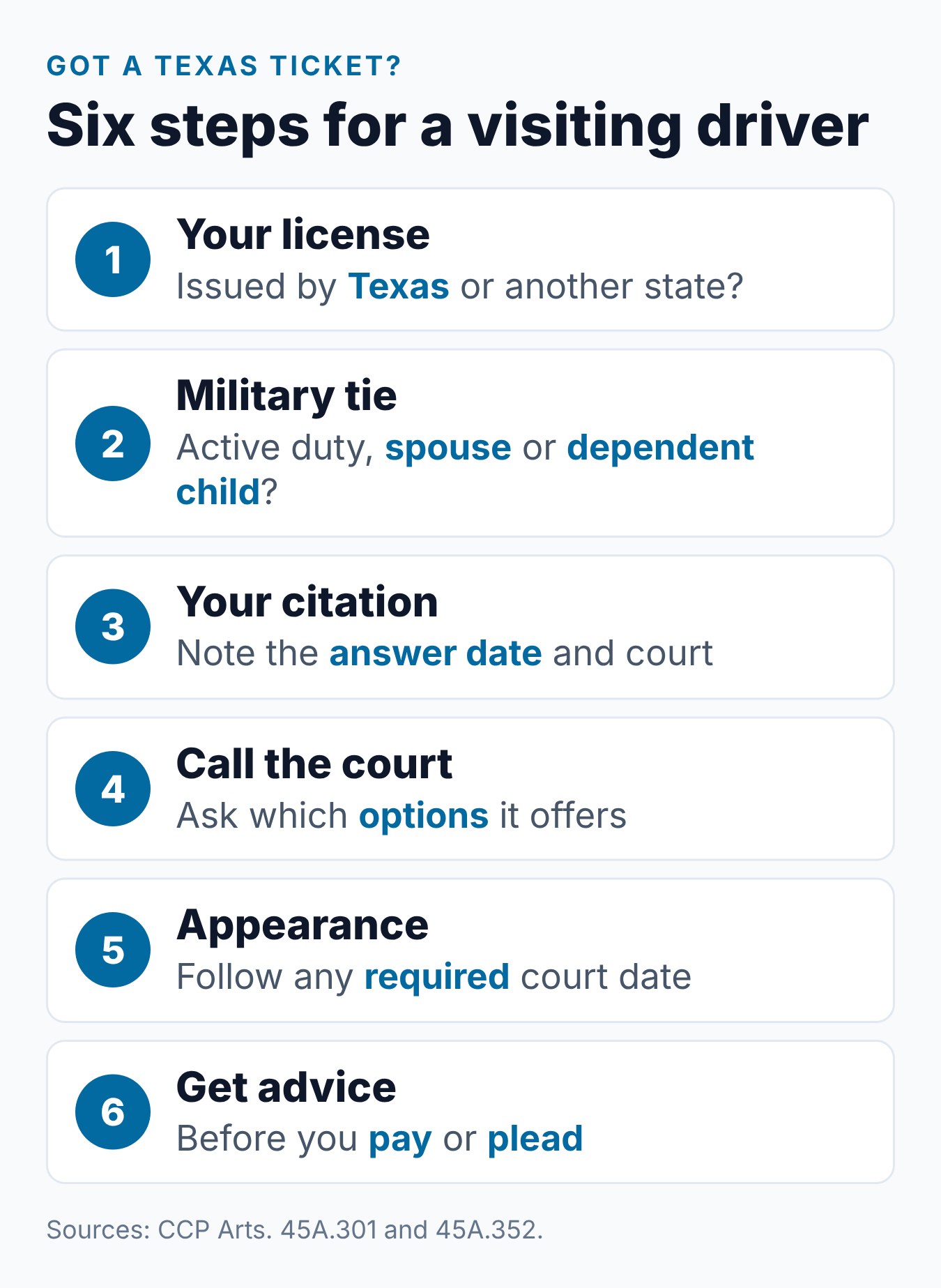
Work through these steps as soon as you get the citation:
- Check your license. Is it from Texas or another state?
- Check your military status, or your spouse’s or parent’s.
- Find the answer date and the court on your citation.
- Call the court and ask which options it offers you.
- Ask whether you must appear in person, and how.
- Talk to a lawyer before you pay or plead, if you are unsure.
What We Found in the Statute
In the Legislature’s compiled text of Chapter 45A we checked on October 26, 2026, Art. 45A.352(a)(2) read that the defendant “has a Texas driver’s license or permit” or “is a member, or the spouse or dependent child of a member, of the United States military forces serving on active duty.”
Subsection (c) of the same article said the court may grant a request “notwithstanding Subsections (a)(3) and (4).” It did not name subsection (a)(2). The article carried a 2025 history note for SB 296, which changed other parts of it.
Common Mistakes to Avoid
Each of these conflicts with Art. 45A.352 or the TDLR rules:
- Enrolling first and asking later. Without a Texas license or military status, the course is not a right.
- Assuming the judge can fix the license gap. The court’s discretion covers late and repeat requests only.
- Missing the answer date. It still matters for every other option.
- Ignoring a required appearance. If the citation says you must appear, you must.
- Forgetting military family status. A spouse or dependent child of an active-duty member qualifies.
For how the process works for drivers who qualify, see our ticket dismissal guide.
How Requirements Can Vary
The driving safety course rules come from Texas law and TDLR and apply statewide. Each justice or municipal court still sets its own fees, filing steps and contact methods, and the facts of your citation decide which options you have.
Laws, fees and court procedures can change. Check your citation, ask the court that handles your case, and use the TDLR and Texas DPS websites for current rules before you act.
Frequently Asked Questions
Can an out-of-state driver take defensive driving for a Texas ticket?
Not as a right, unless you are active-duty military or a spouse or dependent child of a member. Ask the Texas court what options it offers.
I am in the military with a license from another state. Do I qualify?
Yes, if you are serving on active duty. You also need to meet the other conditions, including no course in another state in the prior 12 months.
Can the judge let me take the course anyway?
The law lets a judge allow late or repeat requests, but it does not say the same about the license rule. Ask the court directly.
Will my home state find out about a Texas conviction?
Texas is in the Driver License Compact, which requires member states to report each conviction of an out-of-state driver to the home state.
Is deferred disposition open to out-of-state drivers?
The deferred disposition rules do not list an out-of-state license as an exclusion. It is up to the judge, so ask the court.
Does a Texas learner permit count?
Yes. The law says a Texas driver’s license or permit. The other conditions still apply.
What if I get a Texas license after the ticket?
The statute says the defendant “has” a Texas license or permit and does not name a date for checking it. Ask the court before the answer date how it will treat your case.
Do I have to come back to Texas for court?
If your citation requires a court appearance, you must follow it. Call the court to ask how it handles drivers who live out of state.
Conclusion
Texas gives the DSC right to drivers with a Texas license or permit and to active-duty military families, not to other out-of-state drivers. If you do not fit those groups, call the court before your answer date and ask about options such as deferred disposition.
Texas reports convictions to your home state, so get advice before you pay. If you hold a Texas license or qualify through the military, you can take Driving Logic’s online Texas driving safety course.
Related Articles
- Texas Defensive Driving for Ticket Dismissal: The Complete Guide
- Texas Speeding Ticket Out of State: What Happens Next
- What Is Deferred Disposition in Texas? How It Compares to Defensive Driving
- What Texas Traffic Violations Qualify for Defensive Driving Dismissal?
Sources
- Texas Code of Criminal Procedure Chapter 45A (PDF)
- TDLR — Taking a Driving Safety Course
- Texas Department of Insurance — Auto insurance guide
- Texas SB 296 (2025), enrolled bill (PDF)
Billy Forte is the owner of Driving Logic, a state-approved driver improvement course provider serving Texas and other U.S. states.
This article is general information, not legal advice. Texas traffic and driving safety course rules are set by Texas law, TDLR, Texas DPS and each court, and they can change. Check with the court on your citation and the official TDLR and DPS websites for current requirements, and talk to a Texas lawyer about your specific case.