
Updated June 2026 · Reviewed by Billy Forte
On a Texas learner’s permit, a teen may only drive with a licensed adult 21 or older in the front passenger seat — never alone — and may not use handheld wireless devices while driving. These restrictions are part of the graduated licensing system that eases new drivers into full privileges, and they apply throughout the six-month permit period. Following them matters because the supervised practice during this time is exactly what prepares a teen for the provisional license at 16.
Applies to Texas teen driver education and licensing (ages 14–17). Requirements are set by TDLR (driver education) and the Texas DPS (licensing) and can change.
Key Facts
- Adult supervision required: A licensed adult 21+ must be in the front passenger seat at all times.
- No driving alone: Unsupervised driving is not permitted on a learner’s permit.
- No handheld devices: Using handheld wireless devices while driving is prohibited.
- Throughout the 6 months: Restrictions apply for the full permit-holding period.
- Builds toward provisional: Supervised practice prepares the teen for the provisional license at 16.
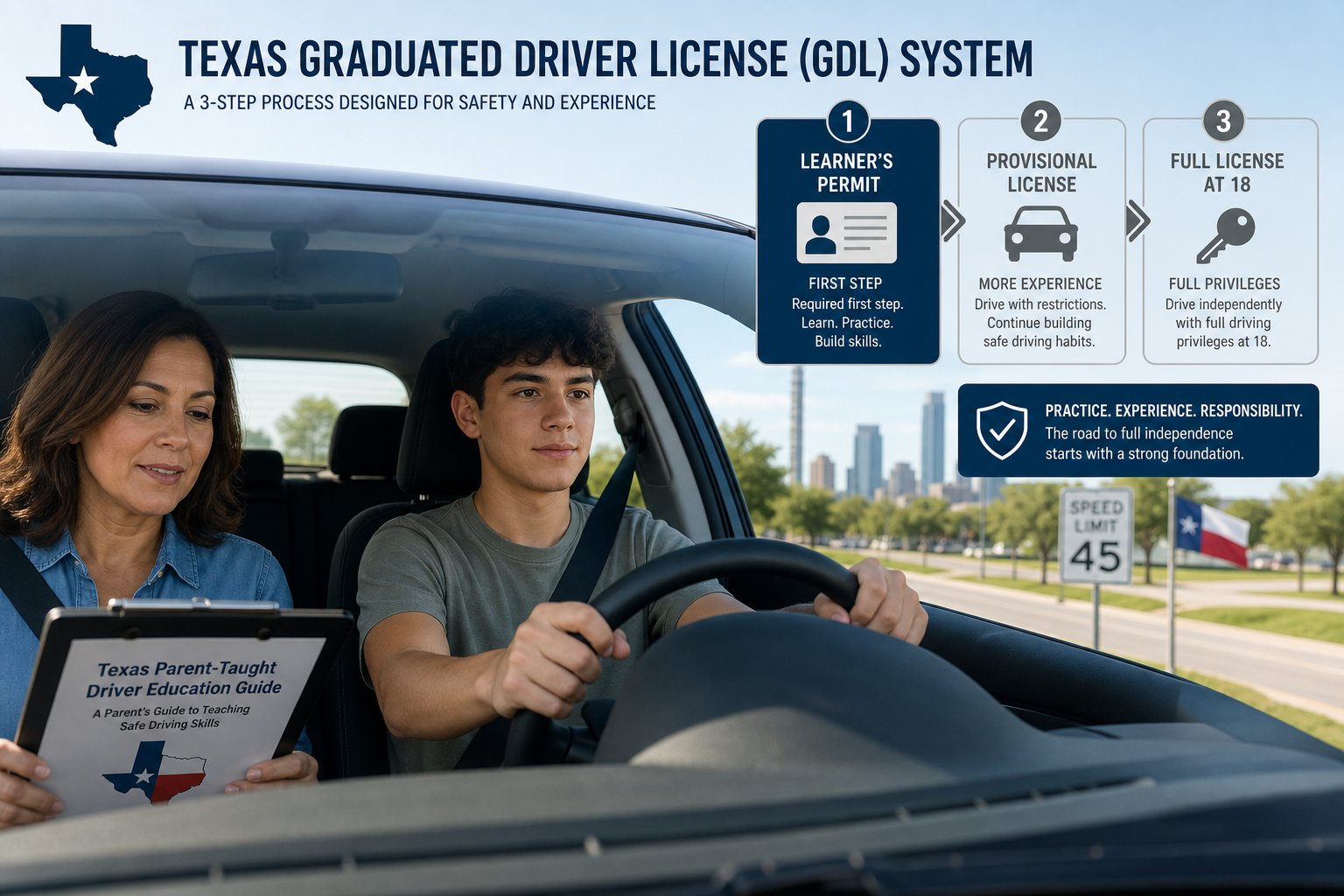
Who Needs A Texas Learner’s Permit And How The Graduated Licensing System Works
If you are 15 to 17 years old and want to start driving in Texas, you need a learner’s permit first. Texas also calls it a learner license or instruction permit. It is the first step in the state’s Graduated Driver License (GDL) system.
The GDL system gives teens more driving freedom in stages. That helps new drivers build skill before they drive alone. In simple terms, the path looks like this:
- Learner’s permit: supervised driving only
- Provisional license: limited solo driving
- Full license at 18: regular adult license rules
You can start a teen course at age 14, but you must be at least 15 to get the permit. And you must keep that permit for a minimum 6-month holding period before you can move up.
Texas uses two main agencies here. The Texas Department of Licensing and Regulation (TDLR) approves driver education providers and course types. The Texas DPS (TxDPS) handles permits, road tests, and license issuance.
One thing trips people up a lot: PTDE and TDE are for teens under 18. PTDE means Parent Taught Drivers Ed. Adult Driver Education, or ADE, is separate and for adults 18 and older. They are not the same program.
So if your teen is just starting, the learner’s permit stage is not optional. It is the supervised practice stage Texas requires before a provisional license.
What You Need Before You Can Get A Texas Learner’s Permit
Before Texas DPS will issue a learner’s permit, you need to finish a few steps first. The big one is teen driver education. If you use the concurrent method, you must complete at least the first 6 hours before applying.
That first part leads to the DE-964E. This is the partial completion certificate used to get the learner’s permit. Later, after finishing the full teen course, you get the DE-964, which is used for the provisional license.
You may also choose PTDE. If you do, the PTDE Program Guide must be ordered from TDLR first. The packet costs $20, and as of January 2026, TDLR sends it by email only.
You will usually need:
- Proof of identity
- Proof of lawful presence
- Social Security number
- Texas residency documents
- Parent or guardian consent
- A completed DL-14A
- School proof, such as a VOE or diploma/GED
The school document matters. A Verification of Enrollment must be current, and students generally must meet attendance rules.
You also need to pass the vision test and the knowledge test, unless your approved driver education provider handles the written exam as part of the course. Then you can book a DPS appointment and bring your documents.
For many families, an online teen course can make this easier. If you want a flexible option, Driving Logic’s Texas PTDE/TDE course is built for busy schedules and works on your device at your pace.
The Main Texas Learner’s Permit Restrictions You Must Follow
The core texas learners permit restrictions are actually pretty clear. If you have a Texas learner’s permit, you must follow these rules every time you drive:
- A licensed driver age 21 or older must sit in the front passenger seat
- You cannot drive alone under any circumstances
- You cannot use a handheld mobile device while driving, except in an emergency
- You must obey all traffic laws
That first rule is the big one. The adult next to you must have a valid driver’s license. It is not enough for that person to simply be over 21. They must be legally licensed to drive.
The front-seat part matters too. The adult must be in the front passenger seat, not in the back seat and not in another car.
Texas families sometimes ask about curfews or extra permit passenger rules. For the learner’s permit stage, Texas DPS focuses on the supervision rule, the phone rule, and general traffic law compliance. So the main point is simple: the permit is for supervised practice only.
If you break these texas learners permit rules, you can face citations, delays, and trouble moving to the next step. Driving without the required adult can also create problems with your licensing timeline. These restrictions stay in place until you qualify for a provisional license.
Supervised Driving Rules, Practice Hours, And Passenger Limits
A Texas learner’s permit is meant for practice, not freedom. You drive to build skill with a qualified adult beside you. That means the supervision rule applies on short trips, long trips, daytime drives, and night practice.
Texas also requires at least 30 hours of supervised driving, and 10 of those hours must be at night. These hours are part of your path to the provisional license. Keep a careful log, because missing hours can slow everything down.
Your supervising adult should be:
- At least 21 years old
- Properly licensed
- Seated in the front passenger seat
- Focused enough to help you drive safely
Texas DPS does not set a special statewide passenger limit for the learner’s permit stage beyond the supervision rule. Still, many families limit extra passengers because they can distract new drivers. Honestly, that is often a smart move.
Night driving practice matters because it is harder. Glare, lower visibility, and driver fatigue can make simple tasks feel less simple. Try to practice in a range of conditions, but do it gradually.
And remember, ITTD is separate. Impact Texas Teen Drivers (ITTD) is a free, 2-hour TxDPS course. It is not the same thing as PTDE or a teen driver education course itself. Families sometimes mix those up, and that can cause delays later.
What Changes When You Move From A Learner’s Permit To A Provisional License
When you move from a learner’s permit to a provisional license, the biggest change is simple: you may drive alone. But you do not get full adult driving rights yet.
To qualify, you must usually:
- Be at least 16
- Hold the permit for at least 6 months
- Finish driver education
- Complete the required supervised hours
- Pass the needed tests with Texas DPS
- Bring the correct records, including the DE-964 full completion certificate
The provisional license still has limits. In general, you cannot drive between midnight and 5 a.m. unless an exception applies. You also cannot drive with more than one passenger under 21 who is not a family member. And if you are under 18, you still cannot use a wireless device while driving.
That means the learner’s permit and provisional license are very different stages. With the permit, there is no solo driving at all. With the provisional license, solo driving is allowed, but only within the teen-license limits.
If your permit gets suspended, that can affect your timeline. In some cases, the 6-month holding period can be extended. So it pays to stay careful during the permit stage.
Common Mistakes That Can Delay Your License Or Lead To Penalties
A lot of permit problems come from small mistakes. Not big drama. Just missing papers, wrong timing, or skipped steps.
One common issue is showing up without the right school record. A VOE does not last forever. It has a limited valid period, so check the date before your DPS appointment.
Other common mistakes include:
- Not finishing the first required driver ed hours before applying
- Bringing the wrong certificate
- Forgetting parent consent forms
- Not logging all 30 practice hours, including 10 at night
- Trying to apply before the full 6-month holding period ends
Phone use is another problem. Texas is strict here for teen drivers. If you use a handheld device while driving, except in an emergency, you can face penalties and possible delays.
The most serious mistake is driving without proper supervision. If you drive without a licensed adult age 21 or older in the front passenger seat, you are violating your permit rules. That can lead to citations and make the licensing process harder.
Also, avoid saying “Texas DMV” when you look for forms or rules. In Texas, the agencies are TDLR and TxDPS. Using the right source helps you avoid bad information.
How To Prepare For The Permit Test And Driver Education Requirements
The best way to prepare is to keep it simple and steady. Start with the Texas Driver Handbook from TxDPS and study the basics well. Focus on signs, lane rules, right of way, speed laws, and safe following distance.
Good prep steps include:
- Read the handbook in short sessions
- Take online practice tests
- Review missed questions
- Study road signs until they feel easy
- Bring glasses or contacts if you use them
- Get enough sleep before your test
If you are under 18, make sure you are in the correct type of course. Teen Driver Education is for teens. PTDE is one teen option, where a parent teaches the course. ADE is only for adults 18 and older.
Also keep your certificates straight:
- DE-964E = partial completion for the learner’s permit
- DE-964 = full completion for the provisional license
- ITTD = free 2-hour course required later, separate from teen driver ed
If you want a course that fits around school, work, and family time, take a look at Driving Logic’s Texas PTDE/TDE option. It gives busy families a flexible way to complete the state-required teen coursework before the next TxDPS step.
FAQ
What are the Texas learner’s permit restrictions?
A licensed adult 21 or older must be in the front passenger seat at all times, the teen cannot drive alone, and handheld wireless devices are prohibited while driving.
Can a teen with a permit drive alone?
No. A learner’s permit is for supervised driving only, with a licensed adult 21+ in the front passenger seat. Driving alone is not allowed until the provisional license.
Who can supervise a permit holder?
A licensed driver who is at least 21 and seated in the front passenger seat. They supervise all driving during the permit period.
What changes at the provisional license?
At 16, after the 6-month hold, the provisional license allows unsupervised driving but adds its own restrictions (no late-night driving except for work/school/emergencies, a passenger limit, and no devices).
Conclusion
The permit restrictions all point the same direction: supervised, distraction-free practice that builds real experience before a teen drives alone. The core rule — a licensed adult 21+ in the front seat, every time — is simple to follow and is the whole purpose of the permit stage. Treat the six months as practice time, and the transition to a provisional license is a natural next step.
The permit starts with Module 1 of a TDLR-approved Texas parent-taught driver education course online, which issues the DE-964E.
Related Articles
- Texas Learner’s Permit: How to Get It, What You Need, and What It Allows
- How Long Do You Need to Hold a Texas Learner’s Permit Before Getting Your License?
- Texas Learner’s Permit vs Driver’s License: What’s the Difference?
- How to Get a Texas Learner’s Permit at 15: Step-by-Step Guide
Sources
Billy Forte is the owner of Driving Logic, a TDLR-approved Texas driver education provider. Driving Logic offers the online Texas parent-taught and teen driver education course that helps Texas teens complete the 32-hour classroom requirement and work toward a learner’s permit and provisional license.
This article is general information about Texas teen driver education and licensing, not legal advice. Requirements, fees, and procedures are set by TDLR and the Texas DPS and can change, so confirm current details with official Texas sources before you enroll or visit a DPS office.