
Updated June 2026 · Reviewed by Billy Forte
A Texas learner’s permit allows a teen 15+ to drive only with a licensed adult 21 or older in the front seat, while a provisional license — available at 16 after a six-month permit hold — allows unsupervised driving with graduated-licensing restrictions. The permit is the supervised-practice stage; the provisional license is the first stage of independent driving. Knowing how teens move from one to the other (and how adults 18+ skip the permit entirely) clears up most of the confusion families have.
Applies to Texas teen driver education and licensing (ages 14–17). Requirements are set by TDLR (driver education) and the Texas DPS (licensing) and can change.
Key Facts
- Learner’s permit: Supervised driving only, with a licensed adult 21+ in the front seat; available at 15.
- Provisional license: Unsupervised driving with restrictions; available at 16 after the 6-month hold.
- Provisional restrictions: No late-night driving (except work/school/medical emergency), a passenger limit, and no devices.
- Teens move up in stages: Permit at 15 → 6-month hold → provisional at 16.
- Adults differ: Adults 18+ do not need a learner’s permit and follow the adult licensing path instead.
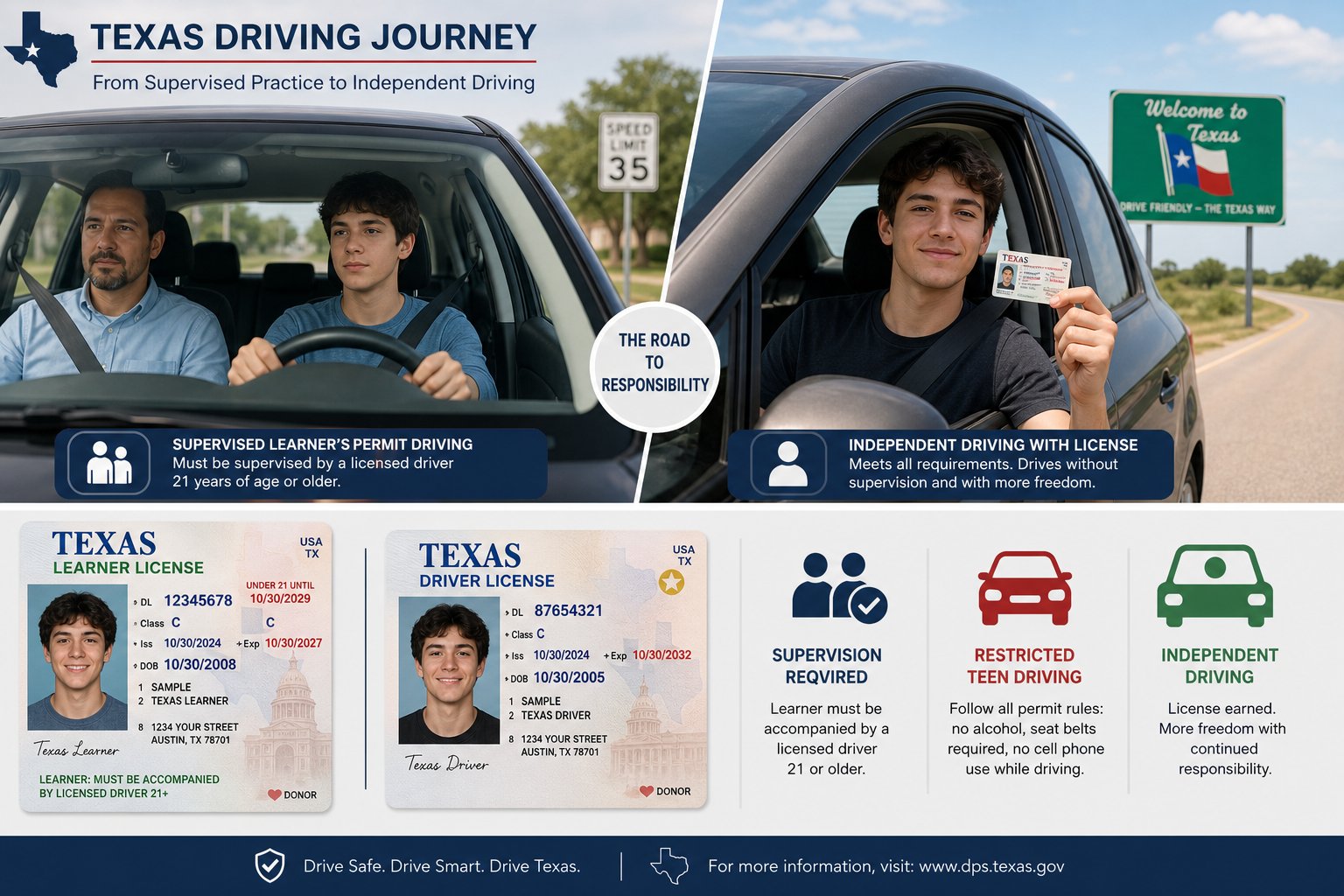
What A Texas Learner’s Permit And A Texas Driver’s License Actually Mean
A Texas learner’s permit, also called an instruction permit or learner license, is a practice card. It does not give you full driving freedom. If you are a teen, you may drive only when a licensed adult age 21 or older sits in the front passenger seat and watches you.
That is the biggest difference in the texas learners permit vs driver’s license question. A permit is for supervised practice. A driver’s license is for driving on your own.
For teens under 18, that first license is usually a provisional license, not full unrestricted driving. You can drive alone, but Texas still places limits on your driving because you are in the Graduated Driver License system.
People also ask, what does a Texas learners permit look like? It looks similar to a regular Texas credential because it is issued by Texas DPS. The exact design can change, but the permit shows that it is a learner license rather than a full license.
The permit and license also serve different stages:
- Learner’s permit: supervised driving only
- Provisional license: independent driving with teen limits
- Adult license: independent driving without teen provisional rules
A simple way to think about it: the permit helps you learn, and the license shows Texas has allowed you to drive with fewer restrictions.
Who Can Get Each One In Texas
In Texas, teens can begin driver education at age 14, but they must be at least 15 to get a learner’s permit. That permit is mainly for drivers ages 15 to 17 who are working through teen driver education.
To get the permit, a teen must have started an approved course. That could be a licensed teen course or PTDE (Parent Taught Drivers Ed). PTDE is only for teens under 18. It is not the same as ADE, which is the separate adult course for ages 18 to 24.
A Texas driver’s license depends on your age:
- Ages 16 to 17: you may get a provisional license if you meet teen requirements
- Ages 18 to 24: you may go for an adult license after adult education and testing
- Age 25 and older: you may apply for a license without a required adult course
Adults can sometimes get a permit for extra practice before the road test, but the common teen path is different. Teen drivers usually move step by step from permit to provisional license.
For teens, the timing matters a lot. You must hold the learner’s permit for a minimum 6-month holding period before you can move up. And even if six months have passed, you still must be at least 16 to apply for the provisional license.
Driver Education And Testing Requirements
Texas uses different education rules for teens and adults. The agencies also have different jobs. The Texas Department of Licensing and Regulation approves courses. TxDPS issues permits and licenses.
Teens under 18
Teens must complete a state-approved teen driver education program. If you use PTDE, you first need the PTDE Program Guide from TDLR. As of January 2026, that packet costs $20 and is delivered by email only.
For the learner’s permit, teens usually need the DE-964E, which proves partial completion of driver education, often after Module 1. For the provisional license, teens need the DE-964, which proves full completion.
Teens also must complete:
- driver education lessons
- 30 hours of behind-the-wheel practice
- 10 hours at night
- the free 2-hour Impact Texas Teen Drivers course
- a road test
ITTD is separate from PTDE or TDE. It is not your main driver ed course.
Adults 18–24 and 25+
Adults ages 18 to 24 must take ADE, the 6-hour adult driver education course. That course is separate from teen PTDE or TDE. Adults in this age group also complete the Texas impact course tied to adult licensing requirements before testing.
Adults 25+ do not have a required driver education course, but they still must meet TxDPS testing and document rules.
Documents And Application Steps To Get Started
To start the process, you usually need a DPS appointment with TxDPS. Do not look for the “Texas DMV.” Texas licensing is handled by TxDPS.
For a teen learner’s permit, the process often includes these steps:
- Complete the required early part of driver education
- Gather your identity and residency records
- Complete the application form used by TxDPS
- Bring a parent or guardian if required
- Pass a vision test and any required knowledge testing
- Submit your driver education proof, such as DE-964E
You may also need documents for:
- identity
- Social Security number
- Texas residency
- lawful presence or citizenship
- school enrollment or a high school record, when required
When you are ready for the provisional license, you return with updated records. At that stage, teens usually bring the DE-964 for full course completion and proof of ITTD completion before the road test.
What does a Texas learners permit look like at the office? It is a Texas-issued credential with your personal details and permit status, and it is different from a full license in legal use even if the card style looks similar.
Before your appointment, check the current list directly on TxDPS because document rules can change.
Restrictions That Apply Before You Have Full Driving Privileges
A learner’s permit has the strictest limit: no solo driving. If you are driving with a permit, a licensed adult age 21 or older must sit in the front passenger seat and supervise you.
That rule is not optional. If the adult is not there, you are not driving within the permit rules.
A provisional license gives teens more freedom, but not full adult privileges. You may drive alone, yet Texas still applies provisional limits under the teen system. These rules can affect things like late-night driving or who may ride with you in some situations.
Even when the law allows you to drive, skill still matters. A lot of crashes happen when new drivers feel ready a bit too early. So use the permit stage for real practice, not just to “get the six months done.”
Good practice should include:
- neighborhood driving
- busy roads
- parking lots and parking spaces
- lane changes
- highway entry and exit
- night driving
- rain, when safe to practice
The permit stage is where you build habits. Check mirrors. Leave space. Brake early. Scan ahead. Those small habits make the jump to a license much smoother.
How Teens, Adults 18–24, And Adults 25+ Move From Permit To License
The path depends on your age.
Teens 15–17
Most teens follow this order:
- Start teen driver education
- Get the DE-964E for permit eligibility
- Apply for the learner’s permit at age 15 or older
- Practice driving with a supervising adult
- Hold the permit for at least 6 months
- Turn 16
- Finish the full course and receive the DE-964
- Complete the 30 practice hours, including 10 at night
- Finish ITTD
- Pass the road test and get a provisional license
At age 18, the provisional status drops off and you move into the regular adult license stage.
Adults 18–24
Adults ages 18 to 24 usually do not follow the teen permit-to-provisional path. They can go straight toward an adult license after completing ADE, meeting testing rules, and submitting documents. Some may choose to get a permit first for supervised practice, but that is a different path from PTDE.
Adults 25+
Adults 25 and older can also go straight for a license. A learner’s permit may still be useful if you want more practice before the road test, but it is not part of the teen graduated system.
If you want a flexible online teen course, Driving Logic’s Texas PTDE/TDE options can help you complete the education side on your schedule.
How To Tell When You’re Ready To Upgrade To A Texas Driver’s License
Meeting the legal rules does not always mean you are fully ready. The best sign is steady, safe driving without constant reminders.
Ask yourself a few simple questions:
- Can you change lanes smoothly?
- Can you merge onto a highway safely?
- Can you make an unprotected left turn?
- Can you park without panic?
- Can you drive at night?
- Can you handle rain and heavier traffic?
- Do you check mirrors and blind spots every time?
You should also know the process side. For teens, that means the 6-month holding period is complete, you are at least 16, your full driver education is finished, your practice log is done, and your ITTD certificate is current for the road test.
If you are still getting surprised by basic traffic moves, take more time. More practice now is better than a ticket or crash later.
And if you still need to complete the teen education step, Driving Logic offers Texas-approved online options that fit a busy schedule. That can make it easier to move from learner’s permit to license without losing track of the required paperwork.
FAQ
What’s the difference between a permit and a license in Texas?
A learner’s permit allows supervised driving only (licensed adult 21+ in the front seat). A provisional license, at 16, allows unsupervised driving with graduated-licensing restrictions.
When can a teen upgrade from permit to license?
At 16, after holding the learner’s permit for at least six months and completing the required driver education and practice.
What restrictions come with a provisional license?
No driving midnight–5am (except for work, school, or a medical emergency), no more than one non-family passenger under 21, and no handheld devices.
Do adults need a learner’s permit in Texas?
No. Adults 18 and older do not need a learner’s permit; they follow the adult licensing path. The permit stage applies to teens 15–17.
Conclusion
The permit and the provisional license are two stages of the same graduated system: supervised practice first, then limited independent driving. For teens, the bridge between them is the six-month holding period and turning 16. Understanding that progression — and that adults skip the permit altogether — makes it easy to know which credential applies and what comes next.
Teens start the path with Module 1 of a TDLR-approved Texas parent-taught driver education course online to earn the DE-964E for the permit.
Related Articles
- Texas Learner’s Permit: How to Get It, What You Need, and What It Allows
- Texas Learner’s Permit Restrictions: What Your Teen Can and Can’t Do
- How Long Do You Need to Hold a Texas Learner’s Permit Before Getting Your License?
- How to Get a Texas Learner’s Permit at 15: Step-by-Step Guide
Sources
Billy Forte is the owner of Driving Logic, a TDLR-approved Texas driver education provider. Driving Logic offers the online Texas parent-taught and teen driver education course that helps Texas teens complete the 32-hour classroom requirement and work toward a learner’s permit and provisional license.
This article is general information about Texas teen driver education and licensing, not legal advice. Requirements, fees, and procedures are set by TDLR and the Texas DPS and can change, so confirm current details with official Texas sources before you enroll or visit a DPS office.