
Updated June 2026 · Reviewed by Billy Forte
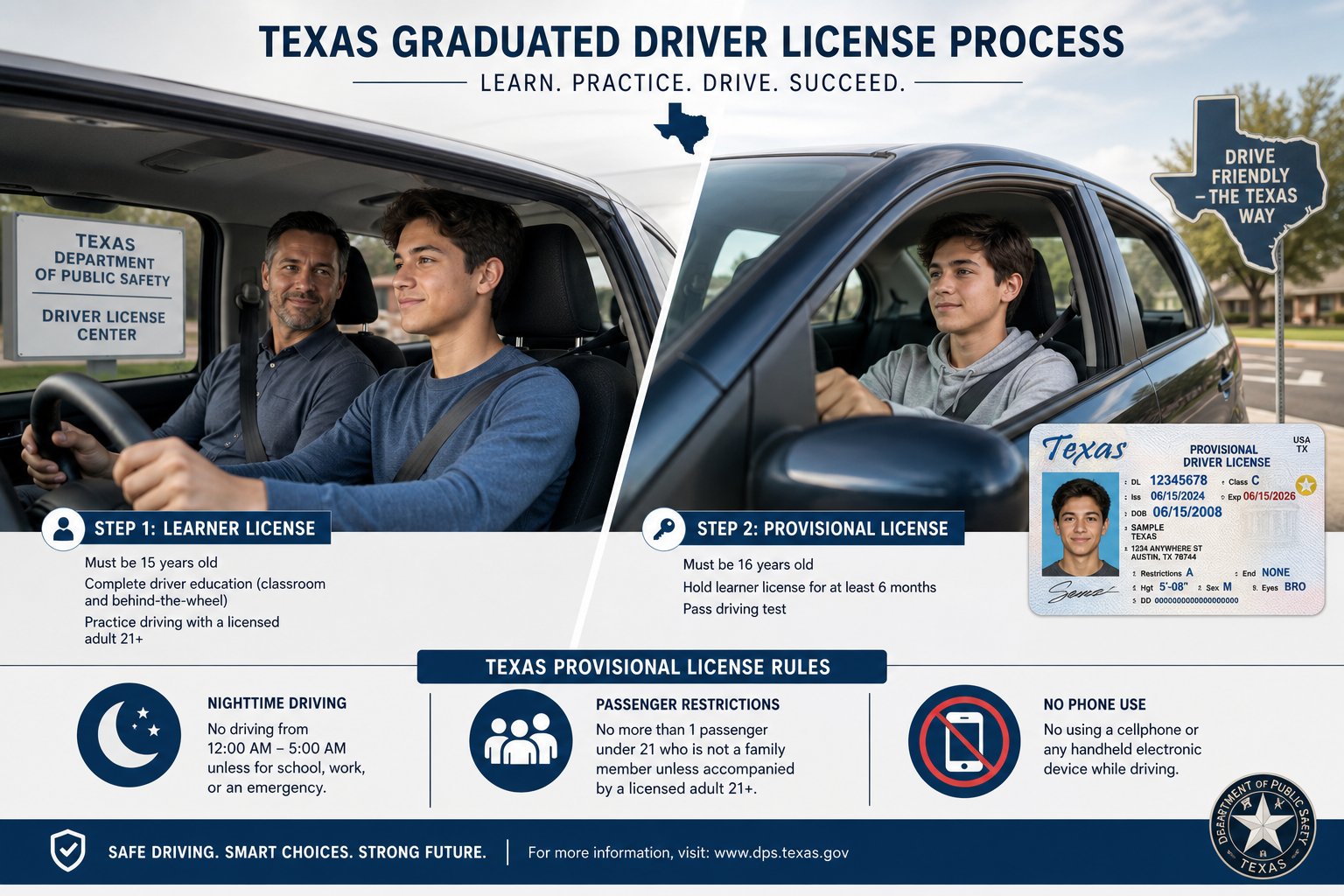
A Texas provisional license (for drivers 16 to 17) comes with three core restrictions: no driving between midnight and 5 a.m. except for work, school, or a medical emergency; no more than one passenger under 21 who is not a family member; and no use of handheld wireless devices while driving. These rules are part of the graduated licensing system and apply until the driver turns 18. Violating them can lead to penalties and can extend how long the restrictions apply, so understanding them is part of safe teen driving.
Applies to Texas teen driver education and licensing (ages 14–17). Requirements are set by TDLR (driver education) and the Texas DPS (licensing) and can change.
Key Facts
- Nighttime limit: No driving midnight–5am, except for work, school activities, or a medical emergency.
- Passenger limit: No more than one passenger under 21 who is not a family member.
- No handheld devices: Handheld wireless devices may not be used while driving.
- Applies until 18: The restrictions remain in effect throughout the provisional period.
- Violations carry consequences: Tickets and penalties can follow, and can affect the licensing timeline.
How The Texas Graduated Driver License Program Works
Texas uses a Graduated Driver License (GDL) system for teen drivers. The goal is simple: give you more freedom in steps, not all at once. That helps new drivers build skill with less risk.
The first step is the learner license. In this stage, you must drive with a licensed adult who is 21 or older in the front seat. If you are under 18, you must hold that learner license for at least six months before you can move on.
The second step is the provisional license. This is the stage most people mean when they talk about Texas provisional license restrictions. You can drive without an adult in the car, but you still have limits on late-night driving, passengers, and phone use.
Texas agencies have different jobs here. The Texas Department of Licensing and Regulation approves driver education providers and course types. You can review official teen driver education information through TDLR. The Texas DPS issues permits and licenses, handles testing, and publishes the state’s license rules through TxDPS.
If you are taking PTDE, remember two common mix-ups:
- PTDE means Parent Taught Drivers Ed for teens under 18
- TDE also refers to teen driver education for minors
- ADE is for adults 18 and older and is not the same thing
- ITTD is a separate, free 2-hour course, not the main driver ed course
That split matters. A lot of families confuse the education course, the state packet, and the DPS step. But in Texas, each part has its own purpose.
Getting A Provisional License In Texas
To get a provisional license in Texas, you must be 16 or 17 years old. You also must have held your learner license for at least six months. Texas DPS will not move you into the next stage early.
You must also complete the required teen driver education. That includes classroom work, in-car training, and practice hours. Texas requires 30 hours of behind-the-wheel practice, with 10 hours at night.
If you are using Parent Taught Drivers Ed, you need the official PTDE Program Guide first. That guide is obtained through the Texas Department of Licensing and Regulation, and as of January 2026 the $20 packet is delivered by email only. There is no physical packet mailed out.
You may also see two certificate names:
- DE-964E: partial completion certificate used after Module 1 for the learner license
- DE-964: full completion certificate used for the provisional license
Before the driving test, you must complete Impact Texas Teen Drivers (ITTD). This is a free, 2-hour course from Texas DPS, and it is separate from PTDE or any other teen driver education course. You can find it at Impact Texas Teen Drivers.
Then you must pass the required testing steps with TxDPS, including the driving test and vision screening. If your family wants a flexible online option for teen course work, Driving Logic offers a Texas PTDE/TDE course built for busy schedules and device-friendly learning.
The Main Texas Provisional License Restrictions
Texas puts clear limits on teen drivers with a provisional license. These are not optional. They are part of the state’s graduated driver license rules and apply until the teen moves out of the provisional stage.
Here are the main rules a teen must follow:
- No driving from midnight to 5 a.m., unless an exception applies
- No more than one passenger under 21 who is not a family member
- No handheld mobile communication device use while driving
- Seat belts are required
- All normal traffic laws still apply
These limits exist because the highest-risk situations for teen drivers are late-night trips, extra teen passengers, and distracted driving. Even a short drive can become unsafe fast when those factors stack up.
It also helps to understand the phone rule in plain language. Under 18, Texas places strict limits on wireless device use while driving. And texting is illegal for all drivers anyway. So if a teen is driving, the safest rule is simple: put the phone away.
The seat belt and traffic law part may sound obvious, but it matters. A provisional license does not relax the normal rules of the road. Speeding, rolling through stop signs, or not buckling up can still lead to citations and can also affect the teen’s driving record.
Night Driving Rule: Midnight To 5 A.M. Exceptions
Texas does allow a few narrow exceptions to the midnight driving rule. A teen with a provisional license may drive between midnight and 5 a.m. only when the trip is necessary for one of these reasons:
- Work
- School
- A school-related activity
- A medical emergency
The key word is necessary. A late fast-food run, hanging out with friends, or just being out after midnight does not fit the exception. If stopped, the driver should be able to explain the reason clearly.
Parents should take this rule seriously because many crashes happen at night. Less light, more fatigue, and more impaired drivers on the road all raise the risk. Texas built this rule around that fact.
If your teen regularly works late or has early school travel, it is smart to keep records like work schedules or event details. That does not guarantee any outcome with law enforcement, but it can help show the trip had a real allowed purpose.
Passenger, Phone, And Distracted Driving Limits
The passenger rule is also strict. A teen with a provisional license may not have more than one passenger under age 21 who is not a family member. Brothers, sisters, and other family members are treated differently, but unrelated teen friends count toward the limit.
Why does Texas care so much about passengers? Because extra teens in the car can pull attention away from the road. Noise rises. People joke around. One bad choice becomes easier.
Phone use is another major issue. For drivers under 18, Texas rules are tighter than they are for many adults. A teen should not use a wireless communication device while driving except in an emergency. That means:
- No texting
- No scrolling
- No holding the phone for calls
- No checking notifications at a light
And yes, texting is illegal for every driver in Texas, not just teens.
The easiest habit is the best one: set the route before leaving, silence the phone, and keep both hands free. That cuts down distraction right away.
What Happens If A Teen Violates Provisional License Rules
If a teen breaks provisional license rules, the result can be more than a warning. Texas may impose fines, a license suspension, or other penalties tied to the specific violation. In some cases, problems on a teen’s driving record can also delay the move to a full license.
That matters because many violations overlap. For example, a teen driving after midnight with two unrelated passengers while using a phone may be breaking several rules at once. If speeding or another traffic offense is involved too, the situation gets worse fast.
Possible consequences can include:
- A traffic citation
- Court costs or fines
- Higher insurance costs
- License suspension or restrictions
- Trouble maintaining a clean driving record
Texas DPS treats these limits as real license conditions, not just suggestions. Parents should too. The best way to avoid trouble is to set clear house rules that match state rules.
A few practical steps help:
- Keep a copy of school or work schedules
- Limit late trips unless clearly allowed
- Make a no-phone rule stronger than the law
- Talk through who counts as a non-family passenger
When Restrictions End And A Full License Becomes Available
For most teen drivers, the provisional stage lasts until age 18. Under Texas DPS rules, that is when the GDL restrictions end and the driver can move to a standard, unrestricted Texas driver license.
That point is important because many people ask whether the rules end after 12 months. For Texas teens, the key source-backed rule is that the provisional license is the under-18 stage, and the teen becomes eligible for the unrestricted license at 18. So if you are 16 or 17, you should expect the provisional restrictions to stay in place until your 18th birthday.
Once the driver is 18, the teen-specific limits such as:
- The midnight to 5 a.m. rule
- The one non-family passenger under 21 limit
- The GDL-stage restrictions tied to the provisional license
no longer apply in the same way as they do during the under-18 provisional period.
But normal traffic laws still apply, of course. Seat belt laws, texting bans, speed limits, and all other road rules remain in force.
If you are still in the training stage and need to complete the right teen course, start with the official steps from TDLR, review licensing details at TxDPS, and complete the required Impact Texas Teen Drivers course. If you want a simple online option for teen driver education, you can also check out Driving Logic’s Texas PTDE/TDE course at mydrivinglogic.com.
FAQ
What are the Texas provisional license restrictions?
No driving midnight–5am (except work, school, or medical emergency), no more than one non-family passenger under 21, and no handheld devices — until the driver turns 18.
Are there exceptions to the nighttime rule?
Yes — driving for employment, a school-related activity, or a medical emergency is allowed during the midnight–5am window.
Who counts toward the passenger limit?
Passengers under 21 who are not family members. Family members generally don’t count toward the one-passenger limit.
What happens if a teen violates the restrictions?
It can result in a citation and penalties, and repeated or serious violations can affect the teen’s licensing progress. The restrictions still apply until 18.
Conclusion
The provisional restrictions all serve the same goal: limiting the highest-risk situations — late-night driving, peer passengers, and phone distraction — while a new driver gains experience. They are straightforward to follow and end at 18. Treating them as safety guardrails rather than mere rules is exactly the mindset the graduated system is built to encourage.
Provisional driving follows driver education — your teen can complete the TDLR-approved Texas parent-taught driver education course online first.
Related Articles
- How to Get a Texas Driver’s License at 16: The Complete Teen Guide
- Texas Teen Midnight Driving Rule: What It Is and the Exceptions
- Texas Teen Driving Passenger Restrictions: How Many Passengers Can a Teen Have?
- Texas Teen Drivers and Cell Phones: What the Law Says
Sources
Billy Forte is the owner of Driving Logic, a TDLR-approved Texas driver education provider. Driving Logic offers the online Texas parent-taught and teen driver education course that helps Texas teens complete the 32-hour classroom requirement and work toward a learner’s permit and provisional license.
This article is general information about Texas teen driver education and licensing, not legal advice. Requirements, fees, and procedures are set by TDLR and the Texas DPS and can change, so confirm current details with official Texas sources before you enroll or visit a DPS office.